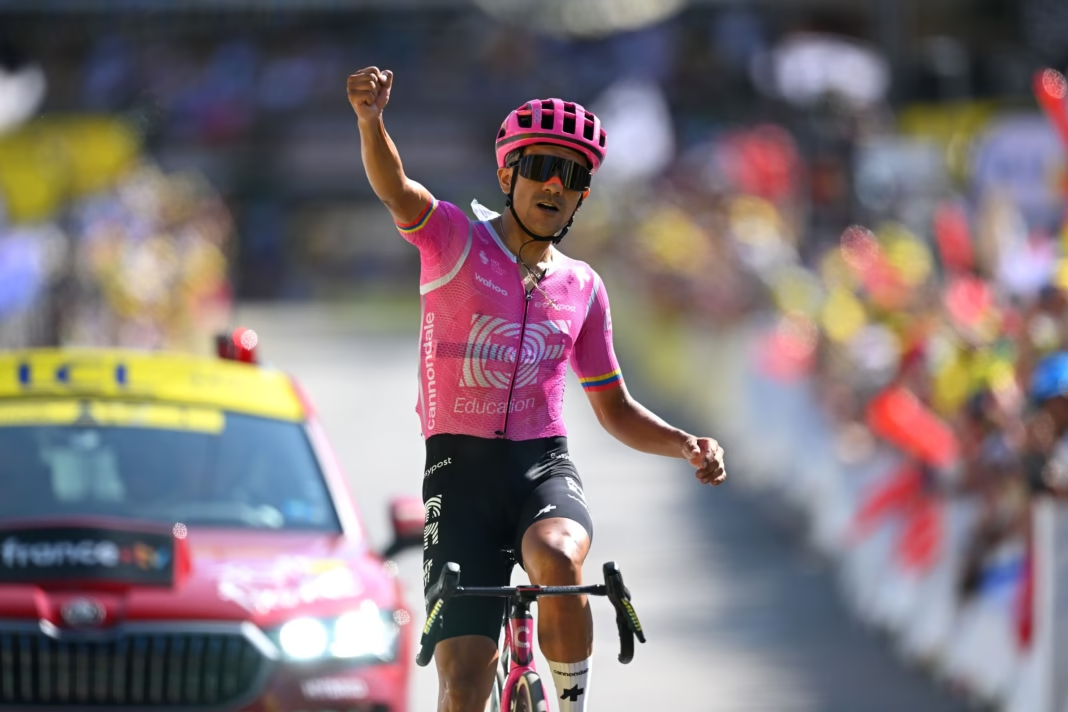
Stage 5 of the 2026 Tour of Guangxi brings the peloton from Jinchengjiang to Yizhou on Saturday 17 October, with about 170.6km of rolling roads and one last realistic opportunity for the sprinters. The route includes three categorised climbs and a substantial amount of accumulated climbing, but the final 50km is largely downhill or flat. That should give the teams with fast finishers time to bring the race back together.
For viewers in Britain, the race is scheduled to start at 03:40 BST. Live coverage on TNT Sports 2 begins at 06:00 BST, with the programme listed until 07:45 BST and streaming available through HBO Max. The most useful viewing window is therefore Saturday’s early morning, rather than the late afternoon slot familiar from European WorldTour racing.
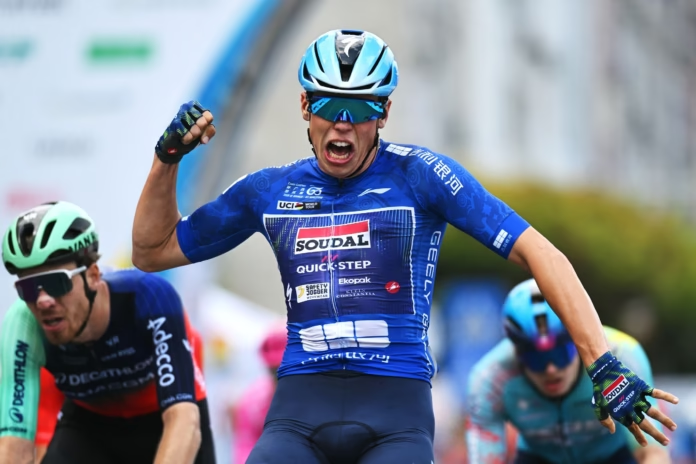
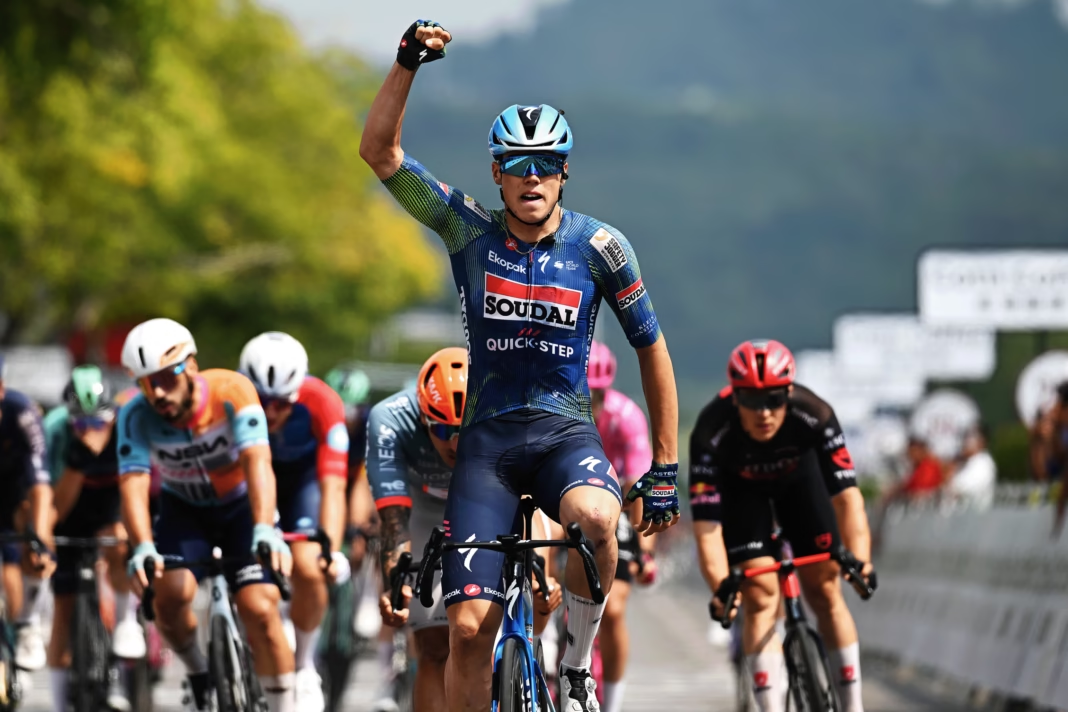
Friday’s tougher stage from Bama to Tian’e ended in another sprint despite the climbing. Paul Magnier won ahead of Cees Bol and Max Kanter, taking his second stage victory of the week and the race lead. With Milan Fretin and Frits Biesterbos having won stages three and two respectively, the sprint hierarchy is anything but settled heading into the penultimate day.
The general-classification contenders also have a reason to approach Saturday carefully. Sunday’s final stage ends on the steep Nongla climb, the obvious opportunity to make serious time differences. A hilly transition stage may sound like a chance to conserve energy, but careless positioning or an unexpected breakaway could still make the final day much harder for a team trying to win the overall race.
Tour of Guangxi Stage 5 start time and UK television coverage
Date: Saturday 17 October 2026. Route: Jinchengjiang to Yizhou, Guangxi, China. Distance: approximately 170.6km, with some route guides rounding it slightly differently. Race start: approximately 10:40 China Standard Time, which is 03:40 BST. UK TV: TNT Sports 2 from 06:00 BST. Streaming: HBO Max. Expected finish: around 07:30–07:45 BST, depending on race speed.
China is seven hours ahead of the UK while Britain remains on British Summer Time, so the riders will have been racing for more than two hours when TNT Sports 2 joins the action. Its listings show live Tour of Guangxi coverage from 06:00 to 07:45 BST, which should capture much of the final portion of the course. The live session is also included in the TNT Sports cycling offering on HBO Max, although the precise start of the streaming tile may differ slightly from the television channel.
It is worth checking the specific Stage 5 listing rather than assuming all six days start at the same time. The routes vary in length and the organisers have scheduled different local departure times. For Saturday, anyone wanting to see the sprint trains organise should aim to be watching when the TNT programme begins rather than join only for the final kilometre.
The six-day Tour of Guangxi UK television guide covers the broader broadcast arrangements. HBO Max has taken over the sports streaming role previously associated with discovery+ in Britain, so the older discovery+ app is not the appropriate starting point for live TNT Sports cycling coverage.
Jinchengjiang to Yizhou: the climbs come early
The stage starts in Jinchengjiang and heads through Guangxi’s interior towards Huanjiang and Luocheng before reaching Yizhou. Unlike the more familiar Nongla finish, it is a new route for the 2026 edition. The road rises and falls through the hill country for much of the first two-thirds, leaving the sprint teams with repeated climbs to manage before they can focus on the run-in.
Published route profiles disagree slightly on the exact climbing total, with estimates ranging from approximately 2,000 to 2,300 metres. Either figure is enough to make this an awkward day for a team hoping to keep all its lead-out riders fresh. The elevation gain is spread across a series of ascents rather than concentrated into a single major mountain pass.
One early categorised climb is around 6.6km at 4.9 per cent. A longer, gentler rise follows as the race moves deeper into the stage, and a shorter climb of about 2.4km at 5.4 per cent provides the last classified obstacle roughly 50km from the finish. The final ascent is not especially severe on paper, but it will come after more than a hundred kilometres of racing and could still be used to shed tired sprinters or force a breakaway clear.
The long run towards Yizhou is what changes the likely outcome. Once the riders have cleared the last climb, the terrain becomes far more favourable for an organised pursuit. Even a breakaway that survives the hilly middle section could find its advantage shrinking quickly if two or three sprint teams commit riders to the chase. The last kilometre is effectively flat, with no summit finish to protect a lone climber’s advantage.

That does not guarantee a bunch sprint. The route still gives attackers several opportunities to force a separation before the final descent. A group containing riders from different teams can be difficult to chase if the strongest sprint squads are unwilling to spend their whole team before Sunday’s finish. Our 2026 Tour of Guangxi route guide sets the Yizhou stage alongside the more demanding days either side of it.
Why the sprinters have another opportunity
The first four stages have shown just how hard it is to prevent a sprint in this race when several teams see a chance of victory. Stage 3 was over 210km long, yet Milan Fretin still prevailed from the finishing group in Bama. Friday’s Stage 4 included significantly more climbing than Saturday’s route, but Magnier and the other fast riders survived to contest the victory in Tian’e.
For Soudal Quick-Step, Saturday is an opportunity to build on Magnier’s growing collection of wins in Guangxi. His opening-day sprint success was followed by a setback on Stage 3 when his foot came out of the pedal at a crucial point of the finale. The victory on Stage 4 restored his momentum and put him back into the leader’s jersey. He has already demonstrated that he can sprint after a hard stage, which makes him an obvious rider to monitor on the road to Yizhou.
The other sprint teams have reasons to be more aggressive than usual. Picnic PostNL’s Biesterbos took his WorldTour stage win in Jingxi and went close again in Bama, while Fretin converted Cofidis’s work into victory the following day. Neither can afford simply to wait for Magnier’s lead-out if they want another win. A late move by one team may prompt a rival to launch earlier than planned, producing a less predictable finish.
The descending final section could also encourage early positioning battles. On a relatively flat run-in, lead-out trains need to arrive near the front without using their last rider too early. Changes in road width, corners and traffic furniture can complicate that job, even when the gradient is unremarkable. The most important work may begin several kilometres before the television picture turns to the final kilometre marker.
Magnier, Fretin, Biesterbos and the other fast finishers
Magnier is the clearest reference after winning two stages, but the race has offered several different sprint outcomes. Fretin beat Biesterbos and Jordi Meeus on Stage 3, with Fabio Jakobsen, Arvid de Kleijn and Juan Sebastián Molano also among the leading finishers. Biesterbos has been close enough across multiple days to suggest that his Stage 2 success was no isolated result.
Bol’s second place on Friday puts him firmly in the conversation, while Kanter was third in Tian’e and has consistently been difficult to dislodge from the front of the sprinting group. Meeus has the speed to win from a reduced field, particularly if Red Bull-BORA-hansgrohe can keep him out of trouble on the climbs. Jakobsen’s top-four Stage 3 result is another sign that he can still contest these finishes after the season’s demanding calendar.
The start list includes other fast riders, but any prediction needs to account for the effects of the preceding stages and withdrawals. Olav Kooij, for example, was a prominent pre-race favourite but did not start Stage 4. It would therefore be misleading to treat earlier win-probability lists as a current list of riders available to contest Saturday’s sprint.
The full Tour of Guangxi start list and the team-by-team guide provide more detail about how the squads were constructed for the week. The decisive question on Stage 5 is whether those teams can arrive at the finish with enough riders left to offer their sprinter a proper lead-out.
A breakaway cannot be ruled out, particularly if the leaders of the general classification decide not to spend energy chasing a group that poses no threat to the overall standings. But a rider going clear on the last categorised climb still faces a long run to Yizhou. The move needs enough numbers to maintain speed on the flatter roads and enough cooperation to avoid being swallowed by the chase.
What Stage 5 means for the overall classification
Magnier moved into the red jersey after Stage 4, but Sunday’s uphill finish at Nongla should create a different contest. Riders with climbing ambitions will be reluctant to waste their energy in an extended pursuit on Saturday unless someone dangerous to the classification is in the break. They will instead try to protect their position, avoid splits and reach the final day without losing a teammate to a crash or a mechanical problem.
The Nongla finish rises for around 3.2km at 7.3 per cent, with the final steep portion climbing into double-figure gradients. That is where the general-classification order is most likely to change decisively. Saturday’s rolling route is less selective at the finish, so keeping a good position and preventing unexpected time losses are likely to be the main objectives for riders such as Tom Pidcock, Kévin Vauquelin and the other contenders.
There is still potential for tension if a breakaway contains a rider only a little way down the standings. A move that might normally be given several minutes could force Magnier’s team or the GC squads to contribute to the chase, affecting how much support they have the following day. Bonus seconds at the finish can also reward a fast rider and alter the margins before Nongla, even if the peloton arrives together.
Friday’s Stage 4 report explains how Magnier regained the lead in Tian’e. The situation after Saturday may look similar if it ends in a bunch sprint, but the balance of power should change sharply when the peloton reaches Sunday’s final climb.
When to watch the decisive part of Stage 5
The race gets under way early for UK viewers, at approximately 03:40 BST, but the live television window begins at 06:00 BST on TNT Sports 2. That is the best starting point for someone who wants to follow the final stages of the chase, rather than trying to find a live feed in the middle of the night. The programme is listed through to 07:45 BST, with the actual finish time dependent on the speed of the peloton.
At around 06:30 BST, the key things to look for will be the size and strength of the break, how many helpers the main sprint teams have left, and whether the last climb has already put significant pressure on any fast riders. A large peloton entering the final 30km will favour Magnier, Fretin and the other sprinters. A well-organised break still holding a meaningful gap that late could change the calculation.
For viewers wanting only the finish, joining by 07:00 BST is sensible, but not a guarantee of seeing the entire finale if the pace is unusually high. The better choice is to watch from the beginning of TNT Sports 2’s scheduled coverage. Saturday’s result will also set up Sunday’s Nongla summit finish, the last opportunity for the climbers to overturn the order at the end of the men’s WorldTour season.