
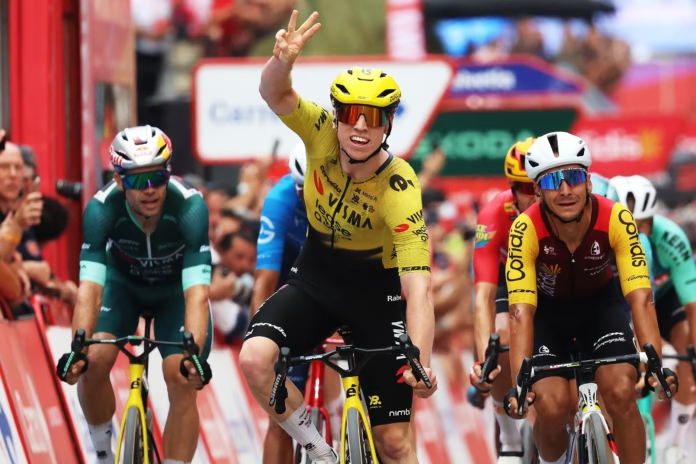
Matthew Brennan has another chance to extend an extraordinary debut Vuelta a España on Wednesday, with Stage 17 taking the peloton 185km from Dos Hermanas to Sevilla on the flattest road stage of the entire race.
Brennan arrives having won Stage 16 at La Rábida for his fourth victory of the Vuelta, once again benefiting from Wout van Aert’s work in the finale. The 21-year-old has now won four stages in his first Grand Tour, becoming the first rider to do so on debut since Fernando Gaviria at the 2017 Giro d’Italia.
Wednesday strips away most of the complications that have surrounded the previous sprint opportunities. There are no categorised climbs, only around 930 metres of elevation gain and a long final section across open roads into Sevilla. The intermediate sprint at San José de la Rinconada comes with 20km remaining before the peloton enters the city for what should be a very fast finish beside the Guadalquivir.
Brennan is the obvious favourite, but Jordi Meeus and Bryan Coquard have been close enough throughout the race to keep this from becoming a formality.
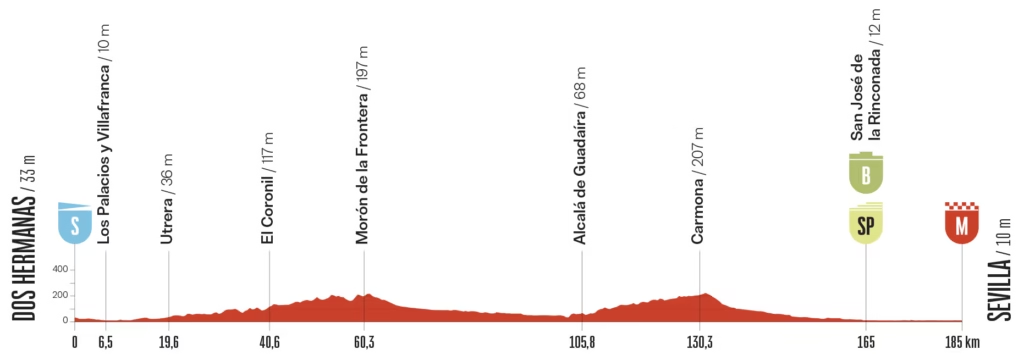
Vuelta a España Stage 17 at a glance
| Detail | Stage 17 |
|---|---|
| Date | Wednesday 9 September 2026 |
| Start | Dos Hermanas |
| Finish | Sevilla |
| Distance | 185km |
| Stage type | Flat |
| Elevation gain | Around 930m |
| Categorised climbs | None |
| Intermediate sprint | San José de la Rinconada, km 165 |
| Neutralised start | 12:00 BST |
| Official start | 12:24 BST |
| Expected finish | 16:19-16:41 BST |
Dos Hermanas is hosting a Vuelta stage start for the first time. From there, the route makes a broad loop through Sevilla province before returning to the Andalusian capital, passing Los Palacios y Villafranca, Utrera, Morón de la Frontera, Alcalá de Guadaíra, Mairena del Alcor, El Viso del Alcor and Carmona.
There are long stretches where the road rises gently, but nothing remotely severe enough to trouble a Grand Tour sprinter in normal circumstances. The organisers have deliberately created one final conventional opportunity for the fast men before Thursday’s time trial and the decisive mountain stages that follow.
Stage 17 is even better for Brennan than La Rábida
Tuesday’s Stage 16 route to La Rábida contained enough climbing in its opening half to give the breakaway genuine encouragement.
Stage 17 removes almost all of that.
The first 60km towards Morón de la Frontera contain the majority of what little climbing exists, but it comes through long shallow rises rather than anything capable of splitting the bunch. The terrain then becomes increasingly straightforward as the race turns north towards Alcalá de Guadaíra and Carmona.
There is no obvious point where a team can put Brennan into difficulty.
That matters because one of the themes of his Vuelta has been how difficult he has been to remove before a sprint. Brennan has already survived terrain considerably harder than this and has repeatedly shown that he does not need a perfectly flat day to reach the finale.
Wednesday gives him one anyway.
Four Vuelta wins have changed Brennan’s debut completely
Brennan began the Vuelta as one of several possible Visma | Lease a Bike options. He now reaches Sevilla as one of the stories of the entire race.
His first victory came in the uphill sprint at Manosque on Stage 2. He won again at Roquetes on Stage 5 and then took a much more conventional bunch sprint in Lorca on Stage 11.
That Lorca win showed how effective Visma can be when the team commits completely to Brennan. The Stage 11 race report saw Van Aert help deliver him through the finale before Brennan beat Coquard and Meeus.
Stage 16 added number four.
The scale of his debut has therefore moved well beyond the question of whether Brennan could win a Grand Tour stage this early in his career. ProCyclingUK’s earlier look at why Brennan’s first Vuelta was becoming much bigger than two stage wins now looks almost conservative.
A fifth win in Sevilla would take the achievement into another category again.
Van Aert has become the most valuable lead-out rider in the race
Brennan’s speed explains much of the success. Van Aert explains another part of it.
Visma have the luxury of using one of the strongest riders in the Vuelta as a lead-out man while retaining the option of letting him race for himself when the stage moves away from Brennan.
That flexibility has already produced results.
Van Aert won in Loja and then attacked into the decisive move before winning the heat-shortened Stage 15 in Córdoba. When the road points towards a normal sprint, he can switch roles and work for Brennan.
Few rival teams have an equivalent.
Van Aert can shepherd Brennan through the positioning fight from much further out than a conventional final lead-out rider. He can close gaps, hold speed through exposed sections and still have enough power left to take the front deep into the final kilometre.
The final question is then handed to a sprinter who has already answered it four times.
 Photo Credit: Getty
The breakaway faces an almost impossible equation
There will still be riders who attack from Dos Hermanas.
For many teams, there are now only five racing days left and three of those are either a time trial or mountain stages. Riders without the climbing ability to contest Peñas Blancas or Collado del Alguacil cannot afford to ignore Wednesday completely.
The difficulty is making an escape useful.
A group of three or four riders will be easy for Visma to control across terrain this exposed. Cofidis should also have an interest in bringing the race back for Coquard, while Red Bull-Bora-Hansgrohe can contribute later if Meeus remains protected.
A larger breakaway would create more uncertainty, but forming one is much harder without a climb or difficult sequence of roads to stretch the bunch.
There is also little terrain later in the stage where an escape can suddenly increase its advantage.
Once the race reaches the final 60km, every kilometre works against the attackers.
The wind is the one variable that could change the stage
The profile is straightforward. The roads are not always protected.
Much of the second half crosses open country around Carmona, La Rinconada and the approaches to Sevilla. A strong crosswind would create an entirely different race from the one suggested by the elevation profile.
That does not necessarily hurt Brennan.
Visma are one of the teams best equipped to handle exposed racing, and Van Aert remains one of the strongest echelon riders in the peloton. Brennan has also repeatedly been kept near the front when other sprinters have found themselves caught behind splits.
The riders with more reason to worry are the GC contenders.
Enric Mas, Felix Gall and Primož Roglič gain nothing from Wednesday but can lose plenty if the race breaks apart at the wrong moment.
For Movistar, Decathlon CMA CGM and Red Bull-Bora-Hansgrohe, positioning through the exposed sections matters even if nobody has any intention of attacking the red jersey.
Jordi Meeus gets the pure sprint he has been waiting for
Meeus has been one of Brennan’s most consistent sprint rivals without yet finding the stage win.
Third behind Brennan and Coquard in Lorca showed that the speed is there. Wednesday should suit him better still because there is almost nothing beforehand to drain his legs.
Red Bull’s complication is Roglič.
The four-time Vuelta winner starts Stage 17 third overall, 2:10 behind Mas, and Thursday’s 32.1km individual time trial from El Puerto de Santa María to Jerez de la Frontera is his best remaining opportunity to take a significant chunk out of that deficit.
The team therefore needs to protect Roglič before thinking about a sprint.
That should not prevent Meeus receiving support in the final kilometres, but it may mean Red Bull are reluctant to spend several riders chasing the break throughout the afternoon.
If Visma and Cofidis do that work, Meeus can conserve his own train and try to challenge Brennan late.
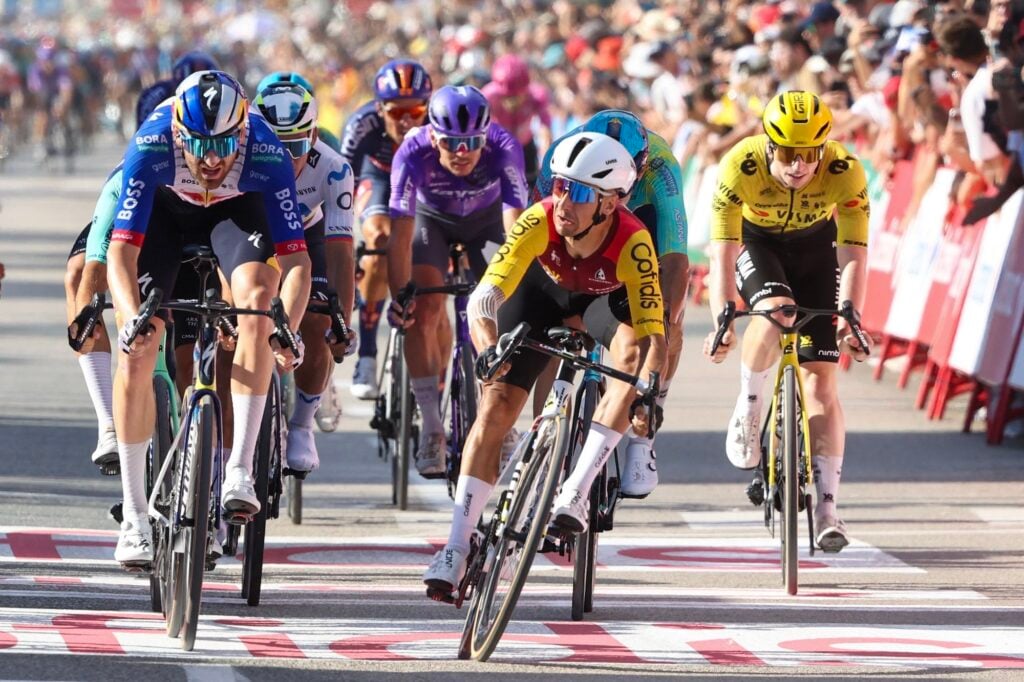 Photo Credit: Getty
Coquard remains the obvious alternative
Bryan Coquard has been consistently close whenever the Vuelta has produced a sprint.
He already has the Stage 8 victory at Xeraco and finished second to Brennan in Lorca.
His route to another win usually improves when the finale is slightly complicated. A small rise, a technical sequence or an untidy sprint can reward the positioning and acceleration that have defined his career.
Sevilla is more likely to become a high-speed power sprint.
That probably favours Brennan and Meeus slightly more, but Coquard’s consistency means he cannot be dismissed. Cofidis also have enough reason to help with the chase, which should put him into a relatively controlled finale.
If Brennan becomes boxed in or Visma mistime the lead-out, Coquard is exactly the sort of rider capable of taking advantage.
Alessandro Romele has carried his form into the final week
Alessandro Romele has been one of the increasingly prominent riders as the Vuelta has developed.
His second place behind Van Aert in Córdoba came after he made the decisive late move, while he has repeatedly shown enough speed and endurance to remain relevant after difficult racing.
Stage 17 is slightly less tailored to him.
Romele’s strongest performances tend to come when the stage has already removed some of the pure sprinters or when he can use his race craft before the final kilometre.
Wednesday gives him little opportunity to do either.
He still has enough speed for another top-five finish, particularly if the final approach becomes chaotic, but XDS Astana may need something to disrupt the straightforward Brennan-versus-Meeus scenario.
Orluis Aular can wait while everyone else works
Orluis Aular remains an interesting outsider because Movistar have absolutely no reason to chase for him.
The team’s entire race is built around protecting Mas.
If Visma, Cofidis and Red Bull bring the break back, Aular can simply arrive at the finish having spent the day protected and take his chance.
That is a useful position.
Aular has the speed to contest reduced and conventional sprints and enough durability that the modest rolling terrain earlier in the stage should not bother him.
The question is whether he can start the final 300 metres close enough to Brennan.
On a finish this fast, recovering several bike lengths once the sprint has begun is extremely difficult.
Van Aert remains Visma’s second route to victory
Van Aert is not the first choice for Stage 17.
There is no reason he should be.
Brennan has won four stages and the profile could scarcely suit him better.
That does not remove Van Aert from the equation.
A puncture, mechanical problem or crash involving Brennan would leave Visma with a rider who has already won twice at this Vuelta and finished second in the last Sevilla sprint two years ago.
It is another reason the team are so difficult to race against.
Other squads have to structure their entire day around one sprinter.
Visma can lose Plan A and still have one of the strongest possible Plan Bs.
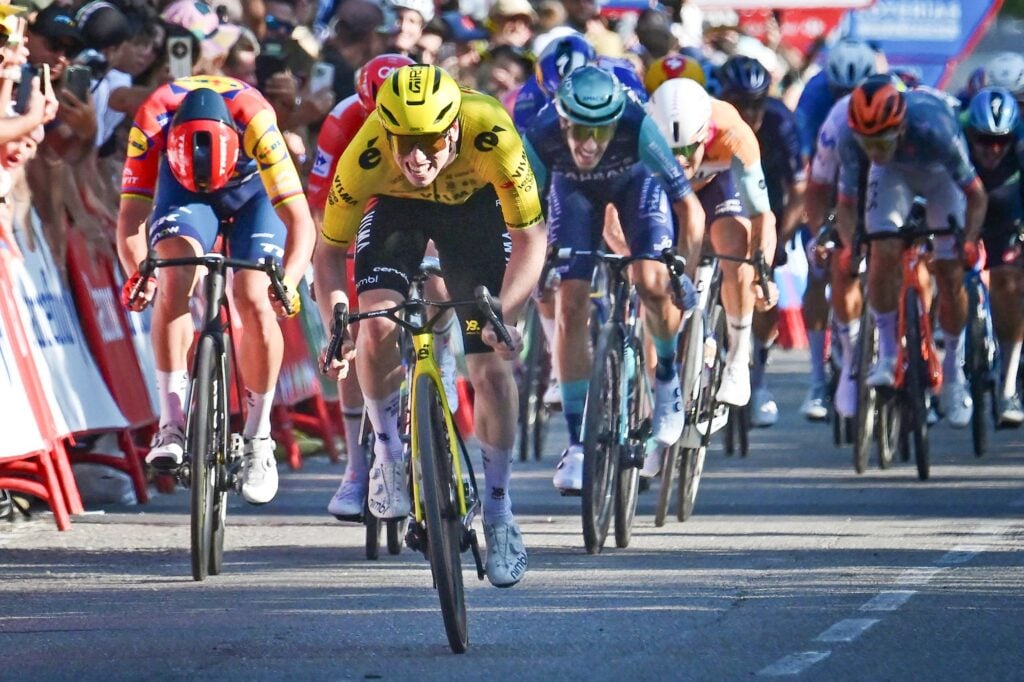
Sevilla produced a surprise winner in 2024
The last Vuelta finish in Sevilla provides a useful warning against treating any sprint as automatic.
Pavel Bittner arrived in the city during the 2024 Vuelta as a 21-year-old Grand Tour debutant.
Van Aert was expected to be one of the principal favourites.
Instead, Bittner beat him in a photo finish to take his first Grand Tour stage victory.
Two years later, another 21-year-old arrives in Sevilla during his first Vuelta.
The difference is that Brennan already has four victories.
The similarity is that the final straight still leaves enough room for timing to matter. Van Aert launched early in 2024 and Bittner gradually came alongside before edging the decision.
Brennan has looked extremely difficult to beat once placed correctly inside the final 200 metres. Visma still need to make sure they do not expose him too early.
The final 20km will decide the positioning battle
The intermediate sprint at San José de la Rinconada comes after 165km and should mark the beginning of the serious fight for position.
There is little reason for the peloton to slow significantly afterwards.
The route heads through La Rinconada before entering Sevilla with just over 10km remaining. The race then moves onto larger city roads and through a series of turns and bridges before reaching Paseo de las Delicias and the final approach along Paseo Cristóbal Colón.
The finish sits beside the Guadalquivir, close to the Plaza de Toros de la Maestranza.
The roads are broad enough for several lead-out trains to compete, but the changes of direction before the final straight make it important to arrive near the front rather than trying to move through the bunch late.
Visma’s strength has repeatedly been getting Brennan to that point without forcing him to spend energy.
Wednesday should test the same skill again.
Mas only needs to reach Sevilla safely
There was no meaningful GC change on Stage 16, leaving Mas with the same commanding position he took out of the second rest day.
He leads Gall by 2:06 and Roglič by 2:10, with Richard Carapaz fourth at 4:24 and Oscar Onley fifth at 5:44.
The state of the Vuelta heading into the final week remains built around two different threats to Mas.
Roglič gets the terrain he needs on Thursday.
Gall gets his best opportunities when the race returns to the mountains.
Stage 17 belongs to neither of them.
For Mas, the only objective is reaching the finish without a crash, split or mechanical problem costing time before the time trial.
The same applies to Onley, who is still trying to protect fifth overall and the white jersey. ProCyclingUK’s look at Onley’s position heading into the final week identified Wednesday as another day where the danger comes from what he could lose rather than anything he can realistically gain.
The GC battle can wait another 24 hours.
-
 Photo Credit: A.S.O./Billy Ceusters
Stage 17 leading contenders
Matthew Brennan
Four stage victories already and now the easiest profile of his Vuelta. With Van Aert helping him through the finale, Brennan is clearly the rider to beat.
Jordi Meeus
The strongest pure sprint alternative. The flat route gives him every opportunity, although Red Bull also have to protect Roglič before Thursday’s time trial.
Bryan Coquard
Consistently close and already a stage winner. A straightforward sprint probably suits Brennan and Meeus slightly better, but Coquard rarely wastes a good position.
Alessandro Romele
Strong through the second half of the Vuelta and second in Córdoba. Wednesday is more of a pure sprint than his ideal terrain, but his form demands respect.
Orluis Aular
Movistar do not need to work for the sprint, allowing Aular to conserve energy and take his chance if other teams bring everything together.
Wout van Aert
Brennan’s lead-out should be his main job. If anything happens to the British rider, Visma immediately have another genuine winning option.
How Stage 17 is likely to unfold
The early breakaway should be allowed some freedom, largely because nobody needs to make the first 100km especially complicated.
Visma can let a small move gain several minutes and then begin reducing the advantage gradually. Cofidis are the most obvious team to help, while Red Bull can add riders later if the situation requires it.
The escape needs substantially more than a routine advantage before Carmona to have any chance.
By the final 40km, the peloton should be travelling quickly enough that the gap falls steadily. The intermediate sprint at 20km remaining then draws the fast men towards the front and effectively begins the lead-out phase.
Wind remains the one possible disruption.
If conditions stay relatively calm, everything points towards a bunch sprint.
Stage 17 prediction
There is little reason to search too hard for an alternative.
Brennan has already won on more complicated finishes, has the strongest lead-out structure in the race and reaches the flattest stage of the Vuelta with four victories behind him.
Meeus and Coquard are good enough to punish any error.
The problem is that Visma have made very few of them.
Prediction: Matthew Brennan to win Stage 17 in Sevilla and take a fifth victory on his Grand Tour debut.

