
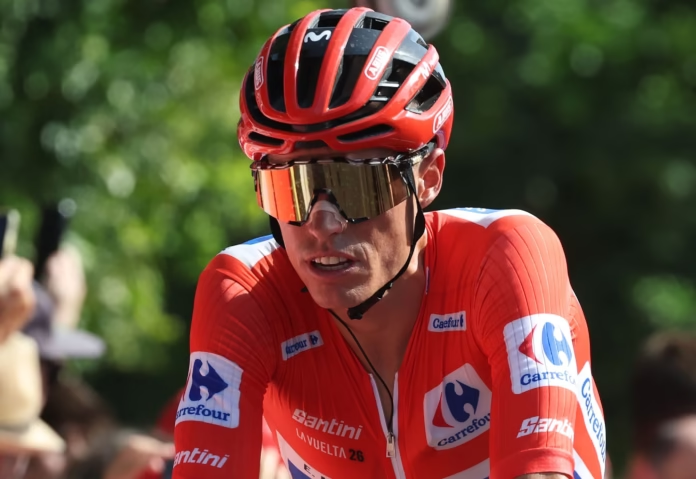
Enric Mas reaches the second rest day of the Vuelta a España 2026 in the position he has spent much of his career trying to reach. He leads a Grand Tour deep into its third week, has repeatedly been the strongest of the remaining favourites in the mountains and holds more than two minutes over every rider still capable of denying him the red jersey.
Yet this Vuelta is not settled.
Mas leads Felix Gall by 2:06 and Primož Roglič by 2:10, leaving only four seconds between the two riders directly behind him. Richard Carapaz remains fourth at 4:24, while Oscar Onley holds an impressive fifth place at 5:44.
More importantly, the final week is designed to test precisely the areas where Mas’ two closest challengers differ.
Roglič has a 32.1km individual time trial into Jerez de la Frontera on Thursday. Gall has the long Peñas Blancas summit finish the following afternoon and the brutal Sierra Nevada finale to Collado del Alguacil on Saturday.
Mas therefore has to defend against the time triallist and the climber, on consecutive days, before reaching Granada.
That is why a two-minute lead is strong without being secure.
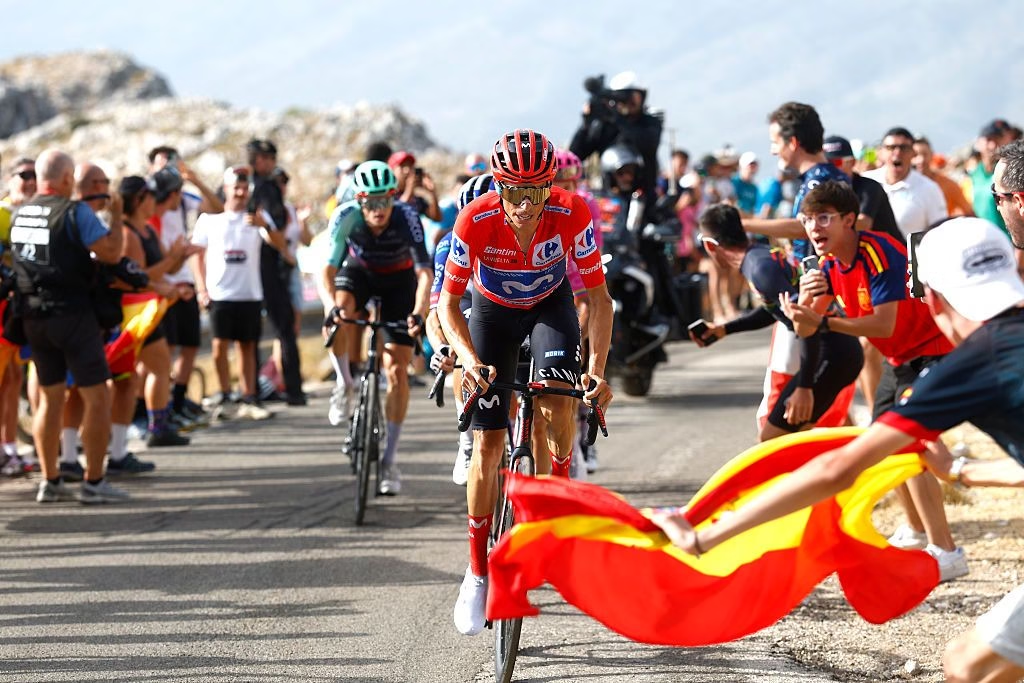 Photo Credit: Getty
Vuelta a España GC heading into the final week
| Position | Rider | Team | Gap |
|---|---|---|---|
| 1 | Enric Mas | Movistar | Leader |
| 2 | Felix Gall | Decathlon CMA CGM | +2:06 |
| 3 | Primož Roglič | Red Bull-Bora-Hansgrohe | +2:10 |
| 4 | Richard Carapaz | EF Education-EasyPost | +4:24 |
| 5 | Oscar Onley | Netcompany INEOS | +5:44 |
| 6 | Jakob Omrzel | Bahrain Victorious | +6:14 |
| 7 | Mattias Skjelmose | Lidl-Trek | +6:49 |
| 8 | Cristian Rodríguez | XDS Astana | +7:01 |
| 9 | Clément Berthet | Groupama-FDJ United | +7:19 |
| 10 | Sepp Kuss | Visma | Lease a Bike | +8:55 |
Sunday’s shortened Stage 15 into Córdoba left those gaps unchanged. Wout van Aert won from the late five-rider move, while Mas, Gall, Roglič and the other GC contenders finished safely together.
That means the race resumes on Tuesday with the hierarchy created on Sierra de La Pandera still intact.
Pogačar’s exit opened the race, but Mas has earned this lead
The defining moment of the first half of this Vuelta remains Tadej Pogačar’s Stage 8 crash and abandonment.
Pogačar had won three stages and led Mas by 3:50. Roglič was 4:50 behind and Gall at 5:01. The race was beginning to look less like a contest for red and more like a fight for the podium behind the Slovenian.
Removing Pogačar transformed everything.
Mas effectively inherited a one-minute advantage over Roglič, with Gall another 11 seconds back. The obvious question was whether Movistar had unexpectedly been handed control of a race that Pogačar had appeared to be dominating.
Mas has spent the following week answering it.
He did not merely protect the jersey on Alto de Aitana. He attacked and won Stage 9, with Onley the only rider able to follow him. Roglič lost another 12 seconds on the road and Gall 18.
That took Mas into the first rest day 1:18 ahead of Roglič and 1:39 ahead of Gall, with our GC contenders analysis after Stage 9 already identifying the central problem of the post-Pogačar race. Roglič had the time trial, Gall had the mountains and Mas had to build enough of an advantage to cover both.
He has done exactly that.
Calar Alto was the day Mas really changed the equation
If Aitana established Mas as a legitimate red jersey, Calar Alto changed the arithmetic.
Gall attacked first on the final climb, but Mas responded and then rode away from Gall, Roglič and Carapaz. By the finish he had gained another 27 seconds.
Jakob Omrzel took the stage victory from the breakaway, but the bigger GC story from Stage 12 at Calar Alto was Mas moving further away from the riders who needed to limit their losses before the final-week time trial.
It was also the performance that made this version of Mas look different from the rider who has finished second at the Vuelta three times.
He did not need to attack.
He already had the race lead and could have followed Gall and Roglič while saving energy for La Pandera.
Instead, he saw an opportunity to gain time and took it.
Those 27 seconds now look increasingly valuable.
 Photo Credit: Getty
Gall has moved ahead of Roglič by climbing better
Sierra de La Pandera produced another shift.
Marco Brenner won Stage 14 from a huge breakaway, but the important movement among the GC riders came further down the climb.
Gall stayed with Mas.
Roglič could not.
The pair gained 25 seconds on Roglič, enough to move Gall into second overall by four seconds.
That is a small difference in the standings but a significant one in terms of how the race has developed. Roglič started the post-Pogačar Vuelta as Mas’ obvious principal rival. Gall has gradually ridden himself into that position through the mountains.
He has attacked repeatedly, even when the attacks have not always produced time on Mas.
At Aitana, Gall tried to make the race hard.
At Calar Alto, he attacked again before Mas countered.
At La Pandera, he finally gained enough on Roglič to move ahead of the four-time Vuelta winner.
Gall therefore reaches the rest day with evidence that he can distance Roglič uphill.
The problem is that Thursday arrives before the mountains that suit him best.
The Jerez time trial can change the race in 32 kilometres
Stage 18 could be the most important 32.1km of the entire Vuelta.
The route from El Puerto de Santa María to Jerez de la Frontera is largely flat and gives Roglič his clearest remaining opportunity to take significant time without having to drop Mas on a mountain.
The opening Monaco time trial offered a useful, if limited, comparison.
Roglič took 12 seconds from Mas over only 9.4km and 25 seconds from Gall.
Thursday is more than three times as long.
There is no sensible way to multiply those gaps directly. Monaco was short and technical, riders are now almost three weeks into the race and Mas has looked stronger since then.
But the broad advantage is obvious.
Roglič should take time.
The question is how much.
If he gains 30 seconds on Mas, the red jersey still has 1:40 in hand.
Gain a minute and the gap falls to 1:10.
If Roglič produces one of his best performances against the clock while Mas has an ordinary day, Saturday could begin with considerably less separating them.
That possibility is why Mas’ advantage cannot be treated as decisive yet.
The 2026 Vuelta route was designed so the time trial could reshape the GC without necessarily settling it. Jerez is immediately followed by two uphill finishes.
Any seconds Roglič gains have to be defended in the mountains.
Gall’s first job is surviving Jerez
Gall faces the opposite calculation.
He is four seconds ahead of Roglič now. He is unlikely to be ahead of him on Thursday evening.
Trying to defend second place against Roglič in a 32.1km flat time trial is not the real objective. Gall needs to prevent the deficit becoming large enough that he spends the final two mountain stages fighting only to recover a podium place.
His route to red comes later.
The better Gall limits his losses in Jerez, the more dangerous Friday and Saturday become for Mas and Roglič.
If Gall loses a minute to Roglič but remains within three minutes of Mas, he still has reasons to attack.
If the gap becomes four minutes or more, the job becomes considerably harder.
There is also a psychological difference between attacking for second and attacking because the Vuelta remains genuinely within reach.
Thursday determines which version of Gall reaches Peñas Blancas.
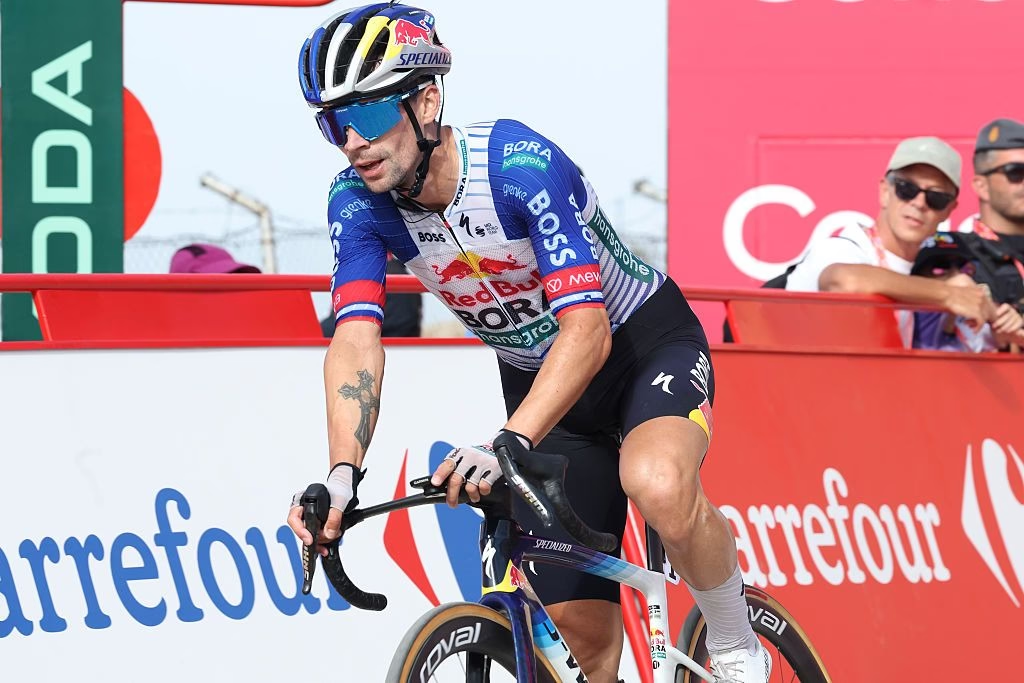 Photo Credit: Getty
Peñas Blancas comes at exactly the wrong time for Roglič
There is no recovery stage after the time trial.
Stage 19 runs for 210.8km from Vélez-Málaga to Peñas Blancas, with the final climb measuring 18.7km at 6.5%.
It is not the steepest summit finish in the race. Its placement is what makes it so important.
Roglič could spend Thursday producing the power required to recover time from Mas and Gall, then has to defend whatever he gains less than 24 hours later on a climb lasting close to 19 kilometres.
Gall should want the opposite race.
Decathlon CMA CGM have every reason to make Peñas Blancas a sustained climbing test rather than allowing the favourites to wait for the final two or three kilometres.
Mas’ approach depends on what happens in Jerez.
If he still leads Roglič by around two minutes, following wheels becomes much easier to justify.
If that gap has been cut towards one minute, Movistar cannot simply assume Saturday will rescue them. Mas may have to use Peñas Blancas to take time back.
That is what gives the final week its tactical tension. Each stage changes the way the next one needs to be raced.
Collado del Alguacil is still big enough to overturn the Vuelta
Whatever happens before it, Stage 20 remains the last place where the entire race can be turned upside down.
The revised Sierra Nevada route covers 186.8km and stacks the climbing heavily into the second half.
Puerto de El Purche is tackled twice, each ascent measuring 8.2km at 8.1%. Puerto de El Duque follows at 7.4km at 8.3%.
Then comes Collado del Alguacil.
The final climb is 8.3km at 9.8%, with sections considerably steeper than the average suggests.
That is not a climb where a rider who begins to struggle necessarily loses ten or 15 seconds. A serious crack can cost minutes.
The accumulated work beforehand matters just as much. The favourites reach the foot of Alguacil after El Purche twice, El Duque and nearly three weeks of Grand Tour racing.
If Mas arrives with two minutes, he should still be in an excellent position.
If Roglič has cut the gap below a minute, the race changes completely.
If Gall remains within striking distance after Jerez and Peñas Blancas, Decathlon have no reason to ride conservatively.
There is no meaningful GC opportunity after Saturday.
Everything left has to be spent there.
Roglič and Gall pose different problems for Mas
This is what prevents Mas simply marking one rider.
Roglič’s best opportunity comes on Thursday.
Gall’s best opportunities come on Friday and Saturday.
If Roglič gains heavily in Jerez, Mas has to monitor him in the mountains.
If Gall loses time in Jerez, Mas still cannot assume he has disappeared. Gall has already shown that he is climbing at a level capable of dropping Roglič and has two long opportunities to recover.
Mas therefore cannot defend the red jersey using one simple strategy.
He needs to limit Roglič against the clock, follow Gall on the longest climbs and avoid spending too much energy responding to one rival when the other may attack next.
That becomes even more complicated if Carapaz starts moving.
 Photo Credit: Getty
Carapaz is still close enough to disrupt the podium battle
At 4:24, Richard Carapaz needs something substantial to happen if he is going to win the Vuelta.
That does not make him irrelevant.
It may make him more dangerous.
Carapaz is 2:18 behind Gall and 2:14 behind Roglič. He cannot reach the second rest day satisfied with fourth place and expect the podium to come to him.
EF Education-EasyPost need to create opportunities.
Carapaz can attack earlier than Mas, Gall or Roglič want to race. He can force the teams protecting second and third to decide whether they chase immediately, and he can use the final mountain stages without having the same obligation to wait for the last climb.
He has already tried that approach several times during this Vuelta.
It has not yet moved him onto the podium, but the final weekend is exactly where an aggressive Carapaz can become awkward for everyone ahead.
A successful Carapaz attack could force Gall or Roglič to work when they would rather leave Movistar responsible for the race.
That matters even if Mas never views Carapaz as his main threat.
Onley is now defending an excellent Vuelta rather than chasing red
Oscar Onley occupies a different part of the race.
After Aitana, the podium appeared realistic. He was the only rider able to follow Mas’ winning attack and reached the first rest day fourth overall.
Calar Alto changed that.
Onley crashed early in the stage and then struggled when the GC race exploded on the final climb. He now sits fifth at 5:44, with the podium 3:34 away.
Overturning that gap requires far more than simply producing another good mountain ride.
Fifth place would still represent a significant result, but it is not secure.
Jakob Omrzel is only 30 seconds behind him in sixth and has already won on Calar Alto. Mattias Skjelmose and Cristian Rodríguez remain close enough to become involved if Onley has another difficult day in the mountains.
The Jerez time trial should be useful for Onley. His job is to create more breathing room before Peñas Blancas and Collado del Alguacil expose the GC riders one final time.
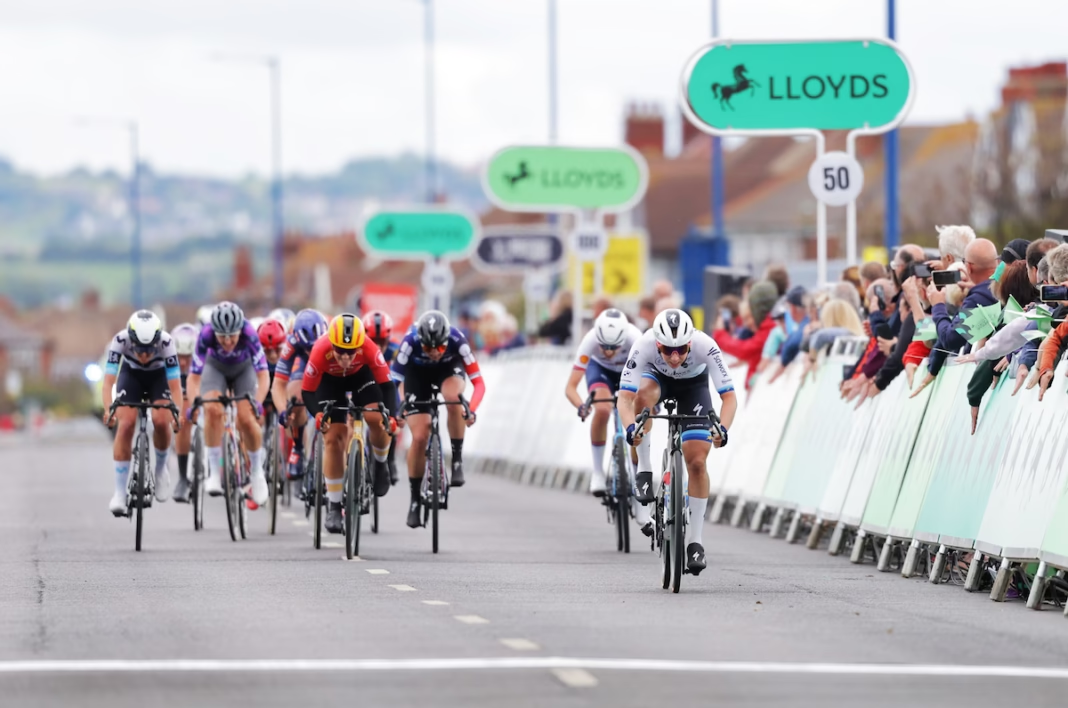
Mas is favourite because he has earned the right to be
There is no need to manufacture uncertainty where it does not exist.
Mas is the clear favourite to win this Vuelta.
He leads by more than two minutes.
He has won on Aitana.
He distanced Gall and Roglič at Calar Alto.
He stayed with Gall while Roglič was dropped on La Pandera.
Movistar have also repeatedly used their team effectively around him rather than leaving Mas isolated until the final climb.
The doubts come from the route, not from anything Mas has done wrong.
He still has to complete a time trial that favours Roglič, followed immediately by two summit finishes where Gall has every reason to attack.
That is a much more difficult final week than simply protecting 2:06 for six stages.
How the final week could change the Vuelta
Tuesday’s Stage 16 from Cortegana to La Rábida should be primarily about staying safe for the GC riders.
Wednesday into Sevilla offers another day when Mas, Gall and Roglič should prefer nothing to happen.
Then the real final week begins.
Thursday favours Roglič. He needs to use 32.1km against the clock to turn a 2:10 deficit into something he can realistically attack in the mountains.
Friday favours Gall. Peñas Blancas gives him almost 19km of final climbing to start recovering whatever he loses in Jerez.
Saturday favours whoever still has the legs. Two ascents of El Purche, Puerto de El Duque and Collado del Alguacil leave no place to preserve energy for another day.
Mas has spent the second week building a buffer for exactly this sequence.
The next question is whether it is enough.

