
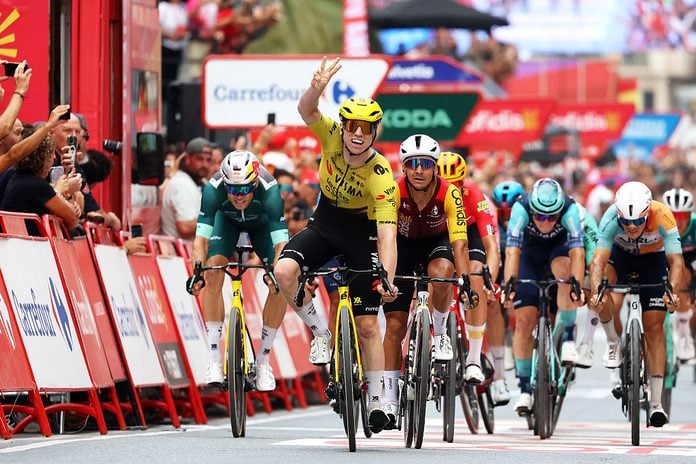
The final week of the Vuelta a España 2026 begins on Tuesday with 181.1km from Cortegana to La Rábida, Palos de la Frontera, and one of the last realistic opportunities for Matthew Brennan and the remaining sprinters.
Calling Stage 16 a sprint stage does not quite capture it. The opening half crosses the rolling roads of the Sierra de Aracena, with almost constant climbing and descending before the race finally drops towards the flatter roads of Huelva. There are no categorised climbs, but the stage still accumulates around 2,250 metres of elevation.
The final 90 kilometres are much easier. Once the hills are finished, the peloton heads through La Palma del Condado, Villarrasa, Lucena del Puerto and Moguer before reaching the exposed roads around Palos de la Frontera and La Rábida.
That balance gives a strong breakaway a chance to form, but a long flat run-in gives the sprint teams plenty of road to bring it back. The wind near the coast is the other variable. La Vuelta identified it as a potential factor when the route was announced, and positioning could become as important as outright speed if the peloton reaches the final 30km in exposed conditions.
For Brennan, already a three-time stage winner on his Grand Tour debut, it is an obvious opportunity to go again.
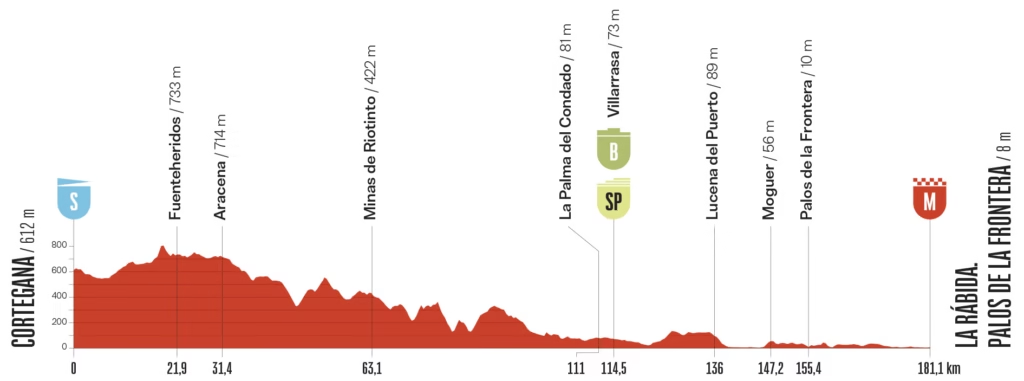
Vuelta a España Stage 16 at a glance
| Detail | Stage 16 |
|---|---|
| Date | Tuesday 8 September 2026 |
| Start | Cortegana |
| Finish | La Rábida, Palos de la Frontera |
| Distance | 181.1km |
| Stage type | Hilly |
| Elevation | Around 2,250m |
| Categorised climbs | None |
| Neutralised start | 12:05 BST |
| Official start | 12:18 BST |
| Expected finish | 16:19-16:42 BST |
Stage 16 comes after Monday’s second rest day and begins the final six-day run towards Granada.
The wider shape of that final week is important. Wednesday’s Stage 17 into Sevilla is even better suited to the sprinters, but Thursday brings the 32.1km individual time trial into Jerez de la Frontera. Peñas Blancas follows on Friday before the final major mountain stage to Collado del Alguacil on Saturday.
The complete sequence is covered in our Vuelta a España 2026 route guide.
The opening 90km give the breakaway a chance
Cortegana sits at around 650 metres above sea level in the northern part of Huelva province, close to the Portuguese border. The race starts climbing and descending almost immediately.
The route passes through Almonaster la Real, Aguafría, Castaño del Robledo and Fuenteheridos before reaching Aracena. It then continues towards Campofrío, Minas de Riotinto and Berrocal.
None of those roads contains a classified climb.
That does not make them easy.
The constant changes of gradient are exactly the sort of terrain where a breakaway fight can continue for a long time, especially after a rest day when riders targeting a stage win know there are increasingly few opportunities remaining.
A group containing three riders who drift away on the opening kilometres is unlikely to satisfy everyone. Stronger rouleurs and Classics riders can continue attacking on the rises, and teams without a realistic sprint option have every reason to make the opening hour difficult.
The important point comes at around kilometre 90.
From there, the profile changes almost completely.
The final half swings the advantage back towards the sprinters
The breakaway’s problem is not getting away. It is staying away once the race reaches the plains.
There are close to 90 kilometres of predominantly flat racing between the final meaningful hills and La Rábida. That is a long time to defend a gap against an organised peloton.
Team Visma | Lease a Bike should have an obvious reason to chase for Brennan.
Cofidis have Bryan Coquard.
Red Bull-Bora-Hansgrohe have Jordi Meeus if they are prepared to devote riders to the sprint rather than simply protecting Primož Roglič.
Other teams may also decide that Tuesday offers a better chance than trying to beat the climbers later in the week.
That should make a small breakaway difficult to sustain.
A large group is different. If 12 or 15 strong riders escape and several sprint teams miss it, Visma could find themselves doing most of the work themselves. The opening terrain is good enough for exactly that type of move to form.
Stage 16 therefore depends heavily on the composition of the escape rather than simply the size of its early advantage.
Brennan has another clear opportunity
Matthew Brennan has already won Stages 2, 5 and 11 during his first Vuelta.
His third victory, in Lorca, was the most conventional sprint of the three. Visma controlled the day before Wout van Aert delivered Brennan through the final corner, and the British rider beat Bryan Coquard and Jordi Meeus.
Our Stage 11 race report showed how difficult Visma have become to beat when they commit fully to one rider.
Stage 16 should be another good fit.
The difficult terrain comes early enough that Brennan has time to recover before the finish. He has also repeatedly shown that rolling roads are not enough to remove him. On Stage 13 he did much more than survive, making the decisive breakaway and closing attacks for Van Aert before still finishing third in Loja.
That Stage 13 victory for Van Aert demonstrated why Visma’s two-rider setup has become so difficult for other teams.
If the stage remains controlled, Brennan is the obvious finisher.
If it becomes too aggressive for a straightforward sprint, Van Aert can become involved.
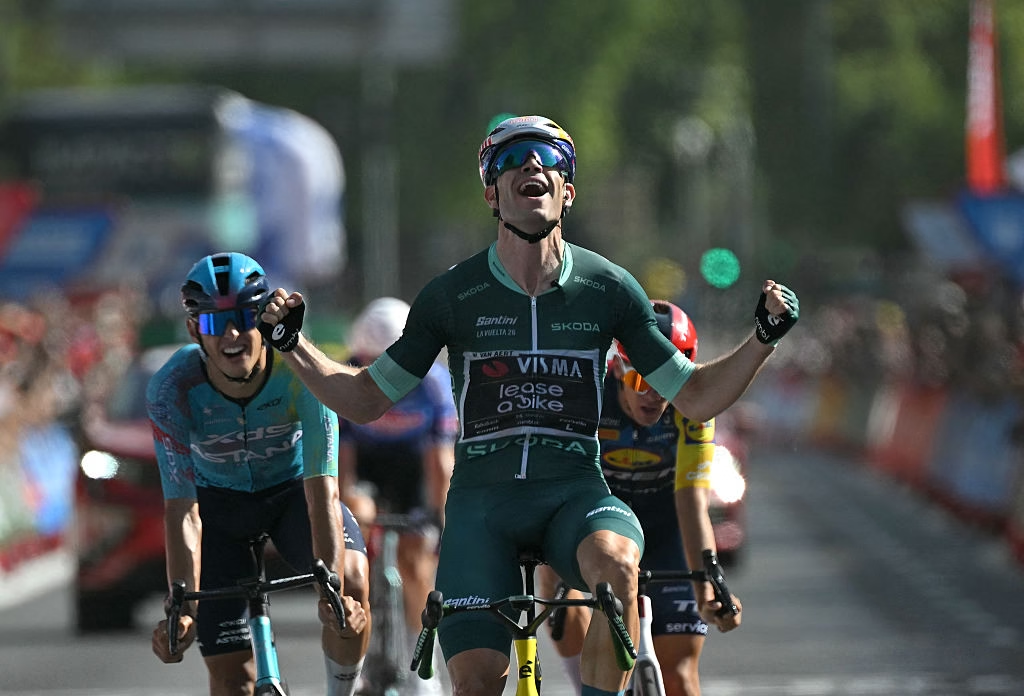 Photo Credit: Getty
Van Aert’s Stage 15 win gives Visma even more control
Van Aert reaches the second rest day having won two of the previous three stages.
His victory in Córdoba on Sunday came after another unusually aggressive race. Stage 15 had been cut to 110.2km because of the extreme heat, and rather than waiting for a reduced sprint, Van Aert joined a five-rider move late in the stage before comfortably beating Alessandro Romele and Thibau Nys.
The late route change and revised timings were covered in our Stage 15 live viewing update.
That result matters for Tuesday because Van Aert now has even less need to chase a personal stage victory at Brennan’s expense.
He already holds the green jersey, has two stage wins and has repeatedly worked for Brennan when the route favours the younger rider.
The logical Visma plan is therefore straightforward: use Van Aert as part of the control and lead-out while keeping him available if the race splits.
Few sprint teams have that flexibility.
Bryan Coquard keeps getting close
Coquard remains one of Brennan’s clearest rivals.
The Frenchman finished second in Lorca and has been consistently involved whenever the Vuelta has produced a finish suitable for the faster riders.
Stage 16 fits him particularly well because the early climbing should not be a problem. Coquard is at his best on days that contain enough difficulty to remove some pure sprinters without becoming genuinely selective.
There is also a tactical reason for Cofidis to help chase.
Visma cannot be expected to control every kilometre alone, and Coquard has already shown he can finish close enough to Brennan to justify investing riders.
If Cofidis contribute through the flat second half, the breakaway’s chances decrease substantially.
Jordi Meeus needs Red Bull to give him the chance
Meeus finished third behind Brennan and Coquard in Lorca and remains one of the quickest riders left in the race.
The complication is the general classification.
Red Bull-Bora-Hansgrohe enter the final week with Roglič third overall, 2:10 behind Enric Mas and only four seconds behind Felix Gall.
Their priority is obvious.
Thursday’s time trial into Jerez is one of Roglič’s best remaining opportunities to reduce Mas’ advantage, while the two mountain finishes that follow will decide whether he can complete the comeback.
That makes it difficult to justify spending several riders controlling a breakaway for Meeus on Tuesday.
If Visma and Cofidis bring the race back without Red Bull having to do much work, Meeus becomes extremely dangerous.
If his team is asked to take responsibility from the opening kilometres, they may decide the GC matters more.
Romele has earned more attention
Alessandro Romele enters Stage 16 after finishing second to Van Aert in Córdoba.
That was not a conventional bunch sprint. Romele made the decisive five-rider move alongside Van Aert, Nys, Andreas Leknessund and Ramses Debruyne, then had enough left to finish second.
It continued a strong Vuelta for the XDS Astana rider, who has repeatedly appeared around the top 10 on the faster finishes.
His best route to victory on Tuesday may again involve racing ahead of Brennan rather than waiting to sprint against him.
The first half gives Romele plenty of opportunities to join a strong move. If the break survives into the final hour, he has enough speed to punish riders who have spent the day trying to avoid bringing him to the finish.
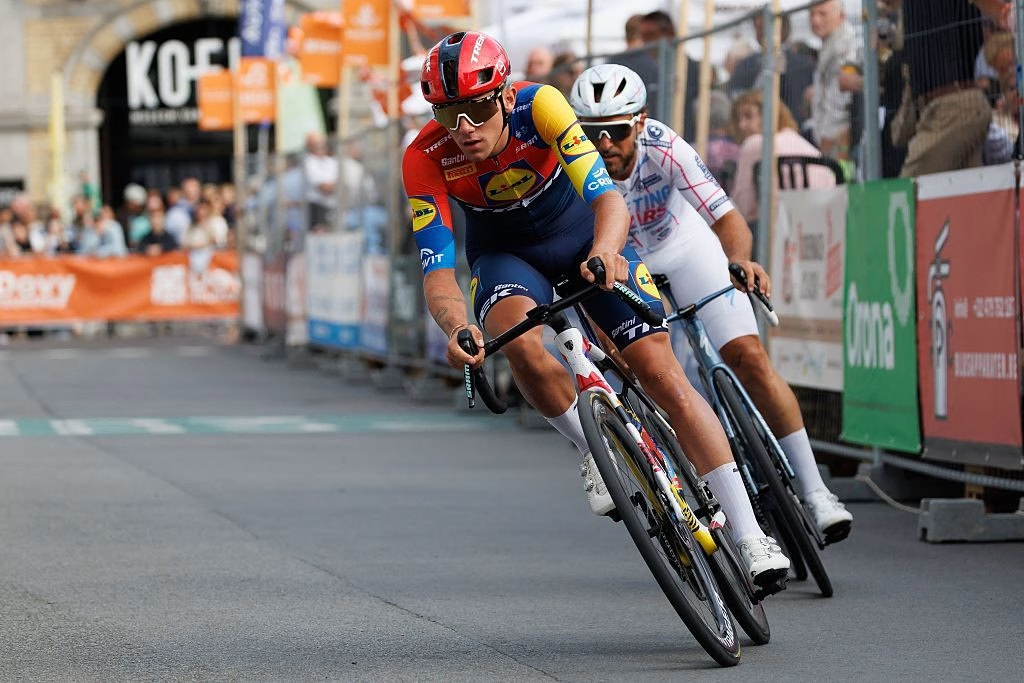 Photo Credit: Getty
Thibau Nys should not wait for a pure sprint
Nys finished third in Córdoba and has already demonstrated that he is much more dangerous when a stage becomes selective.
A completely straightforward finish at La Rábida leaves him trying to beat Brennan, Meeus and Coquard on their terms.
The opening hills give Lidl-Trek another option.
Nys can follow a strong breakaway or attack if the early racing becomes difficult. With Mads Pedersen no longer in the race, he has greater freedom to race for himself.
That makes him one of the riders most likely to complicate Visma’s plan.
If Stage 16 becomes an ordinary sprint, his chances fall.
If it becomes a reduced race shaped by the hills or wind, they rise quickly.
Magnus Cort has little reason to wait
Magnus Cort is another rider who gains more from an unpredictable race than a controlled one.
He was fourth in Lorca but is unlikely to beat the quickest sprinters consistently if they all reach the final 200 metres together.
Uno-X Mobility can therefore use the opening 90km aggressively.
Cort is one of the best riders in the peloton at converting the right breakaway into a stage win, particularly when a route becomes easier late and gives a strong group the opportunity to cooperate.
He can also sprint well enough that other breakaway riders will be reluctant to take him to La Rábida.
That tension could help Visma if Cort makes the move, but it could just as easily turn the escape into a series of attacks that becomes difficult to control.
Orluis Aular can profit without Movistar chasing
Orluis Aular has a different advantage.
Movistar have no reason to chase for him.
Their entire Stage 16 should be organised around getting Mas safely through the afternoon. If the sprint teams bring everything back anyway, Aular can then contest the finish without his teammates having spent the day working.
He was 10th in Lorca and has the durability required for the opening terrain.
That makes him a useful outsider, particularly if the sprint becomes messy after a hard or windy final hour.
The coastal roads could matter more than the climbs
La Vuelta’s own description of Stage 16 highlighted the possibility of wind during the flat coastal finale.
That is the real danger for the GC riders.
There is little reason for Mas, Gall, Roglič or Richard Carapaz to attack each other on the opening hills. None is severe enough to produce meaningful differences, and much harder stages are coming.
The exposed roads around Moguer and Palos de la Frontera are another matter.
If a team sees enough crosswind to split the race, the stage can change within minutes. The GC favourites then have to move towards the front, sprint teams lose domestiques and the chase behind a breakaway can become much less organised.
It would also favour Visma.
Van Aert is one of the best riders in the race in crosswinds, while Brennan has a team built to position him near the front. A reduced front group would not necessarily hurt their chances of winning.
For Movistar, it is simply something to survive.
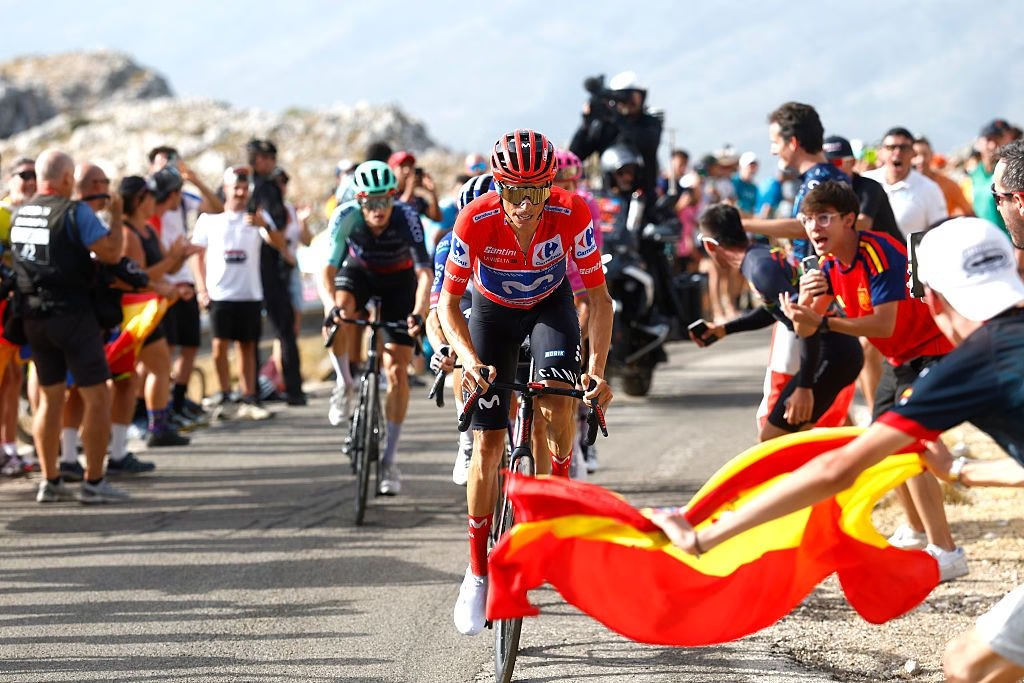 Photo Credit: Getty
Mas takes 2:06 into the final week
There was no change among the main GC contenders on Sunday, so Enric Mas begins the final week with 2:06 over Felix Gall and 2:10 over Primož Roglič.
Richard Carapaz is fourth at 4:24, with Oscar Onley fifth at 5:44.
The important change came on Saturday at La Pandera.
Mas and Gall dropped Roglič in the closing kilometres, allowing Gall to move into second overall while Roglič slipped to third. Marco Brenner won the stage from the breakaway ahead of Santiago Buitrago.
Our Stage 14 race report covers the moment Gall and Mas finally separated Roglič on the final climb.
For Mas, Tuesday and Wednesday are now about avoiding unnecessary problems.
Thursday is where the race changes again.
Roglič should gain time in the 32.1km individual time trial. Gall faces a much more difficult task against the clock, while Mas needs to limit whatever Roglič can recover.
There is therefore little logic in Movistar turning Stage 16 into a GC race themselves.
The breakaway needs numbers
A breakaway can win Stage 16, but four or five riders are unlikely to be enough.
The flat second half is simply too long.
A group of 12 or more containing riders from several strong teams creates a completely different problem. Visma then have to decide how many riders they are prepared to spend before Wednesday’s sprint stage, while Cofidis and Red Bull have to decide whether their own fast men justify helping.
That hesitation is the escape’s best chance.
The strongest teams without a sprinter should recognise it.
This is not a mountain stage where the break can build ten minutes while Movistar ignores it. Brennan’s presence gives at least one team a clear incentive to chase.
The attackers need enough quality and enough representation to make that chase expensive.
Stage 16 leading contenders
Matthew Brennan
The clear sprint reference. Three victories already, excellent support and a route where the difficult terrain comes early enough not to compromise him.
Bryan Coquard
Second behind Brennan in Lorca and durable enough to handle the opening half. Cofidis also have a genuine reason to contribute to the chase.
Jordi Meeus
Possibly the strongest pure-speed threat to Brennan, although Red Bull’s GC priorities may limit the support available to him.
Alessandro Romele
Second in Córdoba and increasingly convincing deep into the race. More dangerous if he attacks before the sprint.
Thibau Nys
Another rider who should prefer a selective stage to a full bunch finish. Third on Stage 15 and likely to have freedom again.
Magnus Cort
The opening terrain is ideal for him to enter the break. His finishing speed also makes him difficult to beat if a small group survives.
Orluis Aular
Can sit behind while other teams chase and then use his durability in the finish.
Wout van Aert
Brennan should be Visma’s first option, but Van Aert has just won two of the last three stages. If the race becomes too hard or too tactical for a conventional sprint, he immediately comes back into the equation.
How Stage 16 is likely to unfold
The first hour should be much harder than the stage classification suggests.
There is enough rolling terrain for repeated attacks, and teams seeking a breakaway victory know they need numbers before the road flattens.
Once a group finally establishes itself, the race should settle into a clearer chase.
Visma are likely to take responsibility, with Cofidis the most obvious team to help. Red Bull may contribute later if Meeus remains protected without compromising Roglič.
The gap needs to be small by the time the race reaches La Palma del Condado and Villarrasa. If a strong group still has four or five minutes with 70km remaining, the chase becomes much more complicated.
The final 30km then add the possibility of wind.
If conditions remain calm and the peloton is organised, Brennan should get his sprint.
If the race breaks up on the exposed roads, the advantage may still sit with Visma, only through a different route.
Stage 16 prediction
Brennan has already shown that he can survive more difficult terrain than he faces on Tuesday, and the long flat second half gives Visma plenty of time to correct anything that happens early.
The breakaway is dangerous enough that the stage should not be treated as automatic, particularly if a large group forms in the Sierra de Aracena.
The coastal approach offers another way for the race to escape normal sprint control.
But if the main group reaches La Rábida together, Brennan remains the rider everyone else has to beat.
Prediction: Matthew Brennan to win Stage 16 and take his fourth victory of the 2026 Vuelta a España.

