
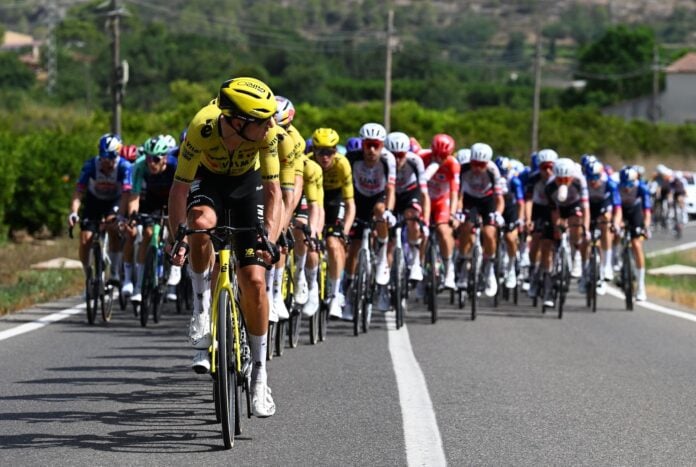
Matthew Brennan came to the 2026 Vuelta a España as one of the youngest riders in the race and a Grand Tour debutant expected to discover what three weeks of racing felt like.
Five stages later, that description already feels outdated.
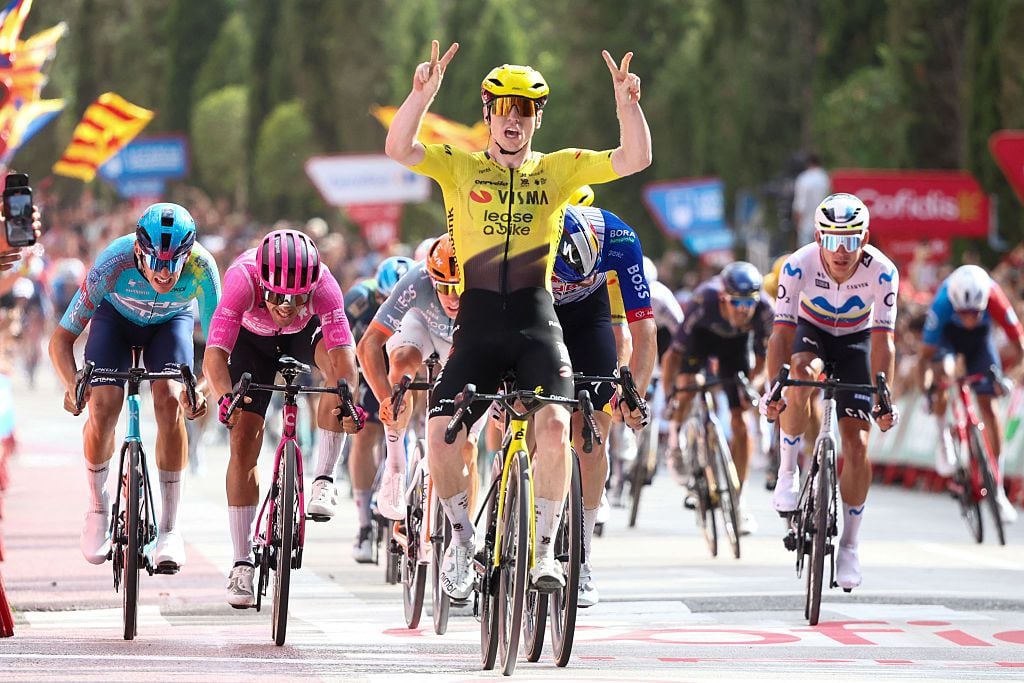
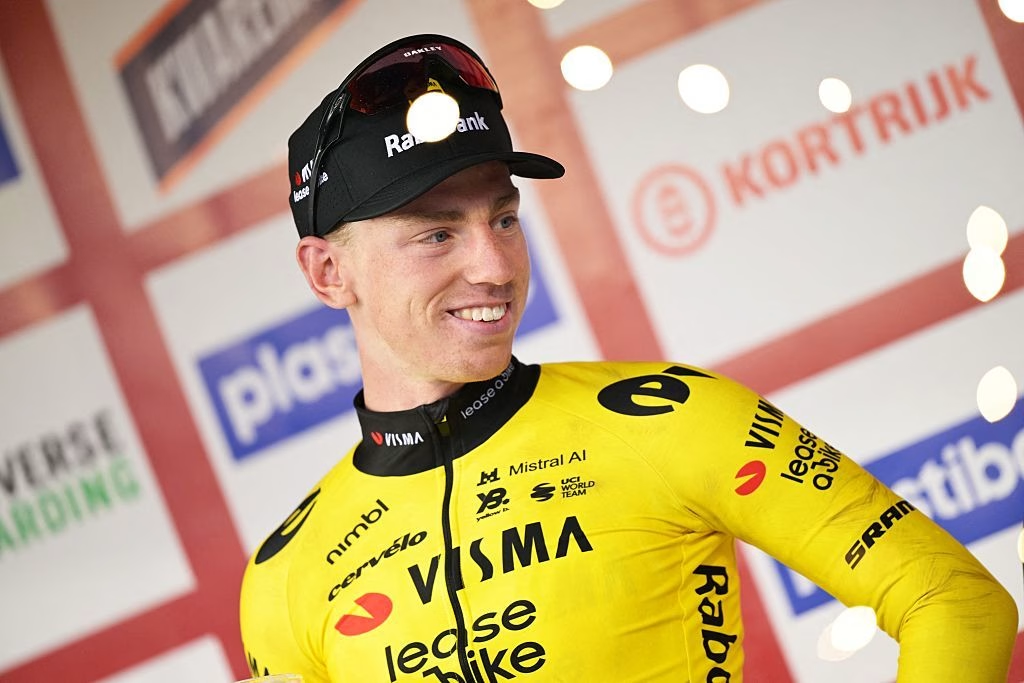
The 21-year-old Brit has won two of the first five stages, taking the uphill sprint in Manosque on Stage 2 before producing a more conventional but equally convincing victory in Roquetes on Stage 5. Both came after exceptionally controlled Team Visma | Lease a Bike finales, both required Brennan to finish the work of far more experienced team-mates, and both have pushed him from promising young rider into one of the central stories of the opening week.
He has effectively gone two from two in the sprint opportunities that have properly suited him. More significantly, he has done it on his Grand Tour debut while sharing a team with Wout van Aert and Christophe Laporte, riders who could lead major races themselves but are instead committing fully to delivering Brennan into winning positions.
The first victory proved Brennan could win a Grand Tour stage.
The second has started a much more interesting conversation about how many he might eventually leave Spain with.
Two wins in five stages is rare territory at 21
Winning twice inside the first five days of a Grand Tour debut is not a normal development curve.
Brennan’s second victory made him the youngest rider to win multiple stages at the Vuelta since Tadej Pogačar in 2019. Pogačar was 20 during that extraordinary first Grand Tour, eventually winning three stages and finishing third overall.
The comparison should stop there in terms of rider type. Pogačar and Brennan are developing towards completely different roles, and two sprint victories tell us nothing about whether their careers will eventually resemble one another.
What the comparison does provide is scale.
Young riders increasingly reach the WorldTour ready to win quickly, but Grand Tours remain a different test. The field is deeper, sprint trains are stronger, positioning becomes more ruthless and fatigue accumulates every day. Even extremely talented fast finishers can spend years trying to convert potential into a Grand Tour victory.
Brennan needed two suitable stages.
His Stage 2 victory in Manosque removed the first question mark. Stage 5 demonstrated that the result was not simply a young rider taking advantage of an unusual uphill finish.
Manosque and Roquetes required different strengths
The most encouraging aspect of Brennan’s two wins is that they have not been copies of one another.
Manosque was not a conventional flat sprint. The finish rose towards the line, Van Aert attacked late and the finale briefly became tangled up with the GC riders before Brennan produced the strongest acceleration from the reduced group.
It suited a rider with sprint speed, but also one capable of handling a more physically demanding finish.
Stage 5 provided another variation.
The late Puerto de Paüls was hard enough to put several established sprinters under pressure. Brennan survived before Visma reorganised on the run towards Roquetes and built the finish around him.
That matters for how the rest of his Vuelta should be viewed.
A pure sprinter may have only a small number of obvious opportunities on a mountainous route. Brennan’s ability to survive late climbing potentially expands the number of stages available to him. A day does not necessarily have to be completely flat to become a Brennan stage.
That quality is one reason he featured so prominently in ProCyclingUK’s Vuelta sprinters and points jersey guide before the race began.
Five stages later, his case is considerably stronger than it was then.
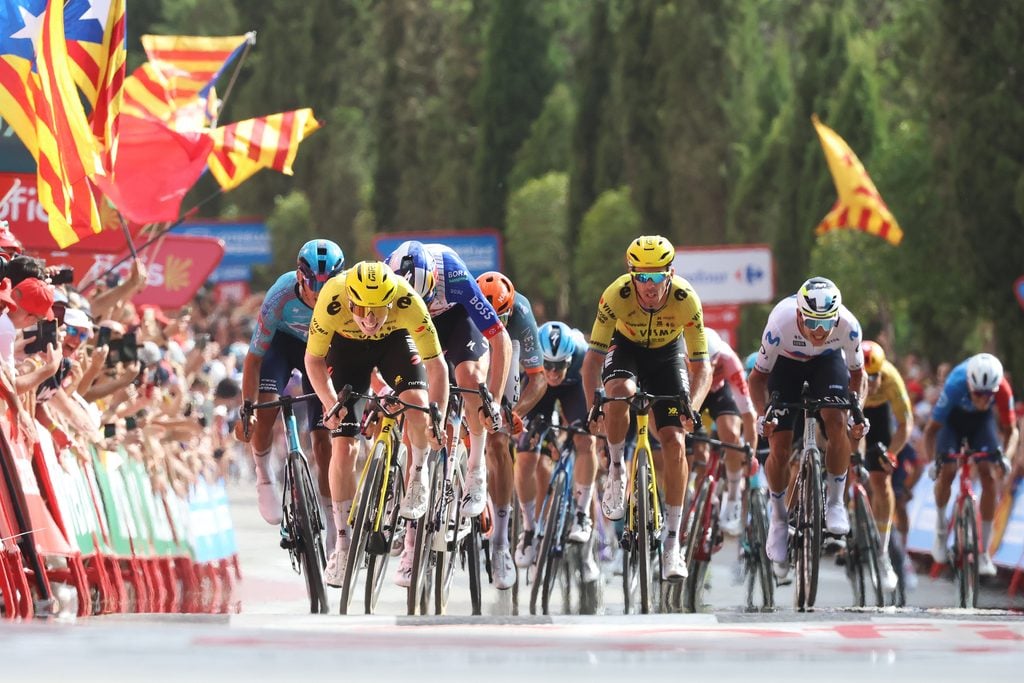 Photo Credit: Getty
Visma’s lead-out is giving Brennan an extraordinary education
Brennan deserves the victories, but it is impossible to separate his success from the quality of the operation around him.
Wout van Aert and Christophe Laporte would be protected finishers for almost any team in the peloton.
At this Vuelta, they are helping lead out a 21-year-old.
That is both a remarkable endorsement of Brennan and an enormous advantage during his first Grand Tour. He is learning how to negotiate high-pressure finales while two of the most experienced Classics riders in cycling handle much of the positioning around him.
Stage 5 was the clearest example. Visma controlled the approach, Laporte and Van Aert kept Brennan where he needed to be and the young Brit still had enough speed left to complete the job.
A perfect lead-out does not win the stage by itself. Brennan still has to follow the correct wheel, remain calm when space disappears and launch at the right moment.
But most Grand Tour debutants learn those lessons by making mistakes.
Brennan is learning them while winning.
Visma no longer need to treat these stages as development opportunities
Before Monaco, there was an obvious argument that simply completing his first Grand Tour would be useful for Brennan.
That objective has already become secondary.
Two stage victories change the team’s incentives because Visma now know they possess one of the best finishing options in the race. Whenever a profile gives Brennan a plausible chance of reaching the final kilometres, they have every reason to organise around him.
That does not mean sacrificing every rider on every rolling stage.
The Vuelta remains extremely mountainous and the team have their own objectives beyond Brennan. But there are now more days where Visma can reasonably begin the morning believing they have the favourite rather than merely a talented outsider.
Stage 6 and the Valdelinares summit finish on Stage 7 clearly move the race away from him again. The Stage 6 preview centres on the gravel ascent of Puerto El Bartolo and a finale where Brennan’s priority will simply be conserving energy.
Later stages will bring him back into the picture.
The calculation has changed from whether he can win again to how many suitable opportunities remain.
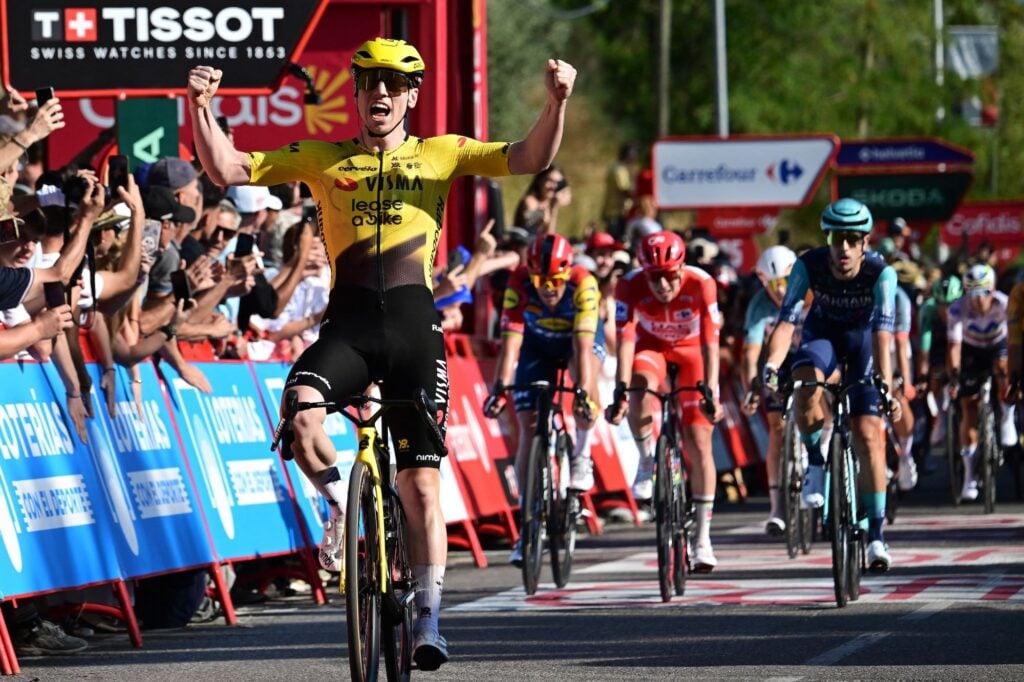 Photo Credit: Getty
The green jersey is no longer a speculative target
The points classification also deserves to be taken seriously.
Brennan is now firmly in the green jersey conversation rather than simply appearing near the top because the race is young.
The complication is that his principal rival is Pogačar.
The red jersey has already accumulated points through his Monaco time trial victory, his extraordinary 50km solo win in Andorra and consistently high finishes. With so many mountain stages remaining, Pogačar will continue to have opportunities to score heavily on days where Brennan is nowhere near the front.
Brennan has the opposite advantage.
Whenever the Vuelta produces a sprint or reduced sprint that he can contest, there are large points available that Pogačar is unlikely to collect. His climbing resilience may also allow him to survive stages that eliminate more specialised sprinters before the finish.
For now, Visma do not need to restructure his entire race around intermediate sprints.
The most efficient route towards green is still winning stages.
If Brennan continues doing that, the classification will remain relevant deep into the race.
Pogačar versus Brennan is an unusual points battle
There is something particularly striking about the two riders dominating the opening week’s victories.
Pogačar and Brennan are winning stages in almost opposite ways.
Pogačar took the Monaco time trial and then destroyed the GC race with his Andorra raid. Brennan has won two fast finishes. With Stage 3 cancelled because of the hailstorm on the road to Font-Romeu, the pair have accounted for four of the first five scheduled stages between them.
That has created an unusual green jersey contest between the overwhelming GC favourite and a 21-year-old Grand Tour debutant.
The cancelled Font-Romeu stage also removed one day on which the points picture might have developed differently, leaving the early classification unusually concentrated around riders who have already won.
The route should gradually favour Pogačar because of the volume of climbing still to come.
But Brennan being close enough for that calculation to matter at all tells the story of his opening week.
 Photo Credit: Getty
The British story at this Vuelta is much wider than one rider
Brennan’s two victories are also part of an unusually strong British presence near the front of this Vuelta.
Ethan Hayter came agonisingly close to beating Pogačar in the opening Monaco time trial. Josh Tarling and Callum Thornley also finished prominently against the clock, while Oscar Onley emerged from the Andorran mountain stage firmly established among the riders fighting immediately behind Pogačar.
Brennan is the one converting that wider strength into stage victories.
For British cycling, that is particularly interesting because he is developing into a type of Grand Tour rider that has been comparatively rare since Mark Cavendish’s peak years.
Britain has produced Tour winners, time trial specialists, Classics contenders and elite track riders. What it has not consistently produced is a road sprinter arriving at the biggest stage races with the expectation that several days could end with him winning.
Brennan is beginning to offer that again.
The difference is that his profile may eventually prove considerably broader than that of a conventional pure sprinter.
The Mark Cavendish comparison is inevitable but only goes so far
Any 21-year-old British rider winning Grand Tour sprints is going to produce comparisons with Mark Cavendish.
There is no avoiding it.
Cavendish became the defining British stage winner of his generation, ultimately building his career around an ability to finish Grand Tour sprints better than almost anyone in cycling history.
His own Grand Tour breakthrough took time. Cavendish rode the 2007 Tour de France without winning before claiming two stages of the 2008 Giro d’Italia at 22 and then exploding at that year’s Tour with four victories.
Brennan already has two Grand Tour wins at 21.
That is an impressive historical marker, but the more interesting difference may be their range.
Cavendish’s greatness came through increasingly refining himself into the world’s best pure sprinter. Brennan’s early career points towards a less specialised rider. He climbs well, can survive selective racing and has already shown that uphill finishes do not necessarily remove his sprint.
That could eventually give him access to races and stage profiles that never needed to form part of Cavendish’s programme.
It would be premature to decide exactly what Brennan is going to become.
The interesting part is that the possibilities still appear unusually broad.
Brennan’s rise did not begin at the Vuelta
Grand Tour victories dramatically increase a rider’s profile, but Brennan did not arrive in Monaco as an unknown quantity.
His 2026 season had already established him as one of the outstanding young riders in the peloton. He won twice at the Vuelta a Burgos shortly before travelling to the Vuelta and had repeatedly demonstrated both finishing speed and an ability to remain competitive on terrain harder than that normally associated with a specialist sprinter.
Those performances were why expectations were already relatively high before his Grand Tour debut.
What nobody could reasonably expect was how quickly he would convert them.
There is a substantial difference between looking capable of winning a Grand Tour stage and immediately winning two of the first five.
The Stage 5 preview already placed Brennan alongside Mads Pedersen and Kaden Groves among the main favourites for Roquetes. By the finish, his status had shifted again.
Future sprint stages will no longer begin with Brennan as the young rider trying to beat the established names.
He is now one of the riders they need to beat.
The second victory may matter more than the first
There is always a particular pressure around the first Grand Tour victory.
Before Manosque, Brennan still had to prove that success in smaller races would translate once he entered cycling’s three-week environment.
Once he won, that uncertainty disappeared.
The effect was visible in Roquetes.
There was no sense that Brennan was waiting to discover whether he belonged. Visma committed to him, he trusted the riders around him and the sprint looked like the execution of a plan rather than an opportunistic breakthrough.
That is what makes the second victory arguably more informative.
Manosque demonstrated that Brennan was capable of winning.
Roquetes showed that Visma can now expect him to.
For someone racing his sixth Grand Tour stage on Thursday, that is an extraordinary change in status.
 Photo Credit: Getty
The hard part of Brennan’s debut starts now
The Vuelta is still nowhere near Granada.
That is worth stressing because Brennan has never previously experienced three weeks of racing at this level. The most difficult mountain blocks remain ahead, and his challenge on many stages will have nothing to do with winning.
He has to survive.
Mountain stages create a completely different pressure for sprinters and heavier Classics riders, particularly once accumulated fatigue combines with high pace from the GC teams. ProCyclingUK’s Vuelta time cuts guide explains why those days can become races of their own at the back of the peloton.
Brennan’s ability to climb better than a conventional pure sprinter should help, but the third week will still be unfamiliar territory.
The green jersey question also depends heavily on how well he absorbs that fatigue.
It is possible his sprint loses some of its sharpness after two weeks in the mountains. It is equally possible that his resilience becomes an advantage as more specialised sprinters begin to suffer.
We simply do not know yet.
That uncertainty is one of the few things remaining from his pre-race status as a Grand Tour debutant.
-
 Photo Credit: Getty
 -
 Photo Credit: Cs-wolves / Wikimedia Commons, CC BY-SA 4.0

Visma may already have found another rider to build around
The wider significance stretches beyond this Vuelta.
Visma | Lease a Bike already have a roster built around some of the biggest riders in the sport, but Brennan increasingly looks like someone who could shape a major part of their race programme for years.
The important thing is that the team do not appear to be forcing him into a narrow role.
On a flat finish he can sprint. On a harder stage he can use his ability to survive climbing. Van Aert and Laporte can currently help guide him through tactical situations while he develops the experience to make more of those decisions himself.
His first Vuelta is therefore producing two things simultaneously.
It is delivering immediate victories, and it is teaching Visma more about what kind of rider they actually have.
Two stages are not enough to define an entire career, but they are enough to change expectations.
Two wins have already transformed Brennan’s Vuelta
Brennan could leave Spain without another victory and his first Grand Tour would already count as a major success.
Two stage wins at 21 cannot be taken away.
But that is no longer a useful way to judge the remainder of his race.
He is firmly in the points classification conversation. Visma have demonstrated that they are willing to commit Van Aert and Laporte to his sprint. He has won both of the finishes that have properly suited him and has shown enough climbing ability to suggest that more stages will become realistic targets than originally expected.
The mountain stages will push him out of the daily victory conversation for periods, but the next suitable finish will now arrive with a very different level of expectation.
Pogačar has produced the dominant performance of the Vuelta’s opening week with his Andorra raid and huge GC advantage.
Brennan has produced the other great individual story.
One arrived trying to win the only Grand Tour missing from his palmarès.
The other arrived to discover what racing a Grand Tour was actually like.
Five stages later, Matthew Brennan already has two victories.
The learning phase is moving remarkably quickly.

