
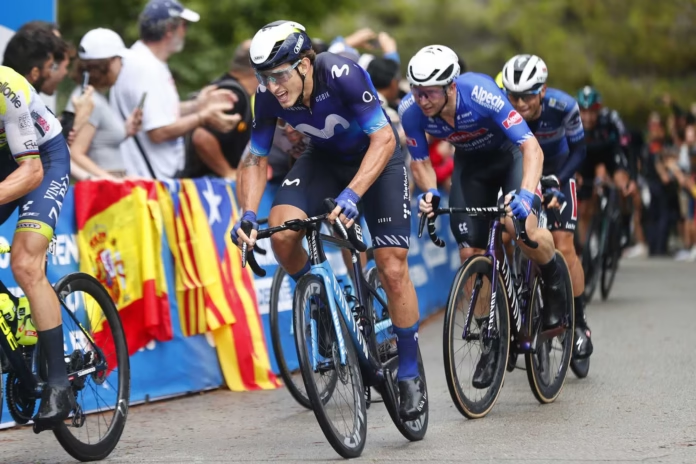
The Vuelta a España 2026 runs from Monaco to Granada across 21 stages, and simply reaching the finish each day is not enough to remain in the race.
Every rider must also finish within the stage’s time limit, usually referred to as the time cut or closing control. Anyone who arrives outside that limit can be eliminated from the Vuelta, even if they physically complete the stage.
That becomes particularly important in 2026 because the route contains six officially classified mountain stages, four medium-mountain stages and more than 58,000 metres of climbing. The Vuelta a España 2026 route guide shows how quickly the race moves into the mountains and how little respite there is before the final week in Andalusia.
For sprinters and heavier riders, that creates two completely different races on the hardest days. At the front, the GC favourites are fighting for stage victories and the red jersey. Far behind, another group may be fighting simply for the right to start again the following morning.
How does the Vuelta time cut work?
The Vuelta does not give every rider a fixed number of minutes after the stage winner.
Instead, road stages are divided into different difficulty groups.
The winner’s finishing time and average speed are then used to determine the percentage of extra time available to everyone else.
The basic calculation is:
Stage winner’s time + the applicable percentage = maximum permitted finishing time
If a stage is won in exactly four hours and the applicable allowance is 15%, riders receive another 36 minutes.
The time limit would therefore be 4:36:00.
That principle is similar to the system used at the Tour de France, although the actual Vuelta categories and percentage tables are its own. ProCyclingUK’s Tour de France time-cut explainer covers the equivalent French system.
 Photo Credit: Unipublic / Cxcling / Antonio Baixauli
Vuelta time-cut percentages at a glance
The Vuelta uses five groups for normal road stages and a sixth for time trials.
| Group | Type of stage | Time allowance |
|---|---|---|
| Group 1 | Stages without major difficulty | 7% to 15% |
| Group 2 | Stages of average difficulty | 6% to 19% |
| Group 3 | Difficult stages | 6% to 18% |
| Group 4 | Special mountain stages | 6% to 18% |
| Group 5 | Difficult mountain stages | 10% to 22% |
| Group 6 | Time trials | 35% |
For Groups 1 to 5, the precise percentage depends on the stage winner’s average speed.
That means two stages assigned to the same group can still produce different time limits.
Group 1: stages without major difficulty
Group 1 covers the most straightforward road stages and normally produces relatively tight time limits because most of the peloton is expected to remain reasonably close together.
| Winner’s average speed | Time allowance |
|---|---|
| 34km/h or less | 7% |
| More than 34 to 36km/h | 8% |
| More than 36 to 38km/h | 9% |
| More than 38 to 40km/h | 10% |
| More than 40 to 42km/h | 11% |
| More than 42 to 44km/h | 12% |
| More than 44 to 46km/h | 13% |
| More than 46 to 48km/h | 14% |
| More than 48km/h | 15% |
These are not normally the stages where an entire gruppetto faces elimination, but they can still become dangerous for injured or ill riders who are dropped early.
A very fast flat stage can be particularly unforgiving because riders at the back may spend hours chasing a peloton travelling comfortably above 45km/h.
Group 2: stages of average difficulty
The second group allows progressively more time as the winning average increases.
| Winner’s average speed | Time allowance |
|---|---|
| 34km/h or less | 6% |
| More than 34 to 36km/h | 7% |
| More than 36 to 38km/h | 9% |
| More than 38 to 40km/h | 11% |
| More than 40 to 42km/h | 13% |
| More than 42 to 44km/h | 15% |
| More than 44 to 46km/h | 17% |
| More than 46km/h | 19% |
The maximum 19% allowance looks generous, but that figure only appears when an already difficult stage has been raced exceptionally quickly.
The extra percentage therefore often reflects how hard the riders at the back have already been forced to ride.
 Photo Credit: Unipublic / Cxcling / Antonio Baixauli
Group 3: difficult stages
Group 3 begins using lower average-speed bands because the terrain is expected to slow the race.
| Winner’s average speed | Time allowance |
|---|---|
| 32km/h or less | 6% |
| More than 32 to 34km/h | 8% |
| More than 34 to 36km/h | 10% |
| More than 36 to 38km/h | 12% |
| More than 38 to 40km/h | 14% |
| More than 40 to 42km/h | 16% |
| More than 42km/h | 18% |
This is where the fight at the back becomes much more visible.
Once the sprinters are dropped, they need to begin calculating how much time they can afford to concede rather than simply riding to the finish at an easy pace.
The beginner’s guide to the Vuelta a España 2026 explains the wider role of the gruppetto and why simply surviving the mountains is part of completing a Grand Tour.
Group 4: special mountain stages
The fourth group is designed for significantly more selective mountain stages.
| Winner’s average speed | Time allowance |
|---|---|
| 30km/h or less | 6% |
| More than 30 to 32km/h | 8% |
| More than 32 to 34km/h | 10% |
| More than 34 to 36km/h | 12% |
| More than 36 to 38km/h | 14% |
| More than 38 to 40km/h | 16% |
| More than 40km/h | 18% |
The important point is that a slow winning speed does not necessarily mean an easy day.
It can mean exactly the opposite.
A stage containing several long climbs may average barely 30km/h because so much time is spent ascending. At the lowest end of the scale, that can still produce only a 6% allowance.
Sprinters therefore cannot simply assume that the slowest mountain stages automatically produce the most generous cuts.
Group 5: the hardest mountain stages
Group 5 is where the biggest time allowances appear.
| Winner’s average speed | Time allowance |
|---|---|
| 30km/h or less | 10% |
| More than 30 to 32km/h | 12% |
| More than 32 to 34km/h | 14% |
| More than 34 to 36km/h | 16% |
| More than 36 to 38km/h | 18% |
| More than 38 to 40km/h | 20% |
| More than 40km/h | 22% |
The 22% maximum is substantially more forgiving than the limits used on easier road stages, but the difference is necessary.
A non-climber can lose enormous amounts of time once the best GC riders begin attacking after several major climbs.
That is why the final mountain stages on the 2026 Vuelta route will matter as much to the sprinters as they do to the riders fighting for red.
For the GC contenders, the objective is to gain time.
For the gruppetto, the objective may simply be to remain within that percentage.

Time trials use a 35% limit
Time trials operate under a separate rule.
The Vuelta applies a 35% time allowance on Group 6 stages.
The 2026 race contains two individual time trials: the short opening test in Monaco and the much longer Stage 18 test at Jerez de la Frontera.
The opening stage is unlikely to produce serious time-cut drama because the distance is so short that the absolute gaps will remain relatively small.
The longer Stage 18 test is more relevant.
A weak time triallist cannot simply roll around the course without making an effort, but the 35% allowance recognises that riders are racing individually and cannot use the shelter or collective pacing of a peloton.
What does a 20% Vuelta time cut actually mean?
The percentages become much easier to understand once converted into minutes.
Imagine a difficult mountain stage is won in 4 hours 30 minutes.
A 20% allowance gives:
54 minutes
The final permitted finishing time becomes:
5 hours 24 minutes
If the allowance is only 16%, the extra time falls to 43 minutes 12 seconds.
That difference of more than 10 minutes can determine whether dozens of riders remain in the Vuelta.
It is also why riders at the back continually receive updated calculations from team staff rather than relying on one estimate made early in the stage.
What is the gruppetto?
The gruppetto, sometimes called the autobus, is the group of dropped riders that forms on difficult stages.
It usually contains sprinters, lead-out riders, heavier rouleurs and domestiques whose work at the front has already finished.
Their aim is not to catch the leaders.
It is to establish a sustainable pace that keeps everyone inside the time cut.
There is considerable skill involved.
Experienced riders know when the group needs to push, where time can safely be lost and which descents or valleys offer opportunities to regain minutes.
The gruppetto may look relaxed compared with a GC attack at the front, but its pace is being managed carefully.
Go too hard early and riders risk blowing up before the finish.
Go too slowly and everyone risks elimination.
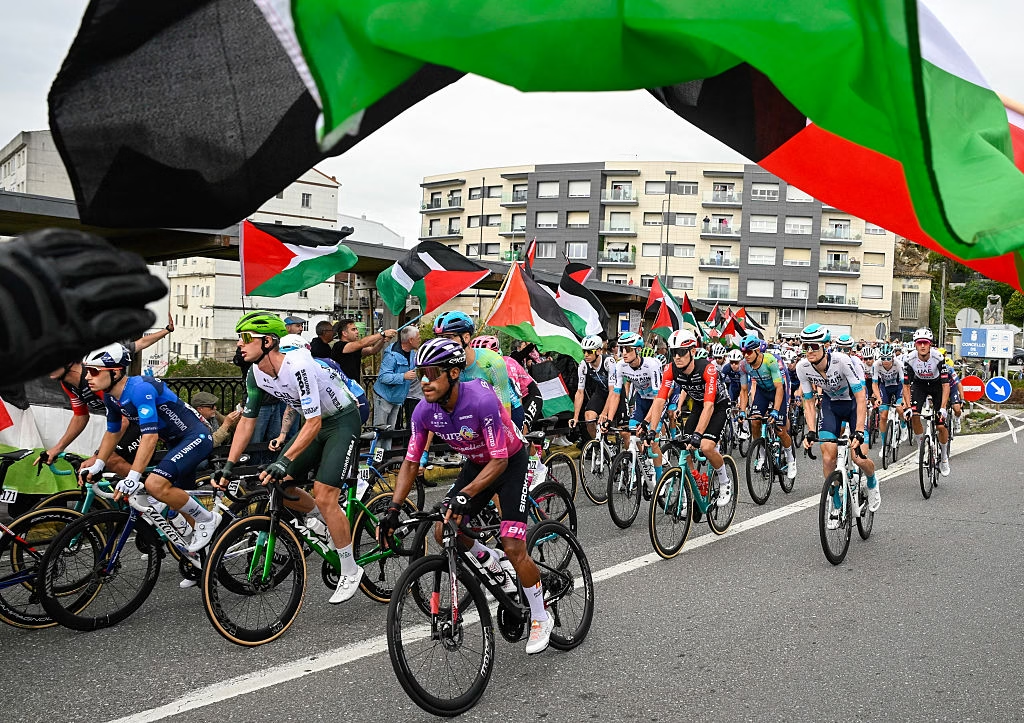
Why getting dropped from the gruppetto is dangerous
Being dropped from the peloton is not necessarily a crisis on a major mountain stage.
Being dropped from the gruppetto can be.
A rider who loses that group also loses its aerodynamic benefit, pacing and accumulated experience.
They then have to ride valleys and descents alone while simultaneously calculating whether the time cut is disappearing.
That is particularly dangerous for someone who is already ill, injured or exhausted.
Once a rider begins losing minutes to the gruppetto itself, surviving the stage becomes much harder.
Why sprinters fear the Vuelta mountains
The Vuelta contains fewer straightforward sprint stages than the Tour de France and repeatedly sends the race onto steep climbs.
That creates an awkward problem for riders targeting sprint victories or the green jersey.
They must first survive the mountains.
A sprinter can win twice during the opening week and still leave the race empty-handed if they miss the time cut later.
The Vuelta a España 2026 sprinters and points jersey guide looks at the riders trying to balance those two demands throughout the race.
For those riders, a major mountain stage is not a rest day between sprint opportunities.
It can be one of the most stressful days of the entire Vuelta.

Why a fast GC battle can make the time cut harder
The relationship between the winner’s average speed and the percentage allowance can initially seem counter-intuitive.
A faster stage usually produces a larger percentage.
That sounds helpful for the gruppetto.
The problem is that the faster average exists because the front of the race has been travelling quickly in the first place.
If a major GC team begins driving hard with 100 kilometres remaining, the sprinters may be dropped much earlier than they expected.
They then have to spend hours chasing.
The higher percentage at the finish does not always compensate for the extra time already lost.
That is why the most dangerous time-cut stages are often those where the GC fight begins long before the final climb.
Which 2026 Vuelta stages could cause the most time-cut trouble?
The obvious danger comes from the biggest mountain days.
Stage 4 in Andorra arrives extremely early and packs several climbs into only around 105 kilometres. Short mountain stages can be vicious because riders have very little flat road on which to regroup or regain time.
Stage 7 to Valdelinares provides another major summit finish before the sprinters have reached the end of the opening week.
Stage 9 to Alto de Aitana then closes the first block of racing with another significant mountain test immediately before the rest day.
The second and third weeks continue the pressure through Calar Alto, La Pandera, Peñas Blancas and Collado del Alguacil.
The final mountain stage is likely to be particularly dangerous because riders reach it with almost three weeks of accumulated fatigue already in their legs.
The Vuelta 2026 route guide has the full stage-by-stage breakdown.
 Photo Credit: Getty
Can riders outside the time limit ever continue?
Yes, but riders cannot assume it will happen.
The Commissaires Panel can extend the time limit or allow riders to continue in exceptional circumstances.
This can become relevant after extreme weather, major incidents or situations where a very large group has missed the cut.
It remains an exception rather than a normal tactical option.
A rider deliberately allowing themselves to finish outside the limit because they expect the jury to intervene is taking an enormous risk.
The safest calculation is always based on making the published cut.
What happens to classification points if a rider is reinstated?
There can also be a secondary penalty.
If riders finish outside the maximum permitted time but are allowed to continue, they can lose the points they have already accumulated in secondary classifications.
That makes the rule especially important to riders challenging for green or the mountains jersey.
Being reinstated might save their place in the Vuelta while effectively ending their classification campaign.
The distinction between the classifications is covered more broadly in the beginner’s guide to the Vuelta a España 2026.
 Photo Credit: Getty
Is finishing last the same as missing the time cut?
No.
Finishing position is irrelevant.
A rider can finish last on a mountain stage, more than 40 minutes after the winner, and remain comfortably inside the race if the permitted limit was 45 minutes.
Another rider could technically finish only a few seconds outside the cut and be eliminated.
The rule is based entirely on time, not finishing position.
That is why the final riders across the line can still be racing hard even when every stage result and GC battle has already been decided.
Does the red jersey have a different time limit?
No.
Every rider is subject to the same closing control.
The race leader, former Vuelta winners and riders leading secondary classifications receive no special exemption.
In normal circumstances, the strongest GC riders are nowhere near the cut.
A serious crash, illness or mechanical problem could theoretically change that.
The same rule applies to everyone who starts the stage.
Why does the Vuelta need a time cut?
Without a closing control, riders who had no interest in a mountain stage could deliberately lose enormous amounts of time and conserve energy for later.
A sprinter might ride two hours behind the leaders on a mountain day, recover as much as possible and then return fresh for the next sprint.
The time cut prevents that.
Everyone still in the race has to complete the stage at a credible competitive pace.
At the same time, the varying percentage system recognises that a heavyweight sprinter cannot realistically be expected to finish close to the world’s best climbers after thousands of metres of elevation gain.
It is a compromise between allowing different types of riders to survive a Grand Tour and preventing anyone from effectively taking days off.
The wider physical demands of that process are explained in ProCyclingUK’s guide to how hard the Tour de France is, where surviving daily time cuts is one of the less visible stresses of a three-week race.
Vuelta a España time cuts explained simply
The easiest way to remember the system is:
- Every stage is assigned a difficulty group.
- The winner’s average speed determines the applicable percentage.
- That percentage is added to the winner’s finishing time.
- Every remaining rider must cross the line before that deadline.
- Riders outside the cut are normally eliminated.
The easiest road stages begin with allowances as low as 6% or 7%.
The hardest mountain category can rise as high as 22%.
Individual time trials use a 35% limit.
The exact figure therefore cannot be known until the stage has been completed quickly enough to establish the winner’s average speed.
That is what creates the drama.
At the front, riders can be fighting for the red jersey while, almost an hour later, another race is still unfolding at the back.
For those riders, the prize is much simpler: make the cut and start again tomorrow.

