
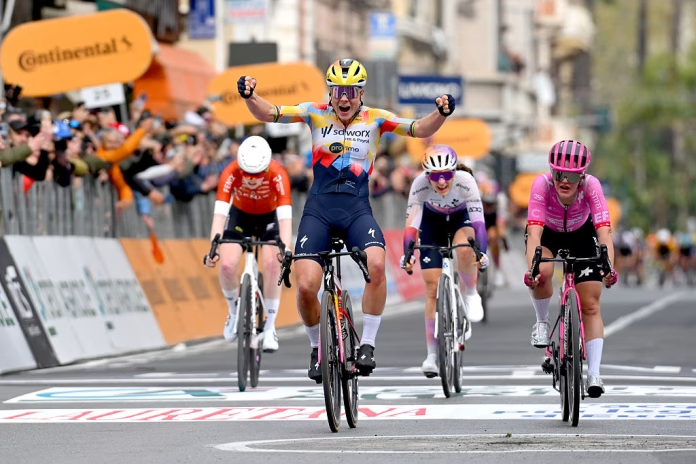
Milan-Sanremo Women 2026 did more than deliver a prestigious winner. Lotte Kopecky’s victory from the five-rider group that formed over the Poggio gave the early spring season a clearer shape. It confirmed that this race is already developing a distinct identity of its own, showed that SD Worx-Protime still has the deepest tactical hand in the biggest one-day races, and underlined that riders such as Noemi Rüegg are no longer simply outsiders taking advantage of one good day.
That matters because Milan-Sanremo Women is no longer just a symbolic return to the calendar. Two editions into its modern era, it is already shaping the wider classics season. The winner, the type of finale, the teams that got it right, and the riders who missed out all tell us something important about what may come next.
SD Worx-Protime still sets the one-day standard
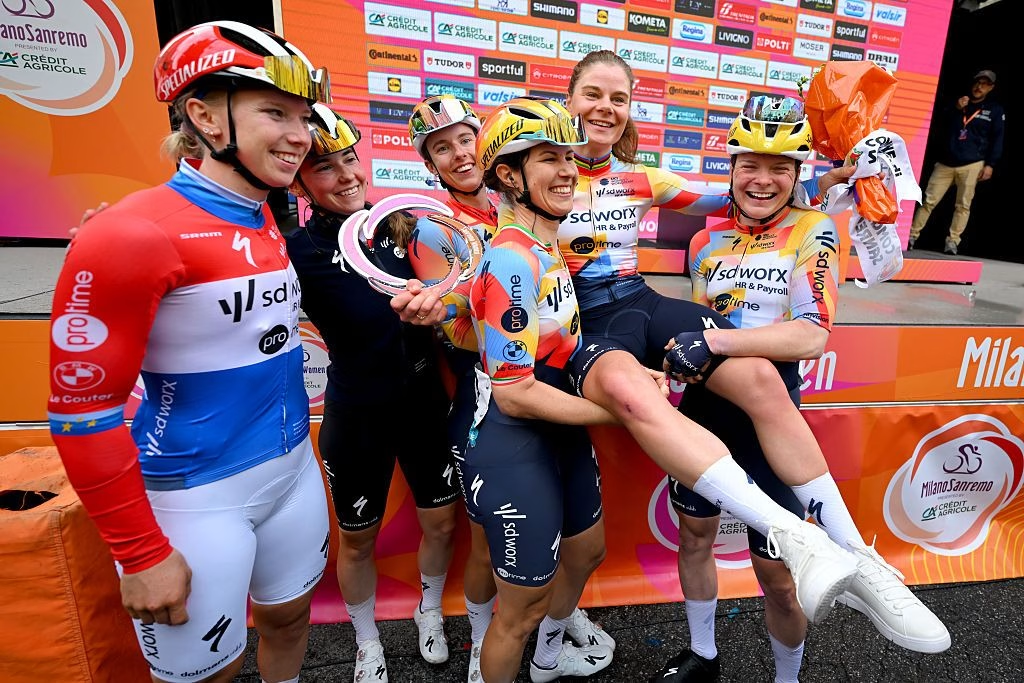
The most obvious takeaway is that SD Worx-Protime remains the reference point for the biggest spring races. In 2025, the team won Milan-Sanremo Women with Lorena Wiebes. In 2026, it won with Kopecky. That is important not simply because they won again, but because they won in a different way.
Last year the race still leaned towards the possibility of a fast finish after the late attacks had been neutralised. This time, the decisive move stayed clear, and Kopecky was the right rider for that more selective version of the race. That shows how difficult SD Worx-Protime is to contain. Rivals are not trying to beat one clear script. They are trying to beat a team that can pivot between a selective Poggio finale and a sprint-based fallback option within the same race.
That has consequences for the rest of spring. At races such as Tour of Flanders Women or Paris-Roubaix Femmes, teams will again need to force SD Worx-Protime into defensive decisions early rather than allow them to arrive at the final decisive point with multiple winning cards still in hand.
 Photo Credit: Getty
Milan-Sanremo Women is already more selective than some expected
One of the biggest pre-race questions around Milan-Sanremo Women has been whether the route would repeatedly settle into a controlled sprint scenario. The first two editions have already pushed back against that idea.
The 2025 edition had a late catch and a sprint finish after Elisa Longo Borghini came close to staying away. The 2026 edition instead broke decisively over the Poggio, with Kopecky, Rüegg, Puck Pieterse, Eleonora Gasparrini and Dominika Włodarczyk making the winning split. That tells us the race has found a very useful middle ground. It is not a pure sprinter’s race, and it is not so selective that only the very best climbers can win. It rewards riders who can survive the Cipressa and Poggio at speed, descend well, and still finish strongly on Via Roma.
That is a major positive for the season because it broadens the type of rider who can target the race seriously. It also means the tactical reading of Milan-Sanremo Women now matters more than ever. Teams have clearer evidence that if they really want to stop the fastest finishers controlling the day, the Poggio can still be enough, but only if the right riders commit fully.
Noemi Rüegg has moved into a different bracket
Rüegg finishing second may prove one of the most meaningful results of the day. A single podium in a new race can sometimes be explained away as a scenario breaking perfectly. Consecutive podiums are much harder to dismiss.
By following the decisive move again and improving from third in 2025 to second in 2026, Rüegg showed that her fit for Milan-Sanremo Women is not accidental. More than that, she showed she belongs at this level of one-day racing. That should change how the rest of the peloton reads her over the coming weeks.
For EF Education-Oatly, it is a significant step. Instead of being seen as a team hoping for an opportunistic result in the biggest classics, they now have a rider who has delivered at the highest level in back-to-back editions of one of the sport’s biggest one-day races. That changes the tone of the season around her. She is now someone teams have to mark, not simply someone they notice once the final group has already gone.
UAE Team ADQ showed there is more than one route to relevance
Elisa Longo Borghini’s absence through illness was one of the race’s most important pre-start developments. She had looked like one of the riders best equipped to turn the race into something difficult enough to avoid a bunch finish, and her withdrawal might easily have pushed UAE Team ADQ into a more reactive role.
Instead, the team still put Gasparrini on the podium and Włodarczyk into the decisive move. That matters because it broadens their classics profile. Longo Borghini remains the team’s clearest reference point for the hardest spring races, but Milan-Sanremo Women 2026 showed that UAE Team ADQ does not become strategically irrelevant without her.
That is important for the rest of the season. A team with multiple riders who can make the decisive split in a race like this becomes much harder to control later in spring, especially in races where the winning move forms through repeated pressure rather than one all-or-nothing attack.
The Poggio has already become a genuine winning launch point
Another important implication is that the Poggio is already proving decisive enough in the women’s race to create a real winning separation. That may sound obvious given the route, but it still needed proving in practice.
This year’s edition offered that proof. The key attack sequence over the Poggio did not simply animate the race before a reset. It decided the final outcome. That gives future editions a stronger tactical identity and it also matters for the wider season because it helps us judge rider form more clearly.
Kopecky and Pieterse both looked immediately comfortable in the race-defining phase. Rüegg was there again. Gasparrini responded well. Those are not small signals. When a race forces selection in the final twenty kilometres and the split stays clear, it often gives a truer reading of current one-day condition than a larger reduced sprint might.
-
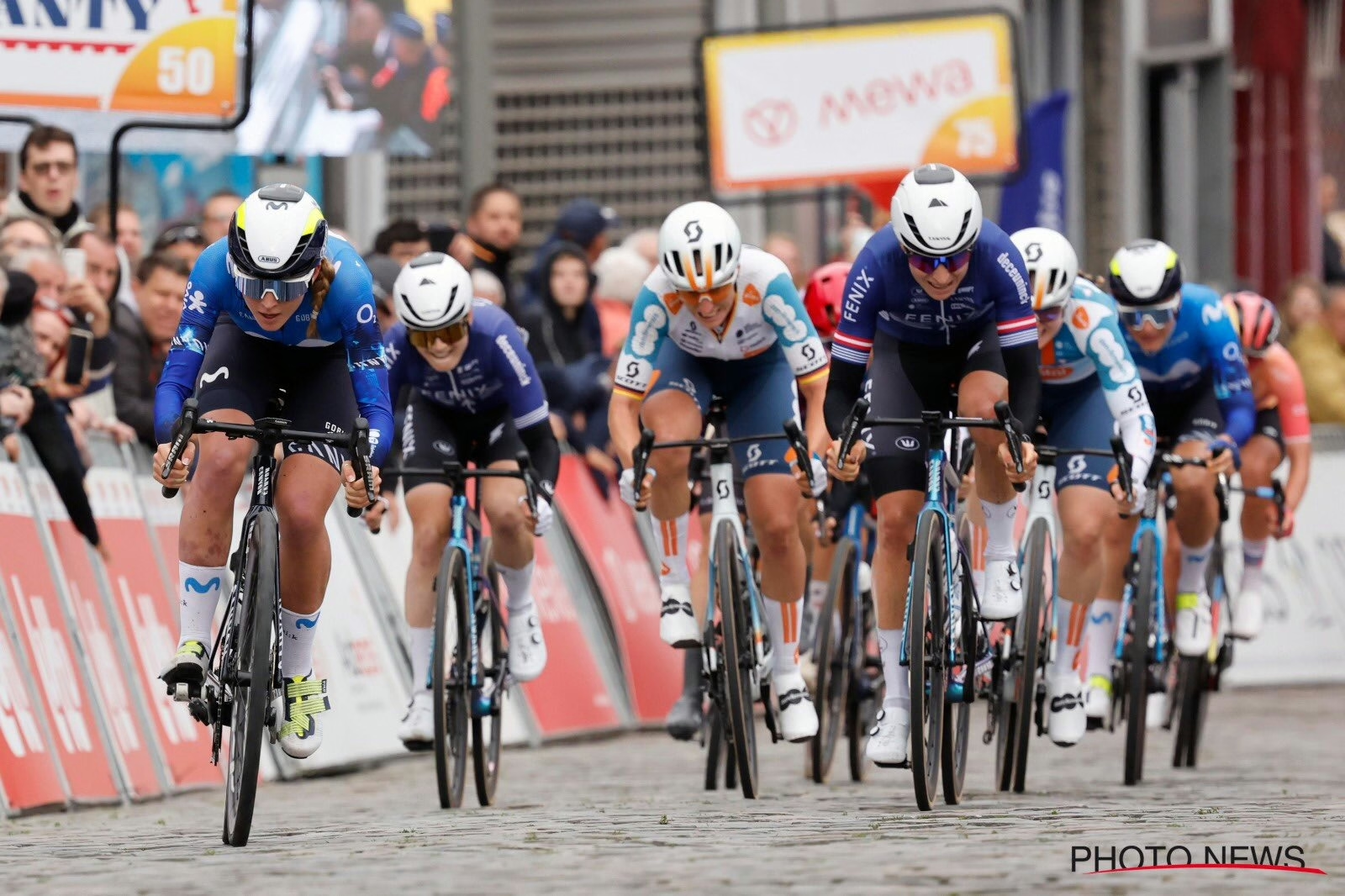
 Photo Credit: PhotoNews
The spring hierarchy is clearer, but not settled
What the race did not do was lock the whole season into one simple story. Kopecky won, but she did not dominate in a way that made everyone else look helpless. The winning group was small, the margins were tight, and the race still required exact judgement rather than brute force alone.
That is why Milan-Sanremo Women 2026 sharpened the hierarchy without closing the door on the rest of spring. SD Worx-Protime still leads the way. Kopecky is clearly one of the defining one-day riders of the season. Rüegg has entered a higher tier. UAE Team ADQ remains dangerous beyond one headline leader. Yet none of that makes the next races feel pre-decided.
In fact, it does the opposite. It gives shape to the season while keeping tactical uncertainty alive. That is exactly what you want from a major March classic. It should tell us who looks strongest, but it should also leave room for the next races to develop their own story.
It also reinforced why this race matters now
Perhaps the broader conclusion is that Milan-Sanremo Women already feels consequential. It is not just a welcome addition to the calendar or a prestige event borrowing weight from the men’s version. It is becoming a race that affects how the whole spring is read.
That is good news for the Women’s WorldTour as a whole. The season benefits when the biggest races each test something slightly different, and the 2026 Women’s WorldTour calendar now has a Milan-Sanremo Women that sits in a very useful space. It is long, tense, tactically layered, and selective without being narrow in the kind of rider it rewards.
So what Milan-Sanremo Women 2026 means for the season is fairly clear. It means the race already matters as a genuine marker, not just a beautiful backdrop. It means Kopecky and SD Worx-Protime have laid down an early classics statement. It means Rüegg has stepped into a more serious category. And it means the spring season now has another race capable of shaping reputations, not merely confirming them.

