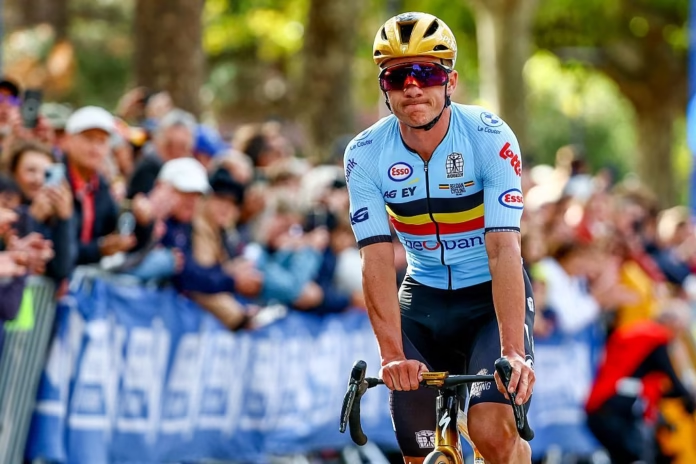
Remco Evenepoel starts Sunday’s elite men’s European Championships road race as the clearest reference point in the final field. The Belgian arrives in Slovenia with a fourth consecutive world time trial title from Montréal, but also with something to answer after finishing 12th in the road race on a day when he admitted he never had his best legs.
The biggest change from the preliminary entries is now settled: defending champion Tadej Pogačar will not race. Slovenia instead build around Primož Roglič, with Matej Mohorič, Jan Tratnik, Domen Novak and Jakob Omrzel giving the hosts enough depth to make the race difficult long before the final climb.
Mads Pedersen, Juan Ayuso, Giulio Ciccone, Romain Grégoire, Marc Hirschi, Mathias Vacek and Maximilian Schachmann give the race several different possible shapes. Pedersen needs to survive repeated steep efforts, Roglič wants the decisive move late, while Evenepoel has every reason to make the closing circuits more selective before the final ascent.
The final start list contains 115 riders from 30 delegations. Great Britain are absent, while Italy arrive with a particularly strong climbing group built around Ciccone, Giulio Pellizzari and Christian Scaroni. The full 2026 European Championships men’s road race start list is now available separately.
Previous winners
2025 – Tadej Pogačar
2024 – Tim Merlier
2023 – Christophe Laporte
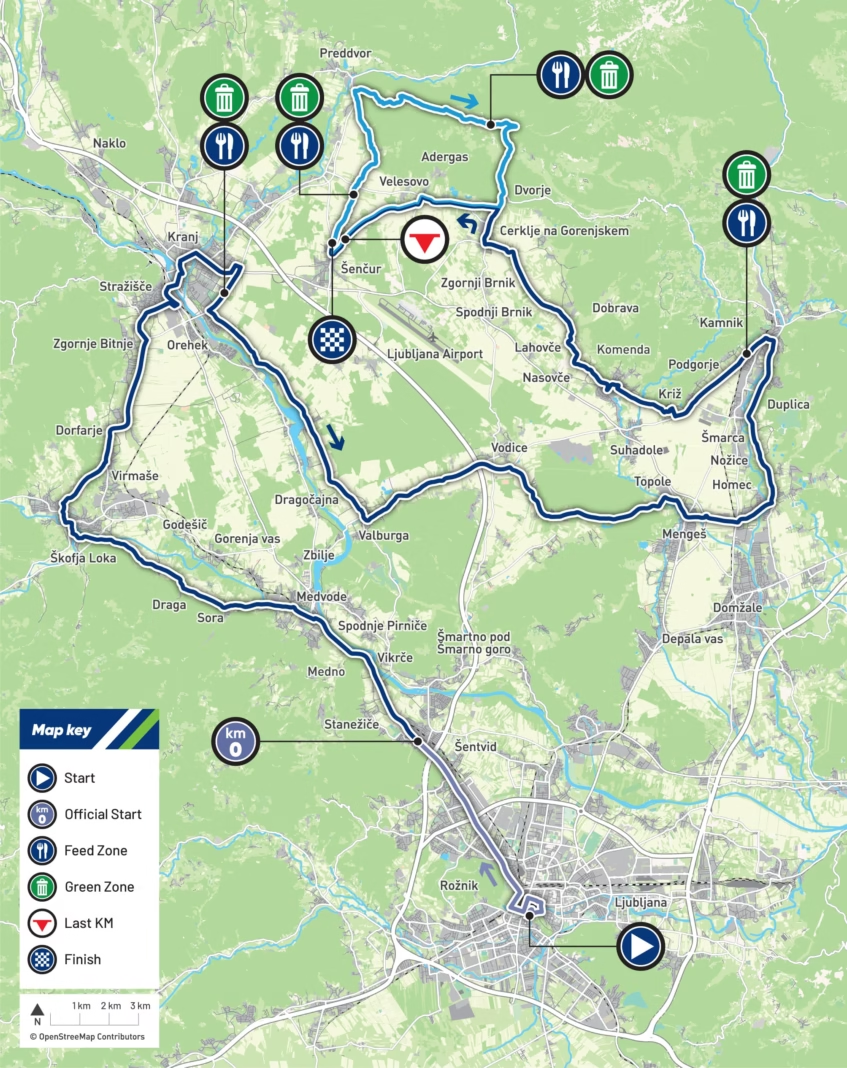
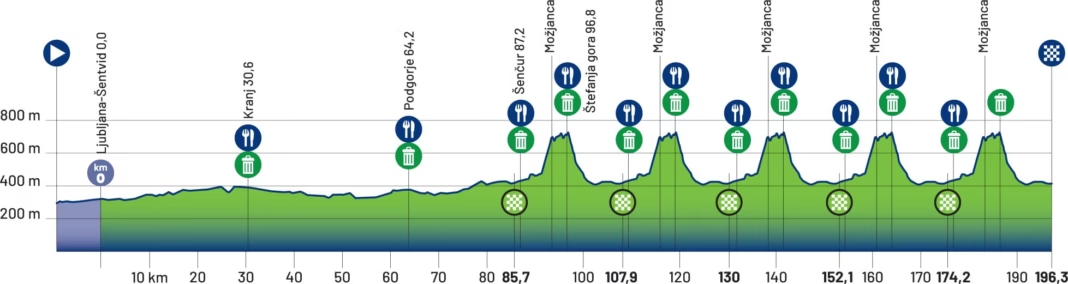
2026 European Championships men’s road race route
The elite men race 196.3km from Ljubljana to Šenčur with 2,571 metres of climbing. A 9km neutralised section carries the peloton through the centre of Ljubljana before kilometre zero in Šentvid, after which the opening 85.8km are comparatively gentle.
The race passes through Škofja Loka and Kranj before crossing towards Kamnik, Komenda and Cerklje na Gorenjskem. That section should allow a conventional early break to form, but it is unlikely to decide much unless the major teams allow an unusually strong group too much room.
The character changes completely once the race reaches the 22.1km finishing circuit. Five laps mean five ascents of Možjanca, 2.1km at 10.2% with a maximum gradient of 15.8%. More than 1,800 metres of the day’s climbing are packed into those closing laps, making repeated efforts rather than one long climb the main filter.
Možjanca does not lead directly into a simple descent. Riders continue over rolling roads before the technical drop towards the Krvavec cable-car area and the quicker return to Šenčur. The final ascent tops out with roughly 13km remaining, so a rider who attacks still needs enough power and organisation to defend the gap after the summit. The full course is covered in our 2026 European Championships route guide.
 Photo Credit: Getty
Remco Evenepoel has the clearest route to victory
Evenepoel finished second to Pogačar at last year’s European Championships and returns after another strong late-season block. Before the World Championships he won the GP Québec with a 28km attack, a result that matters because the Slovenian circuit also rewards riders capable of turning a short climb into a sustained move over the roads that follow.
His Montréal road race was less convincing. Evenepoel finished 12th, 25 seconds behind Brandon McNulty, after recognising early that he was not having his best day. That came only a week after he became the first man to win four consecutive world time trial titles, so the question is recovery rather than underlying form.
Belgium’s final team is well suited to avoiding the trap of making Evenepoel chase every move. Maxim Van Gils and Quinten Hermans can follow attacks on the circuit, while Ilan Van Wilder and Louis Vervaeke can work deep into a selective race. The best Belgian scenario is one where Evenepoel reaches the final two laps with teammates still able to force other nations to react.
Primož Roglič carries the home challenge
Roglič now becomes Slovenia’s obvious leader with Pogačar absent. He arrives after finishing second overall at the Vuelta a España and then 21st at the World Championships, where he was involved in the aggressive phase of the race before fading out of the medal fight.
The European course is a different problem. At 196.3km it is considerably shorter than Montréal, and Možjanca rewards exactly the kind of sharp acceleration Roglič has used throughout his career. His best chance probably comes from making the final ascent decisive rather than trying to match Evenepoel in a long move from one or two laps out.
Slovenia also have enough tactical depth to protect that option. Mohorič can attack on the rolling and technical sections, Tratnik and Novak can work late, while Omrzel gives the team another young climber who does not need to wait for the final lap. Our analysis of Roglič’s 2026 Vuelta showed that his form remained high even if Enric Mas ultimately proved stronger over three weeks.
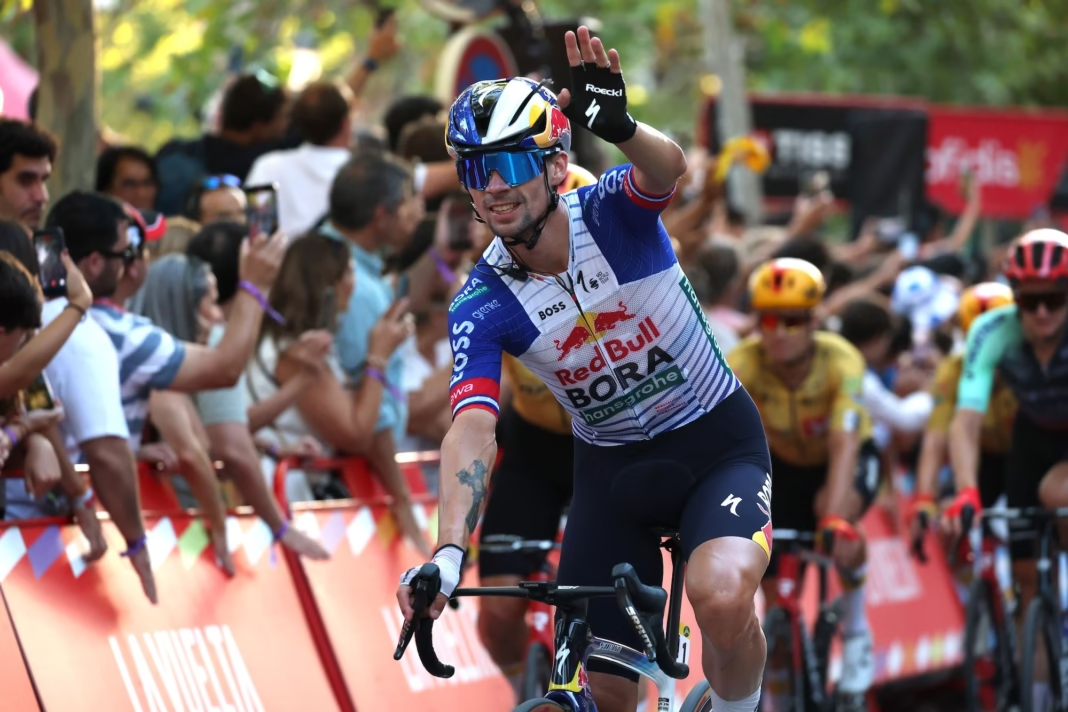 Photo Credit: Getty
Mads Pedersen changes what the climbers can afford to do
Five ascents of a climb averaging more than 10% make Pedersen an awkward fit on paper, but his sixth place in Montréal showed again that he can survive much harder races than a conventional sprinter. The important question is how quickly the favourites decide to make Možjanca selective.
If Belgium, Slovenia and Italy drive the pace from the third lap, Pedersen may simply lose too much ground. If the first four ascents are ridden hard without producing a complete split, Denmark can begin to turn the race around him. A regrouping after the final climb would immediately make Pedersen one of the hardest riders to beat.
Denmark have Kasper Asgreen, Mikkel Honoré, Andreas Kron and Frederik Wandahl among a full eight-rider team, giving them enough riders to cover moves without forcing Pedersen to spend energy before the decisive phase. That is exactly why the other leading nations cannot allow the race to settle into a steady rhythm.
Italy have several ways to avoid waiting for Evenepoel
Italy’s final eight are Giulio Ciccone, Ludovico Crescioli, Alessandro Fancellu, Marco Frigo, Giulio Pellizzari, Alessandro Pinarello, Christian Scaroni and Diego Ulissi. There is no single obvious sprinter to preserve, which should encourage the team to race aggressively.
Ciccone has the strongest immediate form after finishing ninth at the World Championships and second to Evenepoel at GP Québec earlier in September. Pellizzari gives Italy another pure climbing option, while Scaroni finished 18th in Montréal and was fourth at last year’s European Championships.
The tactical opportunity is to force Evenepoel and Roglič to spend energy earlier than they want. Ciccone does not need to wait for the final Možjanca ascent if Pellizzari or Scaroni has already made Belgium work on the previous lap. With no Pogačar in the race, there is less reason for Italy to accept a controlled finale built around somebody else’s leader.
 Photo Credit: Getty
Juan Ayuso has a better course than his Montréal result suggests
Ayuso finished 13th at the World Championships after losing contact with the leading contenders late in a 273km race. Slovenia asks for something different: almost 80 fewer kilometres, repeated short climbs rather than the accumulated distance of Montréal, and a final ascent close enough to the finish for one acceleration to matter.
Spain have no fast finisher to protect, so Ayuso can be supported by a team willing to race early. Urko Berrade, Cristian Rodríguez and Iván Romeo can all contribute to an attacking race, while Pau Miquel and Joel Nicolau add more depth.
Ayuso’s best route is probably closer to Roglič’s than Evenepoel’s. He does not need to attack 30km from the finish if the final Možjanca ascent can reduce the race to a handful of riders. The challenge is making sure Evenepoel has not already gone by then.
France have enough depth to make the penultimate lap matter
France bring Romain Grégoire, Kévin Vauquelin, Pavel Sivakov, Léo Bisiaux, Alex Baudin, Julien Bernard, Clément Braz Afonso and Mathys Rondel. That is a team with more climbing depth than finishing speed, which should push them towards an active race.
Grégoire is the most obvious option if a reduced group reaches Šenčur, while Vauquelin and Sivakov have more incentive to attack on the climb itself. Bisiaux and Rondel also give France riders who can move before the favourites without immediately sacrificing the team’s main options.
The danger is waiting until Belgium set the terms. If Evenepoel reaches the last lap with Van Gils, Hermans or Van Wilder still around him, France may find themselves reacting to several riders at once. Their better chance is to make the fourth ascent of Možjanca expensive.
Hirschi, Schachmann and Vacek can profit from a tactical race
Hirschi remains well suited to a course with a short steep climb and technical roads afterwards. Switzerland also have Jan Christen, Fabio Christen, Valentin Darbellay and Fabian Weiss, so Hirschi does not need to cover every early acceleration himself.
Germany have Maximilian Schachmann and Lennard Kämna as their clearest climbing options, with Marco Brenner and Emil Herzog giving them more riders for an aggressive race. The Netherlands are harder to read but Wout Poels, Tijmen Graat and Sjoerd Bax all have enough strength to stay involved if the field fractures gradually rather than through one explosive attack.
Mathias Vacek is another rider who benefits if the main favourites mark one another. Czechia only have three starters, so he cannot rely on the same team depth as Belgium or Slovenia, but a race decided by a small group rather than a pure climbing duel would suit him far better.
How the men’s European Championships could be won
The first two laps should reduce the number of domestiques without necessarily creating the winning move. The real tactical fight begins once the race reaches the third ascent of Možjanca, because from that point every team has to decide whether it is protecting a leader for the final lap or trying to remove rival options early.
Belgium can afford to make the race hard because Evenepoel benefits if the field is reduced before his attack. Slovenia want the opposite kind of control: enough attrition to remove Pedersen, but not so much chaos that Roglič is forced into a long chase. Italy and France should have the strongest incentive to attack between those two extremes.
The biggest tactical danger for Evenepoel is a race where everyone waits for him. Montréal showed what can happen when the strongest names repeatedly attack one another but fail to organise the chase behind the decisive move. A rider such as Ciccone, Mohorič, Grégoire or Vacek can become much more dangerous if Belgium refuse to spend riders before Evenepoel’s own attack.
If the race is together at the foot of Možjanca for the final time, Roglič and Ayuso have a much better chance than they do in a long-range contest. If Evenepoel has already created separation on the previous lap, the rolling roads after the climb become much more favourable to him. Pedersen’s presence adds the final pressure: any regrouping turns a climbers’ race into one where several nations suddenly need to avoid a sprint.
How to watch the 2026 men’s European Championships road race
The elite men’s road race starts in Ljubljana at 12:30 CEST on Sunday 4 October, which is 11:30 BST in the UK. The finish is expected at around 17:10 CEST, or 16:10 BST.
UK coverage is scheduled on TNT Sports and HBO Max. Our European Championships TV guide has the full viewing schedule and international options.
Top 3 prediction
1. Remco Evenepoel
2. Giulio Ciccone
3. Primož Roglič
-
 Photo Credit: quentinphotographiebe
 -
 Photo Credit: Getty