
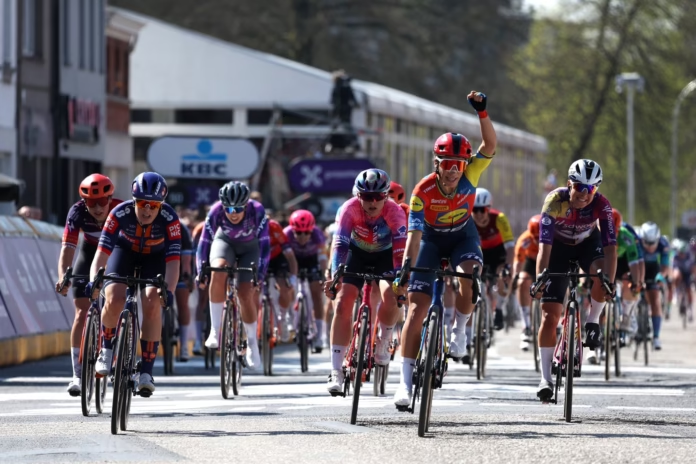
Scheldeprijs Women 2026 takes place on Wednesday 8th April, and for the first time, the race will be held as a UCI Women’s ProSeries event rather than as a lower-tier one-day race. That upgrade matters because it reflects how firmly Scheldeprijs has established itself as one of the key sprint fixtures in the women’s spring calendar. If you want the broader race context first, ProCyclingUK’s beginner’s guide to Scheldeprijs Women 2026 and brief history of Scheldeprijs Women both help frame where the race now sits.
The route itself stays true to that identity. Start and finish are both in Schoten, the total distance is 130.3km, and the race is built very clearly for the pure sprinters. In simple terms, this is one of the clearest fast-finisher opportunities of the early season.
What is the route for Scheldeprijs Women 2026?
The structure is straightforward. The race starts on Churchilllaan in Schoten, heads north towards Brecht, then returns to Schoten for three local laps of 17km each before the finish back on Churchilllaan.
That overall shape tells you quite a lot straight away. There is no major climbing challenge here, no hill sequence to force repeated selection, and no obvious terrain feature that should naturally eliminate the fastest riders. Instead, the route is built to keep a large part of the field in contention for a long time, which is why Scheldeprijs so often ends as a high-speed sprint contest.
If you are following the wider Flemish block on ProCyclingUK, this is also the race that sits slightly apart from the heavier cobbled pressure of Women’s Ronde van Brugge 2026 live viewing and start time update and the more selective spring Classics that follow.

Why does Brecht matter?
The key tactical note on this route is the northern section around Brecht, where the roads are more open and the wind can have an effect.
For a race like Scheldeprijs Women 2026, that matters more than raw elevation. If the weather is calm, the day should settle into the kind of controlled pattern that favours the strongest sprint teams. If the wind is stronger, the outward section has the potential to stretch the bunch, create nervousness and force teams to use energy much earlier than they would like.
That does not automatically mean decisive splits, but it is the one obvious part of the route where the race can become more complicated than a simple drag race back to Schoten.
How important are the local laps?
Once the riders get back to Schoten, they face three local laps of 17km each. Those circuits matter because they turn the race from an outward journey into a repetitive, increasingly tense sprint set-up.
For viewers and teams alike, local laps usually mean a few things. Positioning becomes more intense because everyone gets to rehearse the key roads in real time. Teams can judge the timing of the finish more accurately. The pressure also rises because each lap moves the race closer to full sprint mode.
In a race like Scheldeprijs, those laps are less about variety and more about building control, sharpening lead-outs and increasing the speed of the finale.
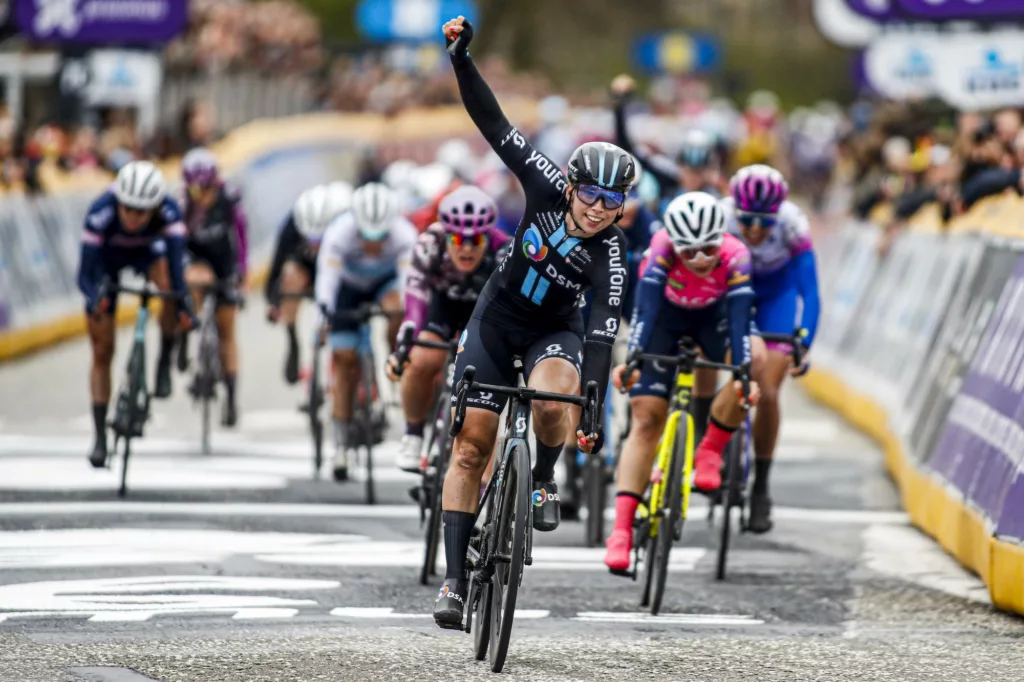 Photo Credit: Rafa Gomez/SCA/Cor Vos
Is Scheldeprijs Women 2026 definitely a sprint race?
It is one of the safest sprint predictions on the calendar, but definitely is still too strong a word in bike racing.
The route is flat, the finish is set up for speed, and the race identity remains strongly tied to the pure sprinters. That is the clearest starting point. Even so, flat races are not always simple. Wind can change the texture of the day, crashes or splits can reshape the run-in, and a nervous field can create surprises.
Still, compared with most Flemish races, Scheldeprijs Women 2026 is far more likely to reward sprint organisation than climbing strength or repeated attacks.
What is the finish like?
The finish is on Churchilllaan in Schoten, and both the route presentation and the event’s recent pattern point towards another traditional sprint there.
That matters because this is not usually a chaotic uphill drag where a sprinter can freelance the final 200 metres. It is a finish where lead-out cohesion, clean positioning and timing are likely to decide the outcome. If a rider hits the front too early, the wide and fast final approach can leave them exposed.
That is also why Scheldeprijs Women often makes sense as an entry-point race for newer fans. ProCyclingUK’s best women’s cycling races in 2026 for new fans and the broader women’s cycling TV guide hub both fit naturally around it.
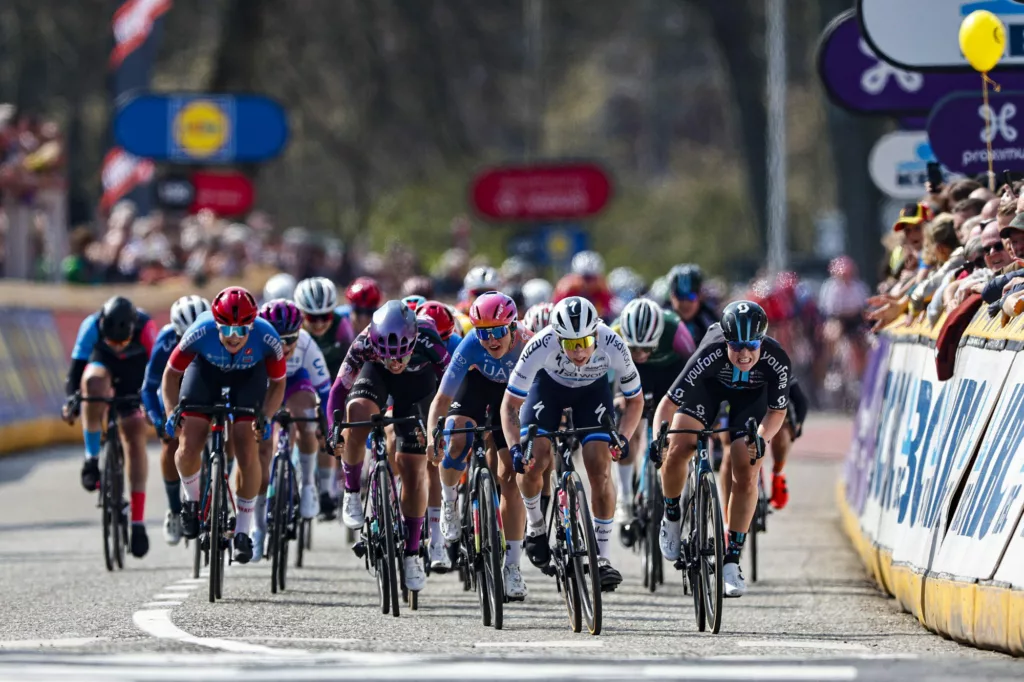 Photo Credit: Getty
What should fans watch for during the race?
The first thing to watch is whether the wind has any real effect on the run towards Brecht. On paper, that is the section most likely to disrupt a straightforward sprint script.
The second is which teams commit early to control. In races like Scheldeprijs Women 2026, the strongest sprint squads often reveal themselves well before the finish because they are the ones willing to close moves, keep the bunch calm and protect their leaders through the local laps.
The third is how organised the lead-outs look on the final lap. Because the course is relatively flat and predictable, this race often comes down to execution rather than improvisation. The best sprinter does not always win. The best-positioned sprinter often does.

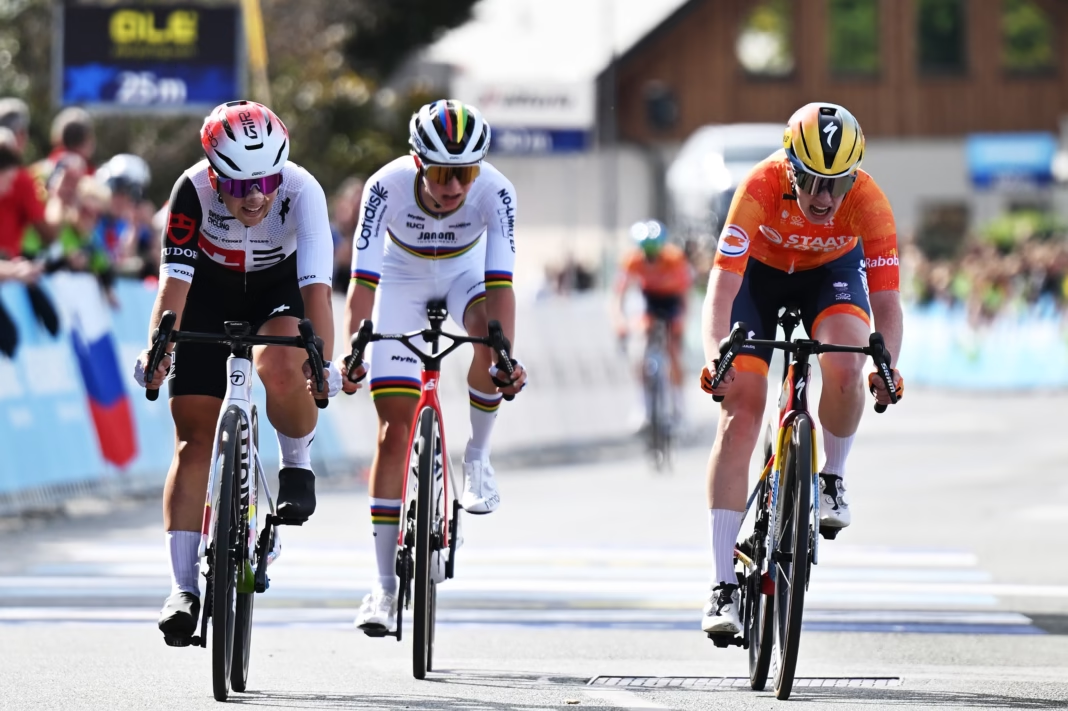
Why Scheldeprijs Women 2026 matters in the spring
Scheldeprijs Women 2026 sits in a useful place on the calendar. It comes after the heavier cobbled block, but before the season moves more fully towards hillier one-day races and stage-race objectives. That gives the fastest riders one of their clearest prestige chances in northern Europe. The event’s upgrade from 2026 only strengthens that sense of importance.
In practical terms, that means this race is more than just another bunch sprint. It is one of the benchmark sprint races of the spring, and one of the cleaner ways to judge which teams can still control a flat one-day event after several weeks of more selective racing.
If readers are planning a trip around the northern Classics, Where to stay for the spring Classics in Belgium is also a useful internal companion.
The simplest way to read the route
If you are coming to Scheldeprijs Women 2026 as a newer fan, the route can be summed up quite simply:
- flat start and finish in Schoten
- an early move north towards the more exposed roads near Brecht
- three finishing laps of 17km back in Schoten
- a fast, likely bunch sprint on Churchilllaan
That is why the race remains so recognisable from year to year. It does not pretend to be something it is not. Scheldeprijs Women 2026 is built for speed, for sprint trains, and for one of the cleanest fast-finisher showdowns of the spring.

