
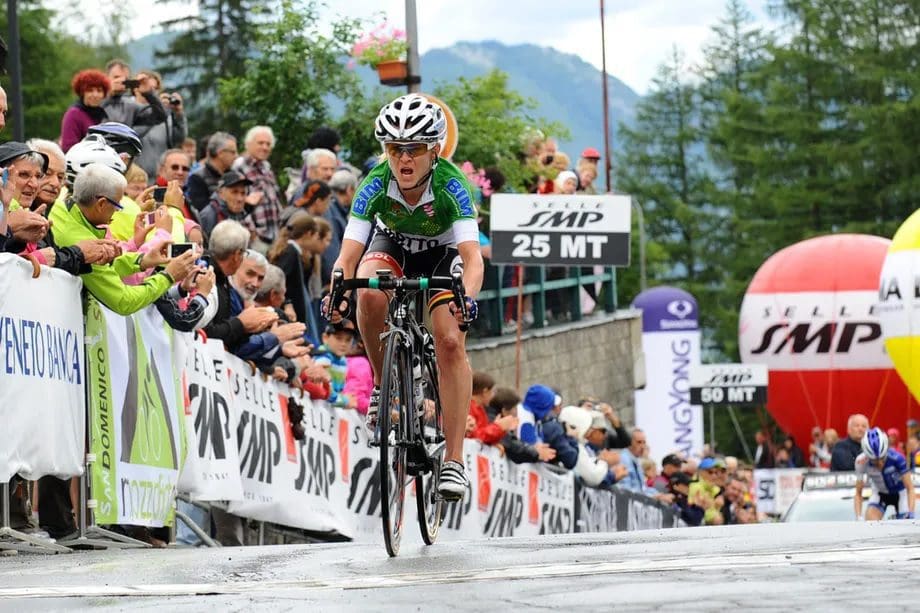
Emma Pooley was one of those riders who made cycling look like a problem she had already solved. On a long climb, she could settle into a rhythm that seemed almost untouchable, shoulders still, cadence light, a small figure grinding away with an unshowy certainty. Against the clock she was even more exact. No wasted motion, no theatrical suffering, just a relentless, technical effort that turned gradients, wind and time into manageable quantities.
Her career sits in a distinctive place in women’s cycling history. Emma Pooley was not the most forceful personality in the peloton, nor the most obviously marketable, but she was one of the most complete riders of her generation when the road tipped upwards or the stopwatch came out. She won Olympic silver, became world time-trial champion, won major stage races, and built the kind of respect reserved for riders who could dismantle a field on a mountain and then back it up in a time-trial against the best in the world.
There was also something very British about the way her career unfolded. Careful, cerebral, a little self-effacing, often built around specific targets rather than a constant drip of racing mileage. She was as likely to be found studying a climb, making a point with dry humour, or fitting elite sport around academic life as she was styling herself as a conventional professional athlete. That combination gave her career its own shape.
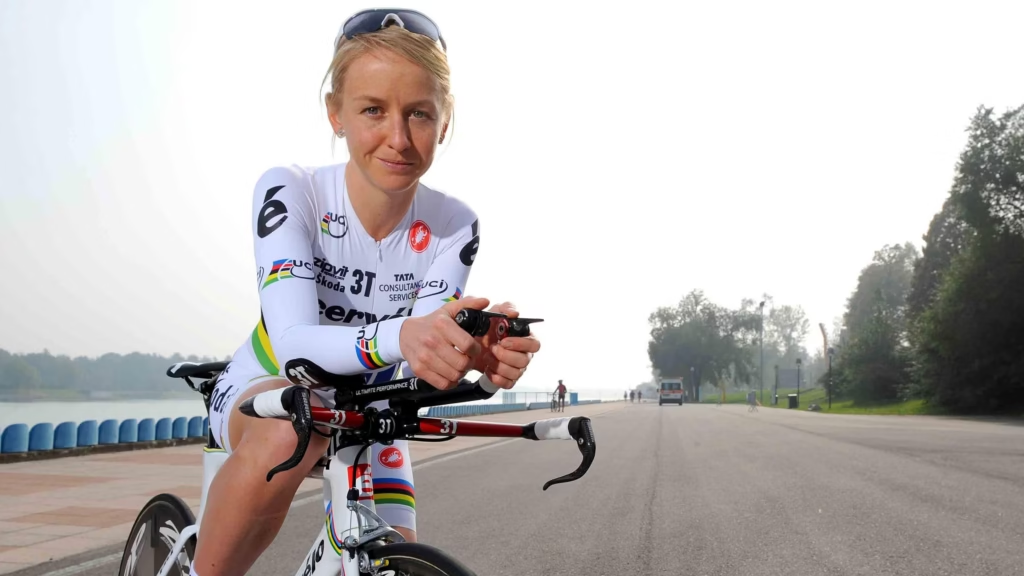
Emma Pooley and the making of a specialist
Pooley was born in London in 1982 and came through cycling as the women’s road scene was still piecing itself together into a more recognisable professional structure. She was a latecomer by the standards of some under-23 pathway stories, but once she committed, the signs were immediate. Her climbing was exceptional. Not just strong, but efficient, with an almost forensic understanding of pacing and effort.
She was a rider who seemed to prefer precise terrain: a climb with a clear rhythm, a time-trial with a line to hold, a race with enough pressure to keep the mind sharp. The broad brutality of flat sprinting was never her world. Give her altitude, heat, a long drag, a headwind and a course that punished hesitation, and she became difficult to contain.
That is why she belongs alongside the riders featured in ProCyclingUK’s women’s cycling rider history archive. Her career was not defined by volume alone, but by the clarity of her strengths and the scale of what she did with them.
From academia to the pro peloton
Emma Pooley studied at Trinity Hall, Cambridge and later completed a doctorate in engineering, which fits neatly with the impression she gave on the bike. This was a rider who understood systems, not just feelings. She was not a romantic climber floating above the road; she was a rider of calculation and discipline. That came through in the way she approached racing, the way she spoke, and the way she managed a career that never quite followed the standard arc.
Her own account of her career places the Tour de l’Aude, national titles and the 2010 UCI time-trial world championship at the heart of her best period. Pooley’s profile was never simply that of a British rider who happened to be good uphill. She was a world-level athlete with a deeply analytical sporting mind, and that made her unusually hard to categorise.
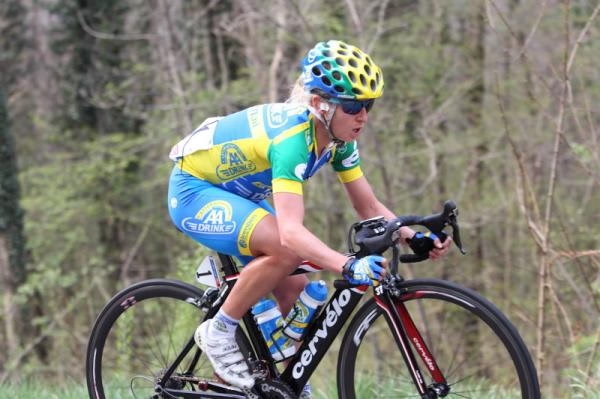
Her time in the professional peloton included spells with teams such as Cervélo TestTeam and AA Drink-Leontien.nl, before later rides with Bigla and Lotto Soudal. She raced in an era when the calendar was expanding, but support structures were uneven, and riders often had to assemble their own careers with unusual amounts of intelligence and resilience.
That team context matters. Emma Pooley was part of the period when women’s trade teams became more serious and more visible, a wider story that sits naturally alongside ProCyclingUK’s women’s cycling team history work, including the Cervelo-Bigla team history.
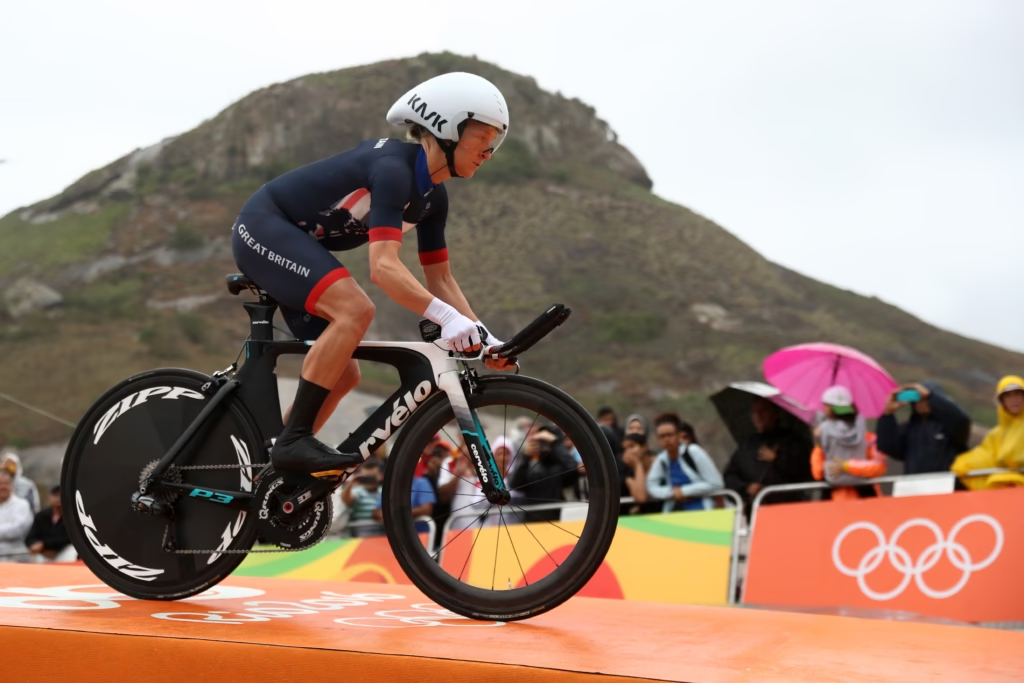 Photo Credit: Getty
Emma Pooley’s Brilliance uphill
Pooley’s climbing reputation was built on more than one famous day. She could do the long, steady damage that breaks a race apart. She could stretch a group until it fractured. She could also attack in a way that looked almost casual, as if she was simply adjusting pace rather than detonating a race.
That made her dangerous in stage races with selective terrain. On the right course, she was a rider who could turn a summit finish into a solo exercise. Her climbing style was not flamboyant. It was economical, almost clinical. The more severe the gradient, the more her restraint seemed to matter.
One of the defining pictures of Emma Pooley is a rider looking as though she has already measured the mountain, and found it finite. That is rare. Many climbers suffer visibly; Pooley often looked like she was solving the problem in front of her. It is part of why she was such a strong time-triallist as well. Her output was not built on noise.
Her climbing placed her in a line of women who shaped races through sustained pressure rather than sprinting speed, from earlier stage-race specialists to later all-rounders such as Annemiek van Vleuten and Anna van der Breggen. Pooley’s era was different, but the route logic was familiar: if the road was hard enough, the strongest rider could make the race honest.
Route logic and race craft
Her best races often came down to route logic. Where is the pressure? Where is the helping wind? Which sections reward a sustained effort rather than repeated surges? Pooley had the instinct to understand this and, crucially, the legs to carry it out. She was never just a pure wattage machine. She read races well.
That combination mattered in a peloton where positioning, timing and timing again are often more valuable than a single moment of force. Emma Pooley could make a hard race harder simply by choosing the right move. She understood attrition. She understood the value of keeping a group in doubt.
She was particularly effective in races where the route stripped away pretence. The women’s cycling monuments debate often focuses on how prestige is created, but Emma Pooley’s career is a reminder that difficulty itself can create meaning. When the course demanded repeated effort, clear pacing and nerve, she became one of the defining riders of her generation.
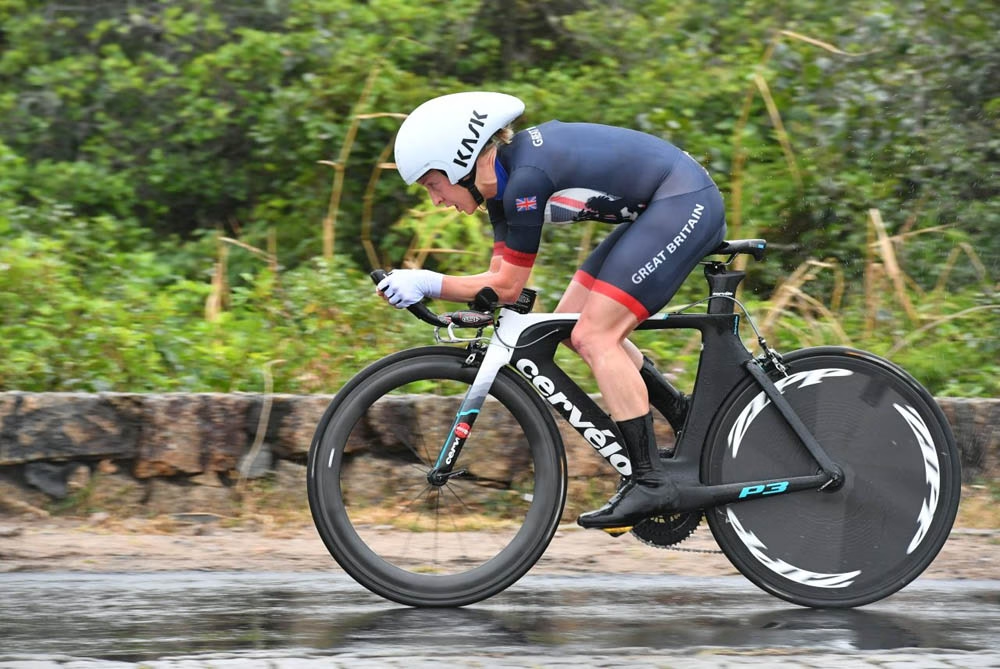 Photo Credit: Graham Watson
Emma Pooley Against the clock
If climbing was her identity, time-trialling was the proof that her talent was not one-dimensional. Emma Pooley was excellent against the clock at the highest level. In an era when women’s time-trials did not always receive the same attention as the road-race drama around them, she made the discipline hard to ignore.
She won Olympic silver in the time-trial at Beijing 2008, one of the breakthrough results of her career, then became world time-trial champion in 2010 in Geelong. Those performances established her as a rider who could translate aerobic capacity into precision. The time-trial is unforgiving of small faults. Pooley’s strength was not only physical. It was mental. She could build an effort, lock into it, and keep it there.
The 2010 world title was especially important because it gave Britain a road world championship victory in a discipline where technique, pacing and aerodynamic control leave little room for excuses. Pooley was not just a strong climber who could ride a decent time-trial. She was one of the best in the world.
For official background on her Olympic record, see her Team GB profile. For her own summary of that career arc, her official website biography is a useful reference.
The 2010 world title
The rainbow jersey in 2010 stands as Pooley’s signature achievement. She beat the best on a course that demanded every part of the time-trial skill set: speed, rhythm, resistance to lifting when the legs started to bite. It was not a surprise win in the sense of a breakaway ambush. It was a confirmation of a rider who had been building towards that level for years.
Cycling Weekly’s report from Geelong noted Pooley’s winning ride over the 22.9km course, a performance that placed her ahead of Judith Arndt and Linda Villumsen. The result still stands as one of the great British women’s time-trial performances.
That title mixed neatly with the rest of her profile. A climber who could time-trial at world-class level is a hard rider to race against, because she can win in more than one way and force rivals to solve different problems in the same race.
In that sense, Emma Pooley also sits within the wider British tradition explored in ProCyclingUK’s history pieces on riders such as Beryl Burton and Nicole Cooke. Different generations, different obstacles, but a shared ability to turn limited structures into world-level results.
Big results and defining rides by Emma Pooley
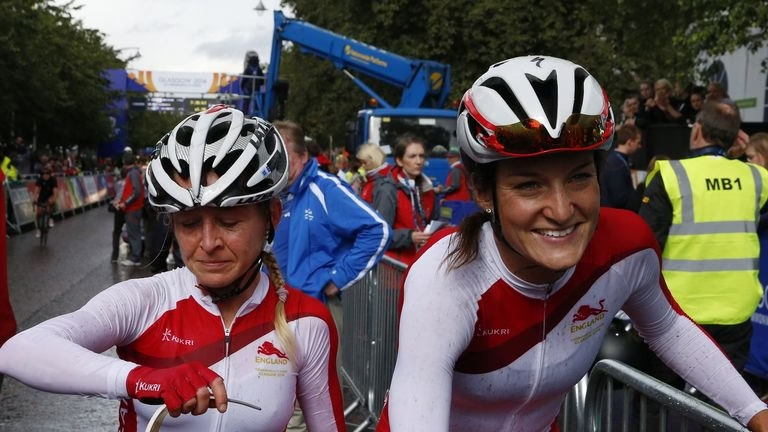
Pooley’s palmarès is impressive, but it is the quality of the wins and podiums that makes it stand out. Olympic silver in the Beijing 2008 time-trial brought her into wider public view. The 2010 world time-trial title confirmed her at the very top of the sport. She also became British champion on the road and against the clock, won major World Cup races, and built a reputation as one of the best climbers in the women’s peloton.
Her 2010 season was especially rich. She won the Tour de l’Aude, a prestigious and brutally hard women’s stage race, becoming the first British rider to do so. She also won La Flèche Wallonne Féminine, GP de Plouay and the Giro del Trentino, and took the mountains classification at the Giro d’Italia Femminile. That was not a rider living off one world title. That was a rider using the entire season to underline her range.
Her road-race credentials should not be overlooked either. Pooley was often at her best in races that were attritional rather than tactical in the modern sprint-heavy sense. She could force selection and sit near the front of a race that was gradually stripping down to essentials.
That is why she is a natural figure in any discussion of the strongest British women in road cycling, alongside Nicole Cooke, Lizzie Deignan and Burton.
The Tour de l’Aude and the lost stage-race world
Pooley’s Tour de l’Aude victory deserves its own place in the story because it points to a version of women’s stage racing that no longer exists in the same form.
The Tour de l’Aude was a hard, prestigious and demanding race. Winning it required more than one good day. It required climbing, recovery, tactical sense and a team capable of holding a race together across repeated pressure. When Pooley won in 2010, it was a career-defining stage-race success and a major British result.
That victory also speaks to a wider women’s cycling history. For years, women’s stage racing had moments of real ambition, but the calendar was fragile. Major races appeared, disappeared, rebranded or struggled for continuity. Pooley’s success belongs to that unsettled period before the modern WorldTour structure and before the current Tour de France Femmes era.
That is why her career connects naturally with ProCyclingUK’s complete history of the Tour de France Femmes. Pooley did not race in the modern Tour de France Femmes, but she helped define the stage-race standards that later generations inherited.
For external context on that Tour de l’Aude win, see The Guardian’s report on Pooley becoming the first Briton to win the race.
Teams, era and the British context
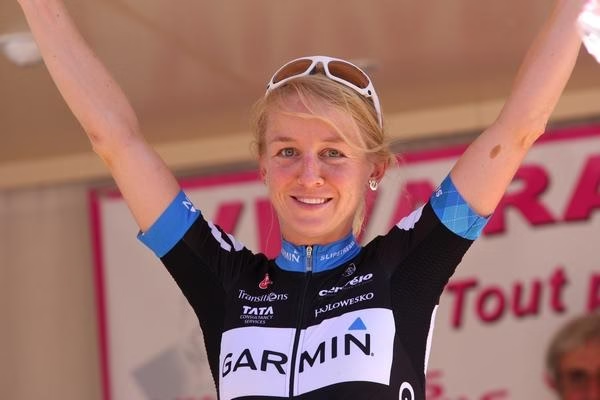
Pooley’s career ran through a period of enormous change in women’s road cycling. The sport was professionalising unevenly, visibility was growing, and British women were beginning to arrive more consistently on major international stages. She was part of that shift, not as a glossy figurehead, but as a rider whose results demanded attention.
She raced for teams that reflected the changing nature of the sport, moving through the ranks as women’s trade teams became more serious and better organised. There was a practical intelligence to the way she navigated it. She did not chase image. She chased the right calendar, the right terrain, the right race.
That perhaps makes hers a very British kind of career. Not because she was modest to the point of invisibility, but because she seemed more interested in substance than performance. She was an elite cyclist with an academic mind, happy enough to let the results do the loudest talking.
Her generation also helped bridge the gap between the older British road tradition and the modern era. Burton had dominated with a force that still feels almost unreal. Cooke forced her way into world and Olympic history. Emma Pooley added something different: a precise, quietly brilliant climber and time-triallist whose best races had the quality of solved equations.
Why Emma Pooley mattered in cycling history
Pooley mattered because she helped define what a truly modern women’s stage-race and time-trial rider could look like in the 2000s and early 2010s. She was part of a generation that showed British women could win at world level on the road, not only in track disciplines. Her world title and Olympic medal gave that argument hard evidence.
She also mattered because she did not fit a clean stereotype. She was not a polemical figure, but she was quietly unusual. A rider from an academic background, equally serious about engineering and racing, finding top-level success without flattening her personality into a marketing template. That is worth preserving in the history of the sport.
Her career also helps explain why women’s cycling history needs more than a simple list of champions. Pooley was not the same kind of rider as Marianne Vos, Annemiek van Vleuten or Jeannie Longo. Her greatness was narrower in some ways, but on the terrain that suited her it was absolute.
Character, presence and the way she raced
Pooley had a dry, intelligent presence that matched her racing. She could sound amused by the whole business of being a professional cyclist even while taking it seriously in the most exacting sense. That combination made her memorable. There was no overwrought mythology around her.
On the road, she looked like a rider who trusted data only so far as it informed feel. The body still had to know. The climb still had to be read in real time. She seemed comfortable living in that tension, where science and instinct overlap. That is often where the most interesting riders sit.
Her career never needed to be inflated. The facts are enough. Olympic silver. World title. World Cup victories. Tour de l’Aude. Flèche Wallonne. Giro Donne mountains success. A climbing style that could break races open. A time-trial that could match the best. A place in the formative years of Britain’s rise in women’s road cycling.
For more on that British road lineage, see ProCyclingUK’s profiles of Beryl Burton, Nicole Cooke and Lizzie Deignan.
-
 Photo Credit: A.S.O./Billy Ceusters
Emma Pooley after racing
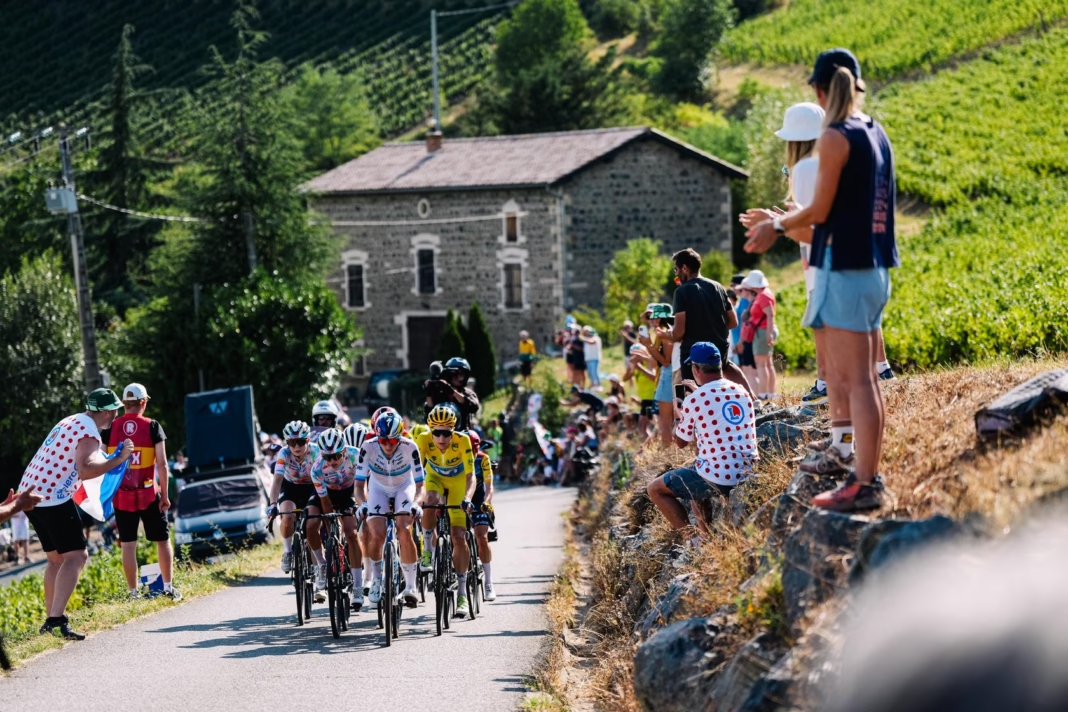
After retiring from full-time professional road racing, Pooley did not drift far from serious activity. She returned to endurance sport in a different form, taking on running, duathlon and triathlon with the same disciplined curiosity that marked her cycling career. She went on to become a world champion in long-distance duathlon, extending the same engine and competitive intelligence into another field.
That post-career direction feels consistent. Pooley never seemed interested in simply continuing the performance identity for its own sake. She has moved on with the same mixture of purpose and understatement that defined her on the bike.
The Guardian’s 2014 retirement report framed that transition clearly, noting her decision to move away from professional cycling after the Commonwealth Games while turning attention towards athletics and triathlon. Trinity Hall’s profile also captures the breadth of a career that has moved through elite sport, engineering, advocacy and writing.
A rider worth remembering
Emma Pooley is worth noting because she was exceptional in two of cycling’s hardest disciplines and because she did it in a way that felt distinct. She could climb with eerie control. She could time-trial with cold precision. She could race with an intelligence that never depended on noise or bluster.
In the story of women’s cycling, she represents one of the sport’s more elegant answers to a simple question: what does mastery look like when the road gets steep and the clock is unforgiving?
With Pooley, it looked measured, light on the pedals, and very hard to beat.
For more features on riders who shaped women’s racing, visit the women’s cycling history hub and women’s cycling rider history archive.

