
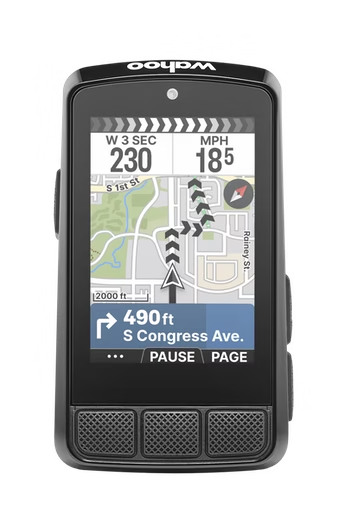
The Wahoo ELEMNT BOLT 3 keeps the basic idea that made the BOLT popular: a small cycling computer controlled by physical buttons, with enough navigation and training functionality for serious road riding without turning the handlebars into a dashboard. The third generation makes its biggest gains where the previous model was beginning to show its age, particularly the display, GPS hardware, storage and processing speed.
The 2.3-inch screen now uses 16 million colours, dual-band GPS is standard and storage has jumped to 32GB. Wahoo quotes up to 20 hours of battery life, while independent tests have generally landed somewhat below that figure in normal use. The result is a considerably more modern BOLT, but one that still asks buyers to accept a small screen and a relatively focused feature set at a £299.99 RRP.
That trade-off is central to whether the BOLT 3 makes sense. Garmin and Hammerhead offer more elaborate interfaces and deeper feature lists, while larger Wahoo models give navigation more room to breathe. The BOLT 3 instead suits riders who actively want something compact, light and straightforward.
This article contains affiliate links. ProCyclingUK may receive a commission from qualifying purchases. At the time of checking, Tredz had the Wahoo ELEMNT BOLT 3 for £275, below Wahoo’s £299.99 RRP.
Wahoo ELEMNT BOLT 3 specifications
Display: 2.3-inch TFT, 240 x 360 pixels, 16 million colours
Weight: 84g claimed
Dimensions: 83 x 47 x 24mm
Storage: 32GB with 2GB RAM
Battery: up to 20 hours claimed
GPS: dual-band GNSS
Connectivity: Bluetooth LE 5.0, ANT+, ANT+ FE-C and dual-band Wi-Fi
Charging: USB-C
Water resistance: IPX7
Controls: six physical buttons, no touchscreen
Included: out-front mount, stem mount, tether and USB-C cable
A much better screen without making the BOLT much bigger
The most obvious improvement is the display. Wahoo has moved from the limited colour palette of the BOLT 2 to a 16-million-colour TFT panel, while increasing the diagonal slightly to 2.3 inches. The resolution is 240 x 360 pixels and the interface has been redrawn around the new hardware.
Independent reviewers have consistently identified the screen as one of the worthwhile upgrades. Cyclist praised its anti-glare performance and clarity, while BikeRadar also found the higher-resolution display a substantial improvement. It matters particularly on the map page, where better colour separation and sharper graphics make junctions and route lines easier to interpret without requiring a physically large computer.
There is an unavoidable limit, though. A 2.3-inch screen cannot show a map with the same scale and surrounding detail as a larger head unit. Riders who regularly navigate unfamiliar networks of lanes may prefer a Wahoo ROAM, Garmin Edge or Hammerhead Karoo simply because more screen area makes complex junctions easier to read. For racing, training and following prepared routes, the BOLT’s smaller format is much easier to justify.
Physical buttons remain part of the appeal
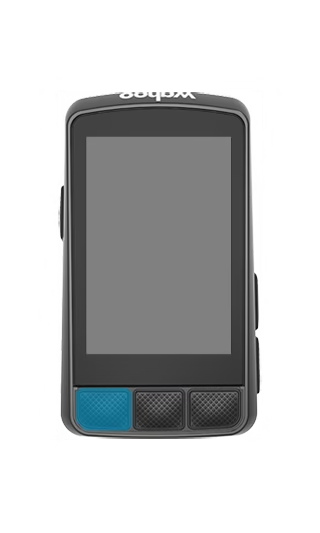
Wahoo has deliberately kept the BOLT 3 touchscreen-free. Three front buttons handle laps, start/pause and page changes, while the side controls cover power, menus, scrolling and Wahoo’s Perfect View Zoom. That lets the rider increase or reduce the number of data fields shown without rebuilding the page.
Buttons are not automatically better than a touchscreen, but they suit this particular computer. A compact screen leaves relatively little room for accurate touch controls, while tactile buttons remain predictable with gloves or in rain. The downside is that more involved tasks, such as entering a destination, naturally push the rider back towards the phone and Wahoo app.
BikeRadar regarded the simple setup and operation as major strengths, but also noted that many settings cannot be changed directly on the computer. That is the recurring Wahoo compromise: configuration is usually easy, but the phone remains an important part of the system.
Navigation is strong, with some small-screen compromises
The BOLT 3 includes free downloadable world maps, turn-by-turn navigation and on-device routing functions including Back on Track, Retrace Ride and Route to Start. Routes can also sync from services including Strava, Komoot and Ride with GPS, while locations shared from Apple Maps or Google Maps can be turned into routes through the Wahoo app.
The independent evidence is broadly positive. Cyclingnews found navigation effective despite the BOLT’s compact dimensions, and BikeRadar reported excellent GPS accuracy. The addition of dual-band GNSS is important here, particularly around tall buildings, tree cover and other environments where reflected satellite signals can make single-band devices less consistent.
Navigation is not completely frictionless. BikeRadar found some quirks, while Cyclist encountered occasional problems involving route syncing and initial GPS acquisition. Cyclingnews also reported some app and sync issues. Those findings are worth separating from the hardware itself: reviewers generally liked the map presentation and GPS performance, but Wahoo’s software ecosystem has not been universally faultless.
The Wahoo app is simpler, but still the weak point at times
The current BOLT sits inside the main Wahoo app rather than the old standalone ELEMNT companion app. Data pages, sensors, activity profiles and many device settings are managed there, alongside routes and other Wahoo hardware.
Consolidation makes sense, especially for riders already using Wahoo trainers, heart-rate monitors or the Wahoo TRACKR RADAR. The BOLT can display radar information and control compatible lights and other connected devices, so keeping setup inside one application should make the ecosystem easier to understand.
Software reliability remains the caveat. Cyclist experienced a phone pairing failure and some route-sync friction, while Cyclingnews also encountered syncing problems. Wahoo has continued updating the platform during 2026, including a redesigned app home page released in September, so this is not a static product. Buyers should nevertheless expect more dependence on the companion app than they would with a computer designed for extensive standalone configuration.
Battery life is good rather than exceptional
Wahoo’s formal support specification quotes up to 20 hours. That is enough for almost any normal training day and most endurance events, but it is no longer an exceptional figure in a market containing computers built around very long battery life.
Real-world testing also shows why the words ‘up to’ matter. Cyclist reported around 16 hours consistently in normal use rather than reproducing the full claim. Screen brightness, GPS settings and connected sensors all affect runtime, so riders should regard 20 hours as a ceiling rather than a guaranteed figure.
USB-C charging makes topping it up straightforward, and for normal road riding the battery is unlikely to be the reason to reject the BOLT. Ultra-distance riders who measure battery life in days rather than hours have more specialised alternatives, but that is not really the audience Wahoo is targeting here.
Compact size remains the BOLT 3’s defining advantage
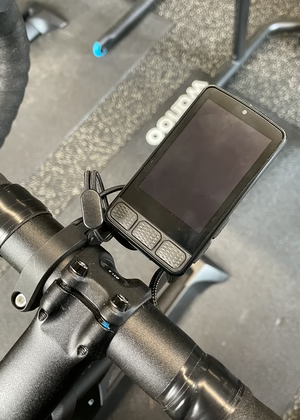
At a claimed 84g and 83mm long, the BOLT 3 occupies very little cockpit space. Cyclingnews measured its test unit at 84.8g, effectively confirming Wahoo’s figure. The supplied plastic out-front mount fits standard 31.8mm round handlebars, while a stem mount and security tether are also included.
That low weight and small frontal area matter more to some riders than others. There is little practical gain for a leisure rider simply from saving a few grams at the bars, but racers often want a computer that provides power, lap, route and sensor information without becoming visually dominant. The BOLT remains unusually good at that.
It also distinguishes the Wahoo from simpler navigation devices. The Beeline Velo 2, for example, takes minimalism much further, but it does not attempt to provide the same training-data and sensor ecosystem. The BOLT is compact without giving up the functions expected from a performance cycling computer.
Where the BOLT 3 falls short
The first limitation is value at full RRP. £299.99 places the BOLT well beyond entry-level GPS computers, and buyers can find devices with larger touchscreens or longer battery claims around the same broad price range. Wahoo is selling refinement and simplicity rather than the longest feature list.
The second is the screen size. The display is substantially better than before, but riders who prioritise mapping cannot escape the physical advantage of a larger panel. More map context is useful when exploring unfamiliar roads, and that is one reason the ROAM exists above the BOLT in Wahoo’s range.
Finally, the software complaints across independent tests cannot be ignored. None makes the BOLT fundamentally unreliable, and Wahoo has continued issuing firmware updates, but app and sync behaviour is the area where the polished hardware has most often been let down. Anyone moving from a previous Wahoo computer should also allow some time to adjust to the consolidated Wahoo app.
Who is the Wahoo ELEMNT BOLT 3 for?
The clearest audience is the rider who already knows what data they want. Power, heart rate, cadence, laps, structured workouts, climb information and navigation all fit comfortably into the BOLT’s remit. The physical controls and small chassis are particularly sensible for racing and fast group riding, where operating a large touchscreen is rarely the priority.
It is also an attractive first serious cycling computer for someone who values a straightforward interface over endless configuration. The Ready-To-Ride dashboard brings routes, workouts and connected sensors together before starting, while the phone app handles the more involved setup.
Riders who want detailed mapping, a large touchscreen or the deepest possible on-device feature set should look elsewhere in the premium market. Likewise, ultra-endurance riders may value exceptional battery life above the BOLT’s low weight and compact dimensions.
Wahoo ELEMNT BOLT 3 verdict
The BOLT 3 is a careful update rather than a reinvention. That works because Wahoo has concentrated on the areas that most needed attention. The screen is sharper and vastly more colourful, dual-band GPS improves the positioning hardware, storage is much more generous and the interface has been modernised without sacrificing the physical controls that suit the BOLT’s compact format.
Its weaknesses are equally clear. The screen remains small for serious map browsing, real-world battery life can fall short of the headline figure and several independent reviewers have encountered software or syncing irritations. Buyers wanting maximum functionality for their money can make a strong case for looking beyond Wahoo.


For riders who specifically want a small performance computer, however, the BOLT 3 is much easier to justify. It provides the navigation, sensor support and training functions most road riders actually use while keeping the hardware light and the controls predictable. At a discounted price it becomes more convincing again: the current Wahoo ELEMNT BOLT 3 listing at Tredz was £275 when checked, with the exact model in stock.
If that price changes, it is worth comparing the saving against Wahoo’s £299.99 RRP rather than treating the BOLT as an automatic choice. At around £275, though, its combination of a much-improved screen, dual-band GPS and compact design makes considerably more sense than the old Pending draft suggested.

