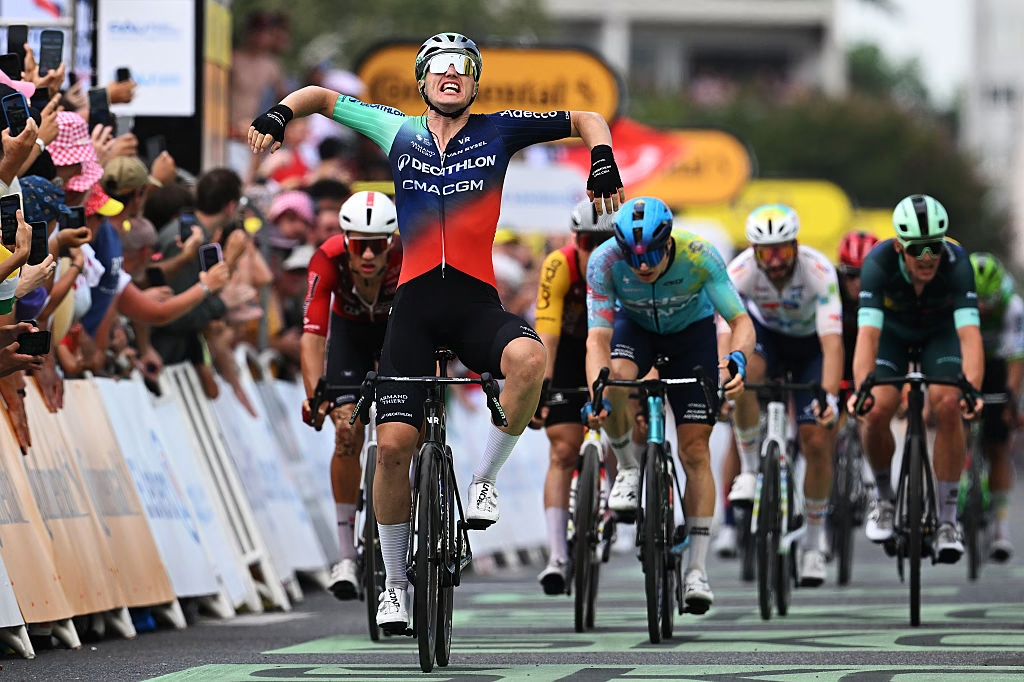
Olav Kooij won stage 5 of the 2026 Tour de France in Pau, taking his first victory at the race after a late crash and split turned what had looked like a controlled bunch sprint into a much more chaotic finale. The Decathlon CMA CGM sprinter came through fastest in the reduced front group, beating Max Kanter of XDS Astana Team and Tim Merlier of Soudal Quick-Step.
Huub Artz finished fourth for Lotto Intermarché, with Jasper Philipsen fifth for Alpecin-Premier Tech and Biniam Girmay sixth for NSN Cycling Team. Mads Pedersen, wearing the green jersey after his stage 4 win, finished seventh on a day where the points battle became almost as important as the stage result.
The sprint was shaped by a crash just outside the final 5 kilometres, which split the peloton and left most of the GC favourites in a group 14 seconds behind Kooij. Tadej Pogačar, Remco Evenepoel, Paul Seixas, Tom Pidcock, Richard Carapaz, Isaac del Toro, Juan Ayuso, Jonas Vingegaard and yellow jersey Torstein Træen were all caught in that same group, meaning the finale created a time loss to the front sprinters but no major reshuffle between the main overall contenders.
A sprint day from Lannemezan to Pau
Stage 5 took the race over 158.3 kilometres from Lannemezan to Pau, one of the Tour’s most familiar host cities. Pau was appearing as a stage city for the 77th time, underlining its place as one of the race’s most regular stops after Paris and Bordeaux.
After the Pyrenean tension of the previous days, this looked like the first clear sprint opportunity of the 2026 Tour. The route was not completely flat, with the category 3 Côte de Baleix coming inside the final 30 kilometres, but the profile still looked manageable for the fastest riders if their teams controlled the day.
The race started with 181 riders after Kelland O’Brien missed the time cut on stage 4. Træen began the day in yellow for Uno-X Mobility, while Pedersen wore green after his breakaway victory the previous day. Alex Baudin carried the polka-dot jersey after his long breakaway on stage 3.
For several teams, this was a chance to reset. Lotto Intermarché had already lost Arnaud De Lie after illness forced him out of the race, while Decathlon CMA CGM arrived with Kooij still waiting for the first sprint chance of his debut Tour.
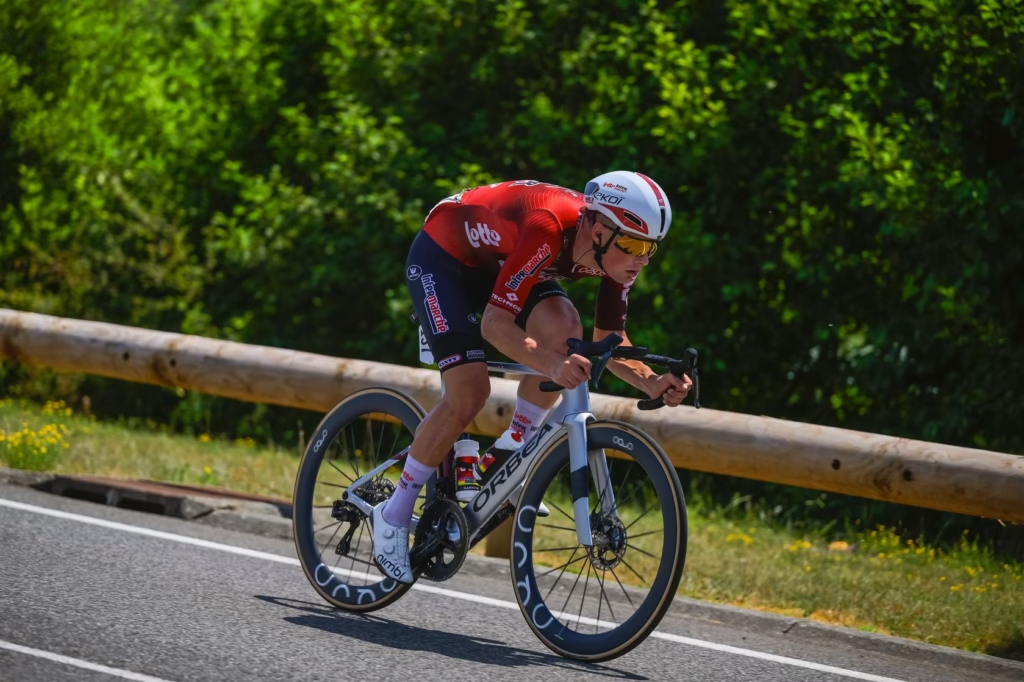 Photo Credit: A.S.O./Charly López
Veistroffer attacks from kilometre zero
The breakaway was formed almost instantly. Baptiste Veistroffer of Lotto Intermarché attacked as soon as the flag dropped, and nobody else showed any real interest in following him. Within minutes, the Frenchman had a gap and the stage had its lone leader.
It was a bold but familiar move from Veistroffer, a former triathlete and engineer in the French Navy who has built a reputation as a breakaway specialist. With De Lie out of the race, Lotto Intermarché needed a different way to show themselves, and Veistroffer gave them exactly that.
The peloton allowed the gap to grow but never let it become dangerous. After 10 kilometres, Veistroffer was 2:25 ahead. The lead reached around 3 minutes, but Soudal Quick-Step, Alpecin-Premier Tech and Uno-X Mobility were all willing to keep him on a short leash.
For a one-man break on a hot sprint stage, the margin was always modest. Veistroffer was effectively alone against the sprint teams, with no chance to share the work and no illusions about how difficult it would be to survive all the way to Pau.
Sprint teams keep the gap controlled
Uno-X Mobility initially helped control the peloton, both because they had the yellow jersey through Træen and because Wærenskjold was a genuine sprint option. Soudal Quick-Step and Alpecin-Premier Tech then became more prominent, working for Merlier and Philipsen.
The gap hovered around 3 minutes for much of the middle part of the stage. Veistroffer was still riding strongly, averaging more than 45km/h early in the day, but the peloton’s management was calm and deliberate rather than urgent.
The heat was again a factor. Riders spent much of the stage collecting bottles, using ice packs and trying to manage the conditions. After several hard days and high temperatures, the peloton had little appetite for unnecessary stress before the final hour.
Still, the points battle offered an early test. The intermediate sprint in Vic-en-Bigorre came with Veistroffer still alone out front, meaning he took the maximum 25 points uncontested. Behind him, the sprint from the bunch was much more revealing.
Kanter and Pedersen score at intermediate sprint
Max Kanter took the best of the remaining points from the peloton, leading home Pedersen, Girmay, Philipsen and Anthony Turgis. Fernando Gaviria, Jake Stewart, Merlier and Mike Teunissen also scored, but the sprint showed that the green jersey fight was already active well before the finish.
Pedersen’s third place from the bunch, and 16 points, added to his growing total after stage 4. Philipsen and Girmay also stayed involved, while Merlier took only 7 points and would need the finish to make up ground.
Shortly after the sprint, Vingegaard suffered a puncture and had to change bikes. The Team Visma | Lease a Bike leader was quickly back underway, and there was no major drama at that point, but it was a sign that even the quieter sprint stages can still create problems for GC riders.
Veistroffer continued towards the final 50 kilometres with a lead still close to 3 minutes, but the structure of the race was clear. The sprinter teams were in command, and the lone escapee would need something extraordinary to stay away.
Côte de Baleix briefly disrupts the sprint plan
The final complication was the Côte de Baleix, a short but sharp category 3 climb measuring 1 kilometre at 8.8 per cent. It came with around 25 kilometres remaining and gave attackers one obvious place to disrupt the sprinters.
Veistroffer reached the climb alone and took the 2 KOM points at the summit, but his gap was falling quickly. Behind him, Baudin and EF Education-EasyPost had their own target: defending the polka-dot jersey. Baudin duly took the remaining point from the peloton, strengthening his hold on the mountains classification.
The climb also encouraged a late move from Fred Wright. The British champion attacked over the top and was joined by Kasper Asgreen of EF Education-EasyPost and Valentin Paret-Peintre of Soudal Quick-Step. Paret-Peintre’s presence allowed Soudal Quick-Step to sit back briefly, while Wright and Asgreen tried to make something of the move.
It never looked likely to survive. Veistroffer still had a small lead, the chasers were caught between the lone leader and a fast-moving bunch, and the roads towards Pau were too wide and direct to favour a late ambush.
Veistroffer caught after huge solo ride
Veistroffer’s day finally ended with around 14 kilometres remaining, after more than 140 kilometres alone at the front. He had animated an otherwise controlled sprint stage, taken the intermediate sprint points, claimed the day’s only KOM and secured the combativity prize.
The Wright-Asgreen-Paret-Peintre move was also brought back, leaving the sprinter teams to take over. At 10 kilometres to go, the bunch was together and moving fast through a slightly downhill approach towards Pau.
Cofidis, Netcompany INEOS, Tudor, Uno-X Mobility, Alpecin-Premier Tech, Bahrain Victorious and Groupama-FDJ United all showed near the front as the final sprint trains began to form. The expected dominance of Alpecin-Premier Tech and Soudal Quick-Step was less clear than expected, with several teams fighting for control.
Cofidis were especially visible in support of Milan Fretin, while Uno-X Mobility drove hard for Wærenskjold. That pressure would soon have consequences.
Late crash creates decisive split
Just outside the 5-kilometre mark, a crash on a right-hand bend disrupted the peloton. Alex Molenaar was among the riders who went down heavily, with Abel Balderstone also involved and several Soudal Quick-Step riders caught up, although Merlier appeared to avoid the worst of it.
Because the crash happened just outside the 5-kilometre safety zone, the split was enough to create official time gaps. The front of the race continued at full speed, with Uno-X Mobility still driving the sprint set-up even though Træen, their own yellow jersey, was no longer in the front group.
That left a reduced group to fight for the stage. The first 19 riders finished on the same time as Kooij, with Aaron Gate at 7 seconds and the main GC group at 14 seconds. Pogačar, Evenepoel, Seixas, Pidcock, Carapaz, Van Wilder, Van Gils, Arensman, Del Toro, Jorgenson, Skjelmose, Ayuso, McNulty, Johannessen, Tiberi, Vauquelin, Bernal, Lipowitz, Piganzoli, Vingegaard and Træen were all recorded in that same 14-second group.
The result meant the crash mattered on the stage classification and cost the favourites time to the front sprint group, but it did not significantly alter the hierarchy between the principal GC names. Almost all of them were caught on the same side of the split.
Kooij takes his first Tour win
Inside the final kilometre, XDS Astana Team and Cofidis were among the best-positioned teams, with Kanter and Fretin both well placed. Alpecin-Premier Tech had to chase from a less ideal position, while Soudal Quick-Step were no longer in the kind of commanding formation Merlier would have wanted.
Kooij timed his move best. The Decathlon CMA CGM sprinter hit out and quickly got clear, holding off Kanter and Merlier to take the stage victory. It was his first Tour de France stage win and a major reward after years of waiting for a proper opportunity at the race.
Kanter’s second place was a strong result for XDS Astana Team, particularly after their aggressive positioning in the final kilometre. Merlier’s third kept him firmly in the sprint conversation, but it was not the win Soudal Quick-Step had spent much of the day preparing for.
Artz’s fourth place gave Lotto Intermarché another result after Veistroffer’s long attack, while Philipsen had to settle for fifth. Girmay took sixth, Pedersen seventh, Fretin eighth, Turgis ninth and Wærenskjold tenth after Uno-X Mobility’s work in the finale.
Kooij changes the sprint picture
Kooij’s win reshaped the early sprint hierarchy of this Tour. Before Pau, Philipsen and Merlier looked like the most obvious favourites, with Pedersen’s green jersey form adding another layer. Kooij had arrived at the Tour with strong form but still needed to prove he could finish the job on this stage.
He did that in a finale that demanded more than pure speed. The crash, the split and the lack of a perfect lead-out meant the sprint became about positioning, reaction and composure. Kooij handled that better than the rest.
For Decathlon CMA CGM, the win also added another dimension to a race that had already been shaped by Seixas’ climbing. The French team now had a sprint victory through Kooij as well, underlining the breadth of their Tour squad.
The green jersey race also gained more depth. Kooij’s 70-point haul at the finish moved him to the top of the points standings, ahead of Kanter on 50, Merlier on 40, Artz on 35 and Philipsen on 30. Pedersen, who had worn green after stage 4, is now seventh on 24 points after another active day.
GC favourites lose 14 seconds to the sprint group
The late split was the main GC note from a stage that had otherwise belonged to the sprinters. Træen kept himself in the main favourites’ group but lost 14 seconds to the stage winner and the front sprinters. Vingegaard was also in that same group, as were Pogačar and Evenepoel.
That made it less damaging than it first appeared when the peloton split in the final kilometres. The concern for the GC riders was not that one favourite had stolen a decisive march on another, but that a sprint day had still forced the main contenders to absorb a small official time loss.
For Pogačar, Evenepoel, Vingegaard, Seixas, Pidcock, Carapaz and Ayuso, the day ended with the same 14-second deficit to Kooij. For Træen, it was a reminder of the difficulty of defending yellow on a day when his team also had a sprinter to position.
The stage belonged to Kooij, but the closing kilometres added another reminder of how rarely the Tour offers a truly neutral day. Even when the route points towards a sprint, crashes, splits and positioning can still reshape the classification.
Tour de France 2026 stage 5 result
Results powered by FirstCycling.com
Main photo credit: Getty