
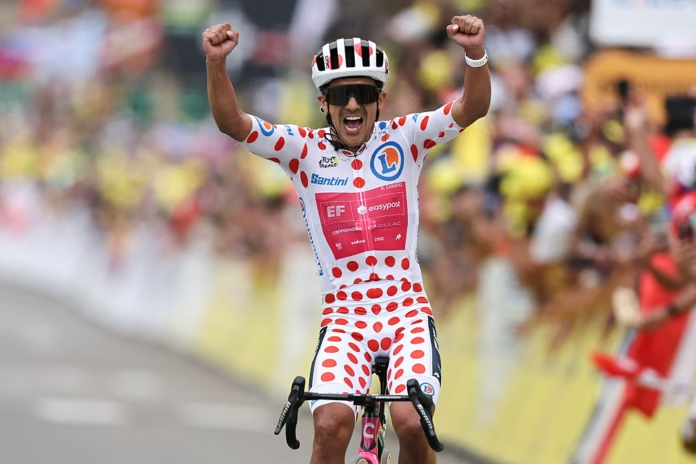
Richard Carapaz arrived at the 2026 Tour de France as one of the most dangerous riders in the race once the road went uphill. He will leave Paris with something much more tangible: two mountain stage victories and the polka-dot jersey, earned through an extraordinary final week of attacking racing.
The first win came on Stage 18 at Orcières-Merlette, where Carapaz attacked from the breakaway on the final climb and rode away alone. Two days later he did it again on Stage 20 around Alpe d’Huez, spending much of the Tour’s hardest mountain stage at the front, mathematically securing the mountains classification and then taking advantage when Sepp Kuss crashed twice on the final descent.
That distinction matters. Carapaz did not win both stages on Alpe d’Huez, but both victories came from the same philosophy: get into the breakaway, make the race difficult and refuse to wait for somebody else to decide when it should be won.
For a rider who already owns a Giro d’Italia title, Olympic gold, Grand Tour podiums and a previous Tour mountains jersey, the 2026 race has still added something significant to his career. At 33, Carapaz has produced one of the defining Tours of his career without ever being central to the fight for yellow.
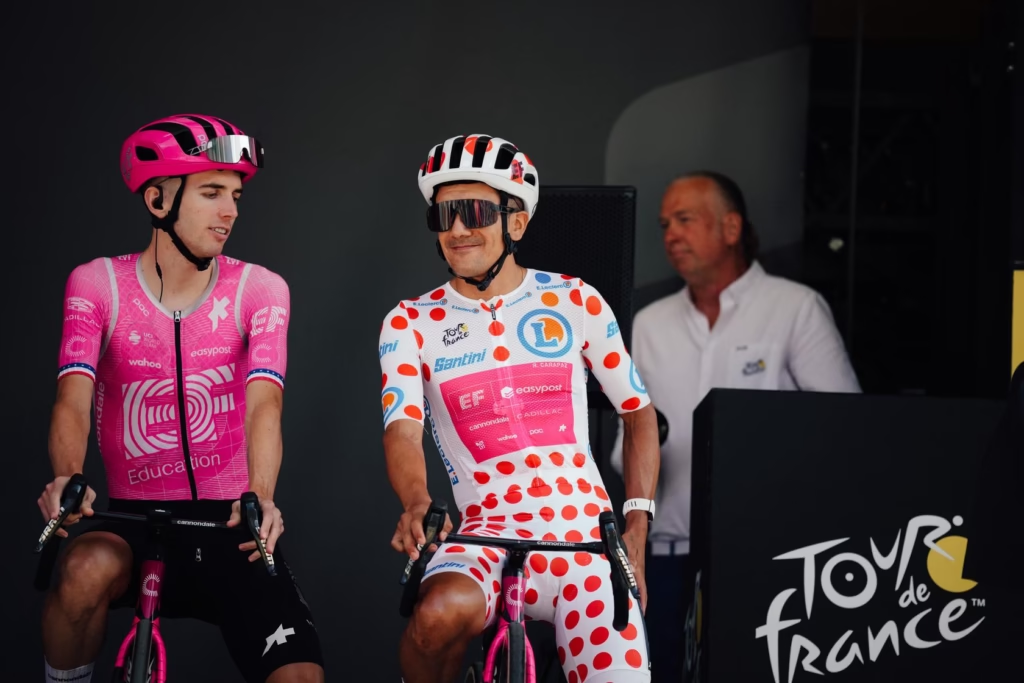 Photo Credit: A.S.O./Thomas Maheux
Carapaz turned the final week into his own race
For much of the 2026 Tour, the general classification belonged to other riders.
Tadej Pogačar and Remco Evenepoel occupied their own battle for yellow, while Isaac Del Toro, Paul Seixas and the riders behind them fought over the remaining podium positions.
Carapaz increasingly raced outside that structure.
Once his GC position gave him enough freedom, he became exactly the rider a breakaway does not want to contain. He attacks repeatedly, rarely waits for the obvious moment and can turn a long mountain stage into a sequence of tactical fights rather than one decisive acceleration.
That threat was already clear before the final Alpine block. Our Stage 18 preview picked Carapaz out as one of the strongest breakaway contenders precisely because his GC deficit gave him freedom while his climbing form remained good enough to win.
Stage 18 was the breakthrough.
Stage 20 was the culmination.
Stage 18 at Orcières-Merlette changed his Tour
Carapaz’s first victory came on the 185.2km Stage 18 from Voiron to Orcières-Merlette.
The race had been aggressive from the opening kilometres, with Carapaz eventually reaching the decisive six-rider lead group before the final climb. He did not wait until the last few hundred metres.
He attacked repeatedly.
With 3.5km remaining, Carapaz finally created the separation he needed and rode alone to the summit, beating Mauro Schmid by 45 seconds. It was his second career Tour de France stage victory and his ninth across the three Grand Tours.
Our Stage 18 race report covers how the repeated attacks eventually broke the remaining escapees.
It also transformed the mountains classification.
Carapaz had started the day third in the competition. By the time the Tour left Orcières-Merlette, he was firmly back in contention for polka dots with two enormous Alpine stages still to come.
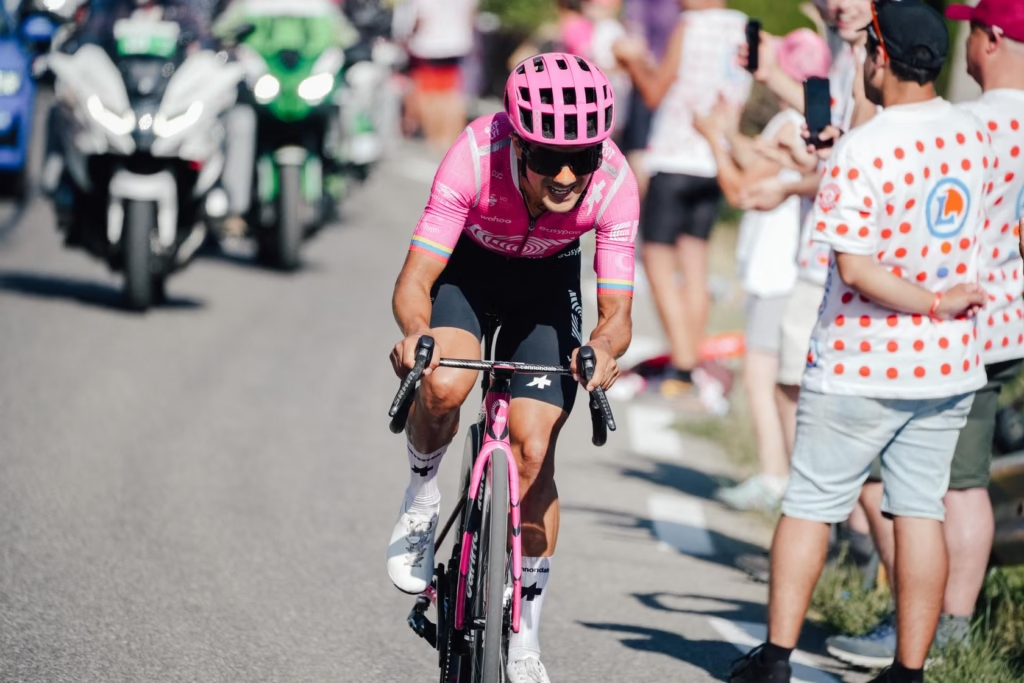
The mountains jersey suddenly became a realistic target
Carapaz knows how to race for polka dots.
He won the Tour de France mountains classification in 2024, a race in which he also wore yellow, won a stage and was named the overall combativity winner.
The 2026 competition developed differently.
Rather than steadily accumulating enough points to control the classification, Carapaz made a late charge across the final mountain block.
His Orcières-Merlette victory closed the gap dramatically. He then attacked again on the first Alpe d’Huez stage before reaching Stage 20 with only a narrow advantage and a huge concentration of mountain points still available.
There was no realistic option to defend from the peloton.
He had to attack.
That is exactly what Carapaz did.
Stage 20 became a 50-point polka-dot raid
Stage 20 was the Tour’s final great mountain stage, crossing the Col de la Croix de Fer, Col du Télégraphe and Col du Galibier before the later Col de Sarenne and descent towards Alpe d’Huez.
Carapaz went forward from the beginning.
On the Croix de Fer he collected the maximum 20 points. He added another 10 on the Télégraphe and then took 20 more on the Galibier, where he also claimed the Souvenir Henri Desgrange.
That meant 50 mountain points in one stage before the race had even reached the Sarenne.
The full arithmetic is covered in our piece on how Richard Carapaz mathematically secured the 2026 polka-dot jersey.
By the time Carapaz crossed the Galibier, the mountains classification was effectively finished.
He still had enough energy left to race for the stage.
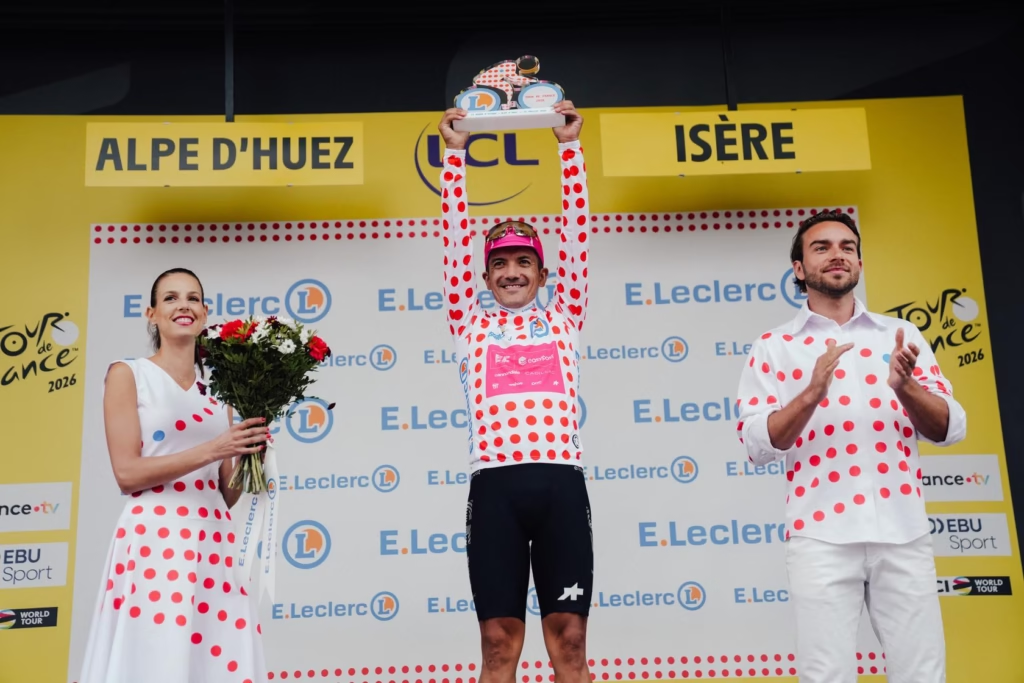 Photo Credit: A.S.O./Thomas Maheux
Sepp Kuss looked like he had taken the win away
Winning the polka-dot jersey required an enormous amount of work, and for a while it looked as though that effort would cost Carapaz the stage.
Sepp Kuss attacked later in the race and managed to drop him.
The American reached the descent from the Sarenne alone at the front and looked increasingly likely to deliver Visma | Lease a Bike its first individual stage victory of the Tour.
Carapaz kept chasing.
Then the race changed twice in quick succession.
Kuss crashed, remounted and continued while still ahead. Shortly afterwards he ran wide again, striking the roadside protection with around 5.8km remaining.
That second incident allowed Carapaz back through.
Our report on Kuss’s two Stage 20 crashes covers how close the American came to a much more serious fall.
Carapaz suddenly had the race back.
Carapaz did not waste his second chance
It would be easy to reduce the victory to Kuss crashing.
That would ignore almost everything Carapaz had already done.
He was close enough to benefit because he had spent the entire stage attacking.
He had gone into the decisive move early, crossed three of the biggest mountains of the day first, mathematically secured polka dots and continued racing after Kuss had dropped him.
When the situation changed, Carapaz was still there.
He then had to finish the job.
Remco Evenepoel was closing strongly from behind, but Carapaz stayed clear to win Stage 20 by 26 seconds, with Kuss recovering to finish third at 31 seconds. Pogačar crossed the line 1:05 behind.
The GC and jersey standings after Stage 20 left Carapaz on 156 mountain points, 56 clear of Pogačar and 57 ahead of Valentin Paret-Peintre.
Paris cannot change that.
Provided he finishes Stage 21, Carapaz is King of the Mountains again.
Two victories built from the breakaway
There is a clear link between Carapaz’s two stage wins.
Neither came because EF Education-EasyPost controlled the peloton all day and delivered its leader to the final climb.
Carapaz had to make the race himself.
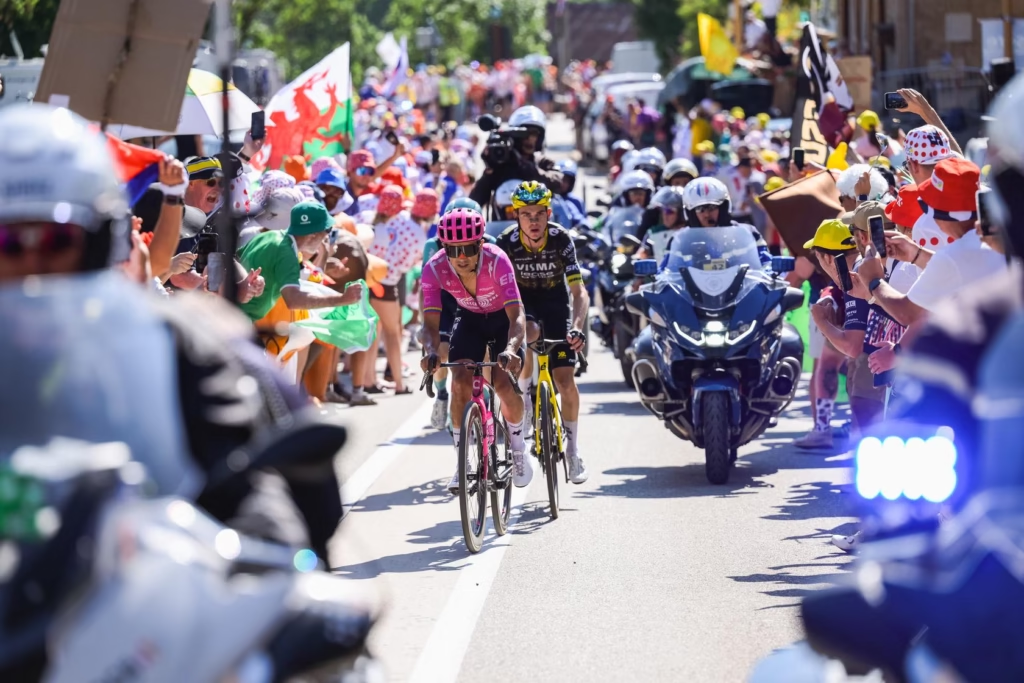
At Orcières-Merlette, he entered the breakaway and repeatedly attacked until nobody could follow.
On Stage 20, he spent almost the entire day ahead, chased mountain points across the Croix de Fer, Télégraphe and Galibier, lost contact with Kuss later and still remained close enough to take the stage when the opportunity returned.
This is what Carapaz looks like when he is given freedom.
He is not interested in protecting a seventh place by sitting beside the other GC riders.
He wants to change the race.
EF Education-EasyPost got more from aggression than protecting GC
That made Carapaz particularly valuable to EF Education-EasyPost once it became clear the Tour would not be decided through a conventional GC campaign for the team.
There is always a temptation for a former Grand Tour winner to keep defending a respectable position even after victory and the podium have disappeared.
Carapaz has repeatedly shown a willingness to abandon that approach.
The reward in 2026 is obvious.
A seventh, eighth or ninth place overall would have been respectable.
Two stage wins and the polka-dot jersey are memorable.
EF could therefore use riders around Carapaz to help create breakaways and keep those moves functioning rather than asking the entire squad to protect him in the peloton.
That was especially important during the final week.
Once Carapaz became the team’s main route to major results, EF could commit completely to the stages and mountains classification.
Carapaz is at his best when the race becomes unpredictable
There is a recognisable style to Richard Carapaz when he is riding well.
He does not need perfect control.
Often he benefits when there is none.
He can attack early, recover, follow somebody else and attack again. His repeated accelerations make him particularly awkward in small groups because rivals rarely know which move is the one they cannot allow to go.
That has been visible throughout his career.
He won the 2019 Giro d’Italia by exploiting moments when the focus was elsewhere and turning tactical opportunities into meaningful time gains.
He became Olympic champion in Tokyo in 2021 by escaping with Brandon McNulty before attacking the American and riding alone to gold.
The 2026 Tour has shown the same instincts.
Carapaz does not need to be the strongest rider in the entire race.
He needs to put himself in the right race.
Who is Richard Carapaz?
Carapaz was born in Ecuador in 1993 and became the first Ecuadorian cyclist to win a Grand Tour when he took the 2019 Giro d’Italia.
He subsequently finished second at the 2020 Vuelta a España and third at the 2021 Tour de France, completing podium finishes in all three Grand Tours.
That Tour podium was followed almost immediately by Olympic gold in Tokyo.
He later joined EF Education-EasyPost, although his first Tour with the American team ended abruptly when a crash on Stage 1 in 2023 forced him out of the race.
The following year brought a much more successful return.
Carapaz wore yellow, won Stage 17 at SuperDévoluy, secured the polka-dot jersey and finished the Tour as its most combative rider.
The 2026 edition has now added another two victories and another mountains classification.
 Photo Credit: Getty
Carapaz is now a two-time Tour King of the Mountains
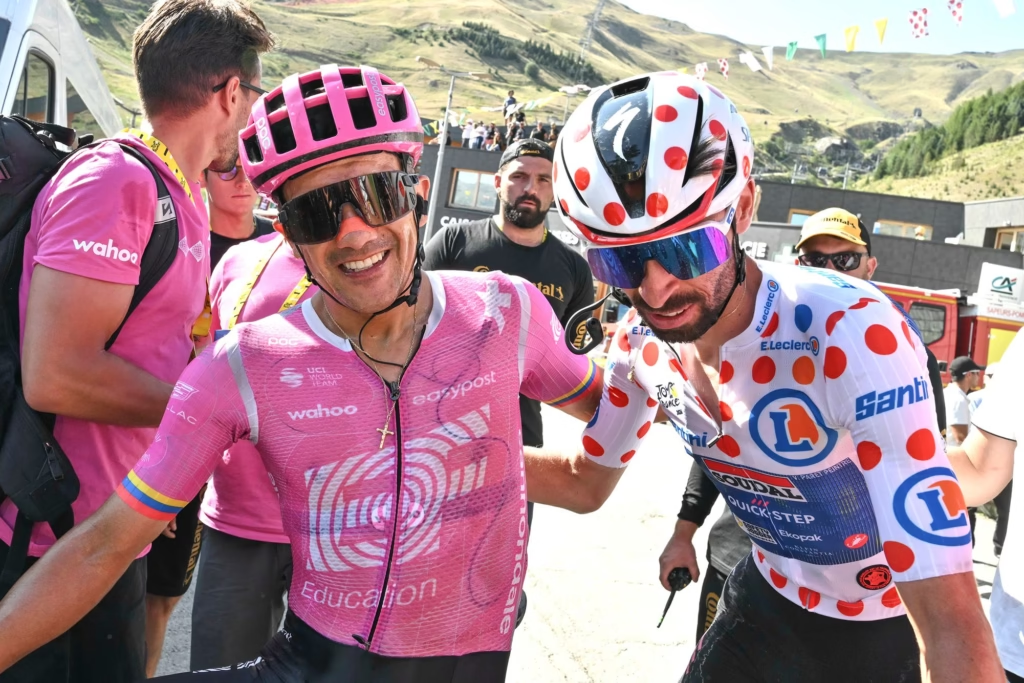
Stage 20 effectively confirmed Carapaz as the Tour de France mountains classification winner for the second time, after his previous victory in 2024.
That puts a different shape on his Tour career.
He has been a podium contender.
He has worn yellow.
He has won stages.
He has now won polka dots twice.
There is an obvious reason why the mountains competition fits him so well.
It rewards riders who are willing to attack over several climbs rather than waiting exclusively for summit finishes.
Carapaz races naturally in exactly that way.
Once the jersey became a realistic objective, every categorised climb became something to attack.
The 50-point haul on Stage 20 was the ultimate version of that strategy.
His final week was relentless
The concentration of Carapaz’s success makes the final week particularly impressive.
Stage 18: win at Orcières-Merlette.
Stage 19: attack again and move into control of the mountains competition.
Stage 20: attack again, score 50 mountain points, mathematically secure polka dots and win the stage.
Three consecutive Alpine stages.
Two victories.
One classification won.
Almost no opportunity to recover.
His Stage 18 win was not the endpoint of his Tour. It was the beginning of an extraordinary final push.
What do the two victories mean for Carapaz’s career?
Carapaz did not need the 2026 Tour to validate himself.
A Giro victory and Olympic gold already guarantee his place among the leading riders of his generation.
But the second half of a rider’s career often changes how that career is remembered.
Carapaz has shown he does not need to be fighting for yellow to remain one of the central riders in a Grand Tour.
That gives him another way to win.
When preparation and route make a GC challenge realistic, he can still approach a race as a leader.
When the overall contest moves beyond him, he can become one of the most dangerous stage hunters in the peloton.
Very few former Grand Tour winners make that transition willingly.
Fewer do it this effectively.

EF could hardly have asked for a better final week
Tour success is relative to what a team can realistically achieve.
EF Education-EasyPost did not have Pogačar’s GC strength or a sprint train capable of dominating flat stages.
Its best route to a major result was creating opportunities.
Carapaz converted those opportunities into something substantial.
Two Tour de France stage victories.
The polka-dot jersey.
Repeated days at the front during the most important mountain stages of the final week.
That return is considerably more valuable than protecting a peripheral position in the general classification.
It also gives EF one of the clearest success stories of the 2026 Tour.
Richard Carapaz became the Tour’s great supporting character
The yellow jersey inevitably defines a Tour de France.
In 2026, that story belongs to Pogačar and his impending fifth overall victory.
But the best Tours also have riders who shape the race without winning it.
Carapaz became that rider in the final week.
When a breakaway needed someone willing to attack, he attacked.
When the mountains jersey became possible, he chased it.
When Kuss dropped him on Stage 20, he kept racing.
When the chance to win returned, he took it.
Carapaz heads to Paris with two stage wins and 156 mountain points, his polka-dot jersey mathematically secured provided he completes Stage 21.
For a rider whose career has always been defined by attacking rather than waiting, it feels like exactly the right kind of Tour.

