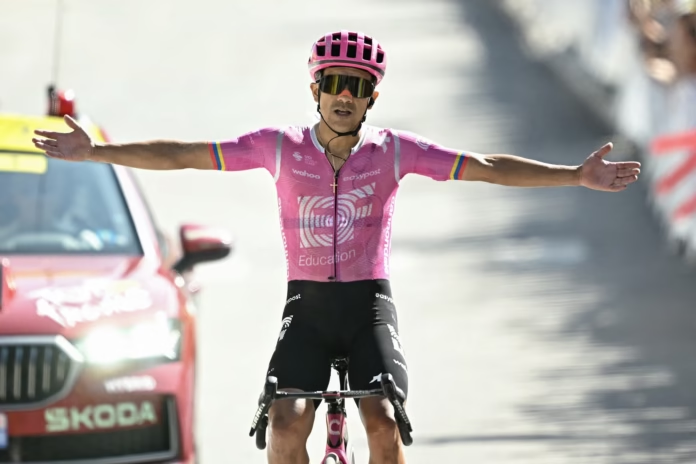
Richard Carapaz won stage 18 of the 2026 Tour de France at Orcières-Merlette, attacking from the breakaway on the final climb to give EF Education-EasyPost the stage victory they had been chasing throughout the race.
The Ecuadorian went clear with 3.5 kilometres remaining after repeated moves from the six-rider lead group, then rode away alone to take his second Tour de France stage win and ninth Grand Tour stage victory. Mauro Schmid won the sprint for second at 45 seconds, ahead of Matteo Jorgenson, with Valentin Paret-Peintre fourth at 1:14.
Tobias Halland Johannessen finished fifth for Uno-X Mobility, ahead of Raúl García Pierna and Pablo Castrillo, while Lenny Martinez, Remco Evenepoel and Tom Pidcock led home the GC group 4:35 behind. Tadej Pogačar retained the yellow jersey without trouble, with Evenepoel still second overall at 4:32 and Isaac del Toro third at 6:51.
A breakaway stage at the start of the Alpine trilogy
Stage 18 took the riders 185.2 kilometres from Voiron to Orcières-Merlette, opening the final Alpine block of the 2026 Tour. With several long climbs, a summit finish and more severe mountain stages still to come, it looked like a day where the breakaway could finally be given serious room.
That is how it played out. UAE Team Emirates-XRG were happy to ride tempo rather than chase the stage win, and once the right climbers moved clear, the peloton allowed the gap to grow. By the second half of the stage, it was clear the winner would come from the escape.
For Pogačar, the priority was control. He had a commanding lead after the time trial in Thonon-les-Bains, and with Adam Yates struggling the previous day and Brandon McNulty clearly below full strength, UAE had little reason to spend resources chasing a breakaway.
For the attackers, the stage had three layers. There was the stage win itself, the mountains classification fight involving Paret-Peintre and Carapaz, and the green jersey effort from Mads Pedersen, who wanted the intermediate sprint points after Philipsen had cut his lead to only 7 points on stage 17.
Early move forms before the Côte d’Engins
The first serious escape formed after a quieter start than the previous day’s chaos to Voiron. Jonas Abrahamsen, Lewis Askey, Mathis Le Berre, Aaron Gate and Nicolas Vinokurov got clear, building a lead of around 45 seconds as the race approached the Côte d’Engins.
That climb, 11.4 kilometres at 5.4 per cent, was always likely to reshape the race. EF Education-EasyPost put riders on the front of the peloton, with Carapaz clearly interested in the KOM points, while Soudal Quick-Step also had reason to keep things under control for Paret-Peintre.
McNulty and Tim Wellens were among the riders distanced early, an ominous sign for UAE’s depth. McNulty had already crashed during his time-trial recon the previous day and was now struggling as soon as the road went uphill.
On the climb, the early break began to fracture. Healy attacked, Carapaz moved, and Paret-Peintre followed. The mountains classification battle was already active before the definitive break had even been formed.
Paret-Peintre beats Carapaz to the first summit
Paret-Peintre won the first major duel of the day, outsprinting Carapaz at the top of the Côte d’Engins. The Soudal Quick-Step rider took 10 points, with Carapaz second for 8 and Healy third.
That result reinforced Paret-Peintre’s growing challenge in the mountains classification. Pogačar still led the competition, but with the yellow jersey unlikely to chase every KOM point, this was a key day for the dedicated climbers.
Behind the KOM sprint, the race was still forming. Pedersen, Jorgenson, Thymen Arensman, Tobias Halland Johannessen, Felix Engelhardt, Castrillo and Nicolas Breuillard moved clear after the summit, creating a strong lead group on the false flat.
EF were unhappy because Carapaz had missed that move, and Healy tried to drag things back. It took repeated attacks, but the stage was beginning to come together around the riders who would later contest the finish.
The breakaway takes shape
The race settled into a layered breakaway through the long middle section. Jorgenson, Pedersen, Arensman, Engelhardt, Tobias Halland Johannessen, Castrillo and Breuillard led, with Romain Grégoire briefly chasing and later joining.
Behind, Healy attacked again with Schmid, García Pierna, Mathias Vacek and Jan Tratnik. Then Soudal Quick-Step launched Paret-Peintre with Jasper Stuyven and Louis Vervaeke, and Carapaz followed.
That move was important. Stuyven and Vervaeke were not stage-winning options on this terrain, but they were exactly the riders Paret-Peintre needed to bridge towards the front. Carapaz read the danger and went with them, keeping himself alive for both the stage and the mountains classification.
By the Côte de Monteynard, the groups had started to come back together. The climb was 9.7 kilometres at 5 per cent, long enough to thin the race but not steep enough to make a full selection. Paret-Peintre again beat Carapaz over the top, taking another 5 points, with Schmid third and Pedersen fourth.
The day’s main break now had the quality and numbers to survive.
Pedersen completes his green jersey mission
The intermediate sprint at Corps was a major target for Pedersen. After Philipsen’s win in Voiron had slashed his points lead, the Dane needed to use this harder Alpine stage to rebuild his advantage.
He did exactly that. Pedersen made the break, stayed with the climbers over the early ascents and then took the intermediate sprint uncontested. It moved him to 477 points, with Philipsen remaining on 445 and Girmay third on 361.
That did not settle the green jersey, especially with Paris still to come, but it repaired some of the damage from stage 17. Pedersen has built much of his green jersey challenge through intermediate sprints, not just finishes, and this was another example of how valuable his all-round strength has been.
Once the sprint was done, Pedersen’s role in the stage began to fade. The race was now moving towards the climbs that would decide the stage win, and the specialist climbers were ready to take over.
Paret-Peintre keeps scoring
The Côte des Terrasses gave Paret-Peintre more points. He again crossed first, with Carapaz second, tightening the mountains battle even further.
By then, the break was clearly going to contest the stage. The peloton was already several minutes down and UAE were not chasing. Tudor, Pinarello-Q36.5 and TotalEnergies later took turns in the bunch, but that was more about defending GC positions from Carapaz than chasing the stage.
The front of the race then began to split. Jorgenson, Tobias Halland Johannessen and Engelhardt opened a gap, before Schmid and García Pierna bridged across. Carapaz and Paret-Peintre reacted behind and eventually joined them, creating the six-rider group that would decide the stage.
It was the right composition: Carapaz for EF, Paret-Peintre for Soudal Quick-Step, Jorgenson for Team Visma | Lease a Bike, Schmid for Jayco AlUla, Johannessen for Uno-X Mobility and García Pierna for Movistar. Six teams, six stage chances, and no passengers.
McNulty abandons as UAE look vulnerable
While the breakaway was moving towards the decisive phase, UAE Team Emirates-XRG suffered a significant loss. McNulty abandoned after struggling for much of the day, becoming the team’s first withdrawal from the race.
His abandon mattered beyond the stage itself. UAE still had Pogačar in yellow and Del Toro in white, but the team’s support structure looked less secure than it had earlier in the Tour. Adam Yates had also been struggling, and Wellens had been distanced early on the climbs.
That gave the final climb a little extra tension. Red Bull-Bora-Hansgrohe took control of the peloton on the approach to Orcières-Merlette, with Evenepoel sitting second overall and potentially sensing a chance to test UAE.
The stage win was already gone to the break, but the GC group still had the final climb to negotiate. With Pogačar isolated more than usual, there was at least a question over whether anyone would attack.
Six leaders hit Orcières-Merlette
The leaders reached the final climb to Orcières-Merlette together. The ascent measured 7.1 kilometres at 6.7 per cent, not the hardest climb of the Tour, but long enough to decide the stage after nearly 180 kilometres of racing.
The group was cautious at first. Jorgenson tried a move with around 4.5 kilometres remaining, but quickly stopped the effort when the others reacted. The riders were watching one another, aware that the climb was hard enough to crack someone but not so steep that every attack would automatically stick.
Carapaz carried the most pressure. EF Education-EasyPost had raced aggressively throughout the Tour without a stage win, and he was the best pure climber in the group. Paret-Peintre had the polka-dot jersey battle in mind, Jorgenson had Visma’s post-Vingegaard stage-hunting ambitions, and Schmid was chasing another stage after already winning in Belfort.
With 5 kilometres remaining, the group was still together. Then the attacks finally began.
Carapaz attacks twice to win
Carapaz made the first real explosive move, and only Paret-Peintre could initially follow. Schmid and Jorgenson dragged themselves back, but the acceleration had changed the rhythm of the climb.
Soon after, Carapaz went again with 3.5 kilometres left. This time nobody followed. The Ecuadorian opened a gap immediately, while Schmid and Jorgenson became the closest chase behind. Paret-Peintre was distanced and Johannessen began to lose contact too.
The gap grew quickly. With 2 kilometres remaining, Schmid and Jorgenson were already 25 seconds behind, and by the flamme rouge Carapaz had 37 seconds in hand.
There was no hesitation now. Carapaz rode the final kilometre alone and crossed the line with enough time to celebrate properly. EF Education-EasyPost had finally converted their aggression into a stage victory.
EF finally get their reward
Carapaz’s win was a deserved reward for both rider and team. EF had been visible throughout the Tour, often attacking, chasing KOM points and trying to force their way into stage-winning positions. On this day, everything finally aligned.
Carapaz had raced the first climb for points, followed the right moves, bridged across when the break split, then waited until the final climb to use his strongest weapon. He did not win through surprise. He won by being the best climber in the group and attacking when the others could no longer respond.
Schmid’s second place continued his excellent second half of the Tour after his stage 13 win in Belfort. Jorgenson’s third gave Visma another strong result after the loss of Vingegaard, while Paret-Peintre’s fourth still mattered for the mountains classification.
Tobias Halland Johannessen took fifth, García Pierna sixth and Castrillo seventh, giving Movistar a strong day in the break even without a podium.
Paret-Peintre strengthens polka-dot challenge
Paret-Peintre did not win the stage, but he had a productive day in the mountains classification. He beat Carapaz at the Côte d’Engins, the Côte de Monteynard and the Côte des Terrasses, then took more points at Saint-Léger-les-Mélèzes.
That kept him close enough to Pogačar to make the final mountain stages interesting. Pogačar still has the advantage if he contests the big climbs and summit finishes, but Paret-Peintre is doing the work needed to keep the jersey battle alive.
Carapaz also gained points, but Paret-Peintre repeatedly beat him in the KOM sprints before the final climb. The difference was that Carapaz had the stronger finish when it came to the stage.
It leaves both riders as central figures in the mountains contest heading into the final Alpine stages. Paret-Peintre may still be the more deliberate polka-dot hunter, but Carapaz has now added the stage win he wanted most.
GC group comes in together
The GC group finished 4:35 behind Carapaz, with Martinez first across the line, followed by Evenepoel and Pidcock. Despite Red Bull-Bora-Hansgrohe setting tempo on the final climb, there were no meaningful attacks between the main contenders.
Pogačar kept yellow, with Evenepoel still second at 4:32. Del Toro remains third at 6:51, Seixas fourth at 7:11 and Ayuso fifth at 9:22.
Given the bigger Alpine stages still to come, that made sense. Orcières-Merlette was hard enough to sting, but not necessarily hard enough to justify burning matches unless someone felt exceptional. Evenepoel’s team showed intent, but the Belgian did not attack.
For Del Toro and Seixas, the white jersey and podium battle remained unchanged. That may suit UAE, especially after a day where their domestique strength looked under pressure. For the challengers, the more obvious opportunities are still ahead.
A controlled day for Pogačar, but not for UAE
Pogačar himself looked safe throughout the stage. He was present near the front when needed, avoided the stress of chasing the break, and finished with the other GC favourites. In that sense, stage 18 was a straightforward day in yellow.
For UAE as a team, it was less comfortable. McNulty’s abandon removed a key mountain domestique, while Yates and Wellens both showed signs of difficulty. The team still has the strongest rider in the race and Del Toro on the podium, but the margin for controlling the final mountain stages may be thinner than it looked a week ago.
That is where the next two stages become interesting. Red Bull-Bora-Hansgrohe have Evenepoel in second and appeared willing to take control. Decathlon CMA CGM still have Seixas close to the podium and white jersey fight. Lidl-Trek have Ayuso and Skjelmose within range of further movement.
Stage 18 did not explode the GC, but it did suggest the final Alpine block could still expose weaknesses.
Carapaz gives the break its day
This was a breakaway stage from early in the day, but not a simple one. It required surviving the KOM fight, making the right splits, working through long rolling sections and still having enough left to attack on the final climb.
Carapaz did all of that. Paret-Peintre took many of the mountain points. Pedersen took the green jersey points he came for. Schmid and Jorgenson stayed close enough to fight for the podium. But the stage belonged to the Ecuadorian.
After Evenepoel’s time-trial dominance and Philipsen’s chaotic Voiron win, the Tour returned to the mountains with a victory for one of its most persistent attackers. Carapaz had been close before. At Orcières-Merlette, he finally finished it.
Tour de France 2026 stage 18 result
| Position | Rider | Team | Time/gap |
|---|---|---|---|
| 1 | Richard Carapaz | EF Education-EasyPost | 4:26:21 |
| 2 | Mauro Schmid | Team Jayco AlUla | +0:45 |
| 3 | Matteo Jorgenson | Visma | Lease a Bike | +0:45 |
| 4 | Valentin Paret-Peintre | Soudal Quick-Step | +1:14 |
| 5 | Tobias Halland Johannessen | Uno-X Mobility | +1:57 |
| 6 | Raúl García Pierna | Movistar Team | +2:12 |
| 7 | Pablo Castrillo | Movistar Team | +4:30 |
| 8 | Lenny Martinez | Bahrain Victorious | +4:35 |
| 9 | Remco Evenepoel | Red Bull-BORA-hansgrohe | +4:35 |
| 10 | Tom Pidcock | Pinarello-Q36.5 Pro Cycling Team | +4:35 |
Main photo credit: Getty