
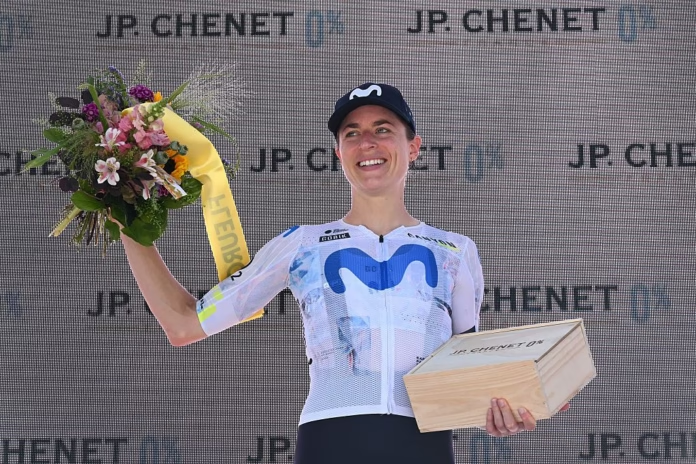
Marlen Reusser avoided serious general classification damage after crashing during Stage 1 of the 2026 Tour de France Femmes, returning to the peloton and finishing tenth in Lausanne.
The Movistar leader was brought down when teammate Arlenis Sierra crashed on a right-hand bend with 21.3km remaining. Reusser could not avoid Sierra and went over her handlebars, leaving the Swiss rider chasing at a point when the peloton was beginning to accelerate towards the final climb.
Movistar remained calm and committed several riders to the pursuit. Reusser regained contact, stayed with the leading group on the Côte Saint-François and received the same finishing time as stage winner Lorena Wiebes.
She was not listed in the official medical report and took the start of Stage 2 from Aigle on Sunday. There is therefore no indication that the crash has caused an injury serious enough to threaten her continuation in the race.
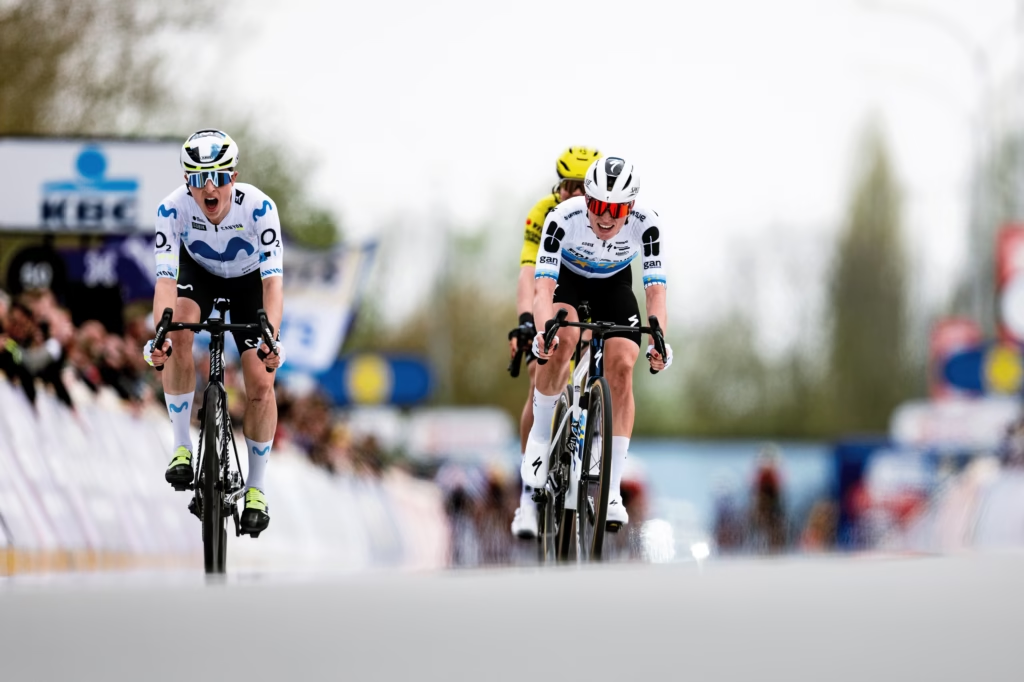
What happened in the Reusser crash?
The incident occurred during the descent towards Lausanne, inside the final 25km of the opening stage.
Sierra lost control through a right-hand corner while riding near the back of the peloton. Reusser was immediately behind and had no space in which to avoid her teammate, sending the Movistar leader over the handlebars as both riders slid towards the kerb.
It was an alarming moment because the race was entering a decisive phase. The pace was rising, teams were beginning to organise for the Côte Saint-François and Reusser risked being left in a prolonged chase before the uphill finish.
Movistar quickly placed teammates around their leader rather than allowing her to attempt the return alone. Reusser also had to deal with a mechanical issue after the fall, but the team brought her back before the final climb began.
She recovered well enough to finish tenth and preserve her position alongside the other principal GC contenders.
Is Marlen Reusser okay?
The initial signs are reassuring.
Reusser completed the stage, did not require treatment recorded in the official race medical communiqué and was cleared to start Stage 2. Movistar have not announced a fracture, concussion or any other injury resulting from the fall.
That does not necessarily mean she escaped without bruising or soreness. Riders often feel the effects of a crash more clearly the following morning, particularly after landing heavily around the hip, shoulder or ribs.
The important point is that there is currently no evidence of a problem threatening her Tour.
Stage 2 from Aigle to Geneva gives Movistar an opportunity to monitor her condition during a day that should be controlled mainly by the sprint teams. Reusser’s priority is reaching the finish safely rather than spending unnecessary energy before the individual time trial.
Did Reusser lose time?
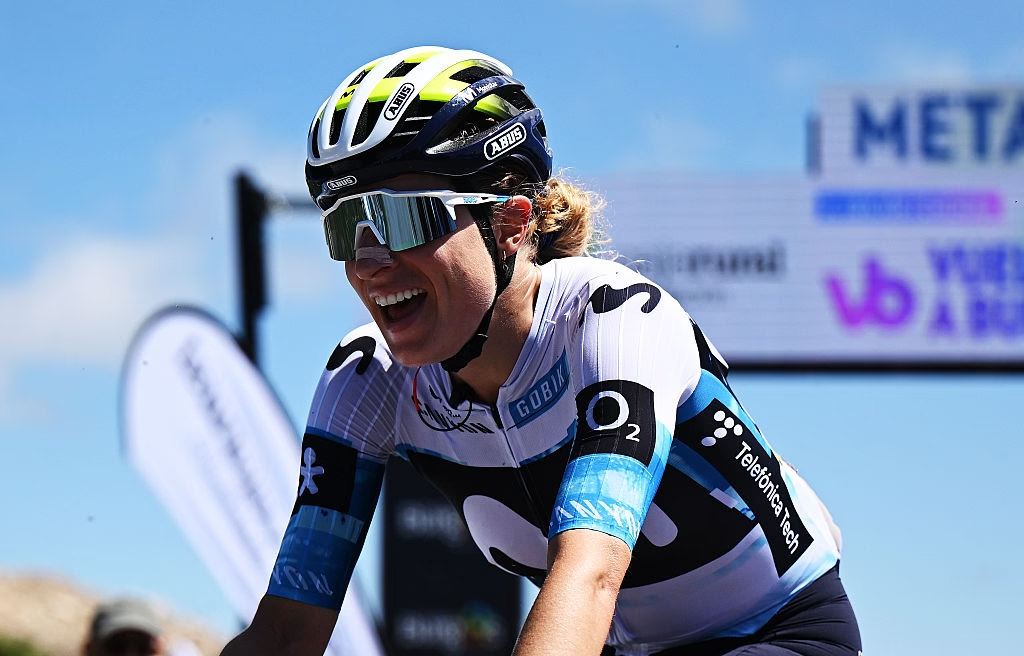
Reusser did not concede any time on the road.
She finished in the leading group alongside Wiebes, Kim Le Court-Pienaar, Demi Vollering, Puck Pieterse, Noemi Rüegg, Elisa Longo Borghini, Kasia Niewiadoma-Phinney and defending champion Pauline Ferrand-Prévot.
Her ten-second deficit in the general classification comes entirely from the winner’s time bonus collected by Wiebes. Le Court-Pienaar gained six bonus seconds for second place and Vollering took four for finishing third.
Reusser begins Stage 2:
10 seconds behind Lorena Wiebes
Six seconds behind Kim Le Court-Pienaar
Four seconds behind Demi Vollering
Level with Ferrand-Prévot, Niewiadoma-Phinney and Longo Borghini
Those differences do not change Movistar’s strategy. Reusser remains fully involved in the battle for yellow and reached the second stage without the crash creating a meaningful GC setback.
Could the crash affect her Dijon time trial?
The physical response over the next two days matters because Stage 4 contains the 21km individual time trial from Gevrey-Chambertin to Dijon.
Reusser is the leading specialist in the field and the clear favourite for that stage. The time trial offers her best opportunity to move ahead of the climbers before the Tour reaches Mont Ventoux and the final mountain stages around Nice.
A crash can still influence a time trial without causing an injury serious enough to force a withdrawal. Bruising around the back, shoulder, hip or ribs can make it uncomfortable to hold an aerodynamic position, while general soreness can affect power production and recovery.
Nothing from Lausanne currently suggests that Reusser’s preparation has been significantly compromised. She returned quickly, stayed with the favourites on the final climb and continued racing the following day.
Movistar will nevertheless want to protect her workload before Dijon. Stage 2 should be about staying safe, while Stage 3 provides another opportunity to avoid unnecessary efforts before the first major GC test.
Our Tour de France Femmes 2026 time trial contenders guide explains why Reusser remains the rider everyone must beat against the clock.
Why Dijon is central to Reusser’s Tour
The 2026 Tour de France Femmes route gives Reusser a genuine path towards the yellow jersey.
The Dijon time trial is long enough to produce meaningful gaps between the GC contenders. Reusser can potentially gain substantial time on the pure climbers and then attempt to defend that advantage through the mountains.
She demonstrated that route to an overall victory at the 2026 Tour de Suisse. Reusser won the Aarburg individual time trial and moved into yellow before confirming her all-round form by winning the final mountain stage at Villars-sur-Ollon.
That climbing performance strengthened the argument that she can do more than simply build an advantage against the clock. The greater challenge at the Tour will be limiting any losses on Mont Ventoux, where the length and gradients create a much more demanding test.
The Stage 1 crash has not changed that equation. Reusser still needs to gain time in Dijon and defend it in the mountains.

c
Movistar’s response prevented a larger problem
Reusser’s recovery also showed the value of Movistar’s support team.
There was no panic when their leader hit the ground. Teammates waited, helped manage the mechanical issue and brought her back into the peloton before the final climb.
That intervention may have protected Reusser from losing considerably more than a few seconds. Chasing alone during the approach to Lausanne would have required a major effort and could have left her unable to follow the favourites on the Côte Saint-François.
Instead, she reached the climb with enough energy to remain in the front group.
The Tour de France Femmes riders-to-watch guide identified Reusser as one of the central overall contenders because she combines the strongest time-trial credentials with improving mountain performances. Stage 1 provided an early test of another requirement for winning a Grand Tour: surviving the unpredictable moments.
Reusser remains firmly in contention
The sight of Reusser going over her handlebars immediately raised concern, particularly given the injury and illness problems that have disrupted several of her previous Grand Tour campaigns.
This time, the outcome appears much more favourable.
She returned to the peloton, finished tenth without losing time and was cleared to continue on Stage 2. There may be soreness for Movistar to manage, but no significant injury has been reported.
Reusser remains four seconds behind Vollering, level with Ferrand-Prévot and the other leading contenders, and on course to reach the Dijon time trial in a strong position.
The crash was a serious scare. For now, it has not become a serious setback.

