The Giro dell’Emilia Donne returns on Saturday 3 October 2026 with a changed opening to one of the most recognisable finales in women’s cycling. The race will start in Ferrara before travelling south-west towards Bologna, where two ascents of the brutally steep climb to the Santuario della Madonna di San Luca will decide the winner.
The move to Ferrara is the major change for 2026. Recent editions began in Mirandola, using the flat Bassa Modenese before gradually becoming harder towards Bologna. This year the race instead leaves from the historic centre of Ferrara and crosses the Emilia-Romagna plains before entering the Bologna area.
The exact technical roadbook, total distance and complete sequence of roads are still awaiting the organiser’s full presentation, scheduled for 22 September. The defining structure is already clear, however: a predominantly fast opening half, the transition into Bologna and two ascents of San Luca, with the second finishing at the sanctuary.
That combination makes the Giro dell’Emilia Donne deceptively difficult. Riders can spend much of the day on flat roads with a sizeable peloton still together, but once the race reaches Bologna there is almost no opportunity to recover. San Luca is only around two kilometres long, yet gradients close to 10% and ramps approaching 18% can turn the race upside down within a few hundred metres.
For more background on why the climb has become so central to the event, ProCyclingUK’s beginner’s guide to Giro dell’Emilia Donne 2026 explains the race format, San Luca and how the modern two-ascent finale developed.
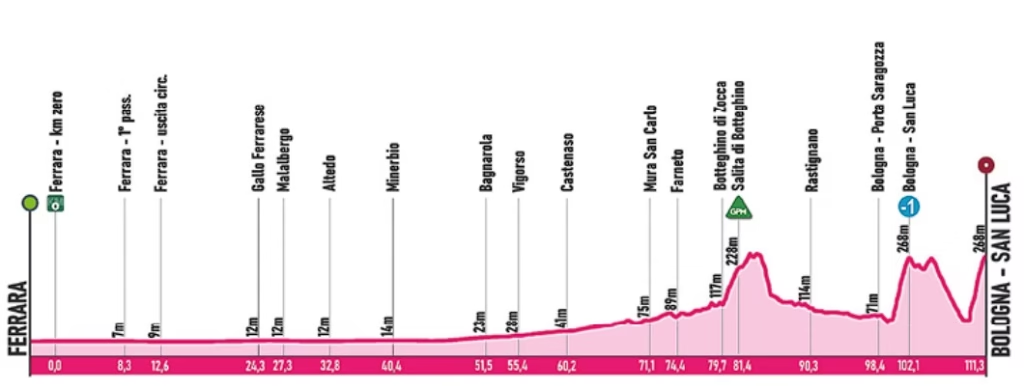
Giro dell’Emilia Donne 2026 route at a glance
Date: Saturday 3 October 2026
Start: Ferrara
Finish: Santuario della Madonna di San Luca, Bologna
Classification: UCI 1.Pro
Series: UCI Women’s ProSeries
Edition: 13th
Final circuit: Two ascents of San Luca
Defending champion: Kim Le Court
Record winner: Elisa Longo Borghini, four victories
The complete race distance and detailed kilometre-by-kilometre itinerary are due to be confirmed with the final roadbook.
What is already established is that Ferrara replaces the recent Mirandola departure and that the race retains the two-lap San Luca finale which has given the modern women’s event much more tactical depth.
Previous winners
2025 – Kim Le Court
2024 – Elisa Longo Borghini
2023 – Cecilie Uttrup Ludwig
The wider story of the race, including Elisa Longo Borghini’s four victories and the development of the two-climb finale, is covered in ProCyclingUK’s brief history of Giro dell’Emilia Donne.
The 2026 race starts in Ferrara
The move to Ferrara changes the geography of the opening half without fundamentally altering the character of the race.
Ferrara sits north-east of Bologna in extremely flat terrain. Riders leaving the city will therefore face a very different opening to a typical hilly Italian Classic. The first part of the race should be quick, exposed and much easier to control than the closing kilometres.
That creates opportunities for an early breakaway, particularly because the favourites have very little reason to spend energy before reaching the more demanding roads closer to Bologna.
Wind could still complicate matters.
The open terrain of the Po Valley offers relatively little protection, and a strong crosswind can make a supposedly easy section much more stressful. Even without full echelons forming, teams will want their leaders positioned towards the front rather than wasting energy repeatedly moving through the bunch.
The route is expected to pass through the Granarolo dell’Emilia area on its way towards Bologna, with local timings placing the race there around midday.
This section should still be more about positioning than attacking. The difference between riding in the first 30 positions and fighting back from much further down the peloton can become important once the urban roads begin.
The approach to Bologna is where the pressure rises
The race changes character as Bologna approaches.
On the plains, a team can move a rider forward gradually. In the city, that becomes harder. Roundabouts, road furniture, corners and changes in width make positioning more expensive, while everybody wants to arrive near the front before San Luca.
That means the decisive racing often begins before the gradient does.
A rider starting San Luca outside the first 20 positions is already at a disadvantage. Gaps open almost immediately once the climb steepens, and moving around riders who are beginning to struggle costs valuable energy.
The strongest teams therefore need enough riders remaining to control the approach rather than simply protecting a leader until the bottom.
That distinction helped make the longer 2025 route more interesting. The race was already reduced before San Luca, leaving a smaller group of riders fighting for the best positions when the final phase began.
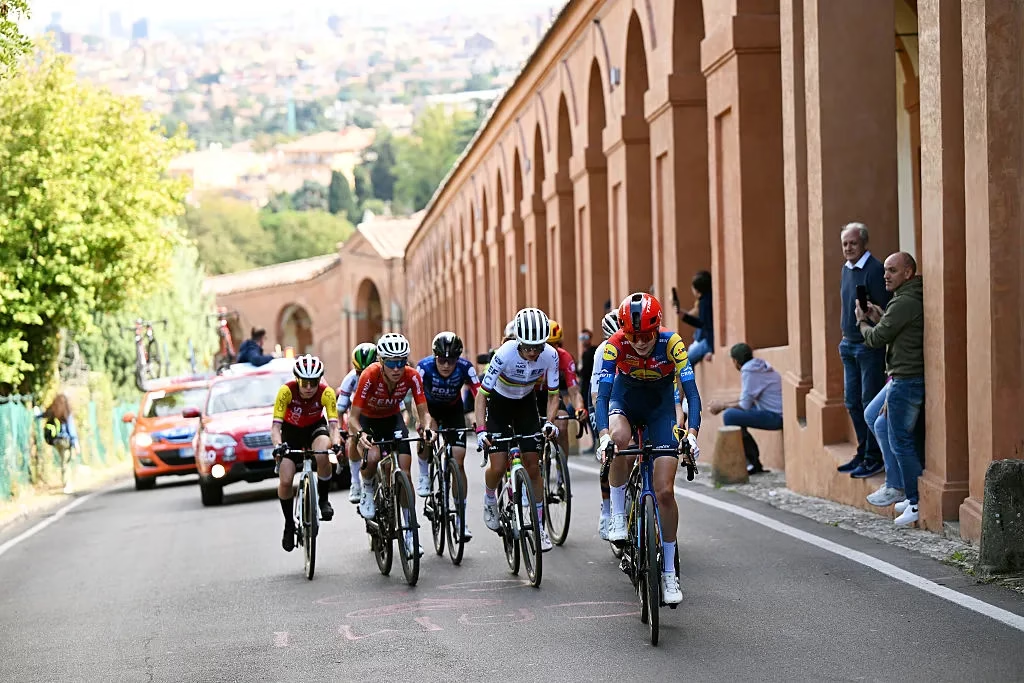 Photo Credit: Getty
San Luca is short enough to encourage explosive racing
The climb to the Santuario della Madonna di San Luca is approximately 2.1km long at an average close to 10%.
Those numbers only give a partial impression.
The gradient changes constantly. Shorter sections offer a chance to regain rhythm before the road steepens sharply again, and the hardest ramps around the famous Curva delle Orfanelle reach roughly 18%.
It is too steep for most riders to simply sit behind a domestique at a controlled tempo.
Once the favourites begin accelerating, the race becomes much more individual.
That favours riders who combine strong climbing with explosive power rather than pure long-distance mountain specialists. A rider accustomed to settling into a 20-minute climb cannot do that here. San Luca repeatedly forces changes of pace.
The famous portico running beside the road makes the climb immediately recognisable, but from a racing perspective the most important feature is how quickly it creates separation.
A gap of five metres can become 20 metres almost immediately once somebody loses momentum on the steepest ramps.
Why climbing San Luca twice changes the race
The women’s event once approached San Luca only for the finish.
That encouraged a relatively predictable tactic: protect the leader all day, deliver her to the bottom and decide everything in a two-kilometre uphill sprint.
The introduction of two ascents changed that.
The first passage can now be used aggressively.
Teams can increase the pace immediately, forcing weaker climbers out of the front group before the race reaches its final lap. Riders can attack near the summit, use the descent to extend a gap or try to isolate rival leaders before the second climb.
It also changes the physical demands.
Anybody riding San Luca at maximum effort the first time has only a short loop through Bologna before doing it again. There is no long valley section in which to settle down and recover.
The race therefore becomes a contest between aggression and restraint.
Wait too long and a rival may already be clear. Attack too hard on the first ascent and the final climb can become extremely long.
The descent can be just as important as the climb
Elisa Longo Borghini demonstrated that perfectly in 2024.
Rather than waiting for the final San Luca ascent, she attacked on the wet descent after the first passage. Her technical ability allowed her to establish a small advantage while the chasing group hesitated.
That gap survived all the way to the finish.
ProCyclingUK’s 2024 Giro dell’Emilia Donne race report shows why the modern route cannot simply be reduced to an uphill sprint.
A rider who crests the first San Luca ascent with a small advantage has options.
The chasers need to decide immediately whether to commit riders to bringing her back. If several teams wait for somebody else to do the work, ten seconds can quickly become enough to change the entire final lap.
Wet weather magnifies that further, but even in dry conditions a confident descender can force the favourites to work before the final climb.
Kim Le Court showed the alternative way to win in 2025
The following year produced a much more conventional finish.
The 2025 race covered 126km from Mirandola and used Monte Calvo to increase the difficulty before Bologna. The peloton was gradually reduced until around 15 riders remained in the main selection.
Niamh Fisher-Black accelerated on the final San Luca climb, but Kim Le Court was able to follow before making her own move inside the closing few hundred metres.
Le Court rode clear to take the victory, with Fisher-Black second.
The full race is covered in ProCyclingUK’s 2025 Giro dell’Emilia Donne report.
The contrast between 2024 and 2025 is useful when looking at the 2026 route.
Longo Borghini won between the climbs.
Le Court waited until the final ascent.
Both approaches can work.
That uncertainty is one of the biggest improvements created by the two-San Luca format.
How the Ferrara start could change the racing
The full 2026 roadbook will determine how much difficulty appears between Ferrara and Bologna, but the opening geography points towards a relatively controlled first half.
That could produce a larger peloton reaching Bologna than in 2025 unless additional climbing is inserted before the final circuit.
If so, positioning becomes even more important.
More riders reaching the city together means more teams trying to occupy the same roads before the first San Luca ascent. The opening climb could consequently be extremely aggressive simply because there are too many riders still present.
It would also increase the value of attacking on the first ascent.
A team with several strong climbers may not want to take a large group to the foot of San Luca for a second time. Raising the pace early can remove faster riders and reduce the number of tactical complications on the final lap.
Conversely, a rider with the best finishing kick may be perfectly happy to survive the first ascent defensively and wait.
Where Giro dell’Emilia Donne 2026 is likely to be decided
There are three obvious points to watch.
The first is the run into Bologna. A favourite caught behind a split or forced to use teammates simply to regain position can arrive at San Luca already having spent more energy than intended.
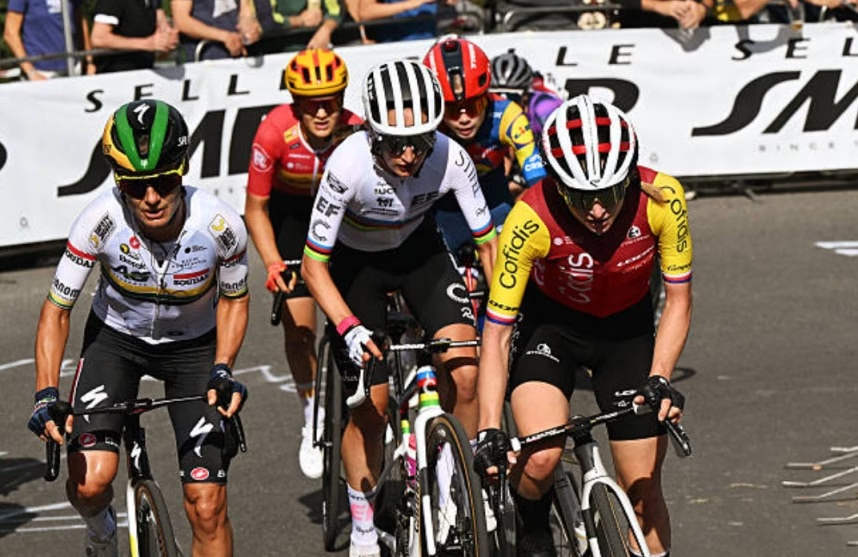
The second is the upper half of the first ascent. This is where teams can decide whether the race remains controlled or becomes an attacking contest.
The third is the descent and transition into the final San Luca climb.
If nobody escapes, the final ascent becomes brutally simple. There is little tactical complexity left once the gradients rise. Riders have to follow the accelerations for as long as possible before deciding when to make their own move.
The Curva delle Orfanelle is likely to be one of the critical points again. The steep gradient there makes it difficult to respond if a rider enters the corner with momentum and opens a small gap.
The European Championships will affect the field
There is one unusual complication surrounding the 2026 edition which has nothing to do with the route itself.
The elite women’s European Championship road race also takes place on Saturday 3 October.
That creates a direct clash for many of the European riders who would normally be ideal Giro dell’Emilia contenders.
Italian, Dutch, Belgian, French, Swiss and other national teams will have to choose riders for the European Championships at exactly the point when trade teams would ordinarily want them in Bologna.
The course itself therefore remains worthy of a major field, but the final start list could look different from recent editions.
Non-European riders may benefit particularly from the clash, while WorldTour teams with deep rosters could give opportunities to riders who would normally work for a national-team selection elsewhere.
A familiar finish despite a different route into Bologna
The move from Mirandola to Ferrara gives the 2026 Giro dell’Emilia Donne a noticeably different opening, but the race ultimately retains the element which defines it.
San Luca remains the problem everybody has to solve.
The first part of the day can encourage a breakaway. The roads towards Bologna can introduce positioning pressure. The opening San Luca ascent can create attacks, while the descent can turn a small separation into something much more serious.
Then everybody still has to climb it again.
That is why Giro dell’Emilia Donne has developed such a clear identity despite only beginning in 2014. The surrounding route can change from year to year, but the final kilometres continue to reward the same combination of climbing strength, acceleration, positioning and judgement.
For 2026, Ferrara provides the new beginning.
San Luca remains the inevitable ending.