
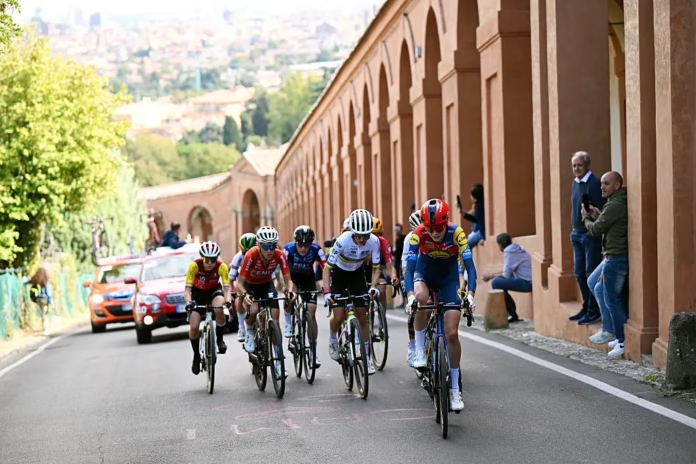
The Giro dell’Emilia Donne returns on Saturday 3 October 2026, bringing one of the most recognisable uphill finishes in women’s cycling back to Bologna.
Officially the Giro dell’Emilia Internazionale Donne Elite, the race has been held since 2014 and now sits at UCI 1.Pro level in the Women’s ProSeries. It is not a Women’s WorldTour event, but the finish beside the Sanctuary of the Madonna di San Luca has helped attract some of the best climbers and puncheurs of the last decade.
Elisa Longo Borghini is the record holder with four victories. Demi Vollering, Cecilie Uttrup Ludwig, Mavi García and defending champion Kim Le Court are also among the riders to have won on the steep road above Bologna.
For 2026 there is an added complication. The elite women’s European Championship road race takes place in Slovenia on the same day, meaning several leading European riders who might normally target San Luca will instead be representing their national teams.
That clash should make the start list less predictable than usual. The race itself remains easy to understand: survive until Bologna, then deal with one of the sharpest finishing climbs in professional cycling.
Giro dell’Emilia Donne 2026 at a glance
| Detail | Giro dell’Emilia Donne 2026 |
|---|---|
| Date | Saturday 3 October 2026 |
| Country | Italy |
| Region | Emilia-Romagna |
| Finish | Bologna, San Luca |
| Classification | UCI 1.Pro |
| Series | UCI Women’s ProSeries |
| First edition | 2014 |
| 2026 edition | 13th |
| Defending champion | Kim Le Court |
| Record winner | Elisa Longo Borghini, four wins |
| 2026 detailed route | Not yet fully published |
| Key climb | San Luca |
| Major calendar clash | Elite women’s European Championship road race |
The early Italian calendar lists the 2026 race as running from Casalecchio di Reno to Bologna, although the organiser has not yet published the full route, distance or timetable.
What is already confirmed is that San Luca remains the centrepiece.
What is the Giro dell’Emilia Donne?
The Giro dell’Emilia Donne is a one-day professional race held in Emilia-Romagna, with Bologna providing its defining finale.
Gruppo Sportivo Emilia launched the women’s edition in 2014 alongside the much older men’s Giro dell’Emilia. The men’s race dates back to 1909, so the women’s event has had considerably less time to establish an identity.
San Luca allowed it to do that quickly.
The climb overlooking Bologna is immediately recognisable and produces a simple sporting problem. Riders can spend much of the race saving energy, but once they reach the foot of San Luca there is nowhere to hide.
The gradients become too steep for ordinary domestique work to offer much protection. Position matters, pacing matters and eventually the strongest riders have to race each other directly.
The women’s race began at UCI 1.1 level before being promoted into the Women’s ProSeries at 1.Pro level for 2020, where it has remained.
Is Giro dell’Emilia Donne a Women’s WorldTour race?
No.
The Giro dell’Emilia Donne is a Women’s ProSeries race, one level below the Women’s WorldTour.
In simple terms, the international hierarchy starts:
Women’s WorldTour
Women’s ProSeries
UCI 1.1
UCI 1.2
That does not mean a ProSeries race has a weak field. WorldTour teams can and regularly do race them, particularly when the course offers something distinctive or the event has sufficient prestige.
Giro dell’Emilia has both.
Its October date also places it in the Italian autumn Classics period, when many riders still have opportunities available after the main stage-racing season has finished.
The 2026 European Championships clash will complicate that picture, but San Luca should still attract a strong field.
Why is San Luca so important?
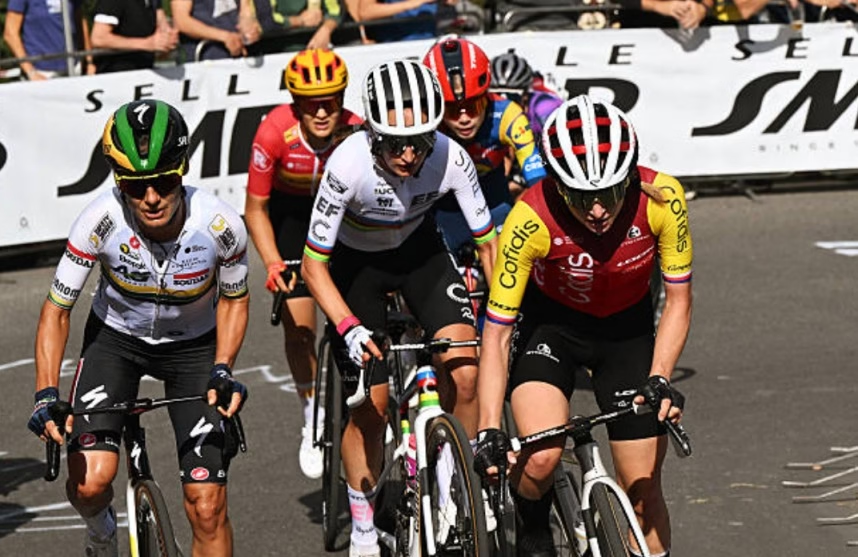
The climb to the Sanctuary of the Madonna di San Luca is the reason Giro dell’Emilia has such a clear identity.
It is roughly 2.1km long at close to 10%, but averages do not explain it particularly well.
The gradient changes constantly.
There are sections where riders can briefly regain rhythm, followed by ramps that force an immediate change of pace. The hardest gradients reach around 18%, enough to turn a small positioning error into an impossible gap once the attacks begin.
The climb follows Bologna’s famous covered portico towards the sanctuary above the city.
That makes it visually distinctive as well as difficult. Anyone watching Giro dell’Emilia for the first time can immediately tell when the decisive part of the race has begun.
What is the Curva delle Orfanelle?
The Curva delle Orfanelle is the most famous point on San Luca.
It is a sharp bend on the climb where the road steepens dramatically, with the section around it approaching 18%.
This is where the apparent order of the race can disappear within seconds.
A rider who looked comfortable lower down may suddenly lose several bike lengths. Somebody who attacks too enthusiastically can pay for it almost immediately.
For beginners, it is one of the best places to watch rather than concentrating exclusively on the finishing line.
When the front group reaches the Orfanelle, look at who is still seated, who is already struggling out of the saddle and who has enough left to accelerate.
The race often starts telling you its result there.
Why is San Luca a puncheur’s climb?
San Luca sits between the usual definitions of a climb.
It is too short for the race to become a conventional mountain test, but too steep for most sprinters or heavier Classics riders.
That tends to favour a puncheur who can climb, somebody capable of producing an explosive effort on a steep gradient and sustaining it for several minutes.
Our guide to what a puncheur is in cycling explains why riders with that combination are so effective on short, irregular climbs.
The Giro dell’Emilia winners list provides plenty of examples.
Demi Vollering won in 2019.
Cecilie Uttrup Ludwig has won twice.
Longo Borghini has four victories.
Kim Le Court added her name in 2025.
All can climb at a very high level, but none needs a 10km mountain before being able to create a decisive gap.
Why do the women climb San Luca twice?
The race did not always use its current finale.
For much of its early history, the women approached Bologna and climbed San Luca once for the finish.
That made the tactical equation fairly simple. Teams protected their leaders for as long as possible and the race effectively became an uphill sprint.
The organisers changed the formula for 2023.
Instead of saving San Luca entirely for the finish, the women began climbing it twice. The first ascent creates a selection, followed by the short Bologna loop and a second climb to the sanctuary.
The change made the finale much better suited to sustained attacking.
A rider who struggles on the first passage has only a short period in which to recover.
Teams can also use the opening ascent to remove rivals rather than waiting for everybody to reach the final two kilometres together.
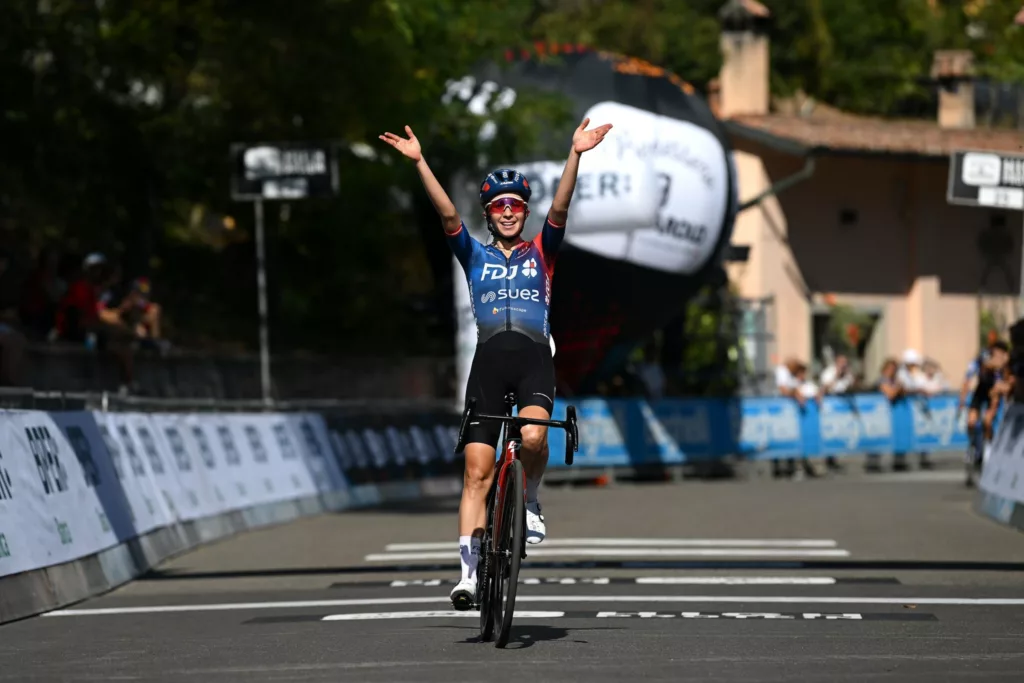
Cecilie Uttrup Ludwig showed what two San Luca climbs can do
The first edition using the double San Luca finale produced an immediate demonstration of why it matters.
In 2023, Sophie Wright attacked before the closing phase, but the race was ultimately pulled apart on the repeated climbs above Bologna.
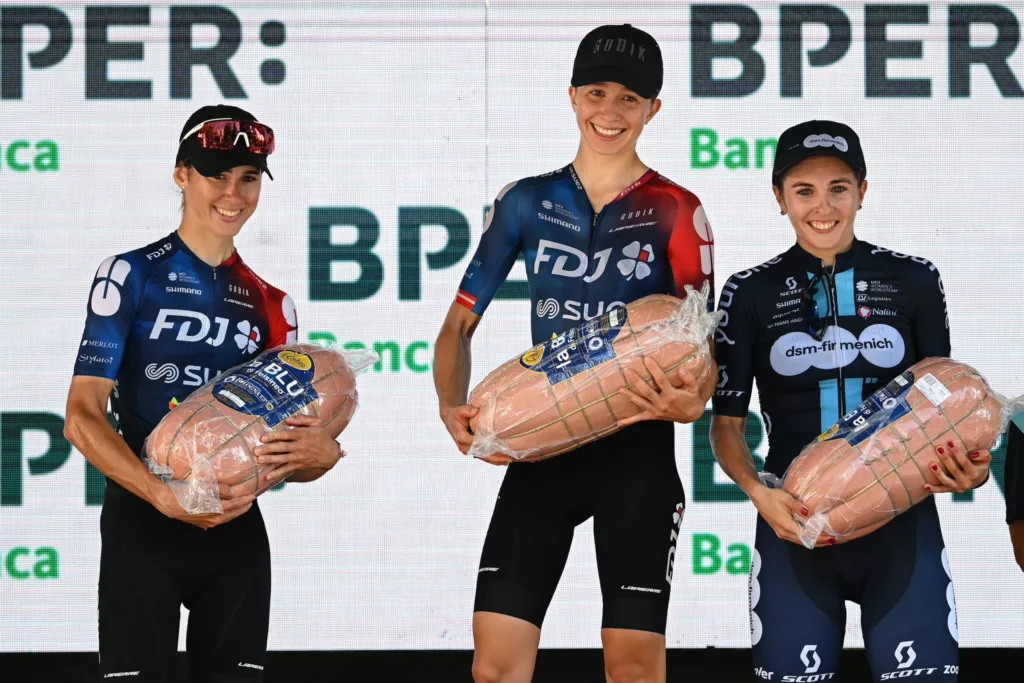
Cecilie Uttrup Ludwig emerged as the strongest rider, winning ahead of her FDJ-Suez teammate Marta Cavalli, with Juliette Labous third.
It was Uttrup Ludwig’s second Giro dell’Emilia victory after also winning in 2020.
Her success also confirmed that the new format had not fundamentally changed the type of rider required.
Explosive climbers still prospered.
They simply had to manage two major efforts instead of one.
You can read more about Uttrup Ludwig’s wider career in our Cecilie Uttrup Ludwig rider profile.

How did Elisa Longo Borghini win in 2024?
The 2024 edition showed another way of dealing with the two-climb finale.
Longo Borghini did not wait for the final San Luca ascent.
After the opening passage, she attacked on the wet descent and used her technical ability to establish a small advantage. Once she had separation, the chasing group struggled to organise itself.
She carried the move all the way to victory for her fourth Giro dell’Emilia title.
Our 2024 Giro dell’Emilia race report covers how she turned the descent between the San Luca passages into the decisive part of the race.
That result is useful for understanding the modern course.
San Luca remains the obvious difficulty, but the race no longer has to be won while climbing it.
The first ascent can create an opportunity somewhere else.
 Photo Credit: Getty
Kim Le Court conquered San Luca in 2025
The 2025 race returned to a more conventional San Luca conclusion.
A 126km route from Mirandola gradually became harder on the approach to Bologna, with Monte Calvo helping reduce the field before the final circuits.
Around 15 riders remained in the main selection late in the race.
Kim Le Court and Niamh Fisher-Black were among the strongest, with the decisive contest eventually unfolding on San Luca itself.
Le Court followed Fisher-Black’s acceleration before producing her own attack in the final few hundred metres. The Mauritian rode clear to win alone, with Fisher-Black second and Yara Kastelijn third.
Our 2025 Giro dell’Emilia Donne race report has the full account.
The win completed an outstanding 2025 campaign for Le Court after her Liège-Bastogne-Liège victory and confirmed how well her combination of climbing and explosive power fits San Luca.
Her recent seasons are also covered through our Kim Le Court rider page.
Giro dell’Emilia Donne winners
The race has produced a strong palmarès since Rossella Ratto won the inaugural edition in 2014.
| Year | Winner |
|---|---|
| 2025 | Kim Le Court |
| 2024 | Elisa Longo Borghini |
| 2023 | Cecilie Uttrup Ludwig |
| 2022 | Elisa Longo Borghini |
| 2021 | Mavi García |
| 2020 | Cecilie Uttrup Ludwig |
| 2019 | Demi Vollering |
| 2018 | Rasa Leleivytė |
| 2017 | Tatiana Guderzo |
| 2016 | Elisa Longo Borghini |
| 2015 | Elisa Longo Borghini |
| 2014 | Rossella Ratto |
Longo Borghini leads the record book with four victories, in 2015, 2016, 2022 and 2024.
Uttrup Ludwig is the only other multiple winner, taking the race in 2020 and 2023.
Longo Borghini’s third victory in 2022 came ahead of Veronica Ewers and Sofia Bertizzolo, with our 2022 Giro dell’Emilia report showing just how little climbing was required before the decisive San Luca finish that year.
Why Elisa Longo Borghini has been so successful here
Four victories across ten editions tell a more interesting story than four wins clustered together.
Longo Borghini first won Giro dell’Emilia in 2015 and successfully defended her title in 2016.
She then went six years without winning before returning to the top step in 2022. Her fourth victory came in 2024.
The course changed during that period.
Teams changed.
Longo Borghini’s role changed.
San Luca continued to suit her.
Her strength is that she does not need the race to unfold in one particular way. She can attack before the final climb, respond on the steepest sections or use descending and positioning to create an opportunity elsewhere.
That versatility has made her the benchmark rider in the short history of the women’s race.
Our Elisa Longo Borghini profile covers the wider career of the four-time winner.
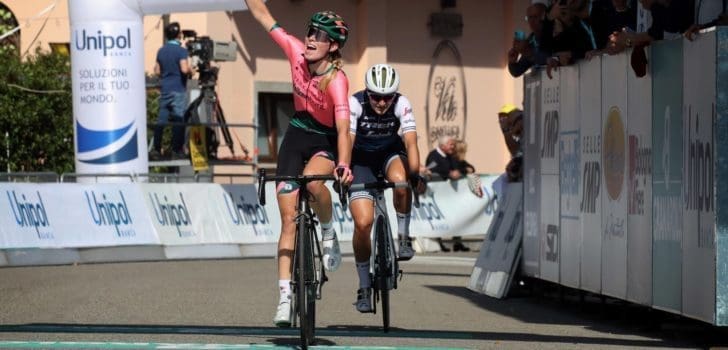
Demi Vollering took an early career win here
Demi Vollering’s victory in 2019 looks more significant with hindsight.
She was still riding for Parkhotel Valkenburg and had not yet become the Grand Tour and Ardennes winner she is now known as.
San Luca suited her immediately.
Vollering’s ability to accelerate hard on a steep gradient would later become one of the defining characteristics of her career, particularly at races such as Flèche Wallonne and Liège-Bastogne-Liège.
The Giro dell’Emilia result was an early indication of what was coming.
Her career since then, including her 2026 Tour de France Femmes victory, can be followed through our Demi Vollering profile.
Is Giro dell’Emilia similar to Flèche Wallonne?
There is an obvious comparison.
Flèche Wallonne Femmes finishes on the Mur de Huy, another short and brutally steep climb where pacing is often more important than launching the earliest attack.
San Luca creates many of the same problems.
The two races are not identical.
Flèche Wallonne contains much more repeated climbing through the Ardennes before the final Mur de Huy. Some editions of Giro dell’Emilia, particularly before the introduction of the double San Luca finale, were comparatively straightforward until the last few kilometres.
But the decisive effort is similar.
A rider needs to arrive near the front, avoid wasting energy when the gradient first increases and still have enough left when the road reaches its hardest section.
Attack 200 metres too early and the climb can expose the mistake very quickly.
How long is Giro dell’Emilia Donne?
There is no fixed distance.
The women’s race has grown noticeably over the last few years:
- 2022: 89.7km
- 2023: 103.5km
- 2024: 113.8km
- 2025: around 126km
The trend has been towards a more complete one-day race rather than simply using a long flat approach to deliver riders to San Luca.
The full 2026 route has not yet been released.
The early Italian calendar lists a start in Casalecchio di Reno and a finish in Bologna, which would be a notable change from the Mirandola starts used recently.
Until GS Emilia publishes the final roadbook, however, the precise distance, intermediate climbs and approach to the two San Luca ascents remain open.
Why is the European Championships clash important?
The 2026 edition faces an unusual calendar problem.
The elite women’s road race at the European Championships is being held in Slovenia on Saturday 3 October, exactly the same day as Giro dell’Emilia.
The European Championship runs from Ljubljana to Šenčur over 130km and finishes with two laps of a hilly circuit containing the steep Možjanca climb.
Many of the riders who would ordinarily be ideal Giro dell’Emilia contenders will also be natural choices for their national teams.
They cannot race both.
That will particularly affect European WorldTour stars. Italian, Dutch, French, Belgian, Danish, Swiss and other national selections are likely to draw heavily from the same type of explosive climbers who normally target San Luca.
The final Giro dell’Emilia start list may therefore have a noticeably different balance.
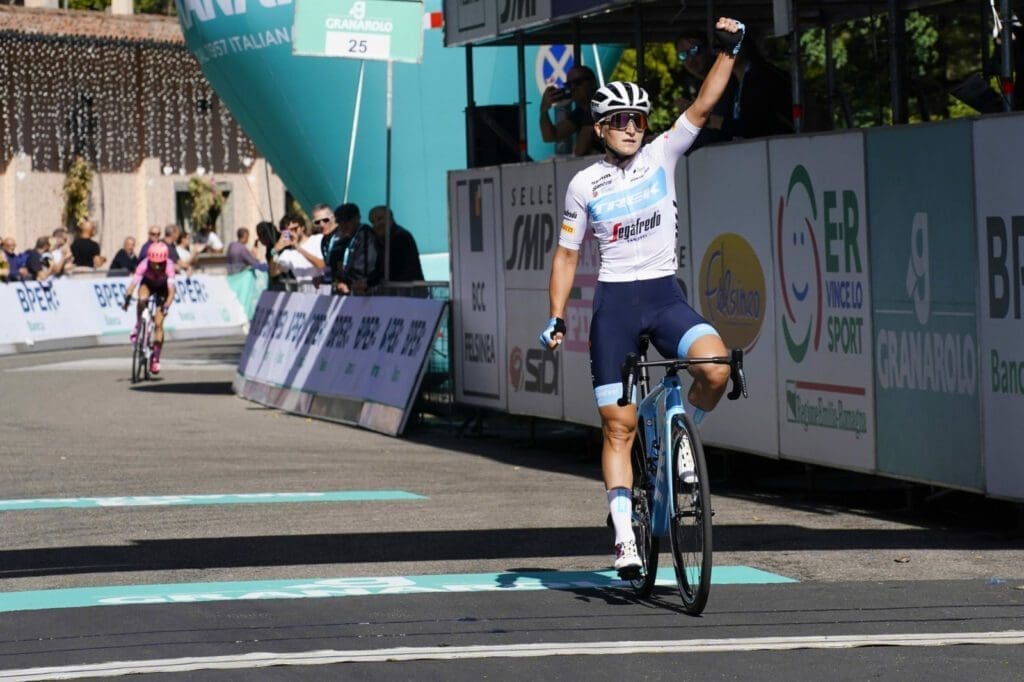
Could the clash help non-European riders?
Potentially.
Riders from countries outside Europe are not eligible for the European Championship, so their trade-team programmes are unaffected by the Slovenia road race.
That does not guarantee their teams will send them to Italy, but it removes one major scheduling problem.
Kim Le Court is an obvious example. As a Mauritian rider, she cannot race the European Championships and could theoretically defend her Giro dell’Emilia title if it fits her programme.
The same applies to riders from Australia, New Zealand, the United States, Canada and other non-European nations.
That may give the 2026 edition a more international feel than usual at the front of the race.
Which teams are expected in 2026?
The early team listings include WorldTour squads such as UAE Team L’IMAD, Movistar, Visma | Lease a Bike, Lidl-Trek and Uno-X Mobility, alongside ProTeams and other invited teams.
That should be treated as a team list rather than a confirmed rider start list.
October programmes can change late in the season anyway. Adding the European Championships on the same day makes final selections even harder to predict.
A team could commit to Giro dell’Emilia months in advance and still lose several obvious leaders when national federations announce their European Championship squads.
The eventual six-rider selections will tell us much more than the early team list.
-
 Photo Credit: quentinphotographiebe
 -
 Photo Credit: Getty
Do the women race the same route as the men?
No.
The women’s and men’s Giro dell’Emilia share San Luca but are otherwise different races.
The men’s event is considerably longer and contains more climbing through the Apennines before reaching Bologna. It also traditionally completes five ascents of San Luca during the finishing phase.
The women’s event is shorter and recent editions have used two San Luca ascents.
That produces different racing despite the shared finish.
The men have much more opportunity for attrition before Bologna.
The women’s race tends to preserve a larger group until much later, making the explosive efforts on San Luca even more important.
What should first-time viewers watch for?
The kilometres before San Luca can sometimes be deceptive.
A large group may still be together and the favourites may appear to be doing very little.
That does not mean the race is waiting politely for an uphill sprint.
Watch which teams still have several riders as Bologna approaches.
Then watch the fight for position before the first San Luca ascent.
Once the gradient begins, look at which riders are using energy simply to hold the wheel and which still appear capable of attacking.
The descent and short circuit between the two climbs are just as important. Longo Borghini proved in 2024 that an attack there can settle the race before the final ascent even begins.
When San Luca arrives for the second time, there is no reason left to conserve anything.
Why is Giro dell’Emilia Donne worth watching?
There are more prestigious races on the women’s calendar and significantly longer ones.
Few have a finale this easy to recognise.
A viewer does not need to understand a complicated general classification or remember half a dozen mountain points.
The race is heading to San Luca.
The favourites know it.
Everybody watching knows it.
The only uncertainty is how many riders will still have a chance when they get there.
The first climb can expose weakness. The descent can reward bravery. The second ascent leaves nowhere to recover from a mistake.
That has been enough to produce winners including Longo Borghini, Vollering, Uttrup Ludwig, García and Le Court in barely more than a decade.
The 2026 European Championships clash may change who gets to contest it, but not what makes Giro dell’Emilia Donne compelling.

