

The Vuelta a España 2026 reaches its first summit finish on Monday 24 August, with Stage 3 taking the peloton 174 kilometres from Gruissan-Aude to Font-Romeu in the French Pyrenees.
After two very different opening days, the race now changes character completely. Tadej Pogačar starts in the red jersey, having followed his Monaco time trial victory with third place on Stage 2 in Manosque, while Matthew Brennan’s sprint win moved the young Briton to third overall. Pogačar leads Wout van Aert by nine seconds and Brennan by ten.
Stage 3 should finally begin stripping away some of those early positions. The first 120 kilometres are relatively benign, but almost all of the day’s climbing is concentrated late. The riders tackle the 19.4-kilometre Col de Mont-Louis at 4.8% before a short transition into the final 9.8 kilometres at around 5% to Font-Romeu, with the finish sitting close to 1,940 metres above sea level.
Those gradients are not severe enough to guarantee huge GC gaps, particularly with the brutal Andorra stage following on Tuesday, but Font-Romeu should give the first meaningful indication of who has arrived at the Vuelta capable of challenging Pogačar in the mountains. The Vuelta a España 2026 route guide shows just how quickly the race escalates, with Font-Romeu immediately followed by another major climbing test in Andorra.

Vuelta a España Stage 3 route
Date: Monday 24 August 2026
Start: Gruissan-Aude
Finish: Font-Romeu
Distance: 174km
Stage type: Medium mountain / summit finish
Elevation gain: Around 2,675m
Key climb: Col de Mont-Louis, 19.4km at 4.8%
Final climb: Font-Romeu, 9.8km at around 5%
Finish altitude: Around 1,940m
Stage start: 13:21 CEST / 12:21 BST
Fastest expected finish: Around 17:18 CEST / 16:18 BST
The opening half of the stage bears little resemblance to the finish. From Gruissan-Aude on the Mediterranean coast, the race crosses relatively gentle terrain before gradually moving inland towards the Pyrénées-Orientales. The road begins rising progressively through the Têt valley, but the stage only becomes genuinely selective once the riders reach the closing 45 kilometres.
An intermediate sprint at Villefranche-de-Conflent comes shortly before the serious climbing begins. From there, the peloton faces a near-continuous rise towards Font-Romeu, with Mont-Louis effectively forming the first part of one extended final mountain effort.
That structure is important. Stage 3 does not contain repeated steep climbs where riders can attack, recover and attack again. Instead, it becomes a long test of sustained climbing strength, altitude and team depth.
Col de Mont-Louis should make the first real selection
The Col de Mont-Louis is 19.4 kilometres long at 4.8%, topping out with only 16.2 kilometres remaining.
The gradient is modest by Vuelta standards, but its length should gradually reduce the peloton. Teams with several climbing domestiques can use the ascent to increase the pace without necessarily committing their leaders to an attack.
That makes UAE Team Emirates-XRG particularly important. Pogačar has João Almeida, Pavel Sivakov, Jay Vine and Pablo Torres among the climbing support around him, giving UAE enough depth to make the race uncomfortable long before their leader needs to move.
The Vuelta a España 2026 team-by-team guide highlighted that strength before the race. Few of Pogačar’s rivals can match UAE rider for rider once the field has been reduced to its mountain specialists.
Decathlon CMA CGM can work around Félix Gall, Netcompany INEOS have Oscar Onley and Carlos Rodríguez, Movistar bring Enric Mas and Cian Uijtdebroeks, while Visma | Lease a Bike can call on Sepp Kuss, Ben Tulett and Jørgen Nordhagen. If one of those teams decides to ride Mont-Louis hard, the group reaching the final climb could already be very small.
Font-Romeu is harder than the gradient suggests
The finishing ascent is approximately 9.8 kilometres at 5%, figures which would normally suggest a relatively controlled GC finale.
The problem is everything that comes before it.
The riders reach Font-Romeu almost immediately after spending nearly 20 kilometres climbing Mont-Louis. Taken together, the closing section resembles one long mountain effort more than two completely separate ascents.
The altitude adds another factor. Font-Romeu sits close to 1,940 metres above sea level, high enough for the reduced oxygen availability to become noticeable after a sustained effort. Riders who are already close to their limit on Mont-Louis can find the final kilometres disproportionately difficult.
That should favour riders capable of holding a high threshold effort for a long period rather than pure explosive climbers waiting for one kilometre at double-digit gradients.
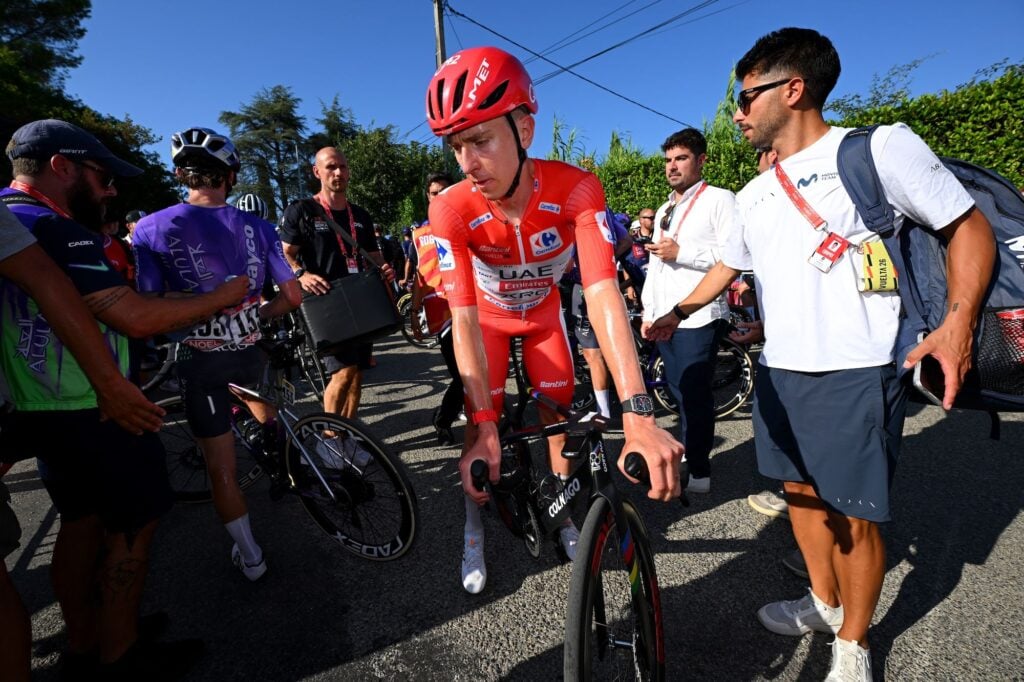
Tadej Pogačar is the obvious reference
Tadej Pogačar is the rider everyone else has to watch.
He has already demonstrated how sharp he is. Pogačar won the opening Monaco time trial by just nine hundredths of a second over Ethan Hayter, then raced aggressively again on Stage 2, responding when the finale became selective before sprinting to third in Manosque.
That willingness to race matters at Font-Romeu.
UAE do not need Pogačar to attack. He already has the lead and Tuesday’s Andorra stage is substantially harder. A controlled ride in the front group would be perfectly acceptable.
But Pogačar rarely ignores an opportunity if another rider shows weakness.
If UAE raise the pace and one of his principal rivals begins struggling on Mont-Louis, there is little reason for him to wait until Tuesday to exploit it.
The most likely attack point is relatively late on Font-Romeu rather than a long-range move. The gradients suit a sustained acceleration over the final two or three kilometres, potentially creating useful seconds without requiring the enormous expenditure needed for an attack from Mont-Louis.
Pogačar was already the clear reference in ProCyclingUK’s Vuelta a España 2026 contenders preview. The first summit finish is where the rest of that hierarchy starts being tested against the road.
João Almeida gives UAE a second GC card
João Almeida is one of the riders with the most to gain from this kind of steady climbing.
The Portuguese rider’s greatest strength is his ability to maintain a high pace for a long time, even when the group begins to fragment around him. Neither Mont-Louis nor Font-Romeu contains the sharp gradient changes that can make it harder for Almeida to respond to explosive climbers.
That makes Stage 3 an excellent early test.
Almeida is Pogačar’s principal lieutenant, but he is also strong enough to remain high on GC himself. His presence creates a tactical complication for every rival team because UAE do not necessarily need to respond immediately if Almeida follows a move.
His Monaco time trial also put him in a useful position, and there is little reason for UAE to sacrifice that secondary GC card this early in the race.
If Almeida climbs at his normal level, he should remain among the final group deep into Font-Romeu.
 Photo Credit: Getty
Félix Gall finally reaches terrain that suits him
Félix Gall should be one of the riders most relieved to see sustained climbing arrive.
The Austrian lost time to Pogačar in the opening time trial, making Stage 3 important even though it is unlikely to decide the Vuelta.
Gall does not need to attack recklessly, but he does need to begin establishing himself among the strongest climbers. The sustained nature of the finale should suit him considerably better than Monaco.
His biggest problem is the gradient.
Five per cent is not steep enough to remove Pogačar’s power advantage easily, so Gall may prefer Decathlon to make Mont-Louis difficult rather than allowing the stage to become a short contest over the final two kilometres.
The harder and longer the selection, the more opportunity Gall has to turn Stage 3 into a pure climbing test.
Oscar Onley gets his first chance to show his GC level
Oscar Onley faces one of the most important days of his opening week.
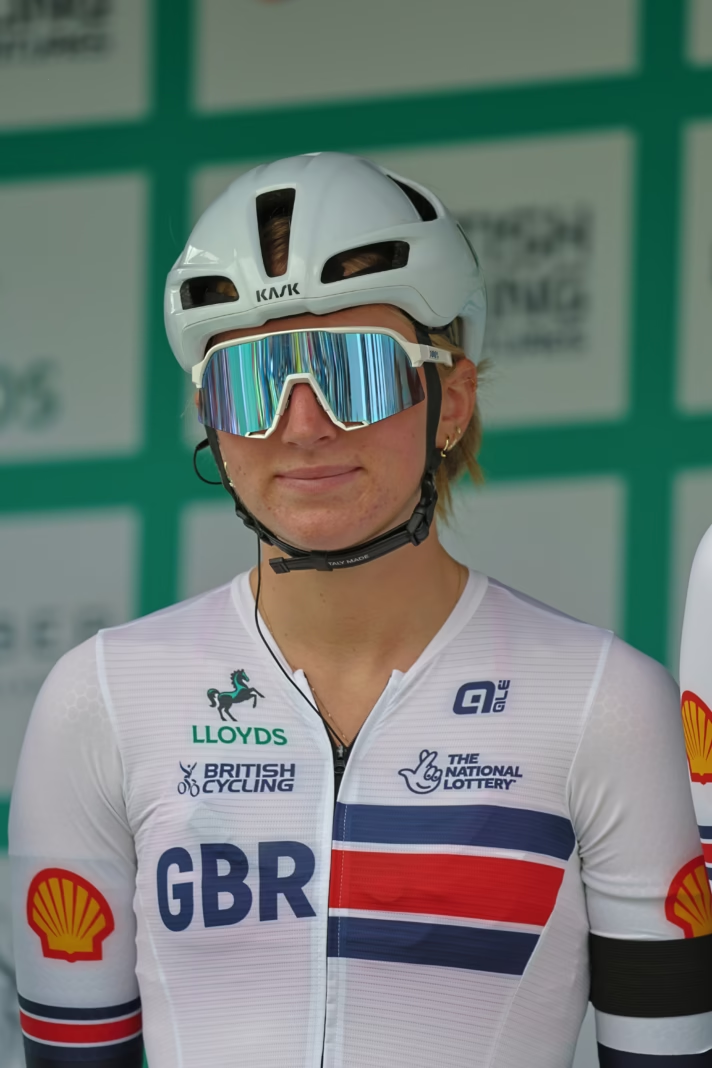
The British rider is Netcompany INEOS’ main GC leader, but Monaco immediately put him on the defensive against Pogačar’s superior time trialling. Font-Romeu offers a very different test.
Onley is particularly effective on sustained medium-gradient climbs where positioning and repeated acceleration matter less than maintaining climbing power. That makes the final 35 kilometres significantly better suited to him than the opening TT.
Netcompany INEOS also have Carlos Rodríguez and experienced climbing support around him, allowing Onley to remain protected until the race reaches its decisive phase.
A finish alongside Pogačar would represent an excellent result. Losing ten or fifteen seconds would hardly end his GC ambitions. Losing substantially more before Andorra would be more concerning.
The full Vuelta a España 2026 start list has the confirmed eight-rider Netcompany INEOS squad and the rest of the 184-rider field.
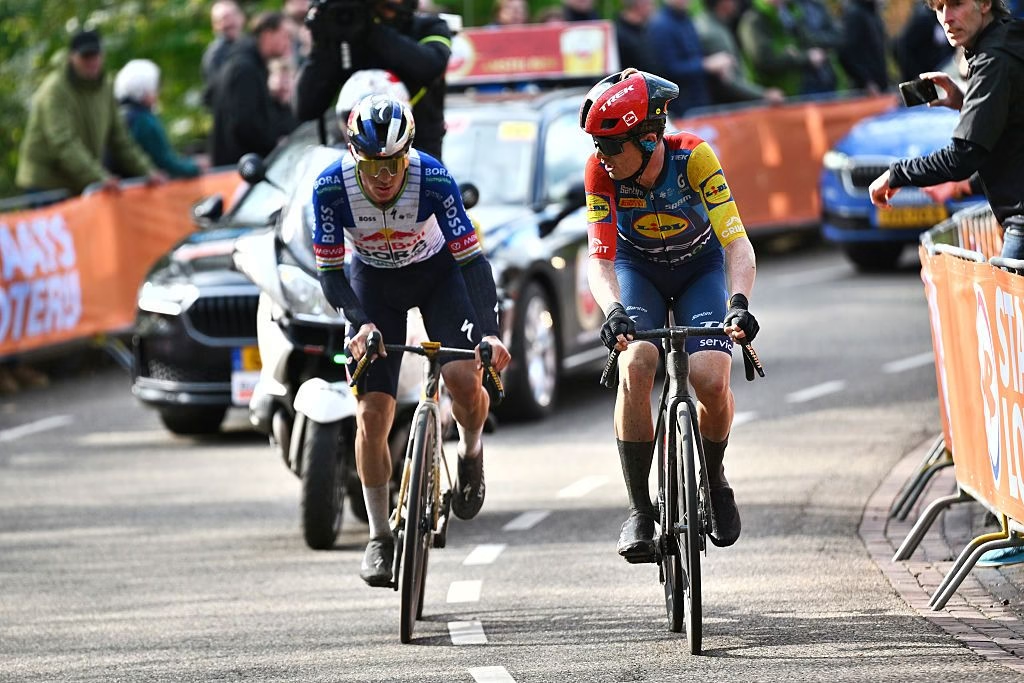
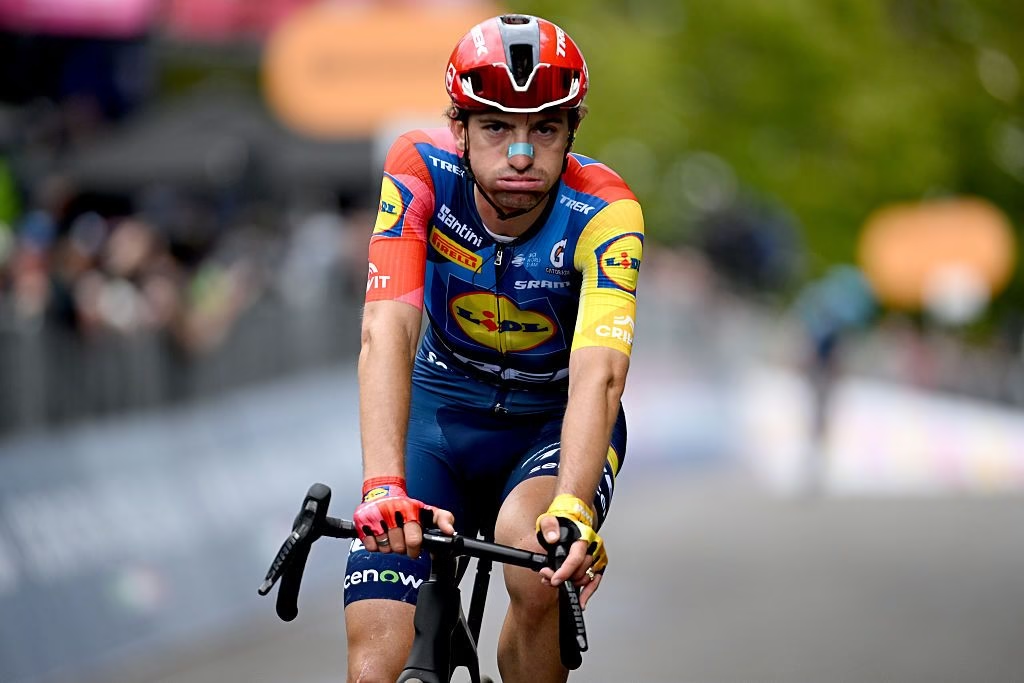
Mattias Skjelmose needs to confirm his Grand Tour level
Mattias Skjelmose begins the first mountain stage as another rider with genuine podium ambitions.
The Dane has developed into a much more complete Grand Tour rider, with enough climbing consistency and time-trial ability to remain competitive across the varied 2026 Vuelta route.
Stage 3 should suit him because it rewards sustained power without the extreme gradients that will arrive elsewhere in the race.
Lidl-Trek do not necessarily need to control anything for him. Their best approach may simply be to keep Skjelmose protected while UAE and the other GC teams do the work, then judge his level once Font-Romeu begins.
A strong finish here would reinforce his place among the leading contenders immediately behind Pogačar.
Richard Carapaz should welcome an aggressive race
Richard Carapaz starts the 2026 Vuelta with EF Education-EasyPost, and Font-Romeu gives him his first meaningful opportunity to influence the race.
Carapaz is at his most dangerous when a mountain stage becomes unpredictable rather than being reduced to one controlled final acceleration.
That creates an interesting tactical question.
The moderate gradients do not obviously favour a decisive solo attack, but Carapaz may be one of the riders willing to move earlier than Pogačar. EF also have Georg Steinhauser available as a strong climbing card, giving them scope to make the race less straightforward.
If Carapaz or Steinhauser goes on Mont-Louis, UAE have to decide whether the move is serious enough to chase.
The final climb’s steady gradient gives a small group a chance of sustaining a gap if the favourites begin looking at one another.
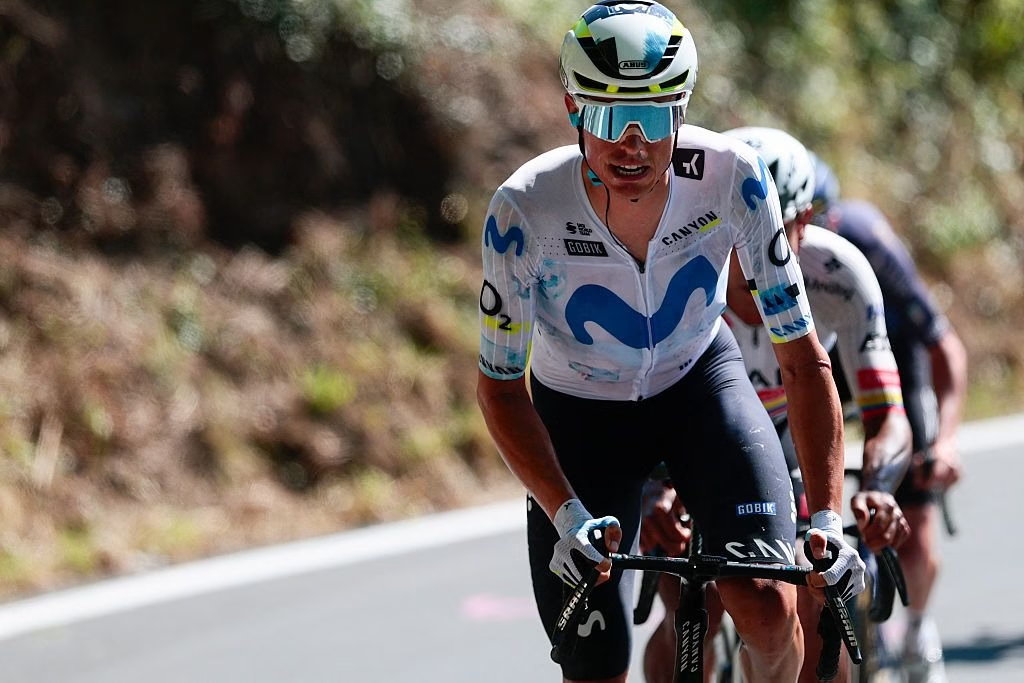 Photo Credit: Getty
Enric Mas needs a reassuring first mountain day
Enric Mas has built much of his career around the Vuelta, and Stage 3 provides the first indication of whether he can again feature near the top of the classification.
The route should suit him.
Mas is comfortable on long, regular climbs and does not need extreme gradients to remain with the strongest riders. His challenge is whether he can produce the acceleration required if Pogačar attacks late.
Movistar also have Cian Uijtdebroeks and Iván Romeo, giving them enough tactical options to avoid placing every responsibility on Mas.
For Mas, the ideal Stage 3 may actually be relatively uneventful: stay with Pogačar, avoid losing time and reach Tuesday’s Andorra stage with his GC intact.
Ben Tulett can begin turning dark-horse status into something more
Ben Tulett is one of the most interesting riders to watch once Mont-Louis begins.
Visma | Lease a Bike have no conventional GC favourite on Pogačar’s level, but Tulett gives them a young climber capable of moving high into the overall classification if the opening mountain stages go well.
The British rider should appreciate the steady gradients and the absence of repeated brutal ramps.
Visma also have Sepp Kuss and Jørgen Nordhagen, which means they can approach the stage flexibly rather than forcing Tulett to cover every move himself.
Tulett featured prominently among ProCyclingUK’s Vuelta a España 2026 GC dark horses, and a strong Font-Romeu ride could quickly move him beyond outsider status.
 Photo Credit: Getty
Primož Roglič remains difficult to read
Primož Roglič remains one of the largest unknowns in the race.
Red Bull-BORA-hansgrohe arrived with expectations already tempered by the disruption to his preparation, and his opening time trial left him more than 20 seconds behind Pogačar.
Stage 3 will tell us much more.
The sustained gradients are not necessarily ideal for producing Roglič’s trademark explosive finishing attack, but he remains capable of climbing with the best when healthy.
The bigger question is whether he has the endurance and consistency required after his interrupted build-up.
If Roglič finishes comfortably with Pogačar, the discussion around his GC potential immediately changes. If he loses significant time, Red Bull can begin approaching the race with a much broader set of objectives.
Tobias Halland Johannessen is made for this terrain
Tobias Halland Johannessen deserves serious attention at Font-Romeu.
Uno-X Mobility have brought a team capable of supporting him through the mountains, and Johannessen’s aggressive climbing style fits a finale where the obvious favourite may initially prefer control.
He does not need to beat Pogačar directly to have a successful day.
Finishing among the strongest GC riders would immediately establish him as a credible top-10 threat, while an attack from distance could also put him into the stage victory conversation.
Like Tulett, Johannessen entered the race as one of the most interesting names in the Vuelta dark-horses analysis. Font-Romeu is the first stage where that status can be properly tested.
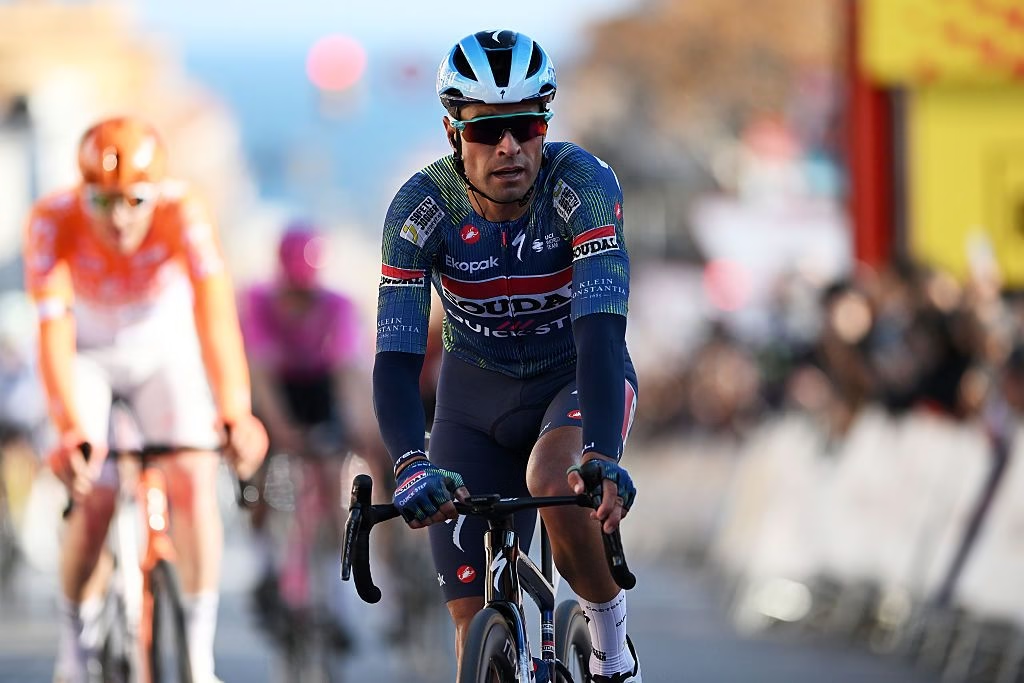
Mikel Landa finally gets the terrain he wants
Mikel Landa should also become much more visible as the road climbs.
Soudal Quick-Step spent the opening weekend with Ethan Hayter at the centre of the action, but Stage 3 shifts attention towards their climbing options.
Landa remains one of the most experienced mountain riders in the field, and the long, steady finale should suit him much better than the technical Monaco TT or Manosque finish.
The question is whether he has the explosiveness to follow a late Pogačar acceleration.
If the final climb instead becomes a long threshold effort, Landa should be considerably more comfortable.
Sepp Kuss can race with much less pressure
Sepp Kuss gives Visma another strong option without the burden of entering the Vuelta as the team’s clear overall leader.
That could make him particularly dangerous.
Kuss has already won this race, but his role in 2026 can be much more flexible. He can support Tulett, follow attacks or pursue his own result depending on how the race develops.
The steady Font-Romeu gradients are well suited to his climbing style.
If Kuss is close to his best, expect him to remain present until relatively late and give Visma another card if other teams begin focusing too heavily on Tulett.
Could the breakaway win Stage 3?
Yes. Stage 3 is the first genuinely strong breakaway opportunity of the Vuelta.
The opening 120 kilometres give a group plenty of time to establish an advantage, while the summit finish provides enough difficulty for strong climbers to survive once the peloton begins chasing.
The central question is UAE’s intention.
If Pogačar wants another stage win, the escape needs a substantial advantage before Mont-Louis.
If UAE are content simply to defend the red jersey, a strong group containing riders safely down the general classification could be given considerably more room.
Tuesday’s Andorra stage also encourages caution. Pogačar does not need to spend his team chasing a breakaway for most of the afternoon when a much more severe climbing day follows less than 24 hours later.
That could give stage hunters their first major opening of the race.
The breakaway needs the right composition
Not every escape will receive freedom.
A rider only a minute or two behind Pogačar creates an obvious problem because the red jersey could potentially change hands.
A group built around riders already far enough down is much easier for UAE to tolerate.
That makes the composition of the morning move particularly important.
The strongest break needs climbers with enough freedom on GC to be ignored but enough ability to survive almost 30 kilometres of sustained climbing at the end of the stage.
If the gap remains above four or five minutes at the bottom of Mont-Louis, the stage victory can become a separate contest from the GC battle behind.
If UAE have already reduced it below two minutes, the balance swings heavily towards Pogačar and the favourites.
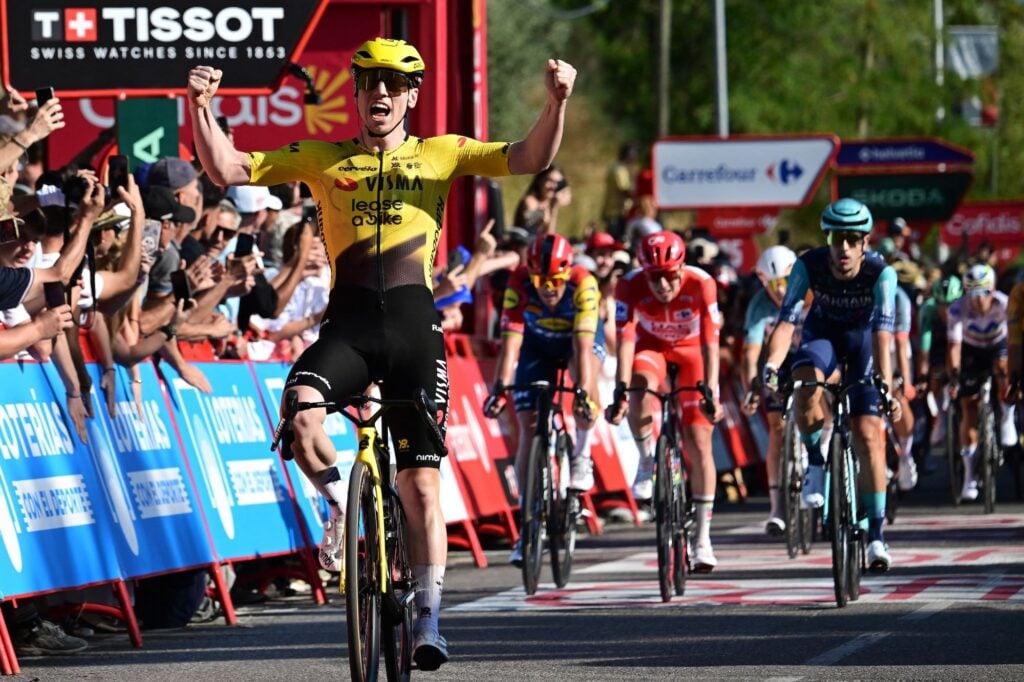 Photo Credit: Getty
Matthew Brennan’s spell near the top of the GC should end here
Matthew Brennan begins Stage 3 third overall, just ten seconds behind Pogačar, after his excellent victory in Manosque.
That position is unlikely to survive Font-Romeu.
Brennan has already shown extraordinary versatility, but almost 30 kilometres of sustained Pyrenean climbing is a completely different demand from the rolling Stage 2 terrain.
Visma have no reason to force him to defend his GC position.
His Vuelta is about stage victories and opportunities on terrain suited to his sprinting and Classics strengths. Losing time on Monday is therefore not a failure. It simply allows the overall classification to begin reflecting the riders who genuinely intend to contest it.
For newer viewers, the beginner’s guide to the Vuelta a España 2026 explains why early GC positions can change so dramatically once the race reaches sustained mountain terrain.
Wout van Aert should also surrender his GC position
Wout van Aert starts second overall at nine seconds, but the first summit finish should naturally move him backwards.
His Stage 2 attack showed that his condition is excellent, and he remains capable of surviving serious climbing, but Font-Romeu is long enough that following Pogačar and the pure GC riders would require a considerable effort for relatively little long-term benefit.
Visma are more likely to preserve Van Aert for future stage opportunities rather than ask him to defend second overall at all costs.
That could actually simplify the race.
Once Brennan and Van Aert begin losing ground, Pogačar’s genuine GC rivals become much easier to identify on the road.
-
 Photo Credit: Getty
 -
 Photo Credit: Cs-wolves / Wikimedia Commons, CC BY-SA 4.0

How aggressive will Pogačar be before Andorra?
This is the central tactical question.
Stage 4 is only 104.8 kilometres around Andorra la Vella but contains three Category 1 climbs, giving Pogačar a clear reason to conserve some energy on Monday.
Font-Romeu is hard enough to test everyone but not hard enough to guarantee a major return from an all-out attack.
A measured strategy would involve UAE controlling Mont-Louis, keeping the strongest rivals under observation and then allowing Pogačar to accelerate only if an obvious opportunity appears late.
The opposite possibility is equally plausible.
Pogačar has already raced aggressively on both opening stages. If he senses that one or more rivals are vulnerable, there may be little value in waiting another day.
The full 2026 Vuelta route contains far harder mountain stages, but the sequencing of Font-Romeu and Andorra gives the race its first opportunity for a two-day GC offensive.
Who wins Vuelta a España 2026 Stage 3?
Tadej Pogačar is the strongest individual favourite.
The final climb is not steep, but that may actually help him. Pogačar’s ability to produce enormous sustained power on moderate gradients is one of his greatest advantages, and his sprint means he does not necessarily need to drop every rival to win.
If UAE control the breakaway, the simplest scenario is Pogačar reaching the final kilometre with a reduced GC group before using his acceleration.
João Almeida is one of the strongest alternatives if the stage becomes a long threshold test, while Félix Gall should welcome a hard pace from Mont-Louis onwards.
Oscar Onley, Mattias Skjelmose and Richard Carapaz are among the riders who should begin revealing their genuine GC level here, with Carapaz particularly dangerous if the race becomes tactical rather than tightly controlled.
Enric Mas, Ben Tulett, Primož Roglič, Tobias Halland Johannessen, Mikel Landa and Sepp Kuss form another strong group capable of either finishing close to Pogačar or exploiting hesitation with an attack.
The breakaway remains the biggest threat to a favourites’ stage victory. With Andorra following immediately afterwards, UAE may decide that preserving their mountain domestiques is more valuable than chasing every escape.
The most likely GC scenario is a reduced favourites group reaching Font-Romeu before the first meaningful gaps appear during the final few kilometres. They may only be measured in seconds rather than minutes, but those seconds will tell us far more about the genuine Vuelta hierarchy than the opening weekend did.
Stage 3 is not the hardest day of the 2026 Vuelta. It may, however, be the stage that first reveals who is actually capable of turning this race into something more than a procession behind Tadej Pogačar.

