Stage 3 of the 2026 Vuelta a España was cancelled after severe hailstorms forced the race to stop on the Col de Mont-Louis, ending what had been set to be the first major climbing test of the race before the riders could reach the Font-Romeu finish.
The stage had already been neutralised after riders were hit by hailstones on the upper slopes of the category one climb, with several seeking shelter at the roadside before being moved into a nearby hotel. The conditions were then judged too severe for the race to continue, leaving the stage without a winner and without the expected first summit-finish showdown between the general classification contenders.
Before the cancellation, Ethan Hayter had been in the day’s breakaway again, Mats Wenzel had gone clear from the remnants of that move, and Lorenzo Fortunato had attacked from the peloton to bridge across as the race approached the summit. Instead of a battle for Font-Romeu, the Vuelta’s first mountain stage ended in extraordinary weather and confusion.
A first mountain stage that never reached Font-Romeu
Stage 3 was supposed to take the Vuelta from Gruissan to Font-Romeu, giving the race its first proper uphill finish after two very different opening days.
Tadej Pogačar had won the opening Monaco time-trial by 0.09 seconds from Hayter, then Matthew Brennan had taken stage 2 in Manosque after a late uphill sprint. Pogačar therefore started stage 3 still in red, with Wout van Aert second overall at 9 seconds and Brennan third at 10 seconds.
The route looked like the first chance for the climbers to test one another. The first part of the stage was flat and exposed, with the possibility of crosswinds, before the road rose towards the category one Col de Mont-Louis and then the category two finish at Font-Romeu.
It was not the hardest mountain stage of the Vuelta, but it was hard enough to create real information. Pogačar, Primož Roglič, Richard Carapaz, João Almeida, Oscar Onley, Tobias Halland Johannessen and the rest of the GC group were expected to give the race its first climbing hierarchy.
The weather prevented that from happening.
Hayter goes on the attack again
Hayter was again one of the central figures of the stage.
After missing the stage 1 win by less than a tenth of a second and then going into the breakaway on stage 2, the Soudal Quick-Step rider attacked again early on stage 3. He joined a six-rider move containing Olivier Le Gac, Magnus Cort, Asbjørn Hellemose, Timo Roosen and Wenzel.
Milan Vader tried to bridge across for Bahrain Victorious but never made contact, and the six leaders were allowed to build a modest advantage. Hayter was the best-placed rider overall, starting the day 29 seconds behind Pogačar, which again made him a virtual threat to the red jersey once the gap moved beyond half a minute.
UAE Team Emirates-XRG did not panic. Pogačar’s team quickly took responsibility at the front of the peloton and kept the break close enough to avoid giving away the race lead for free.
UAE control before the wind hits
For much of the opening half of the stage, the race sat in a controlled pattern.
The breakaway’s gap moved out towards 2:40, but UAE Team Emirates-XRG kept it under observation. Pavel Sivakov had spoken before the stage about not giving away the red jersey for free, and the way the team rode reflected that. They were not burning every rider early, but they were not allowing Hayter to take the stage away either.
The flat opening roads also kept the peloton nervous. Crosswinds had been expected, and once the race entered exposed sections, the bunch began to stretch. UAE pressed on at the front, with help from other teams, and the peloton briefly split into a first group of around 50 to 60 riders.
No major GC contender appeared to be definitively caught out, although Almeida was briefly back near the UAE team car and Felix Gall had to chase back after missing the front split.
The race eventually regrouped, but the warning was clear. Stage 3 was already producing stress before the climbing had even started.
Hayter takes the intermediate sprint
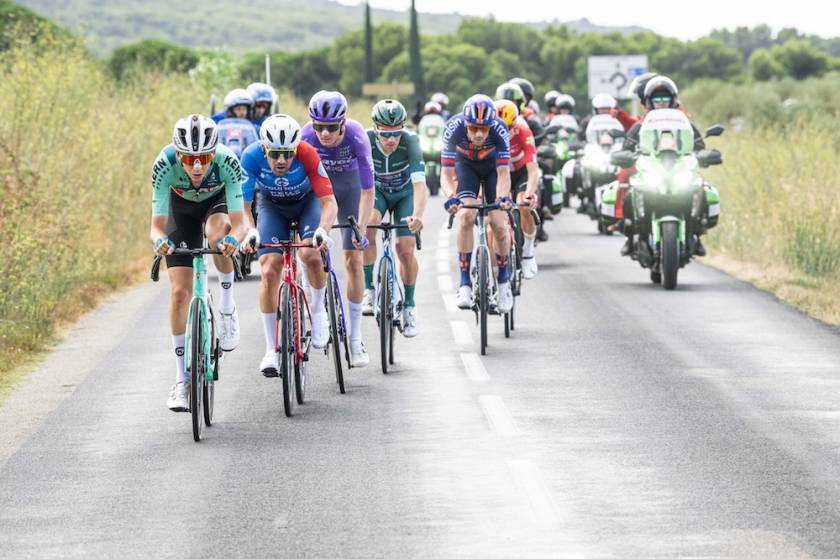
The breakaway stayed together long enough for Hayter to win the intermediate sprint at Villefranche-de-Conflent.
That extended his advantage in the points classification and continued his aggressive start to the Vuelta. After two near misses in the race for red, he had clearly decided to keep racing on the front foot rather than waiting passively in the bunch.
The peloton showed little interest in the remaining points, with UAE domestiques sweeping them up behind.
By then, the stage was beginning to turn towards the mountains. The official climb of Col de Mont-Louis still lay ahead, but the road was already rising steadily. The break’s advantage was around 2 minutes with 50 kilometres remaining, then 1:40 with 40 kilometres to go.
The escape was still alive, but the first category climb was beginning to pull the race back together.
UAE tighten the race on Col de Mont-Louis
Once the road kicked up towards the Col de Mont-Louis, UAE Team Emirates-XRG began to squeeze the breakaway.
The climb was long rather than brutally steep, rising for just under 20 kilometres at a steady gradient. That suited a controlled pace from a strong team, and UAE still had several riders around Pogačar as the gap came down.
The breakaway began to split under the pressure. Hellemose lifted the pace first, with Cort and Wenzel the only riders able to follow. Hayter, Le Gac and Roosen were dropped and soon looked likely to be caught by the peloton.
Behind them, Van Aert was distanced from the peloton with around 30 kilometres remaining, ending any realistic hope of taking the red jersey on the day. That was one of the first clear competitive consequences of the climb before the weather took over.
At that point, the stage still looked as though it might deliver the expected GC test. UAE were controlling, EF Education-EasyPost were positioned behind them for Carapaz, and the strongest riders were waiting for the upper slopes.
Wenzel goes solo in heavy rain
As the climb continued, Wenzel became the strongest rider left from the breakaway.
The Equipo Kern Pharma rider attacked Cort and Hellemose, dropping Hellemose and then eventually moving clear of Cort as well. With around 6.5 kilometres to the summit, Wenzel still held a lead of close to 50 seconds over the peloton.
It was a brave ride from a rider making his Grand Tour debut, and it briefly looked as though he might at least take the mountain points on the Col de Mont-Louis. Cort, meanwhile, was awarded the day’s combativity prize after his role in the break.
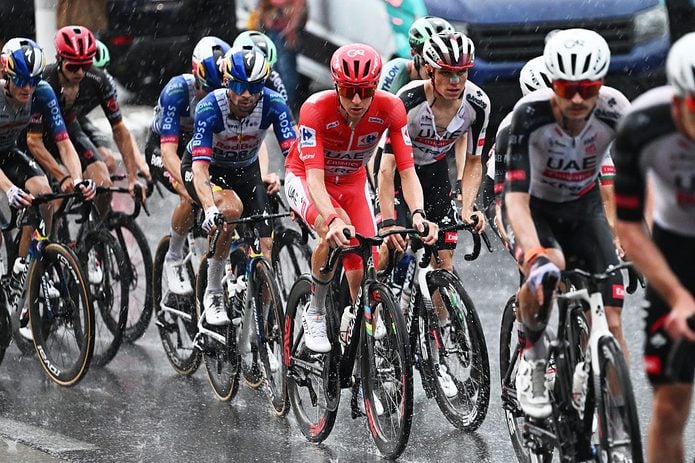
Then the weather changed the race completely. Rain intensified on the climb, television pictures became limited by signalling issues, and the conditions quickly deteriorated from difficult to dangerous.
The road had already become miserable. Then the hail arrived.
Fortunato attacks before the race is stopped
Before the neutralisation, Lorenzo Fortunato attacked from the peloton.
The XDS Astana Team rider set off in pursuit of Wenzel as the race neared the top of the Col de Mont-Louis. He was initially around 17 seconds behind the solo leader, with the peloton a similar distance behind him.
Fortunato then bridged across to Wenzel, putting two riders at the head of the race with just over 20 seconds on the bunch near the summit. In normal circumstances, that would have been the moment when the race finally began to open.
But the conditions were no longer normal. Heavy rain had turned into hail, and the riders were being pelted on the climb. Some stopped at the roadside. Others looked visibly cold as the race organisation scrambled to deal with a situation that had become unsafe.
The Vuelta had reached the point where competition was no longer the priority.
Riders seek shelter as hailstorm hits
The race was neutralised as hailstones battered the riders on the mountain.
The scenes were extraordinary. Riders sought shelter at the roadside, with the peloton scattered and no meaningful racing possible. Many were visibly cold, and the situation quickly became chaotic as they were moved into a hotel near the road.
At first, the stage was only neutralised, with the possibility that racing might restart once the storm passed. That always looked difficult. The riders were on a mountain road, soaked, cold and stopped in the middle of what should have been the decisive section of the stage.
The finish at Font-Romeu still lay ahead, but the conditions had already stripped the stage of any sporting shape. Restarting after a long pause, with riders sheltering from hail and temperatures dropping, would have created its own fairness and safety issues.
The organisers eventually made the only realistic decision.
Stage cancelled with no winner
Stage 3 was cancelled.
That meant no stage winner, no summit finish at Font-Romeu and no GC showdown on the first real mountain day of the Vuelta. The official classifications did not list a stage ranking, reflecting the fact that the race had been stopped before reaching the finish.
It was a frustrating outcome, but a necessary one. Grand Tours are built around endurance and bad weather is part of the sport, yet hail on a mountain climb is a different level of risk. Once riders are stopping to seek shelter and the bunch is no longer able to race safely, the stage cannot continue as a normal sporting contest.
For Wenzel and Fortunato, the timing was especially harsh. They were at the front of the race and close to the summit when the decision process began. For the GC riders, the first mountain test simply disappeared.
For the Vuelta, it was an extraordinary early interruption.
Pogačar remains in red
With the stage cancelled, Pogačar remains in the red jersey going into stage 4.
The UAE Team Emirates-XRG rider had looked well protected before the hailstorm. His team controlled the break, split the peloton briefly in the crosswinds, then led onto the Col de Mont-Louis with enough strength still around him to suggest they were preparing for a serious finale.
We never found out whether Pogačar planned to attack, defend or simply test the others on the Font-Romeu finish. The race was still building towards that moment when the weather intervened.
For his rivals, the cancellation removes one chance to challenge him early. Roglič, Carapaz, Onley, Almeida and the rest of the GC group will now have to wait for the next mountain opportunity.
The first meaningful climbing answers of the Vuelta remain unanswered.
Hayter’s aggressive start continues
Although the stage produced no result, Hayter’s role was again notable.
For the third successive day, he was one of the most active riders in the race. He had been second by 0.09 seconds in Monaco, then attacked on stage 2 to chase bonuses and briefly threaten red. On stage 3, he went up the road again, won the intermediate sprint and was once more virtual leader on the road before the climb began to bite.
His attack did not survive the Col de Mont-Louis, but the pattern is clear. Hayter has started the Vuelta aggressively, using every opportunity to make the race uncomfortable for Pogačar and the other favourites.
Whether that approach is sustainable across three weeks is another question. But in a race where the opening margins have been tiny, he has already become one of the main animators.
Wenzel’s chance disappears in the storm
Wenzel may be the rider who feels the cancellation most sharply.
The young Equipo Kern Pharma rider had survived the breakaway best, dropped more experienced riders and gone solo in the rain on the Col de Mont-Louis. With the summit approaching, he was in position to fight for mountain points and perhaps a place in the day’s story even if the GC riders eventually caught him.
Fortunato’s bridge changed the front of the race, but Wenzel had already shown himself strongly. On a day when his team needed visibility, he had delivered it.
The cancellation means there is no formal stage result to reward that effort, but the ride still mattered. He was the last survivor of the break, the rider who forced the peloton to chase on the first major climb, and one of the few names to emerge from a stage that ultimately belonged more to the weather than the race.
A Vuelta stage defined by weather, not tactics
Stage 3 should have been about tactics.
The breakaway had Hayter as a red jersey threat, UAE had to decide how hard to defend, the crosswinds briefly split the peloton, and the Col de Mont-Louis was beginning to reduce the race before the Font-Romeu finish. There were enough ingredients for a proper early GC confrontation.
Instead, the stage became about safety. Once the hailstorm hit, the competitive story stopped. Neutralisation was unavoidable, and cancellation soon followed.
That leaves the 2026 Vuelta in an unusual position after three days. Pogačar has won a time-trial and kept red through a hilly sprint day. Brennan has announced himself with a stage win. Hayter has attacked repeatedly. But the first mountain finish, the stage that should have clarified the climbing hierarchy, produced no winner and no final selection.
The race moves on with the GC still waiting for its first real mountain verdict.
Vuelta a España 2026 stage 3 result
Stage cancelled due to severe weather