Stage 9 of the 2026 Vuelta a España takes place on Sunday 30 August, with the race heading from La Vila Joiosa/Villajoyosa to Alto de Aitana for one of the hardest mountain stages of the opening week.
The stage covers 187.4km, with six categorised climbs and more than 5,000 metres of climbing before a summit finish on Aitana. The neutralised start is scheduled for 12:26 CEST / 11:26 BST, with the finish expected between approximately 17:14 and 17:47 CEST / 16:14 and 16:47 BST depending on the speed of the race.
UK viewers can watch the stage live on TNT Sports and HBO Max, with coverage scheduled to begin at 11:00 BST, unusually early because of the scale and importance of the mountain stage.
The complete three-week context is in ProCyclingUK’s Vuelta a España 2026 route guide.
What time does Vuelta a España Stage 9 start?
The riders roll out from Villajoyosa at:
12:26 CEST / 11:26 BST
The race then heads quickly into the Alicante mountains, with very little opportunity for the peloton to settle before the climbing begins.
The expected finish on Alto de Aitana is between:
17:14 and 17:47 CEST / 16:14 and 16:47 BST
That is a relatively wide finishing window, reflecting how much the average speed could vary on a stage containing this amount of climbing.
Vuelta Stage 9 key UK timings
| Stage event | UK time |
|---|---|
| TNT Sports/HBO Max coverage begins | 11:00 BST |
| Neutralised start | 11:26 BST |
| Recommended tune-in for mountain action | Around 13:30 BST |
| Final two hours | Around 14:15 BST |
| Alto de Aitana begins | Around 15:40-16:00 BST |
| Expected finish | 16:14-16:47 BST |
Anyone interested mainly in the general classification should aim to be watching by 15:30 BST at the latest.
The race could already be heavily reduced before Aitana begins, and waiting until the final climb risks missing important attacks on the preceding mountains.
 Photo Credit: Getty
How to watch Vuelta a España Stage 9 in the UK
Stage 9 is being shown live on TNT Sports and HBO Max.
Coverage begins at 11:00 BST, giving UK viewers almost the entire stage rather than only the final two or three hours.
That is particularly useful on this route because the early climbing should make the fight for the breakaway much more important than on a conventional mountain stage.
ProCyclingUK’s guide to watching the 2026 Vuelta a España in the UK covers the wider broadcast arrangements across the full three weeks.
Stage 9 UK viewing details
Date: Sunday 30 August 2026
Stage: La Vila Joiosa/Villajoyosa to Alto de Aitana
Distance: 187.4km
Stage type: Mountain
Neutralised start: 11:26 BST
UK coverage begins: 11:00 BST
Expected finish: 16:14-16:47 BST
TV: TNT Sports
Streaming: HBO Max
Why Stage 9 is worth watching from early in the day
This is not a mountain stage where very little happens until the final climb.
The route begins aggressively and contains repeated climbing throughout the day.
That creates two separate races.
The first is the fight to get into the breakaway.
Climbers targeting the stage win or mountains points have every reason to attack early, and because the terrain rises almost immediately, a strong group could take a long time to establish.
The second race is the general classification battle behind.
The absence of Tadej Pogačar has completely changed that contest, with Enric Mas now defending the red jersey against Felix Gall, Primož Roglič, Sepp Kuss, Oscar Onley and Richard Carapaz.
Pogačar’s exit has transformed the meaning of Stage 9
Only a day earlier, Stage 9 looked like another opportunity for Pogačar to extend a commanding lead.
His crash and abandonment on Stage 8 changed everything.
Pogačar had dominated the opening week, including an extraordinary 50km solo victory in Andorra on Stage 4.
By the end of Stage 7, he had built a lead of 3:50 over Mas and appeared to be moving steadily towards the one Grand Tour missing from his palmarès.
Then Stage 8 changed the race completely.
Pogačar crashed with around 32km remaining on the road to Xeraco and could not continue. ProCyclingUK’s report on Tadej Pogačar abandoning the 2026 Vuelta covers the incident that ended his race.
The Vuelta withdrawal tracker is also being updated as riders leave the race.
Mas now has the red jersey, while the rest of the leading contenders suddenly find themselves back within realistic striking distance.
That makes Aitana the first stage of a completely new race.
Alto de Aitana should decide the day
The final climb measures 22km at 5.8%, gaining more than 1,200 metres before the summit.
That makes it the longest sustained climbing test of the Vuelta so far.
Unlike a short summit finish, riders cannot simply wait until the final kilometre.
Aitana rewards riders capable of holding a very high pace for 40 minutes or more.
That should favour the strongest pure climbers, particularly if the preceding mountains have already weakened the group.
The lower slopes are therefore likely to matter almost as much as the final few kilometres.
A rider who begins struggling with 15km remaining still has a very long way to go.
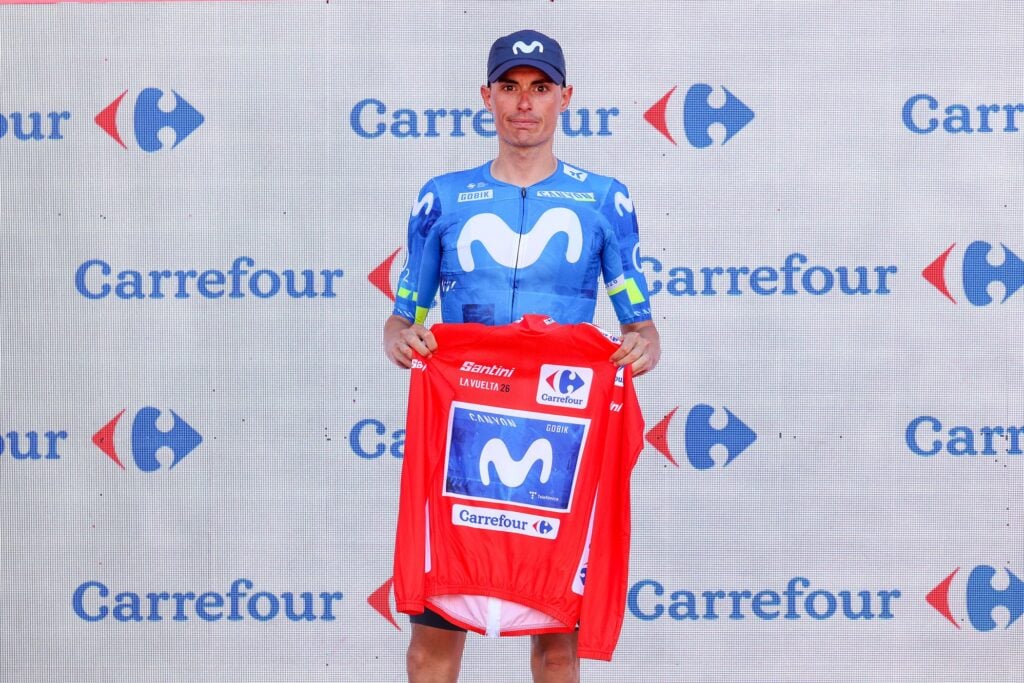 Photo Credit: Getty
Enric Mas starts his first day in red
Mas begins Stage 9 with the responsibility of defending the race lead.
That is an uncomfortable position given the route.
He has looked exceptionally strong during the opening week and was the rider who came closest to matching Pogačar on Stage 6.
Now he has to defend against several riders rather than chase one dominant leader.
The tactical problem for Movistar is deciding how much control to assume.
If they ride too hard, they could expose Mas before the final climb.
If they allow the race to become chaotic, they risk letting a dangerous GC move develop before Aitana.
That makes the opening two-thirds of the stage unusually important.
Felix Gall has every reason to make the stage brutal
Gall should welcome the route.
A long mountain stage with thousands of metres of climbing suits his strengths far better than a short, explosive summit finish.
He starts close enough to Mas that he does not need a spectacular long-range raid.
He simply needs to make the race difficult enough that differences emerge naturally.
If the final climb becomes a long threshold test, Gall could be one of the strongest riders on the mountain.
Primož Roglič is suddenly back in the race
Roglič’s position has also changed dramatically.
He had been losing ground to Pogačar but now sits close enough to the red jersey to become a genuine overall threat again.
The question is whether his climbing form is good enough.
He has not consistently looked as strong as Mas or Gall on the hardest terrain so far.
Aitana should give a much clearer answer.
If Roglič can match the best riders on a climb this long, the Vuelta becomes considerably more dangerous for Mas.
If he loses more time, the race may begin shifting towards Gall, Kuss or another contender instead.
Sepp Kuss and Richard Carapaz should attack rather than wait
Both Kuss and Carapaz have strong reasons to make Stage 9 aggressive.
Kuss is particularly well suited to long mountain climbs where sustained power matters more than acceleration.
Carapaz is tactically more unpredictable and may benefit from attacking before the obvious final climb.
Neither gains much by allowing Mas and Roglič to dictate the race until the final kilometre.
That creates a scenario where attacks could begin well before Aitana.
For viewers, it is another reason not to wait until the final half-hour.
Oscar Onley has another major GC test
Onley has been one of the strongest riders of the opening week and now finds himself firmly involved in the fight behind Mas.
Stage 9 presents a different challenge from the shorter summit finishes already raced.
Aitana is long enough to expose even a small weakness, while the amount of climbing beforehand makes recovery and pacing just as important as raw acceleration.
If Onley reaches the final kilometres with Mas, Gall and Roglič, his podium challenge becomes considerably more serious.
If he loses several minutes, the opening week begins to look more like an excellent start than the foundation for a genuine three-week GC bid.
The breakaway could still win the stage
The GC battle may dominate the headlines, but the stage victory could still come from the break.
The route is perfect for strong climbing specialists to escape early.
If Movistar are focused primarily on defending Mas rather than chasing the stage win, the break could be allowed several minutes.
The issue is how much time is enough.
Aitana is long enough that the GC group could take several minutes out of a tired escapee.
A breakaway probably needs a substantial advantage at the foot if it is going to survive.
That creates an interesting balance between stage hunters and GC teams.
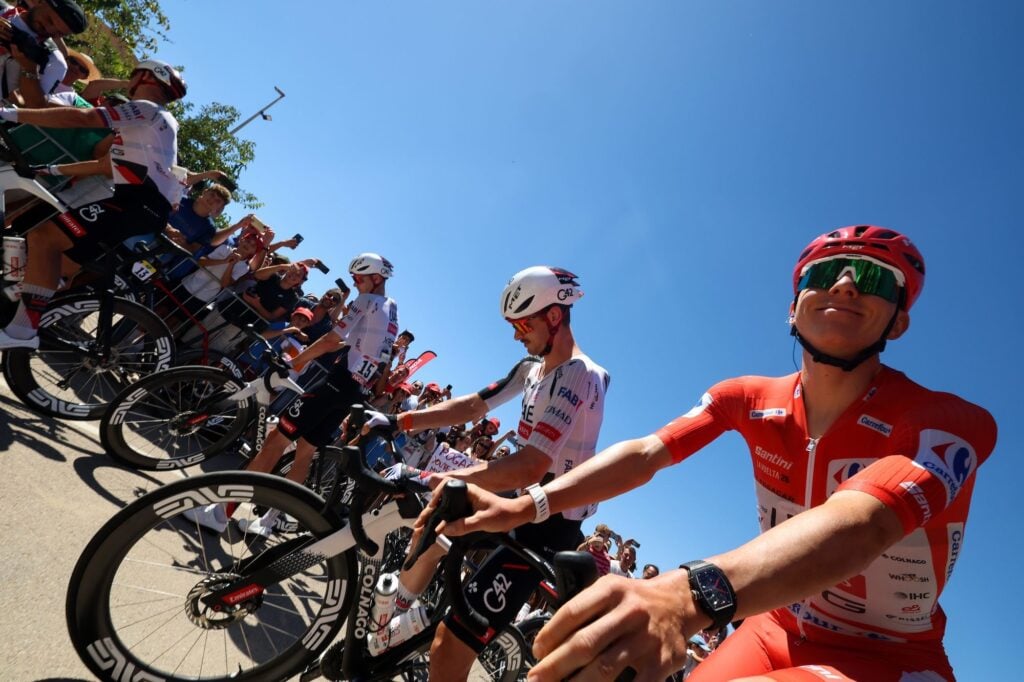 Photo Credit: Getty
The mountains classification could change dramatically
Stage 9 contains enough categorised climbing to reshape the polka dot competition as well.
A rider getting into the break can collect points across several climbs before the GC contenders even begin thinking seriously about Aitana.
That makes the early kilometres valuable for riders targeting the mountains jersey.
ProCyclingUK’s Vuelta a España 2026 jerseys guide explains how the mountains classification works alongside the red, green and white jerseys.
With so many points available, a determined breakaway rider could leave Stage 9 with a significantly stronger grip on the polka dots.
Stage 8 completely reset the Vuelta
Stage 8 had been expected to provide a much calmer afternoon for the GC riders.
The route to Xeraco was built primarily around the sprinters, with Puerto de Barx providing the only major late complication.
Instead, Pogačar’s crash became the defining moment.
Anyone following the race through ProCyclingUK’s Stage 8 live viewing and start time update had expected the late climb to determine which sprinters remained in contention.
The race that emerged afterwards could hardly have been more different.
Mas now leads a compressed GC and the first rest day comes immediately after Aitana.
There is very little reason for the main contenders to save energy.
When should you start watching Vuelta Stage 9?
There are four useful viewing points.
11:00 BST is the complete experience.
That is when TNT Sports and HBO Max coverage begins, before the stage starts. It should show the full battle for the breakaway and almost every major climb.
13:30 BST is a good option if you want the mountain stage without watching the entire day.
By then, the breakaway should be established and the stage should already be deep into the climbing.
14:15 BST is the recommended option for viewers mainly interested in the GC battle.
That gives you roughly the final two hours, enough to see how the peloton is being reduced before Aitana.
15:30 BST is the latest sensible point.
Waiting longer risks joining after important attacks have already happened.
Vuelta a España Stage 9 live viewing schedule
For UK viewers:
11:00 BST: TNT Sports/HBO Max coverage begins
11:26 BST: Neutralised start in Villajoyosa
Around 13:30 BST: Recommended tune-in for the full mountain battle
Around 14:15 BST: Final two hours begin
Around 15:30 BST: Latest recommended tune-in for GC action
Around 15:40-16:00 BST: Alto de Aitana expected to begin
16:14-16:47 BST: Expected summit finish
Stage 9 was always going to be one of the defining stages of the first week.
After Pogačar’s exit, it has become much more important.
Mas starts in red, but Gall, Roglič, Kuss, Onley and Carapaz all have realistic reasons to believe they can change the race on Aitana.
With the first rest day coming on Monday, there is very little reason for anyone to hold back.
Sunday should reveal which of the remaining contenders is ready to take control of the 2026 Vuelta.