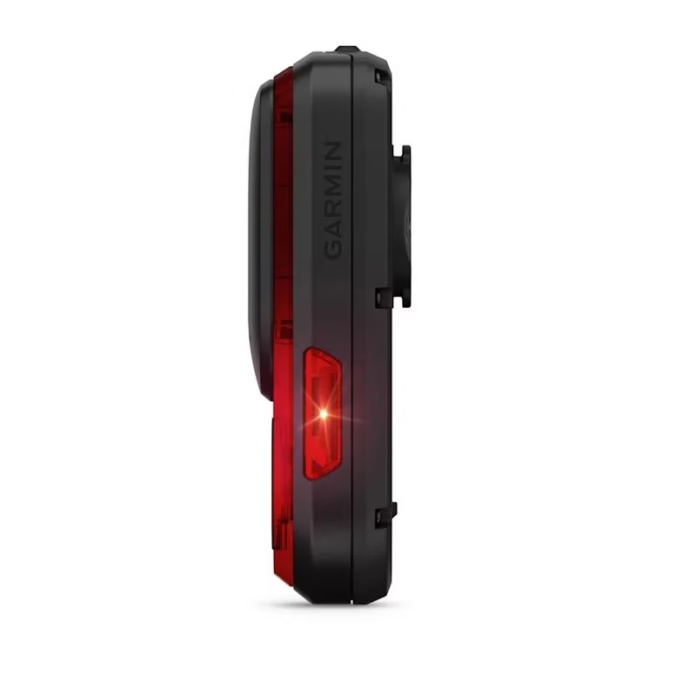
A radar rear light is one of the few cycling accessories that changes how much information you have about traffic approaching from behind. Garmin’s Varia RearVue 820 and Wahoo’s TRACKR RADAR both warn a compatible device when vehicles approach, but the difference in what they can detect, where they display it and how much they cost is substantial. Garmin lists the RearVue 820 at £259.99 in the UK, while Wahoo lists the TRACKR RADAR at £179.99.
The £80 list-price gap buys more than a brighter lamp. Garmin’s newer radar has a wider detection beam and offers vehicle size and lane-position information with supported Garmin devices or the Varia phone app. Wahoo’s unit is simpler, less expensive and widely compatible with radar-capable bike computers, but independent tests have identified occasional blind spots. This is an evidence-led comparison of specifications and published independent road tests, not a ProCyclingUK controlled head-to-head test.
Garmin RearVue 820 vs Wahoo TRACKR RADAR specifications
| Specification | Garmin Varia RearVue 820 | Wahoo TRACKR RADAR |
|---|---|---|
| UK manufacturer list price | £259.99 | £179.99 |
| Claimed radar detection | Up to 175m | Up to 150m |
| Radar beam width | 60 degrees | 35 degrees |
| Maximum light output | 100 lumens in day flash | 53 lumens in high flash |
| Quoted battery with light | 24h day flash; 10h solid | 20h low flash; 15h high flash |
| Weight | 90g | 99g |
| Water resistance | IPX7 | IPX7 |
| Charging | USB-C | USB-C |
| Phone-only radar alerts | Yes, through Varia app | No, compatible head unit/watch required |
| Vehicle size and lane data | With supported Garmin devices or Varia app | No equivalent detailed display |
The quoted battery modes are different, so 24 hours against 20 hours is not a controlled endurance comparison. Detection distances are also maximum claims, not a guarantee that every car will appear at that distance. Garmin’s marketing states 175 metres, while one of its support manuals uses 170 metres. Neither figure should be interpreted as a fixed warning distance on every road.
Why Garmin’s radar is the more ambitious system
The RearVue 820 has a 60-degree detection beam, compared with Wahoo’s 35 degrees. That broader sweep matters on bends and multi-lane roads, where a vehicle can approach from an angle rather than directly behind the saddle. Garmin also says its improved tracking can maintain awareness of vehicles moving at similar speeds. Its own documentation warns that same-speed tracking can be limited by slow speeds, heavy rain, snow, obstructions or incorrect mounting, so the feature is useful rather than infallible.
Independent BikeRadar testing found the RearVue 820 detected vehicles at an impressive measured distance and distinguished vehicle sizes and lane positions on a compatible Garmin Edge. Cycling Weekly also praised the new radar’s responsiveness and its handling of more complex traffic. The critical qualification is that the enhanced presentation does not appear on every head unit: an ANT+ radar-compatible computer from another brand will receive more conventional approach alerts rather than the full lane-and-size display.
Garmin’s Varia app is a genuine alternative for someone who does not own a cycling computer. It can show traffic information and issue alerts on a phone. That is a major difference from Wahoo, whose phone app manages settings and firmware but does not act as a standalone radar warning display. A rider who wants rear-traffic awareness without buying a head unit should not overlook this distinction.
 Photo Credit: Garmin
Wahoo’s TRACKR RADAR still does the essential job
Wahoo claims detection of approaching vehicles up to 150 metres away with a 35-degree beam. For a straightforward rural road, that can provide a useful advance warning, and the device works with Wahoo ELEMNT computers as well as other compatible ANT+ radar head units. The TRACKR has a bright dual-LED rear light, adaptive lighting options and a brake-light function that reacts to deceleration. Its £179.99 list price is considerably easier to justify than Garmin’s premium.
The independent evidence is mixed rather than uniformly negative. Cycling Weekly’s long-distance testing praised the TRACKR’s range, visibility and connectivity. Road.cc found detection generally good and appreciated its quick USB-C charging, but thought it fell short of Garmin’s established radar performance. BikeRadar reported occasional blind spots and instances where a car travelling close behind at similar speed disappeared from the display. Those observations matter more than a headline range figure alone.
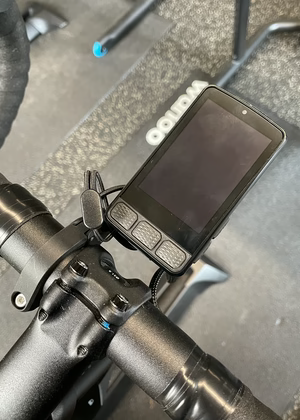
There is also an important practical limitation. Wahoo’s official support documentation says the TRACKR RADAR needs a cycling computer or sport watch that supports ANT+ radar for normal radar use. The Wahoo phone app can update firmware and configure lighting modes, but cannot substitute for that display. If you own a suitable computer already, the restriction may be irrelevant. If you rely on your phone, the apparent saving could disappear once you add the cost of a head unit.
The safety question is not which one replaces looking behind
A radar does not tell you that the road is clear enough to change lane, nor can it identify every cyclist, motorcycle or vehicle in every circumstance. Neither manufacturer presents its device as a replacement for shoulder checks, mirrors or judgement. Even a warning system that performs well in independent tests can miss vehicles on bends, behind obstructions or in complicated traffic. The value is extra awareness of approaching traffic, not permission to stop checking.
The Garmin’s wider field and enhanced tracking are meaningful advantages for busy, multi-lane roads and complex approaches. They are not a promise that every close-following vehicle will be shown. Wahoo’s narrower beam can still work well for steady rural riding, but BikeRadar’s findings are a reason to treat the warnings as one piece of information rather than an authoritative view of the road behind.
Brightness, brake lights and battery modes
The RearVue 820 can produce a 100-lumen daytime flash, with Garmin claiming visibility from up to two kilometres under suitable conditions. It offers solid, night flash, day flash and a gentler peloton mode. Garmin quotes 24 hours in day flash, 10 hours in solid or night flash and up to 30 hours in radar-only mode. A brake-light pattern signals slowing or stopping. The combination is particularly attractive to riders who switch between solo training, commuting and group rides.
Wahoo quotes 53 lumens in high flash, 21 lumens in high steady, and battery estimates ranging from 10 hours in high steady to 20 hours in low flash. It also has a brake-light feature and settings that adjust behaviour to approaching traffic. These are credible figures for a rear light that will be charged regularly, although the Garmin offers a higher maximum output and more generous quoted endurance in its own brightest flash mode.
Brightness alone does not describe how a light looks from a driver’s position. Beam shape, flash pattern, mounting angle and surrounding light all affect visibility. A lower-lumen light with a clear, well-positioned beam can be more useful than a brighter unit obscured by a saddlebag. Both units use USB-C and have IPX7 water-resistance ratings, but the charging port still needs to be kept clean and closed correctly.
Mounting on real bikes
Rear radars need a clear line of sight behind the rider. Garmin’s RearVue 820 uses a seatpost mounting system with options for common round and aero profiles. Wahoo supplies straps and several wedges for different seatpost shapes, plus a quick-connect mount. Both can be awkward if a saddlebag, rear rack or low saddle leaves little clear space. A secure mounting position is more important than a small weight difference.
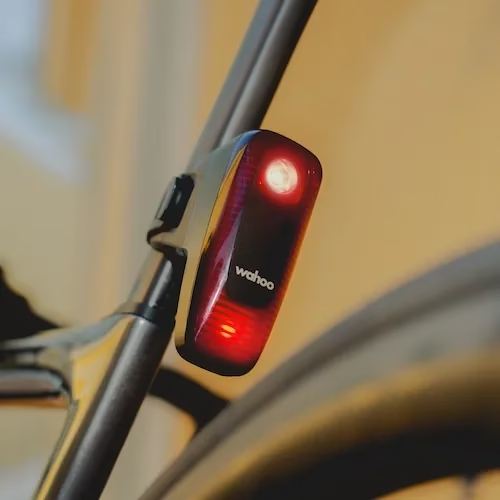 Photo Credit: Wahoo
Wahoo’s unit weighs 99g and Garmin’s 90g, a difference too small to matter on the road. BikeRadar did criticise the bulk of Wahoo’s mounting bracket, especially on smaller frames. Before buying either, look at the actual clearance between your saddle, bag and rear tyre, and check that the light will sit upright and unobstructed. A radar hidden behind a saddlebag is poor value however sophisticated its software.
What happens with a Garmin, Wahoo or phone display?
With a recent compatible Garmin Edge, the RearVue 820 can display richer information about approaching traffic, including relative lane and vehicle size. On a Wahoo or another ANT+ radar-compatible head unit, it works in the more conventional alert mode. Wahoo’s TRACKR gives standard approach warnings on compatible computers, with particularly straightforward integration into ELEMNT devices. Compatibility should be checked against the exact computer and firmware, not assumed from the brand name.
The Garmin Varia app can make the RearVue 820 a standalone radar choice for a rider who uses a phone mount. Wahoo’s companion app cannot. If you already use a Garmin Edge 540, 550, 840, 850 or another model listed as supporting the richer RearVue functions, that can make the £80 premium more attractive. If your computer only shows conventional dots for approaching vehicles, the benefit of Garmin’s more elaborate detection may be smaller.
Which radar light is better value in the UK?
At manufacturer list prices the RearVue 820 costs £80 more, but retailer discounts narrow that gap. Sigma Sports has listed the Garmin at £239 with stock shown, and Tredz has listed it at £240. These are price observations rather than guaranteed offers, and Wahoo discounts may change the difference again. Compare delivered prices and exact part numbers before deciding. The Garmin model discussed here is part number 010-03180-00, not the older RTL515 or a different regional lighting variant.
The Garmin is the stronger recommendation for someone who wants the best available vehicle detection and can use its enhanced features. It is also the clearer choice for phone-only radar alerts. The Wahoo makes sense for riders who already own an ANT+ radar-compatible head unit, want a bright rear light with basic approach warnings and would rather put the saving towards another useful piece of kit. Independent testing makes it harder to recommend purely on the claim of 150 metres of detection.
Our Garmin Varia RearVue 820 review looks at the premium model individually, while the Wahoo TRACKR RADAR review explains its everyday compromises. For other price points, the six-model radar rear light guide includes Lezyne, Magicshine, Trek and Magene alternatives.
Check the exact product before checkout
The official Garmin RearVue 820 listing and official Wahoo TRACKR RADAR listing identify the models and their manufacturer specifications. These are direct, non-affiliate links. Confirm compatibility with your own display, whether the included mount fits your seatpost and the final UK price. The decision should be based on the alerts you can actually use, not a feature that only appears with a different computer.