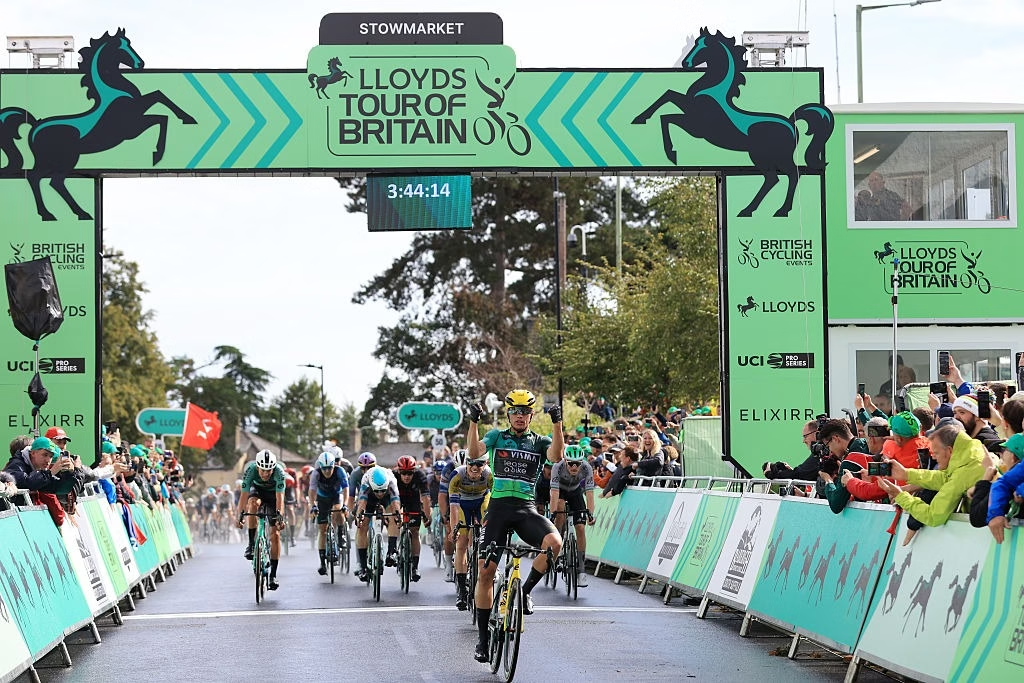
The first genuine sprint stage of the 2026 Tour of Britain arrives on Thursday, but the road from Boston to Skegness may not be quite as straightforward as its profile suggests.
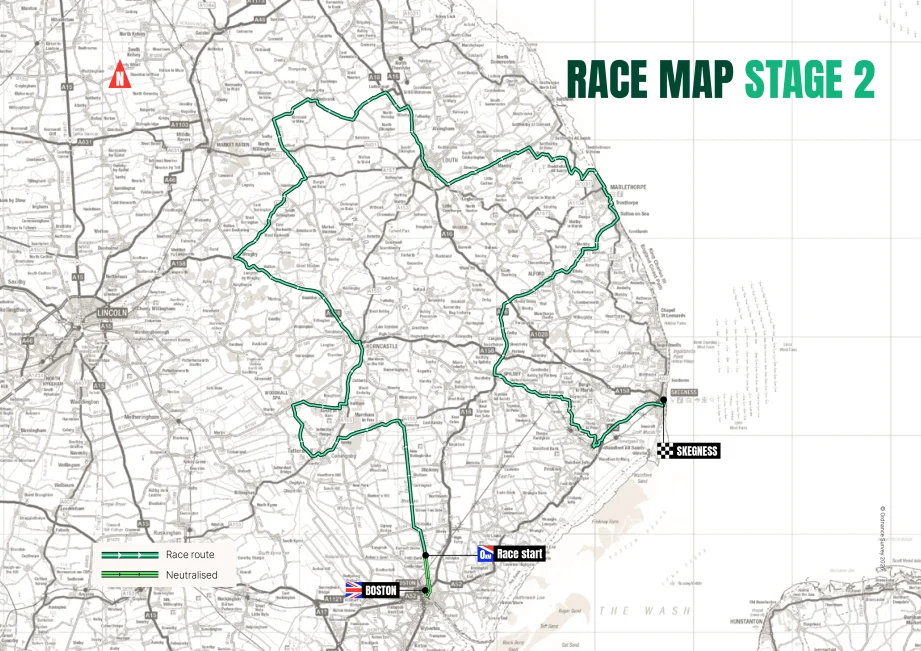
Stage 2 covers 180.2km across Lincolnshire with only 873 metres of climbing, making it comfortably the flattest day of the five-stage race. Tim Merlier and Olav Kooij consequently start as the obvious favourites, with Ethan Vernon, Sam Welsford, Matteo Moschetti and Sam Bennett among a deep group of sprinters who had little reason to spend additional energy once the opening stage exploded on Michaelgate.
The weather creates the complication. Strong westerly winds are expected across Lincolnshire, with sustained speeds around 25km/h and much stronger gusts possible on exposed roads. There is also now a chance of light rain around Skegness during the afternoon. None of that guarantees echelons, but on roads this open it gives the strongest teams another way of turning what should be a routine sprint stage into something much more nervous.
Lewis Askey begins the day in the race leader’s jersey after a superb victory in Lincoln. The NSN Cycling rider attacked on the final ascent of Michaelgate to beat Filippo Ganna by two seconds, with Tim Wellens third at the same stage-result gap. Once bonuses are included, Askey takes a nine-second GC advantage over Ganna and 11 seconds over Wellens into Stage 2.
It is exactly the sort of start suggested was possible in our Tour of Britain Men 2026 preview, where Askey was one of the British riders identified as capable of turning the race’s short climbs and tactical terrain into a serious overall challenge.
Tour of Britain Men Stage 2 at a glance
| Detail | Stage 2 |
|---|---|
| Date | Thursday 3 September 2026 |
| Start | Boston |
| Finish | Skegness |
| Distance | 180.2km |
| Elevation gain | 873m |
| Stage type | Flat |
| Race start | 10:30 BST |
| Expected finish | Around 15:05 BST |
| Main favourites | Tim Merlier, Olav Kooij |
| Main threat | Wind and possible crosswind splits |
Boston and Skegness are only around 35km apart directly, but the Tour takes a far longer route north through Lincolnshire before turning back towards the coast. Both towns are hosting the modern men’s Tour of Britain for the first time, although Skegness was a regular stop during the Milk Race era.
The wider story of how the race developed from those earlier British stage races into the modern event is covered in ProCyclingUK’s history of the Tour of Britain.
Stage 1 changed the GC immediately
The opening stage did considerably more damage than a first day containing only 1,393 metres of climbing might have suggested.
Repeated passages of Michaelgate progressively stripped the peloton apart before an 11-rider group emerged at the front during the final 40km. Wellens, Matteo Trentin and Kim Heiduk all tried to use the tactical hesitation before Florian Vermeersch attacked inside the final 2km, only for the final ascent to turn the race again.
Askey produced the decisive acceleration on Michaelgate, passed the remaining attackers and held off Ganna to take both the stage and the first leader’s jersey. It was another significant step in the progression of a rider who had already broken through with his first professional victories before joining the structure now known as NSN Cycling.
The general classification now contains meaningful gaps before the race has even reached Yorkshire.
| Position | Rider | Team | Gap |
|---|---|---|---|
| 1 | Lewis Askey | NSN Cycling Team | Leader |
| 2 | Filippo Ganna | Netcompany INEOS | +9s |
| 3 | Tim Wellens | UAE Team Emirates-XRG | +11s |
| 4 | Daan Hoole | Decathlon CMA CGM | +20s |
| 5 | Matteo Trentin | Tudor Pro Cycling Team | +21s |
| 6 | Jasper Stuyven | Soudal Quick-Step | +22s |
| 7 | Florian Vermeersch | UAE Team Emirates-XRG | +24s |
The most striking pre-race casualty was Benoît Cosnefroy, who lost more than four minutes and has effectively disappeared from the central GC battle after beginning the week as the leading overall favourite. Askey, Ganna and Wellens now occupy a much stronger position than expected before Lincoln.
Stage 2 should not create gaps through climbing, but the wind means none of them can afford to treat Thursday as a recovery day.
The sprinters effectively took the final part of Stage 1 off
For Kooij, Merlier and the other pure fast finishers, Wednesday’s GC gaps are largely irrelevant.
Once Michaelgate and the aggressive front group had taken the stage victory out of reach, there was no reason to continue spending energy simply to limit a general classification deficit that did not matter. Kooij eventually finished 4:39 down, while Merlier also came home well behind the decisive group. Welsford and Vernon conceded even more once their chances of contesting the stage had disappeared.
Those gaps simplify Stage 2.
Kooij is no longer a plausible GC wildcard, something that had been an interesting possibility before the race. Merlier can concentrate entirely on his sprint rather than preserving a position of his own, while Vernon has the unusual situation of chasing a stage victory for the same team that now needs to defend the race lead.
For most of the sprinters, Thursday is effectively a fresh start.
The route heads north before turning towards the coast
The stage begins in Boston at 10:30 BST, with the peloton initially heading north rather than taking the obvious direct road towards Skegness.
The race passes through Coningsby, Woodhall Spa, Horncastle and Wragby before heading back into the Lincolnshire Wolds. From there, the route moves towards Louth and eventually reaches the coast around Mablethorpe and Sutton-on-Sea before turning south towards Skegness.
There are two classified climbs around the middle of the stage. Kirmond Road measures roughly 700 metres at 6.7%, while Rothwell Hill is around 1.6km at 3%. Neither is remotely difficult enough to trouble the main sprinters through climbing alone.
Their importance comes from where they sit within a stage full of exposed roads and repeated changes of direction. If the wind has already stretched the peloton, even a modest rise can make it harder for a chasing group to regain contact.
That is the theme of Stage 2. The terrain itself is easy. The roads may not be.
The coast could make Stage 2 much more nervous
The route becomes particularly exposed as it approaches Mablethorpe, Sutton-on-Sea and the Lincolnshire coast.
That is where the GC teams will be looking closely at the wind direction rather than the altitude profile.
A westerly wind around 25km/h, combined with stronger gusts, is more than enough to create problems when the road turns across it. Not every section produces a favourable echelon angle, and long stretches may actually become easier if riders are travelling directly into a headwind or have enough shelter within the bunch.
The danger comes from the transitions. A peloton can spend half an hour riding steadily before one turn exposes the entire field and suddenly makes the first 20 positions worth fighting for.
That gives Stage 2 a very different character from a conventional flat sprint day. Everyone expects the race to end together, but nobody can safely ride as though it definitely will.

Could UAE or INEOS deliberately split the race?
They have reasons to try if the opportunity appears.
Wellens begins only 11 seconds behind Askey, while Ganna is even closer at nine seconds. Neither needs a climb to take time if the race offers them a crosswind opportunity instead.
Netcompany INEOS are particularly dangerous on this terrain. Ganna is one of the most powerful riders in the peloton on flat roads, while Connor Swift, Ben Swift and Kim Heiduk give the team plenty of experience in difficult positioning and exposed racing. Ganna was already identified before the race as one of the riders who would need to create opportunities away from the conventional climbing stages, and Stage 1 confirmed how close he is to the leader.
UAE have similar firepower through Wellens, Vermeersch, Nils Politt and Mikkel Bjerg. If the road turns and Askey is poorly positioned, there is little incentive for either squad to politely wait.
The final Tour of Britain team line-up always suggested the WorldTour teams would possess a major advantage if the race became a battle of numbers and raw power. Crosswinds are one of the clearest situations in which that depth can matter.
NSN consequently have two simultaneous objectives. Vernon wants a sprint, but Askey now has a race lead worth protecting. Fortunately, keeping Askey near the front is largely compatible with positioning Vernon until the final kilometres. The problem begins if NSN have to expend half their team chasing a split before the sprint train ever becomes relevant.
Langton Hill should not stop the sprint
After the coastal roads, the route briefly turns inland before returning towards Skegness.
There is enough rolling terrain to prevent the final hour becoming completely featureless, but nothing that should remove Kooij or Merlier through climbing alone. The final kilometres flatten significantly as the riders approach the resort.
The more interesting possibility is that a short rise helps maintain a split that has already been created by the wind. A group of 20 strong riders can use even relatively modest terrain to continue forcing the chase behind, particularly if several GC teams are represented at the front and therefore have no interest in helping close the gap.
If the peloton remains intact, however, the final section overwhelmingly favours the sprinters.
The final 3km in Skegness favour outright speed
The finish comes on Grand Parade, alongside the Skegness seafront, with the race expected to arrive at approximately 15:05 BST.
The riders approach through Lumley Road before reaching the final finishing stretch on Grand Parade. The closing 3km are essentially flat, making this the purest speed test of the 2026 Tour of Britain.
That distinction matters because Friday’s Stage 3 into Beverley is more complicated. There is substantially more climbing and an uphill element to the finish, giving stronger sprinters and Classics riders a better chance of disrupting Merlier.
Skegness is the stage where the pure fast men should have the fewest excuses.
Tim Merlier gets the finish he wants
If Stage 2 reaches the final kilometre with a conventional peloton, Tim Merlier is arguably the rider to beat.
The Belgian has built a career around precisely this type of finish: flat, fast and increasingly frantic inside the final 3km. His three victories at the 2026 Tour de France reinforced that there are very few riders capable of matching his top-end speed when he begins his sprint from a good position.
Merlier also had no reason to chase the Michaelgate selection on Wednesday. Once the opening stage stopped being relevant to him, saving energy for Boston to Skegness was considerably more useful than trying to lose two minutes rather than four.
Soudal Quick-Step’s wider race does create one complication. Jasper Stuyven remains only 22 seconds behind Askey, while Ilan Van Wilder is still expected to become more relevant when the race reaches Yorkshire. The team cannot simply ignore crosswind threats in order to place every rider around Merlier.
If the bunch reaches Skegness together, though, Merlier becomes the clearest reference point.
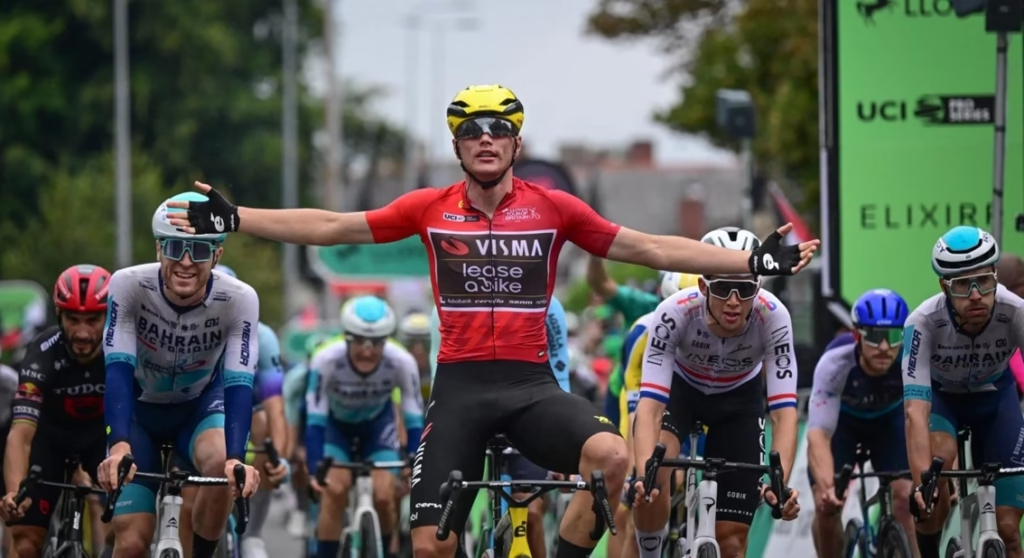 Photo Credit: Cor Vos
Olav Kooij has history on his side
Olav Kooij has become almost synonymous with Tour of Britain sprinting.
The Dutchman already has seven career stage victories at the race and needs three more to draw level with Mark Cavendish’s men’s record of ten. He won the opening stage of the 2025 Tour of Britain in Southwold before eventually collecting three victories during the week.
Stage 2 is the obvious place to begin his 2026 account.
Kooij is racing his first Tour of Britain for Decathlon CMA CGM after signing a three-year contract with the French team. Cees Bol was recruited alongside him and provides an experienced finishing ally, while Daan Hoole’s fourth place overall gives Decathlon another interest in staying near the front if crosswinds develop.
The key question is whether Kooij can beat Merlier on a finish decided almost entirely by speed. Kooij’s broader durability usually becomes more valuable when a stage contains enough difficulty to remove some of the pure sprinters. Skegness offers little of that unless the wind does the selection for him.
That places even greater importance on Decathlon’s positioning during the final kilometre.
Ethan Vernon has another chance to end his Tour of Britain wait
Ethan Vernon has repeatedly come close at the Tour of Britain without taking a stage victory, and Thursday provides another strong opportunity.
His large Stage 1 deficit says little about his sprinting condition. Once teammate Askey had made the decisive selection and Vernon was no longer capable of reaching the finish with the favourites, there was no reason to spend unnecessary energy on the Michaelgate circuits.
NSN now have the pleasant complication of defending the race lead while trying to win a bunch sprint with somebody else.
Vernon probably needs either exceptional positioning or a slightly disrupted finish to beat both Merlier and Kooij on pure speed. The wilder the final few kilometres become, the more likely he is to find a route past the two favourites.
A second British victory in two days would also turn an already excellent start to the race into something much bigger for NSN.
 Photo Credit: Getty
Sam Welsford gives Netcompany INEOS a genuine sprint option
Netcompany INEOS face a similar balancing act.
Ganna is nine seconds behind Askey and cannot afford to miss a crosswind split simply because the team is concentrating on Sam Welsford. At the same time, the Australian is a specialist sprinter and Skegness is one of his clearest opportunities of the entire week.
His Stage 1 result does not matter. Like Merlier and Kooij, Welsford was able to conserve energy once the race had escaped him on the Michaelgate circuits.
The bigger question is how many resources INEOS are prepared to commit to his lead-out. Ben Swift and Connor Swift are exactly the sort of riders who can guide a sprinter across exposed roads, but they are also valuable for keeping Ganna out of trouble.
Ben Swift is additionally riding his final Tour of Britain after announcing that he will retire at the end of the 2026 season, giving the team’s home race another layer of significance.
Bennett and Moschetti give Pinarello Q36.5 two options
Sam Bennett and Matteo Moschetti give Pinarello Q36.5 two credible possibilities in Skegness.
Both can win a flat sprint on the right day, although neither starts at the same level of expectation as Merlier or Kooij. Bennett brings enormous experience and a long record of victories at the highest level, while Moschetti has enough outright speed to profit from a disorganised finish.
The danger is tactical ambiguity.
Having two quick riders is useful earlier in a stage, especially if one is caught behind a split, but the team will need clarity once the race reaches the final kilometres. Two riders independently searching for wheels can easily become two riders finishing between fifth and 15th.
A conventional bunch finish should favour one clearly protected option.
Askey’s main objective is staying out of trouble
Askey does not need another victory on Thursday.
His race changed the moment he rode away on Michaelgate. He is now the Tour of Britain leader with Ganna nine seconds behind and Wellens at 11, and protecting that position matters more than trying to become involved in a mass sprint against Merlier and Kooij.
His main threat is not the terrain but a moment of poor positioning. A crosswind split containing Ganna or Wellens would force NSN into an expensive chase, while a crash on narrow or wet roads could do much more damage than either classified climb.
The bonus seconds should be largely irrelevant unless one of the GC contenders finds an unexpected route into the sprint.
If the main peloton reaches Grand Parade together, Askey should remain in the leader’s jersey regardless of who wins Stage 2.
The weather may decide whether this is routine or chaotic
The current forecast makes the wind the central tactical issue, with a westerly breeze expected to strengthen across the exposed Lincolnshire roads and gusts capable of producing significantly more pressure than the average speed suggests.
There is also now some possibility of light rain around Skegness during the afternoon, which could add slippery roads to the positioning battle during the approach to the coast. Temperatures should remain relatively mild rather than creating any additional physical problem.
The wind direction matters more than the headline number. Long stretches may pass without incident when the road provides shelter or points directly into the breeze. The danger is a sudden exposed crosswind or cross-tailwind section where UAE, INEOS or another powerful team can accelerate before everyone further back has reacted.
That makes Stage 2 one of those days where very little may happen for 150km and yet the GC teams still cannot switch off for a minute.
How Stage 2 is likely to unfold
A small breakaway should be allowed to form relatively early, with the Continental teams having obvious reasons to spend time at the front on the flattest day of the race. Decathlon CMA CGM and Soudal Quick-Step should then carry much of the responsibility for keeping the advantage under control, with NSN contributing if necessary while Askey wears the race leader’s jersey.
The two classified climbs are unlikely to alter the sprint field. The important phase begins once the route reaches the more exposed roads towards Louth and the coast, where every change of direction becomes a potential cue for UAE or Netcompany INEOS to increase the pressure.
Any split may prove temporary because the stage lacks sustained climbing, but temporary is enough if Askey, Ganna or Wellens is on the wrong side of it. The GC teams cannot assume everything will naturally regroup.
If the wind fails to create a decisive separation, the race should be largely back together for the run towards Skegness. From there the advantage passes to the sprint trains, and everything points towards a direct contest between Merlier and Kooij on Grand Parade, with Vernon and Welsford waiting for either favourite to make a mistake.
Wednesday belonged to Askey and the attackers. On the flattest roads of the 2026 Tour of Britain, Thursday should belong to the fastest riders in the race.