
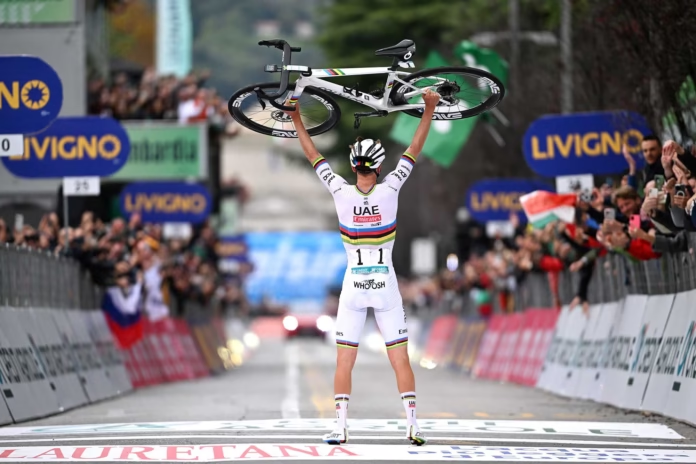
Il Lombardia returns to Como for its 120th edition with a route designed to keep the climbing coming almost from the moment the race leaves Bergamo. The 2026 race takes place on Saturday 10 October and covers 239km, with around 4,600 metres of elevation gain spread across nine climbs.
The direction is reversed from 2025, taking the peloton from Bergamo towards Lake Como before a demanding final hour built around the Madonna del Ghisallo, San Fermo della Battaglia and Civiglio. There is no Colma di Sormano this time, but the replacement is hardly forgiving. The final 28km contain three separate climbs and very little opportunity for riders to recover between them.
The last section closely resembles the Como finale used in 2022. San Fermo is climbed once before the riders cross the finish line, Civiglio follows almost immediately and San Fermo then returns for a second ascent with only five kilometres remaining. That structure creates several possible attacking points rather than one obvious place where everybody has to wait.
It will also produce a new winner. Tadej Pogačar has won the previous five editions but his 2026 season was ended by injuries suffered at the Vuelta a España. His absence changes the tactical picture considerably on a course where waiting until the final climb may carry much more risk than it did when one dominant favourite controlled the race. For the wider background to the Monument, see our beginner’s guide to Il Lombardia 2026 and history of Il Lombardia.
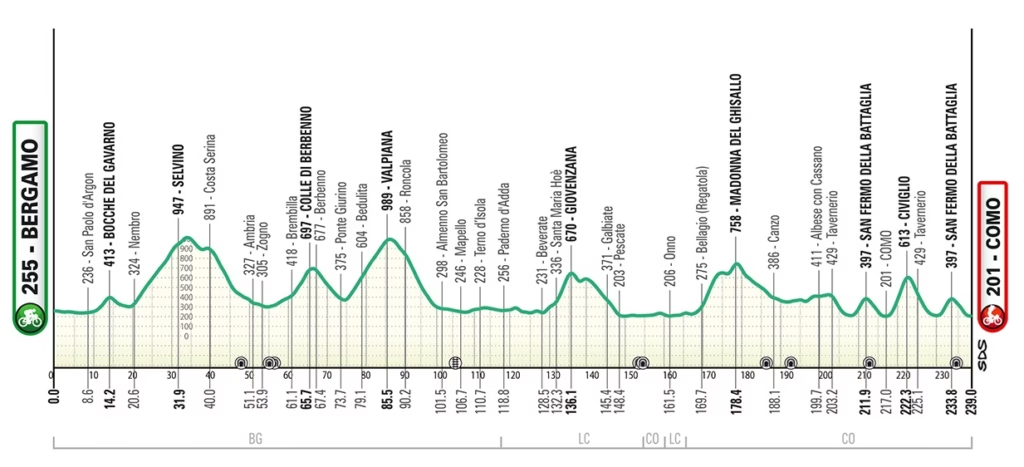
Il Lombardia 2026 route at a glance
| Detail | Il Lombardia 2026 |
|---|---|
| Date | Saturday 10 October 2026 |
| Start | Bergamo |
| Finish | Como |
| Distance | 239km |
| Elevation gain | Approximately 4,600m |
| Number of climbs | 9 |
| Ghisallo summit | 60.6km to go |
| First San Fermo summit | 27.1km to go |
| Civiglio summit | 16.7km to go |
| Final San Fermo summit | 5.2km to go |
The opening kilometres from Bergamo
There is very little time for Il Lombardia to settle into a comfortable rhythm. After leaving Bergamo and heading towards Val Seriana, the riders get only a short relatively flat opening before the first climb begins to change the shape of the race.
Colle dei Pasta is the first obstacle, with the route cresting at Bocche di Gavarno after only 14.2km. It is unlikely to decide anything directly, but its position matters. Breakaway riders will want to use the opening climbs to establish a move, while teams with ambitions later in the race will already have to decide how much freedom to give them.
The terrain then becomes substantially harder on the way to Selvino.
Selvino begins the long process of wearing riders down
The climb to Selvino is 10.1km long at an average of 5.9%, gaining almost 600 metres before reaching its summit with just over 207km still to race.
The numbers are not severe by Lombardia standards, with a maximum gradient of around 9%, but that is not really its function. Selvino comes early enough that the strongest riders should remain comfortable, while domestiques and breakaway riders begin accumulating fatigue that will matter much later.
Its long series of hairpins also introduces one of the recurring themes of the route. This is not simply a climbing race. Positioning through bends, descending and maintaining contact when groups stretch out will be important throughout the day.
The peloton descends before heading towards another sequence of climbing roads around Colle di Berbenno.
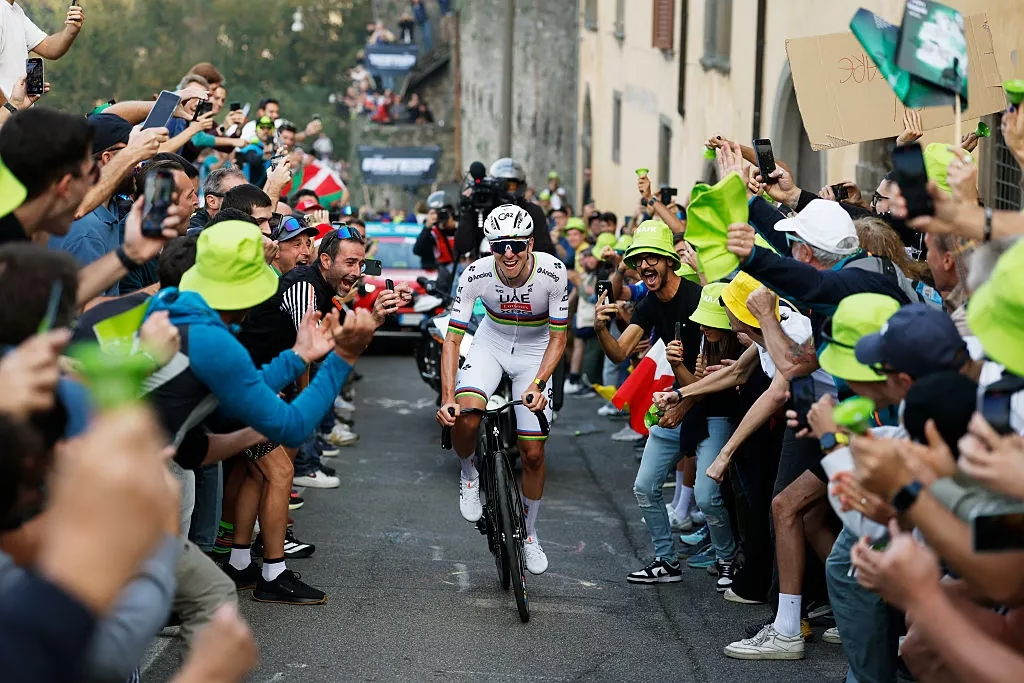 Photo Credit: Getty
Berbenno and Valpiana keep the pressure on
Colle di Berbenno is crested after 65.7km before the race drops again and starts the long climb towards Valpiana.
Valpiana is another substantial early test at 10.1km and 6.2%. The maximum gradient reaches 10%, with the summit coming after 85.5km of racing and still more than 150km from Como.
That distance from the finish means the climb is unlikely to trigger a serious move from the main contenders. What it can do is remove weaker domestiques and ensure nobody reaches the decisive final third with completely fresh legs.
By this point the race has already contained four separate climbs in fewer than 90km. There is still considerably more than half of Il Lombardia to come.
Giovenzana is the first genuinely sharp climb
The terrain becomes more explosive when the route reaches the Giovenzana side of Colle Brianza.
Giovenzana is only 3.6km long but averages 9.2%, making it a very different proposition from Selvino or Valpiana. The first 2.85km average around 10.5% and the steepest ramps reach 16% before the gradient eases towards the top.
The summit at Giovenzana comes with around 103km remaining, followed shortly afterwards by the high point at Colle Brianza before the fast descent towards Lecco.
This is still too far from Como to expect the main favourites to commit fully, but it is a useful point for stronger teams to begin applying pressure. A hard pace here can remove support riders before the approach to Lake Como and force rivals to spend energy earlier than planned.
The race changes character on the road to Bellagio
After descending towards Lecco, Il Lombardia finally offers a more sustained spell away from the steepest roads. The route follows Lake Como towards Bellagio, giving teams an opportunity to reorganise before one of the race’s most famous climbs.
This section matters tactically. Any breakaway that survived the opening hills needs enough advantage to reach the Ghisallo with a realistic chance of staying ahead, while the major teams have to decide whether to begin closing the gap before the climbing resumes.
Once the race reaches Bellagio, the relatively calm section is over.
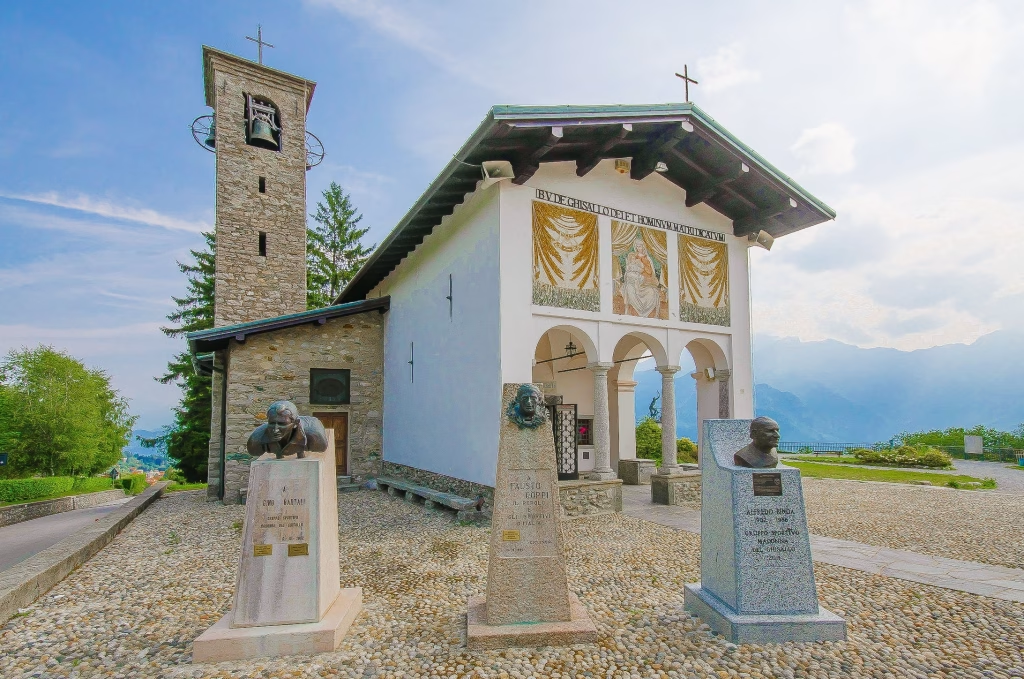
Madonna del Ghisallo: 8.6km with a deceptive profile
The Madonna del Ghisallo is one of the climbs most closely associated with Il Lombardia, but its average gradient hides how uneven it is.
The official profile measures 8.6km at 6.2%, with 532 metres of elevation gain. The opening 4.25km are much harder, averaging around 9.3% and containing ramps of up to 14%.
The road then flattens considerably through the middle of the climb. For more than two kilometres the gradient is minimal in places, providing a short opportunity to recover before the road rises sharply again towards the summit.
The final two kilometres average roughly 8.6%, with gradients reaching around 12%.
The summit comes after 178.4km, leaving **60.6km to the finish**.
That position creates one of the biggest tactical questions of the entire route. The Ghisallo is hard enough for an elite climber to create separation, but there is still a long way to Como. Anyone attacking here needs either enough strength to commit to a long solo ride or cooperation from a small group behind the summit.
The absence of Pogačar may make that calculation more interesting. His ability to turn distant attacks into prolonged solo efforts has shaped recent editions, but there is no obvious reason for the rest of the field to reproduce that approach automatically.
The descent from the Ghisallo
Descending is an important part of the 2026 route rather than simply the road connecting one climb with the next.
The descent from the Ghisallo is fast and contains several long straight sections. Riders who crest in small groups can use the downhill section to extend gaps, while anyone losing contact near the summit may find that the race does not come back together simply because the climbing has finished.
The road continues generally downhill towards Como before the race enters its decisive final circuit.
San Fermo della Battaglia arrives for the first time with 29km to go
The first ascent of San Fermo della Battaglia begins the final sequence.
San Fermo measures 2.7km at an average of 7.2%, gaining 195 metres. The maximum gradient is 10%, and the road becomes narrow enough that position near the front will matter before the climbing even starts.
The summit is reached after 211.9km, leaving **27.1km to race**.
On its own, San Fermo is not the hardest climb of Il Lombardia. Its importance comes from where it sits. There has already been more than 200km of racing and thousands of metres of climbing, while Civiglio is waiting almost immediately afterwards.
An acceleration here could force the contenders into much smaller groups before the hardest climb of the finale rather than allowing everyone to approach Civiglio together.
 Photo Credit: Getty
The riders cross the finish before Civiglio
After the first San Fermo ascent, the race descends into Como and crosses the eventual finish line with around 22km remaining.
That passage gives the riders an early look at the finishing straight, but there is almost no time to think about a sprint. Around one kilometre later the road begins rising towards Civiglio.
This is where the 2026 route becomes especially difficult to control.
Civiglio is the hardest climb of the finale
Civiglio is only 4.2km long, but its average gradient of **9.7%** makes it the clearest place for pure climbing strength to create separation.
The climb gains 406 metres and is remarkably consistent. Kilometre after kilometre sits around 9-10%, with several sections above 10% and a maximum gradient of around 14%.
There is very little respite.
The summit sits at an altitude of 613 metres and comes with **16.7km remaining**.
If several favourites have stayed together through the Ghisallo and first San Fermo, Civiglio is the obvious place to change that. A four-kilometre effort close to 10% after more than five hours of racing is long enough to create meaningful gaps but short enough to encourage repeated attacks rather than a steady mountain tempo.
The road also narrows significantly towards the summit, making position important before the final part of the climb.
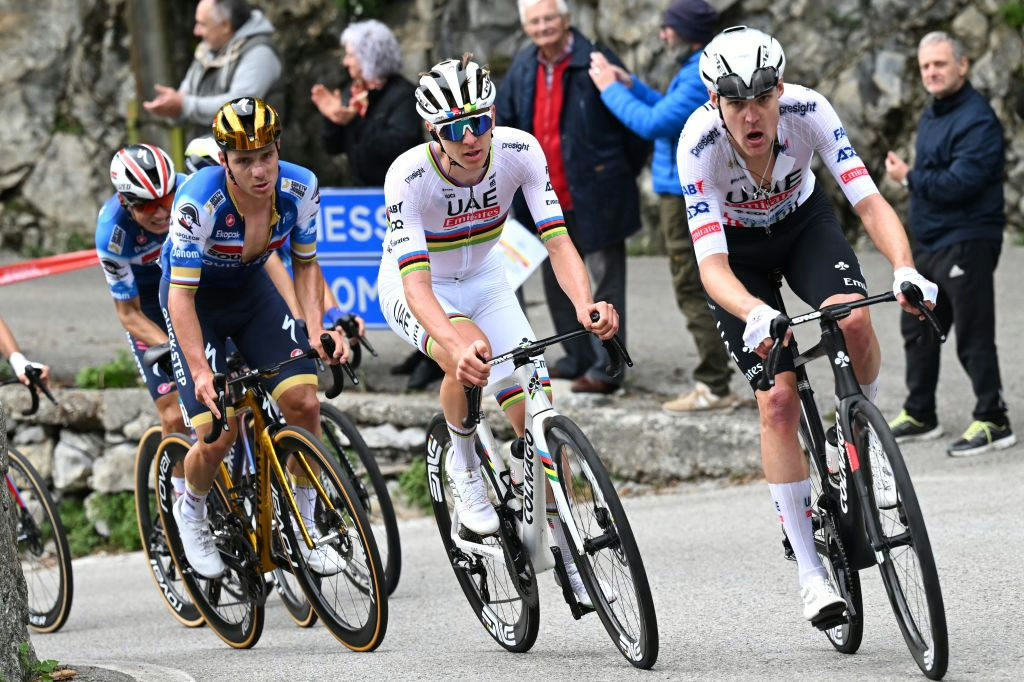
The Civiglio descent can be as important as the climb
Reaching the top of Civiglio with a gap does not automatically decide the race.
There are still nearly 17km remaining and San Fermo has to be climbed again. A lone leader therefore has to balance an aggressive descent against the need to save enough energy for one final uphill effort.
A small chasing group faces the opposite problem. Cooperation can bring an attacker back, but every rider knows another selection is coming. That can quickly undermine the chase if nobody wants to do work for a faster rival.
The result is a section where gaps of only a few seconds can become tactically significant.
Final San Fermo: the last climbing chance
San Fermo della Battaglia returns for the second time after the race has crossed back through Como.
The statistics are unchanged: 2.7km at 7.2%, with a maximum gradient of 10%. The context is completely different.
This time the summit is only **5.2km from the finish**.
Anyone who still has an attack left has very little reason to wait. A rider reaching the top alone has a short descent and brief run through Como separating them from victory, while a small group that stays together has to start thinking immediately about positioning for the finish.
The road surface is rougher on the climb and the road itself narrows, particularly through the hairpins. That makes moving up difficult once the pace increases.
The final 5km into Como
The last San Fermo summit comes just over five kilometres from the line.
From there the riders descend on a relatively wide and well-surfaced road. The route passes through two illuminated tunnels and two large roundabouts before the descent finishes inside the final kilometre.
There is one final broad left-hand bend with around 600 metres remaining before the road straightens towards the finish.
If a small group reaches this point together, the race becomes a very different contest from everything that preceded it. After 239km and 4,600 metres of climbing, riders who are normally strong sprinters may have very little acceleration left, while climbers who would rarely contest a conventional sprint can become dangerous.
What the Il Lombardia 2026 route means for the race
The most important feature is not simply the 4,600 metres of climbing. It is how the difficulty is distributed.
Selvino, Berbenno and Valpiana make it difficult to reach the second half of the race completely fresh. Giovenzana provides a much sharper effort before the race reaches Lake Como. The Ghisallo then starts the serious tactical phase with more than 60km still remaining.
From there, the riders have several choices.
A strong climber can try to use the Ghisallo for a long-range attack. A team with numbers can make the first San Fermo difficult and try to isolate rival leaders. Civiglio offers the best opportunity to create a gap through sustained climbing power, while the final San Fermo gives punchier riders one last chance to attack without having to defend a move for very long.
That variety distinguishes this route from versions of Lombardia built more clearly around one major final climb.
The omission of the Sormano also matters. In 2024, Pogačar used the Colma di Sormano as the platform for the attack that carried him towards his fourth consecutive victory. The 2026 course instead concentrates more of the decisive action inside the final half-hour around Como.
With Pogačar ruled out for the remainder of the season following his Vuelta crash, there will also be no defending champion capable of forcing everybody else to race around one overwhelming favourite. His five consecutive victories from 2021 to 2025 have taken him level with Fausto Coppi on five Lombardia wins, a run covered in more detail in our history of Il Lombardia. His attempt to move clear of Coppi will have to wait after the injuries that ended his 2026 season.
That should leave the tactical initiative much more open on 10 October. The route provides enough climbing for the strongest riders to separate themselves, but no single point where the race has to be won.
Ghisallo can start it. Civiglio can break it apart. San Fermo can still change everything with five kilometres remaining.

