
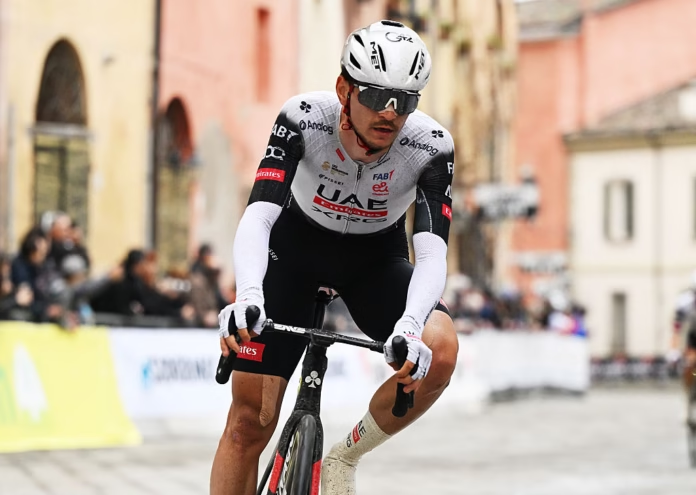
Alessandro Covi won the 2026 Giro del Veneto for Team Jayco AlUla, with Anthon Charmig taking second and Benoît Cosnefroy completing the podium. The result followed a race that moved through three distinct phases: an eight-rider breakaway, a gradual reduction of that move, and a succession of late attacks that kept the front of the peloton unsettled into the final kilometres.
The early escape gave the race its first structure, but it did not survive intact. By 61 kilometres remaining, three of its members had been dropped, while Pavel Sivakov was already counter-attacking from the peloton. UAE Team Emirates – XRG then took a visible role in the chase, and the final 14 kilometres became a sequence of attacks involving Brandon McNulty, Fabio Christen and several other contenders.
Covi ultimately emerged ahead of Charmig and Cosnefroy, while Christen finished fourth and Christian Scaroni fifth. The final order reflects a race in which the original breakaway was gradually dismantled, the peloton repeatedly changed shape, and the decisive moves came too close to the finish for any single chase to settle the outcome early.
How it unfolded
An attack in the peloton was recorded with 150 kilometres remaining before an eight-rider move formed at 137 kilometres. Tommaso Nencini, Francesco Carollo, Giacomo Garavaglia, Kevin Pezzo Rosola, Thomas Rossetti, Leonardo Volpato, Riccardo Lorello and Andrea Scarso made up the escape, bringing a broad mix of teams into the first major break of the race.
The move was followed by a crash involving Marco Martín in the peloton with 136 kilometres left. The incident was recorded separately from the breakaway and did not, on the available race sequence, establish a direct connection with the final result. At the front, the eight riders continued as the main escape group through the next phase.
By 92 kilometres remaining, Scarso had been dropped from the breakaway. The reduction mattered because the escape was no longer moving as a complete unit, even though Scarso was not caught by the peloton until 76 kilometres remained. The race therefore had its first clear split between the surviving leaders, a detached breakaway rider and the bunch behind.
The early breakaway loses its shape
The breakaway’s decline became more pronounced with 61 kilometres to go, when Nencini, Pezzo Rosola and Rossetti were dropped. That left only part of the original eight-rider group at the front, while the peloton began to dictate the next phase of the race.
Nencini and Pezzo Rosola were still not caught immediately. Their return to the peloton was recorded at 53 kilometres remaining, confirming that the chase had taken time to complete the work of gathering in the remnants of the early move. The first break had now been stripped of its original numerical advantage and was no longer the central force in the race.
That transition coincided with a change in the type of racing. At 59 kilometres remaining, Sivakov launched a counter-attack from the peloton, and at 44 kilometres he was recorded pulling in the bunch. His move did not produce a new confirmed breakaway, but it showed that the race had moved from controlling the original escape to testing the peloton with repeated accelerations.
UAE Team Emirates – XRG takes responsibility
Sivakov’s presence at the front of the peloton was followed by pulls from António Morgado at 42 kilometres remaining and UAE Team Emirates – XRG more generally at 40 kilometres. The sequence placed that team at the centre of the pursuit and kept the bunch moving after the early escape had been neutralised.
The pressure did not prevent further attacks. Andrea Pietrobon went clear from the peloton with 38 kilometres remaining, creating another attempt to break the developing control. His move lasted until 30 kilometres to go, when he was caught, so the race reached its final third without a lasting replacement for the original breakaway.
The consequence was a compressed race dynamic. The early move had been eliminated, Pietrobon’s effort had also been brought back, and the peloton remained sufficiently active for fresh attacks to follow. Rather than one escape controlling the finish, the race was now being decided by who could make the next move and whether the bunch could respond.
Four riders change the race at 14 kilometres
With 17 kilometres left, Tudor Pro Cycling Team was pulling in the peloton. Two kilometres later McNulty attacked for UAE Team Emirates – XRG, and the move developed into a four-rider attack containing McNulty, Jonas Abrahamsen, Scaroni and Christen.
This was the first late move to bring together riders who would remain relevant to the final order. Scaroni would finish fifth and Christen fourth, while the presence of Abrahamsen and McNulty added further depth to the group at a point when the race had only 14 kilometres remaining.
The formation did not settle the race. At 13 kilometres to go, Christen and Marc Hirschi counter-attacked as a pair, changing the composition of the front once again. The rapid succession of moves meant that the four-rider attempt was followed almost immediately by another effort rather than a period of stable cooperation.
That sequence is central to the final shape of the result. Christen was active in the late phase and finished fourth, but the race continued to split and reform around him. The decisive contest was therefore not simply the survival of one late breakaway, but a series of linked attacks that kept the leading riders in different combinations.
McNulty keeps the pressure on
McNulty attacked again with 9.9 kilometres remaining, this time in a group of three with Gorka Corres and Diego Ulissi. The move followed Christen’s counter-attack and confirmed that the race was still being shaped by acceleration rather than by a settled final group.
Sergio Samitier then launched another counter-attack with 6.4 kilometres left. Less than a kilometre later, Christen attacked again, continuing his presence in the late sequence after already featuring in the four-rider move and the two-rider counter-attack.
The repeated changes had two effects. They kept the race open for riders beyond the first late group, and they made the finishing order dependent on the final succession of moves rather than solely on the composition of the 14-kilometre attack. With four kilometres to go, McNulty was recorded pulling in the peloton, indicating that the bunch was still involved in the closing pursuit as the race approached the finish.
Covi takes the win as Charmig and Cosnefroy complete the podium
Covi crossed the finish first for Team Jayco AlUla, with Charmig second for Uno-X Mobility and Cosnefroy third for UAE Team Emirates – XRG. The final podium was not directly represented by the named late attacks in the event sequence, which underlines how the race continued to evolve after each move was formed.
Charmig’s second place gave Uno-X Mobility the closest confirmed result behind Covi, while Cosnefroy placed UAE Team Emirates – XRG on the final podium after the team had featured heavily in the middle and late phases through Sivakov, Morgado and McNulty. The team’s activity was therefore reflected in the final classification, even though the narrative events do not identify a single winning manoeuvre for Cosnefroy.
Covi’s victory came after the race had already passed through the breakaway, the chase, and the succession of late counter-attacks. The available chronology establishes his winning result and the final podium, while the decisive action before the line was spread across several groups and attacks rather than one clearly identified move by the winner.
What the final order says about the race
The race was won through a process of attrition in the broadest sense: the eight-rider breakaway was reduced, the remaining escapees were caught, Pietrobon’s later effort was closed down, and the final 14 kilometres produced several new combinations. Each phase removed one possible route to victory and moved the contest closer to the riders who could still respond late.
The podium also captures the contrast between continuity and change. Charmig and Cosnefroy finished immediately behind Covi, but the late event sequence prominently featured McNulty, Christen and Scaroni rather than a single fixed trio. Christen converted that activity into fourth place, Scaroni into fifth, while the top three emerged from the final race outcome after the late groups had continued to shift.
After Scaroni, Alessandro Fancellu finished sixth, Roger Adrià seventh, Clément Izquierdo eighth, Ludovico Crescioli ninth and Simone Velasco tenth. Their places completed a top 10 shaped by a race that remained unsettled from the dismantling of the first breakaway through to the final attacks.
Giro del Veneto 2026 Result
| Pos. | Rider | Team / nation | Time / gap |
|---|---|---|---|
| 1 | Alessandro Covi | Team Jayco AlUla | — |
| 2 | Anthon Charmig | Uno-X Mobility | — |
| 3 | Benoît Cosnefroy | UAE Team Emirates – XRG | — |
| 4 | Fabio Christen | Pinarello Q36.5 Pro Cycling Team (PRT) | — |
| 5 | Christian Scaroni | XDS Astana Team (WT) | — |
| 6 | Alessandro Fancellu | MBH Bank CSB Telecom Fort (PRT) | — |
| 7 | Roger Adrià | Movistar Team (WT) | — |
| 8 | Clément Izquierdo | Cofidis (PRT) | — |
| 9 | Ludovico Crescioli | Team Polti VisitMalta (PRT) | — |
| 10 | Simone Velasco | XDS Astana Team (WT) | — |

