
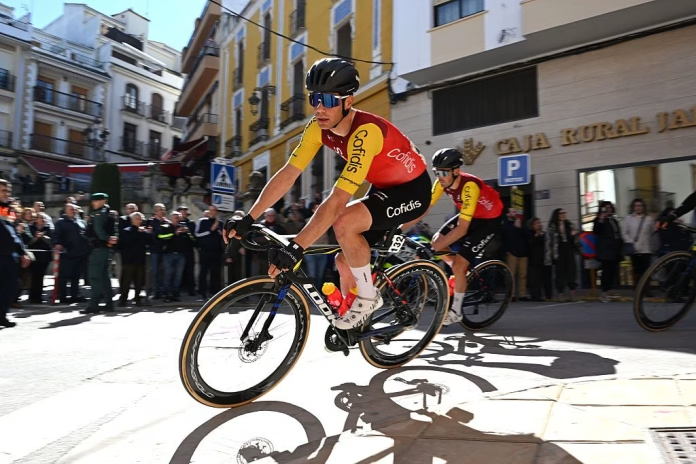
Milan Fretin won Stage 5 of the 2026 Tour of Guangxi in 3:45:12, taking a tightly contested finish ahead of Matteo Moschetti and Erlend Jordbrekk Blikra. All three were placed on the same time, with Fretin securing the stage victory while the result was decided by finishing order rather than a recorded time gap.
The race was shaped by a breakaway that repeatedly changed composition, survived several rounds of pressure and remained relevant deep into the closing phase. The peloton accelerated with 96 kilometres remaining, riders were dropped from the rear and separate chasers appeared, but the escape was still gaining ground again at 26 kilometres to go.
That late reversal forced several teams to share the pursuit. Cofidis eventually came to the front with 3.2 kilometres remaining, while Visma, Tudor and Decathlon CMA CGM also contributed before Fretin finished the job. A crash involving Paul Magnier and Frits Biesterbos came inside the final kilometre, adding disruption to an already unsettled run-in.
How it unfolded
Florian Vermeersch made the first named move with 167 kilometres remaining, but the opening escape did not settle immediately. Four riders were reported to have a small gap, then only two were clear two kilometres later. The fluidity of those early moves meant that the breakaway was being formed through repeated attempts rather than one clean departure.
That first phase also saw Brady Gilmore, Artem Shmidt and Niklas Behrens caught by the peloton with 153 kilometres still to race. A new three-rider move appeared at 142 kilometres, before Jasha Sütterlin attacked at 136 kilometres. Patrick Gamper then countered with Baptiste Veistroffer, Davide Formolo and Brandon Smith Rivera, giving the front of the race a more substantial shape.
The four-rider counter-attack became the most clearly defined move of the early stage. It reached the climb towards the KOM sprint with 124 kilometres remaining, and Veistroffer later appeared in the results of the second KOM sprint, 114 kilometres from the finish. The break had therefore survived the unsettled opening and had enough room to contest the first major objectives.
The break gains structure before the chase intensifies
Veistroffer was again named in the results of the third KOM sprint, 93 kilometres from the finish. By then, the race had moved beyond the initial sequence of attacks, but the escape had not been erased. Its repeated presence at the sprint points showed that the front group remained an active part of the stage rather than an early move already being absorbed.
The balance began to change around 96 kilometres to go. The gap between the breakaway and the peloton was decreasing, an acceleration went through the main field and riders began dropping at the rear. Those events altered the chase from a controlled pursuit into a more selective effort, with the pressure affecting the size of the bunch behind the leaders.
The acceleration also created another layer behind the break. An unidentified rider from EF Education-EasyPost attacked, followed shortly afterwards by Max Walker attacking from the peloton. The race consequently had an escape at the front, a potential chase forming behind it and a main field that was already putting riders under strain.
Walker’s move did not immediately settle the race into a single chase group, but it showed that the acceleration had opened opportunities for riders to move clear. Six kilometres after Walker’s attack, the gap between the breakaway and the chaser was still decreasing. The leaders remained ahead, yet the pursuit was beginning to bring the separate groups closer together.
Veistroffer keeps the escape visible
Veistroffer’s appearance in the results of the fourth KOM sprint, 45 kilometres from the finish, confirmed that the break had continued to survive through the middle portion of the stage. The front group had already endured the peloton’s acceleration and the EF Education-EasyPost attacks, but it still retained enough advantage to contest another objective.
That persistence mattered because the gap had earlier been moving in the peloton’s favour. The escape did not disappear as soon as the main field accelerated, and the separate chaser activity did not produce an immediate regrouping. Instead, the stage entered a prolonged transition in which the break, the chasers and the peloton remained connected by a changing set of gaps.
The result was a longer pursuit than the initial reduction in the gap suggested. The peloton had applied pressure, and riders had been dropped, but the front group still reached the late part of the route with its advantage intact enough to influence the decisions of the teams behind.
UAE’s pursuit loses momentum
With 30 kilometres to go, Rune Herregodts was reported to have finished his pulling duties for UAE Team Emirates-XRG, while Julius Johansen was still pulling in the peloton. UAE was therefore visibly involved in the pursuit as the race approached the intermediate sprint, with one rider leaving the work and another continuing it.
The effort did not lead to an immediate resolution. At 26 kilometres remaining, UAE had given up trying to bring the break back before the intermediate sprint, and the gap was increasing. That was the decisive change in the late chase: a move that had been under pressure was no longer being reduced at that moment.
This did not make the breakaway the winner, but it preserved uncertainty deep into the stage. Instead of arriving at the closing kilometres with the escape steadily being swallowed, the peloton had to reorganise after the main pursuit lost momentum. The intermediate sprint became a point around which the remaining teams had to adjust their approach.
At 13 kilometres to go, Soudal Quick-Step and Decathlon CMA CGM were listed as pulling in the peloton. Su Haoyu was then working for XDS Astana Team with 10 kilometres remaining. The chase had become a shared responsibility, with several teams contributing after UAE’s earlier effort had failed to close the gap before the sprint.
A collective run-in brings Fretin forward
Cofidis took responsibility with 3.2 kilometres left. That was the first clearly named contribution from Fretin’s team in the final run-in, and it placed Cofidis at the front during the part of the race that would determine the stage result. The move from the team did not need to create a time separation, because the final contest was decided inside a tightly grouped finish.
Visma then added two successive pulls. Tijmen Graat was working at 2.7 kilometres, followed by Louis Barré at 2.3 kilometres. Their effort showed that the closing pace was not being controlled by Cofidis alone, even after Fretin’s team had moved to the front.
Arthur Kluckers was pulling for Tudor Pro Cycling Team at 1.5 kilometres, and Daan Hoole was working for Decathlon CMA CGM at 700 metres. The sequence created a changing front of the peloton in the final three kilometres. Several teams were still attempting to shape the approach, while their riders moved through the closing work in turn.
That pattern also explains why the final result was so compressed. The pursuit had been rebuilt by multiple teams after the late increase in the gap, and the closing kilometres remained sufficiently organised to bring the stage towards a finish rather than allowing one late move to decide it away from the line.
With 500 metres remaining, Paul Magnier and Frits Biesterbos crashed. The incident came after the final sequence of pulls had begun and inside the closing run-in, but the available race facts do not establish that it decided either rider’s final result.
The crash added another complication to the last few hundred metres, yet the stage continued to its expected finish. At 100 metres to go, Fretin was recorded as the winner, completing a closing phase in which Cofidis had taken a visible role after the earlier chase had repeatedly changed direction.
Fretin’s victory was therefore the consequence of emerging first from a tightly contested final contest, not of a recorded time advantage over the nearest rivals. Moschetti finished second and Blikra third, both on the same time as the winner. Their positions show how narrow the final order was even after a stage that had spent much of its distance under the influence of a breakaway.
Why Fretin prevailed
The winning shape of the stage was established in three parts. The early attacks eventually produced a durable move containing Gamper, Veistroffer, Formolo and Rivera. The peloton then applied enough pressure to drop riders and generate chaser activity around 96 kilometres to go. Finally, when UAE’s pursuit lost momentum at 26 kilometres, other teams had to rebuild the chase before the finish.
Fretin benefited from the way that final pursuit came together. Cofidis was pulling with 3.2 kilometres remaining, and the team’s presence was followed by work from Visma, Tudor and Decathlon CMA CGM. That sequence brought the race into a closing contest where Fretin finished ahead, while Moschetti and Blikra were close enough to share his recorded time.
Moschetti and Blikra were the closest finishers in the final order, but neither was separated from Fretin by a recorded gap. Their podium places were decided inside the same compressed finish as the winner’s victory. The stage therefore combined a long, unsettled breakaway phase with an outcome decided at the very end by position.
Joshua Giddings finished fourth, followed by Jordi Meeus, Max Kanter, Sam Welsford, Arvid de Kleijn, Cees Bol and Oded Kogut. Each was recorded on the same time as Fretin, so the top 10 was separated by finishing order rather than a published time difference.
The stage began with Vermeersch’s attack and a series of short-lived early groups, developed through the more substantial move formed around Gamper and Veistroffer, and remained open after the peloton’s acceleration. The escape survived several pressures, the late chase changed hands and the final kilometres were interrupted by a crash, but Cofidis placed Fretin in the decisive position. He converted that closing opportunity into the Stage 5 victory.
Tour of Guangxi Stage 5 2026 Result
| Pos. | Rider | Team / nation | Time / gap |
|---|---|---|---|
| 1 | Milan Fretin | COF | 3:45:12 |
| 2 | Matteo Moschetti | PQT | Same time |
| 3 | Erlend Jordbrekk Blikra | UXM | Same time |
| 4 | Joshua Giddings | LOI | Same time |
| 5 | Jordi Meeus | RBH | Same time |
| 6 | Max Kanter | XAT | Same time |
| 7 | Sam Welsford | NCI | Same time |
| 8 | Arvid de Kleijn | TUD | Same time |
| 9 | Cees Bol | DCT | Same time |
| 10 | Oded Kogut | NSN | Same time |

