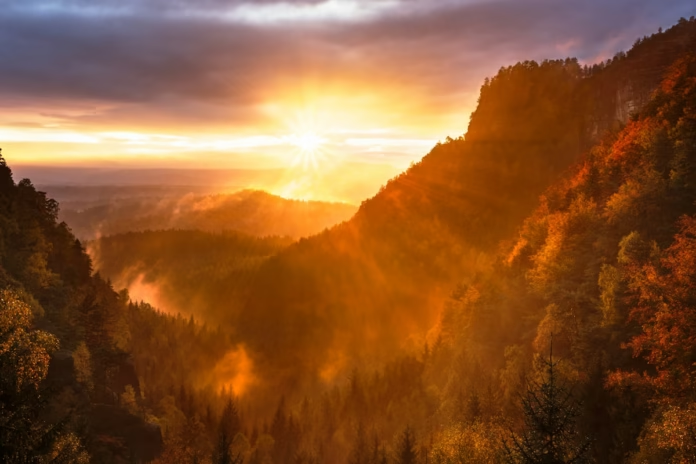
Bohemian Switzerland sits in northern Czechia, where the Elbe has cut a deep valley through sandstone country near the German border. It has two distinct types of cycling: an accessible riverside route and much hillier roads and signed tracks through the surrounding villages. Děčín, Hřensko and Krásná Lípa make useful bases, but route choice matters because many of the area’s best-known walking paths are not open to bicycles.
Děčín and the Elbe valley
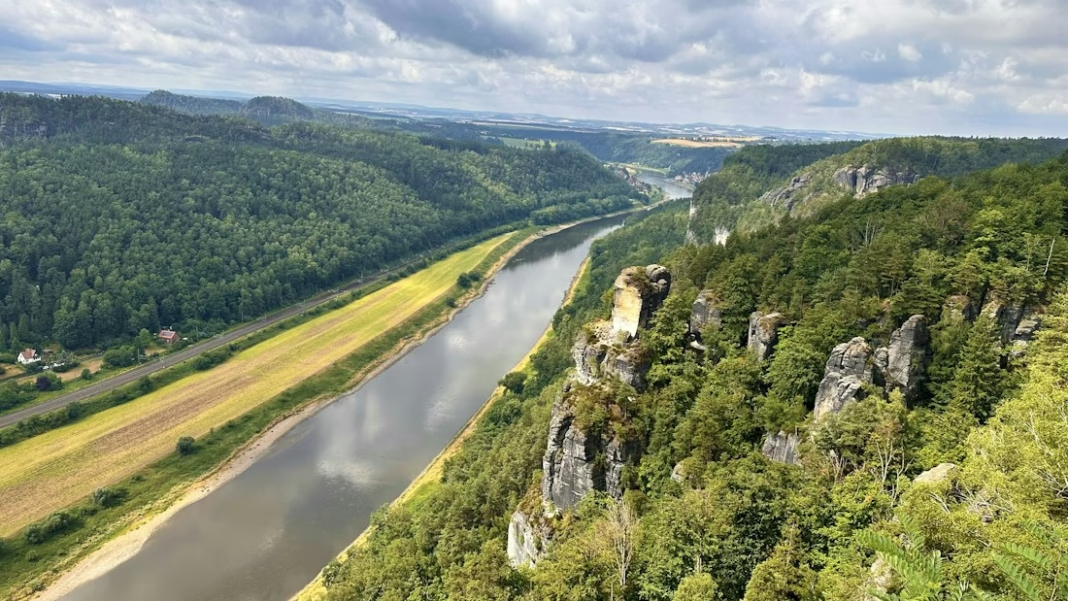
Děčín is a practical starting point because it has rail connections, accommodation and direct access to the Elbe Cycle Route. The riverside riding is relatively gentle compared with the surrounding sandstone uplands. It is the right option for a first day, a family outing or a recovery ride after travelling, and the cycle route continues across the German border towards Bad Schandau.
The contrast between the river and the hills is substantial. The Elbe cuts through a deep sandstone valley, while the roads climbing away from it gain height through woodland and scattered villages.
A particularly useful cross-border option is the 45.97 km Saxon-Bohemian Switzerland circuit published by the Saxon Switzerland tourism organisation. Starting in Bad Schandau, it follows the Elbe towards Schmilka, crosses to Hřensko, climbs towards Mezní Louka and Vysoká Lípa, then returns through the Kirnitzsch valley. The published profile gives around 360 metres of climbing, although the route is rated difficult because of its surfaces and road conditions. It is a mixed-surface outing, not a fast road-only loop.
The official route guidance warns that the segregated Elbe cycle path ends at Schmilka. From there, riders must share the road with traffic through Hřensko and towards Mezní Louka. Weekends can be busy around the turn-off for the Pravčická Gate, so this is not an ideal place for a large group to ride two abreast. The return through the Kirnitzsch valley also involves a tram line alongside the road, which calls for care when positioning a wheel near the tracks.
The official itinerary uses cycle routes 8 and 21, then 3029 and 3030 before crossing back towards Germany. Those numbers are more reliable navigation anchors than an informal description of a scenic loop, but the current GPX and any closure notices should still be checked before departure. The sandstone landscape is protected on both sides of the border, and a route that looks convenient on a walking map may not be open to bicycles.
Another practical option begins at Jedlová railway station and follows route 3013 towards Krásná Lípa, before continuing via Doubice, Zadní Doubice and Kyjov. Děčín’s tourist portal describes much of the first part as good-quality forest gravel, making it suitable for a gravel bike or a touring setup with sufficiently wide tyres. The possibility of returning by train is useful for riders who want to enjoy the route without a lengthy ride back to the starting point. A route that looks short on a map can contain repeated climbs, particularly if it crosses the valley rather than following the water.
The local tourist organisation recommends the Elbe route for less experienced riders and families. It is a useful foundation for a longer trip because it provides an easier day without requiring a car transfer. The cycleway can still be busy with walkers and other cyclists, so a steady pace is more sensible than treating it as an uninterrupted training road.
Hřensko, Srbská Kamenice and a proper road loop
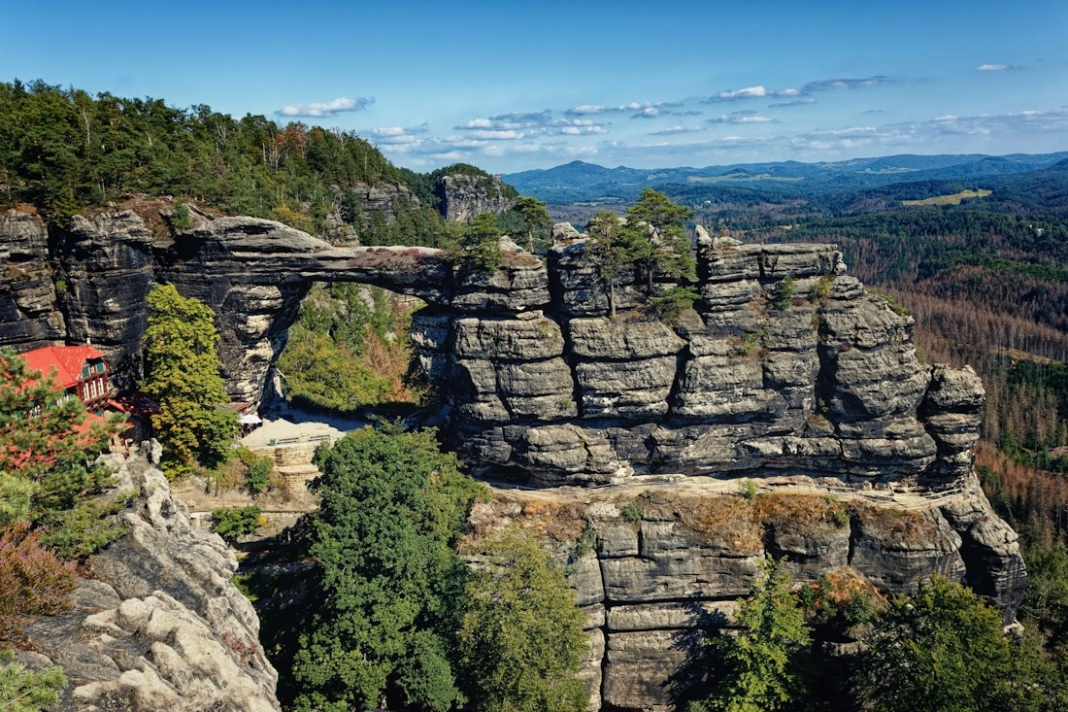
Hřensko lies close to the German border and is one of the principal gateways to Bohemian Switzerland National Park. The local tourism website identifies a cycling route linking Děčín, Hřensko and Srbská Kamenice before returning to Děčín. It combines the riverside approach with the more demanding roads of the hinterland.
The appeal for road cyclists is the change in rhythm. A relatively flat approach can be followed by sustained climbing on narrower roads, where corners and woodland limit the view ahead. The return towards Děčín rewards careful pacing rather than an early effort on the first hill.
Do not treat a suggested place-to-place itinerary as a fixed, permanently open GPX track. National park restrictions, roadworks and closures can change the available route. Check the current local route information and build the ride on permitted roads and marked cycling routes rather than assuming that every walking trail is rideable.
A longer ride through the national park
The city of Děčín publishes a route beginning in Hřensko and passing Mezná, Vysoká Lípa, Na Tokáni, Jetřichovice, Růžová and Janov before returning. It uses cycle routes 3029 and 3076 on parts of the itinerary. This is better suited to a gravel, trekking or mountain bike than a narrow-tyred road setup if the chosen sections include unsealed paths.
Several famous attractions near the route require walking. The Šaunštejn rock castle and viewpoints around Jetřichovice are not places to ride a bicycle up to the summit. Locking the bike securely and exploring on foot is part of a sensible day here. The area is a protected landscape first and a cycling destination second.
The official cycling network is signed, but a rider still needs an up-to-date map. In the national park, keep to authorised cycling routes and roads. Do not follow a hiking-only path simply because a navigation app shows it as a shortcut. Protected sandstone areas are particularly vulnerable to erosion, and access rules are enforced for good reason.
Krásná Lípa and the quieter eastern side
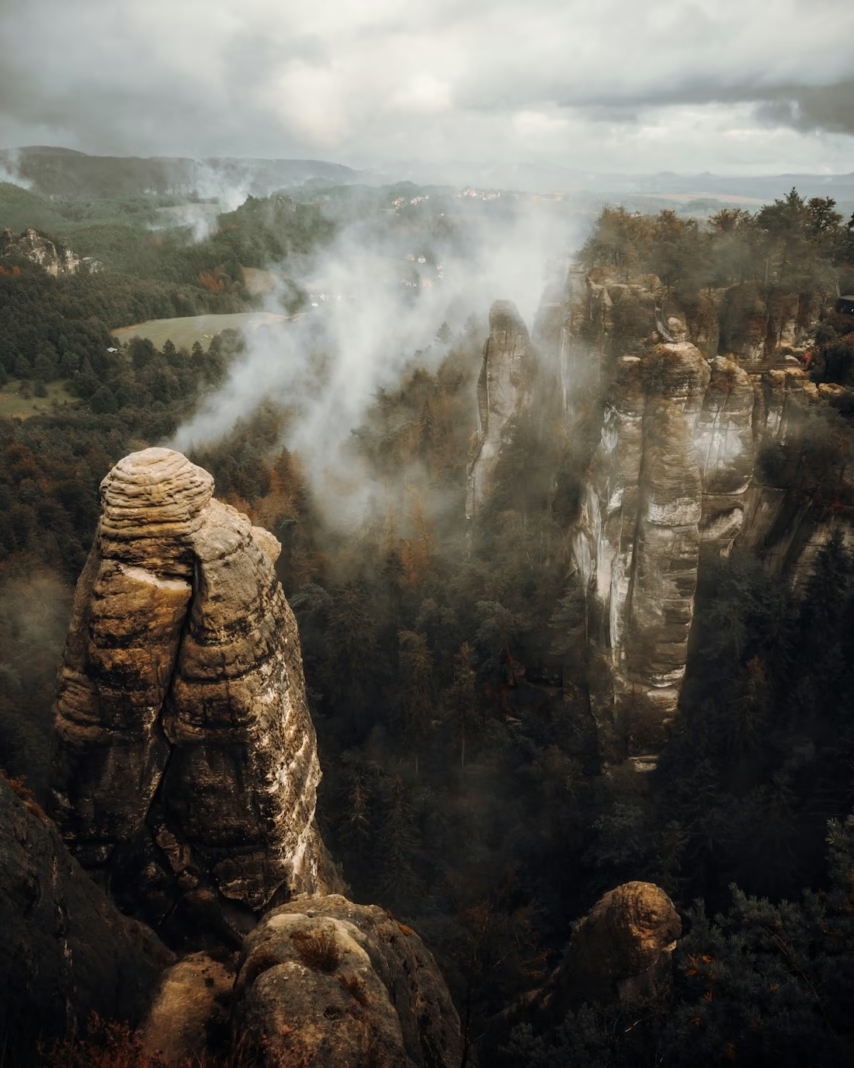
Krásná Lípa provides another useful base, particularly for riders who want to explore the Šluknov area, Kyjov Valley and the approach to the Lusatian Mountains. The regional tourism organisation highlights the Křinice corridor and routes connecting small settlements through wooded country. The roads are generally quieter than the main valley routes, although gradients and surfaces vary.
This side of the region is well suited to a multi-day itinerary. For another Central European mountain itinerary, see our guide to cycling in the High Tatras. One day can be spent on the Elbe Cycle Route, another on the inland roads and a third on a marked gravel route. That variety makes a mixed-surface bicycle attractive, but it is not essential if the trip is planned around surfaced roads.
The towns also offer more practical options for accommodation, bike hire and repairs than isolated hamlets. Check opening days outside the summer season, because small businesses may operate reduced hours. A route that passes through several villages should not be assumed to have a café or shop open at every stop.
A cross-border route through the Kyjov valley
There is a worthwhile alternative to treating Děčín and Hřensko as the centre of every ride. The regional tourism organisation describes a 48km excursion beginning at Krásná Lípa, taking cycle route 3013 through Kyjov and then following route 3032 into the Kyjov valley. From there the itinerary crosses towards Hinterhermsdorf and Bad Schandau in Germany, returning towards Hřensko using the Elbe Cycle Trail. It is a mixed-surface outing recommended for gravel, mountain bikes and suitable electric bikes rather than a fast road bike with narrow tyres.
That itinerary has a practical complication: the suggested Elbe return uses ferries, including the crossing from Bad Schandau to Krippen and another from Schöna to Hřensko. Check crossing times and bicycle carriage before setting off, especially outside the main visitor season. The regional guide also suggests a seasonal cycle bus for the return from Hřensko to Krásná Lípa, but it should be treated as an option to verify, not a guaranteed year-round service. Riders who prefer to remain on roads can build a different loop, although that is likely to bring more climbing.
The national park’s own visitor rules allow cycling on roads, local roads and designated signed cycle routes, not on every forest path shown on a walking map. That matters particularly near the sandstone viewpoints, where routes to famous landmarks are intended for walkers. A two-day visit works well with a flatter Elbe ride first and a more demanding inland day second. For more ideas beyond northern Czechia, the site’s cycling travel guides cover other European regions with very different roads and terrain.
When to go and what to take
Late spring to early autumn is the most straightforward period for cycling in the region. Summer provides longer daylight but can bring thunderstorms, heavy visitor traffic around the best-known attractions and high temperatures in exposed valley sections. Spring and autumn can be excellent for quieter roads, although mornings may be cold and woodland surfaces can remain wet.
The terrain demands lower gearing than the riverside sections suggest. A compact or sub-compact chainset with a generous cassette is useful if the itinerary includes several inland climbs. For gravel routes, tyres with adequate volume and puncture protection matter more than an aggressive tread on every section. Carry a repair kit, lights and offline navigation.
Rain changes conditions quickly on shaded tracks, and sandstone surfaces can be slippery. Descend with room to stop, especially near walkers and narrow bends. Mobile coverage may be uneven in valleys, so save maps before leaving. If travelling across the German border, carry appropriate identification and check any temporary border arrangements.
Getting there and organising a trip
Děčín is connected by rail to Prague and Dresden, making it a convenient base for travellers who do not want to hire a car. Check bicycle carriage rules when booking, because international and regional services may require reservations or have limited bike spaces. Local trains can also help create one-way rides without retracing every kilometre.
Accommodation in Děčín suits a road-focused itinerary, while Hřensko and Krásná Lípa place riders closer to the national park. Choose a base according to the riding you want: the Elbe valley for easy access and services, or the smaller towns for quieter routes and more climbing.
A well-planned visit combines the marked cycling network with walking excursions to the sandstone viewpoints. Some of the region’s most recognisable landmarks are reached on foot rather than by bike. Separating those activities avoids both route-planning mistakes and unnecessary conflict with the park’s conservation rules.
-
 Photo Credit: David Pintens / BELGA MAG/AFP via Getty Images
-
Photo Credit: BELGA MAG/AFP via Getty Images