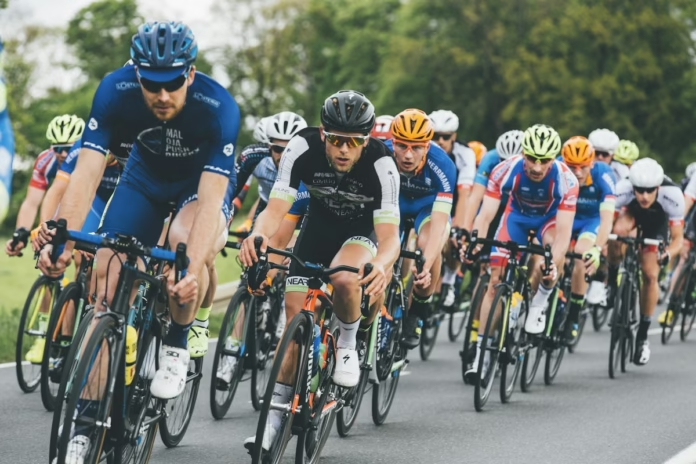
WorldTour promotion and relegation is decided over three-year licence cycles rather than through a conventional league table at the end of every season. The current 2026–28 period has 18 men’s WorldTour places and 14 women’s WorldTour places. Results matter, but the UCI also assesses teams’ finances, administration, organisation and ethics before granting a licence.
What promotion and relegation actually means
The UCI WorldTour is the highest division of men’s professional road cycling, with 18 licences available for the 2026–28 cycle. A team does not move up or down after one bad month. Licences are awarded through a formal process at the end of a multi-year period, and teams must satisfy sporting and non-sporting criteria.
The UCI uses the term sporting criterion for the ranking component, but its Licence Commission also considers ethical, financial, administrative and organisational requirements. A team high enough in the points table is not automatically entitled to a licence if it fails another requirement. Equally, a team with a strong budget cannot ignore the sporting ranking.
This makes promotion and relegation a useful shorthand rather than a perfect description. WorldTour teams hold licences for a defined period, while UCI ProTeams operate in the second division. At the end of a cycle, applicants are compared for the limited top-tier places.
Why the 2026–28 cycle matters
The 2026 season opened a new three-year licence cycle for both men’s and women’s top divisions.
The UCI announced the licence allocation after reviewing applications against five criteria: sporting, ethical, financial, administrative and organisational. That matters because the public discussion often treats the last available place as a simple points race. The rankings establish the sporting position, but the Licence Commission has a separate responsibility to examine whether a team can operate at the required standard.
The number of licences is fixed for the cycle, which means a team cannot claim a place simply by scoring more points than it did the previous year. Its ranking has to be considered against competing applicants. A sponsor changing hands, a merger or a team’s withdrawal can also alter the identity of the applicants without changing the broad principles of the process.
The UCI’s December 2025 announcement awarded 18 men’s WorldTour licences and 14 women’s WorldTour licences for 2026–28. It also recorded that registration remains subject to annual compliance. A three-year licence therefore provides sporting stability, but it is not permission to ignore financial or organisational obligations for three seasons.
For followers of the 2026–28 ranking, it is sensible to keep two separate questions in mind. The first is how many eligible UCI points a team is accumulating compared with its rivals. The second is whether it is likely to meet the licensing requirements when the next decisions are made. Only the first can be estimated from results alone. For the first time the UCI aligned the duration and timetable of women’s WorldTour licences with the men’s three-year process. The women’s top division has 14 licences for 2026–28, while the men’s has 18.
The 2026–28 points race is therefore a long-term contest. Results from one season matter, but the decisive assessment is not made on the basis of a single race or the last few weeks of October. Teams can improve their position through a balanced calendar and consistent scoring across multiple riders.
The women’s structure should not be described as identical in every operational detail to the men’s. Licence numbers, eligibility rules and team requirements differ. The common principle is that sporting performance sits alongside other regulatory criteria in a formal licence decision.

How UCI points influence the ranking
Teams collect UCI ranking points from eligible races across the international calendar. Points depend on the level of the event and the rider’s finishing position or other qualifying results. A win at a major WorldTour race carries a different value from a placing in a smaller race, which is why teams must balance the calendar carefully.
The sporting criterion for the men’s 2026–28 cycle uses the relevant UCI team ranking and its specified rider-count rules. A team cannot simply add every point scored by every rider without regard to the ranking methodology. The regulations determine which riders’ totals count, and those rules should be checked rather than copied from a previous licensing period.
This creates different approaches. A team with a Grand Tour contender may earn large results on selected days, while another squad can score steadily through one-day races, stage placings and smaller events. Neither approach is guaranteed to succeed. Injuries, cancellations and a rider’s departure can alter the points outlook over three years.
What happened at the end of 2025
The UCI awarded the 18 men’s WorldTour licences for 2026–28 after assessing applications and the 2023–25 sporting results. Cofidis and Pinarello–Q36.5 applied but did not receive top-division licences. They were instead registered as UCI ProTeams for 2026.
The announcement also showed that licensing is not only a points calculation. Team Picnic PostNL received a licence limited initially to one year, subject to conditions concerning the financial criterion before it could be extended. That decision illustrates why a ranking table alone cannot tell readers the complete outcome.
The women’s process awarded 14 WorldTour licences. Its simultaneous renewal with the men’s system was an important administrative change, but the teams and licence allocation should be assessed separately. A result in the women’s calendar does not feed into the men’s promotion contest.
What being a ProTeam changes
A UCI ProTeam is a professional organisation, not an amateur squad. ProTeams can compete in major races when invited or when qualifying under the applicable participation rules. The difference is that WorldTeams have the top-division status and corresponding rights and obligations, while ProTeams must plan around a less certain programme.
For riders, that can influence the calendar and the opportunities to score points. A team invited to a Grand Tour gains valuable exposure, but invitations are not a substitute for the stability of a WorldTour licence. Sponsors may place considerable value on the predictable presence at major races that comes with the higher tier.
Teams must also maintain their annual registration and comply with financial and administrative rules throughout the licence period. Securing a licence does not remove the UCI’s oversight until the next sporting assessment.
What the 2025 decisions tell us about the next licensing contest
The UCI’s December 2025 decisions illustrate the consequences of the sporting ranking. Eighteen men’s WorldTour licences were available for the 2026–28 period. The assessment used eligible team points accumulated from 2023 through 2025 alongside the other licence criteria. Cofidis and Pinarello Q36.5 Pro Cycling Team applied but did not receive top-division licences. The decision was not equivalent to relegation after a single disappointing season: three years of results determined the sporting basis for an application. The new 2026–28 points cycle will provide the comparable sporting record for the next licensing round.
The women’s competition has its own licence allocation, not a shared league table with the men’s teams. The UCI awarded 14 UCI Women’s WorldTour licences for 2026–28 and aligned the duration of women’s and men’s top-division licences for the first time. Team Picnic PostNL received a women’s licence initially limited to one year, subject to financial conditions for its continuation, which is a useful reminder that sporting position alone cannot secure an unconditional three-year place. Our guide to changes in women’s WorldTour points explains a different, related part of how the system developed.
What ProTeam status means for race invitations
Losing a WorldTour place does not necessarily mean losing access to the sport’s biggest races. Organisers issue wildcard invitations, while regulations provide some automatic invitations based on ProTeam rankings. From 2026, the three best-ranked men’s ProTeams from the previous year have guaranteed access to men’s WorldTour stage races under the applicable rules; men’s ProSeries organisers must invite the five highest-ranked ProTeams and ProTeams from the host country. These mechanisms can provide a path to high-level racing, but they are not identical to the participation rights of a WorldTeam.
Teams near the sporting cut-off therefore face two connected problems. They need to score points across enough eligible riders to compete for a future licence, and they need access to races where those points can be earned. A team with a strong Classics squad might follow a different calendar from one built around stage racers, while recruiting a prolific scorer changes both the budget and the points outlook. Our explanation of how teams choose race leaders shows how those sporting priorities affect individual race selections.
How to read the 2026–28 standings
A useful standings table should identify the date it was updated, the points counted under the current regulations and the distance between the relevant teams. Raw totals are easy to misread when the season is still running or when websites apply different ranking snapshots.
The important positions are near the boundary for the 18 available men’s licences, but a ranking during 2026 is not an official promotion or relegation decision. Two full seasons of results remain after 2026, and non-sporting criteria still have to be assessed when applications are considered.
The best way to follow the contest is to compare official UCI rankings at regular intervals, track changes in team rosters and examine where each squad expects to score. A team that loses its leading points scorers may face a different challenge the following season, while a well-balanced roster can reduce its dependence on a single star.