How much power can the best women professional cyclists produce, and is there a record for the highest functional threshold power? The short answer is that there is no recognised, independently verified world record for women’s cycling FTP. Teams and riders may publish selected power figures, but no governing body maintains a complete, standardised table of professional riders’ threshold results.
That does not make power data meaningless. It makes the context essential. A number recorded in a laboratory, a value estimated from a 20-minute test and the power produced during a race climb are different measurements. Comparing them as if they were all official FTP scores can produce a very misleading list of the world’s strongest riders.
What is FTP in cycling?
Functional threshold power, or FTP, is an estimate of the power a rider can sustain at a hard but relatively steady effort for roughly an hour. It is usually expressed in watts and used to set training zones. It can be measured or estimated in several ways, including a long maximal time trial, a carefully designed shorter test and power modelling from a rider’s training files.
The widely used 20-minute test takes around 95% of the average power from a maximal effort as an approximation of FTP, although its accuracy varies between individuals and test protocols. A ramp test uses a different method. If one rider quotes a laboratory estimate and another quotes a virtual trainer’s ramp-test value, the numbers should not be placed in a straightforward ranking without that qualification.
Is there an official women’s professional cycling FTP record?
No official UCI classification records the highest FTP among professional women. The UCI awards titles for performances in road races, time trials and track events, not for a training-test number. FTP data is frequently private to riders and teams, and even a publicly shared figure can become outdated as an athlete’s fitness changes through the season.
Headlines claiming that a particular cyclist has the highest FTP in history should therefore be treated carefully. Unless the same test has been carried out under comparable conditions, the result is an interesting reported measurement, not a verified record. There is also no requirement for elite riders to disclose their body mass, test protocol, equipment calibration or full power files.
Why watts per kilogram matters on climbs
Absolute watts tell you how much mechanical power the rider produces. Dividing power by body mass gives watts per kilogram (W/kg), a useful comparison when gravity is a major part of the resistance on long climbs. For example, a rider producing 280 watts at 60kg has 4.67 W/kg, while a rider producing 250 watts at 50kg has 5.00 W/kg. These figures are examples for explanation, not measurements of professional cyclists.
On flatter terrain, aerodynamics, total power, rolling resistance, positioning and the ability to hold a time-trial position can outweigh a small difference in W/kg. Two riders with identical threshold ratios may produce very different speeds. That is one reason a time-trial specialist and a mountain climber should not be compared using only one figure.
Does the highest FTP mean the fastest rider?
Not necessarily. Races demand more than steady-state power. A short climb can require repeated efforts above threshold, while a road race may reward an explosive attack, sprint speed, recovery after previous climbs, handling and efficient riding in the bunch. A rider who can repeat hard surges may beat someone with a higher FTP on a course featuring repeated accelerations.
Stage races introduce another variable: fatigue. The power a rider can produce after several hours and several consecutive days of racing matters more than an isolated fresh test. Nutrition, recovery, heat, wind and the tactical demands of a race all affect how close a rider gets to a laboratory or training value.
What can time-trial performances reveal?
Long time trials offer a useful demonstration of sustained speed and pacing, but speed alone cannot establish FTP. Wind direction, course profile, equipment, aerodynamics and weather all affect the time. Even when a broadcaster shows a power figure, the number may be instantaneous or averaged over a short interval rather than the whole effort.
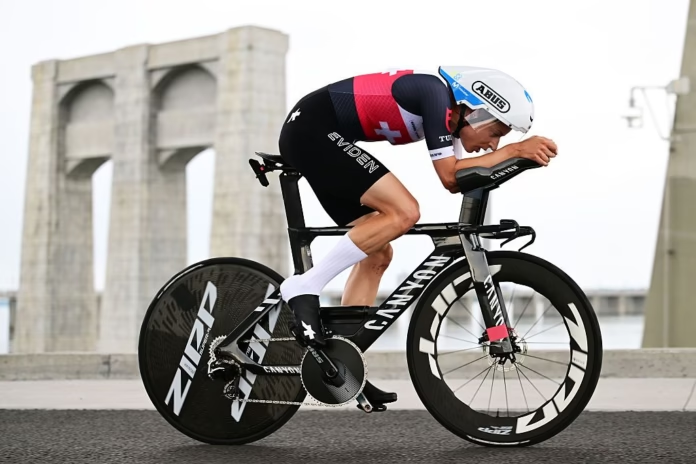
For a practical explanation of the discipline, see our guide to how a cycling time trial works. Riders such as Marlen Reusser and Lieke Nooijen demonstrate the importance of sustained power and pacing, but their championship results cannot be converted reliably into an FTP without appropriate power data.
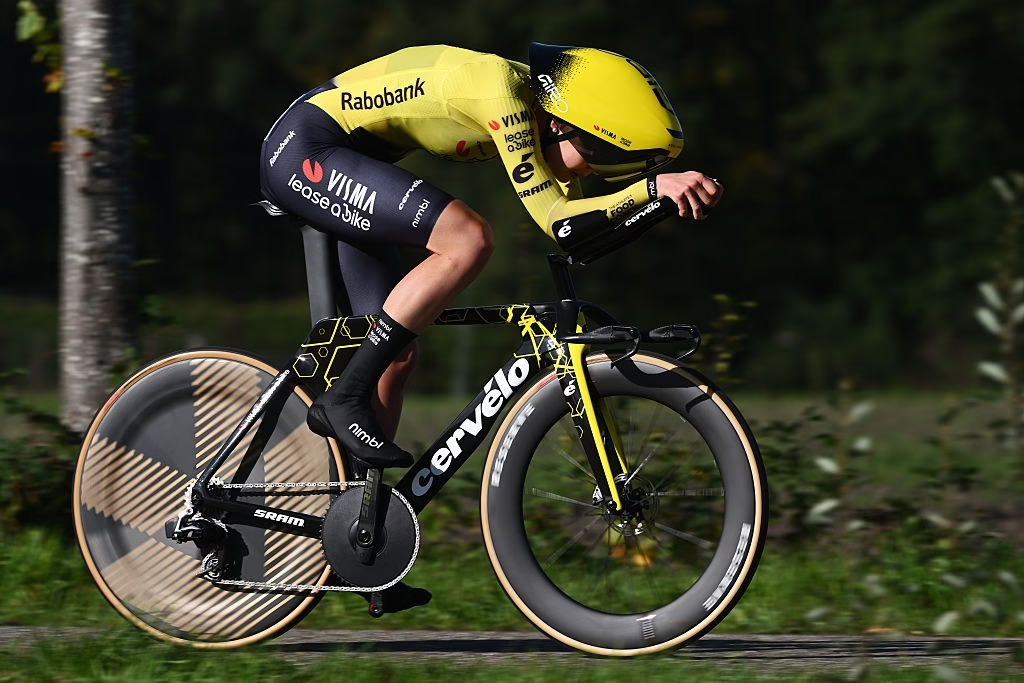 Photo Credit: Getty
How should readers compare professional cycling power data?
When a rider or team shares a power number, first check exactly what is being measured. A useful comparison needs the duration of the effort, the average rather than a peak second, the measuring device and ideally the test or race conditions. Ask whether the figure is actual recorded power or an estimate produced by a calculator or performance model.
Next, check whether the number is absolute watts or W/kg, and whether rider weight was measured at the time. Finally, compare like with like: a 20-minute climb with another 20-minute climb, rather than a 20-minute best effort with a reported one-hour threshold. Even then, differences in weather, altitude, drafting and previous workload can make a simple ranking unfair.
What is a good FTP for a female cyclist?
There is no single target that fits every rider. FTP depends on training background, body size, age, event demands and the method used to estimate it. For amateur cyclists, the useful comparison is often with their own previous tests performed consistently, rather than a claimed elite benchmark. Improvement at a repeatable test is usually more actionable than chasing an unverified WorldTour figure.
Readers looking for older professional power discussions can also consult our archived 2022 pro cyclist FTP article, but historical claims should be checked for their original source and testing method. A published number is only as informative as the evidence behind it.
Frequently asked questions about women’s cycling FTP
Who has the highest FTP in women’s cycling?
There is no verified, official ranking that establishes an all-time leader. Selected rider or team disclosures cannot be treated as a complete record, and measurement methods vary.
Is 20-minute power the same as FTP?
No. FTP is an estimate of sustainable threshold power, while 20-minute power is the output of a shorter effort. Multiplying a maximal 20-minute average by 0.95 is one common estimate, not a guarantee of the rider’s exact FTP.
Can you estimate a cyclist’s FTP from race results?
Not reliably from results alone. Times, elevation and approximate body mass can feed a model, but uncertainty about air resistance, drafting, wind and other factors means the answer is still an estimate. It should be labelled accordingly rather than presented as data measured by the rider’s power meter.
Updated 21 October 2026. This explainer distinguishes documented training methods from illustrative examples and does not attribute private power data to any rider.