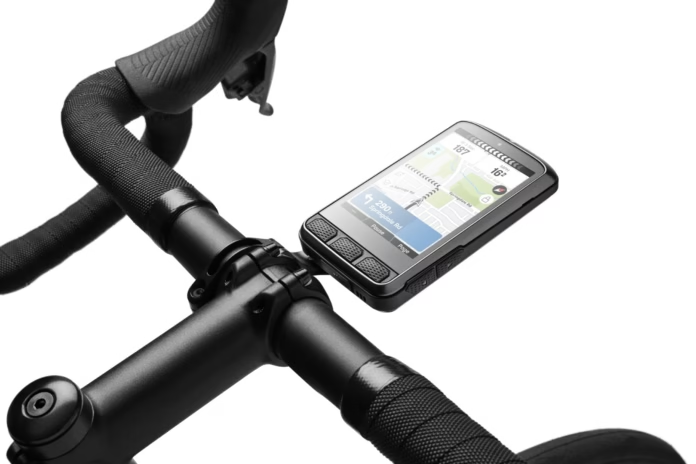
Garmin and Wahoo have taken different routes to the flagship GPS bike computer. The Edge 1050 focuses on extensive training tools, navigation and a connected cycling ecosystem. The ELEMNT ACE brings a larger screen, a relatively straightforward interface and Wahoo’s new airspeed sensor. Both promise far more than recording speed and distance. The question is whether any of those extras will improve the rides you actually do.
This is a research-led comparison of specifications, manufacturer documentation and independent road tests, not a claim that ProCyclingUK has tested these two units side by side. As of October 2026, the purchase decision is also about value: each is expensive enough that screen design, battery demands and accessory compatibility should carry more weight than a single headline feature.
For riders already invested in Garmin watches, Varia radar, training plans or Connect IQ, the Edge 1050 is the more complete choice. For cyclists who spend long hours navigating unfamiliar roads and prefer Wahoo’s presentation of maps and ride information, the ACE has a persuasive case. Neither is automatically the better computer for every rider.
Garmin Edge 1050 vs Wahoo ELEMNT ACE: specifications
| Specification | Garmin Edge 1050 | Wahoo ELEMNT ACE |
|---|---|---|
| Screen | 3.5-inch colour touchscreen | 3.8-inch colour touchscreen |
| Weight | 161g | 208g |
| Claimed battery | Up to 20h demanding use; 60h battery saver | Up to 30h |
| Navigation | On-device maps, routing and rerouting | On-device maps, routing and rerouting |
| Satellite reception | Multi-band GNSS | Dual-band GNSS |
| Connectivity | ANT+, Bluetooth, Wi-Fi | ANT+, Bluetooth, Wi-Fi |
| Water resistance | IPX7 | IPX7 |
| Distinctive features | Garmin Pay, GroupRide, bell, Connect IQ | Wind sensor, Ready-To-Ride dashboard, larger display |
Battery estimates are manufacturer claims, not equivalent laboratory tests. The Garmin’s 60-hour figure depends on battery saver mode and should not be compared directly with the Wahoo’s 30-hour headline. Screen brightness, navigation, sensor connections and GPS settings will affect both devices. Published dimensions and weight also exclude the practical consequences of fitting a mount on particular handlebars.
Display and controls: bigger is not necessarily better
The ACE’s 3.8-inch touchscreen gives it a useful advantage for looking at a complex junction or scanning several ride fields at once. Wahoo uses that space for comparatively clear mapping, while the interface retains physical buttons for actions that are easier to perform with gloves or on a rough road. A large screen, however, means a large device. At 208g before its mount, the ACE is noticeably heavier than the 161g Garmin.
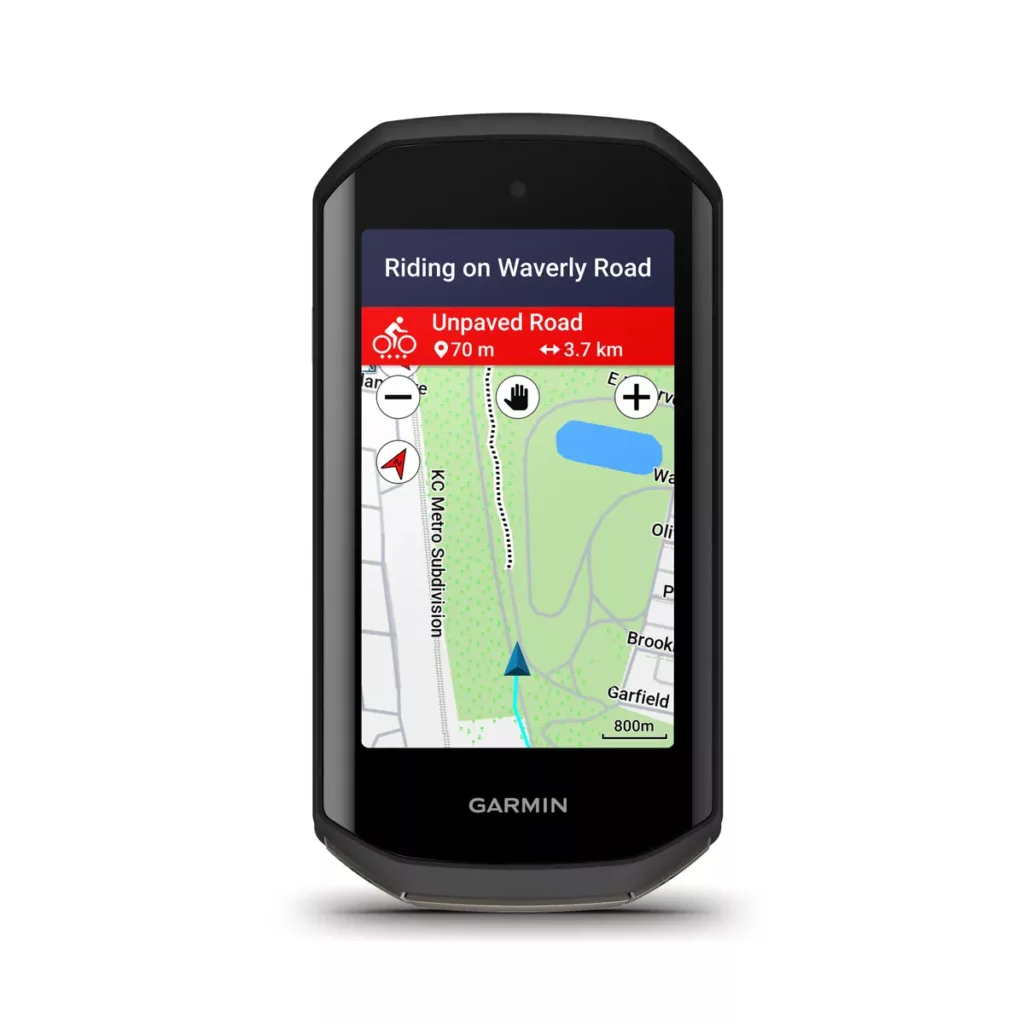
The Edge 1050 responds with a bright 3.5-inch LCD touchscreen and an interface built around Garmin’s extensive set of functions. That gives riders considerable control over data pages and alerts, but also more menus to learn. Someone switching from an older Garmin may appreciate continuity; someone who simply wants to start a ride and see a route might prefer Wahoo’s more focused presentation.
Independent testing supports that split rather than suggesting a runaway winner. BikeRadar preferred the ACE’s map clarity in its direct comparison, while independent Edge 1050 reviews have praised the Garmin’s bright display and fast response. Screen legibility in sunshine, rain and with gloves matters more than the decimal-point difference in diagonal measurements.
Navigation: both can get you home, but their approach differs
Both devices are equipped for turn-by-turn directions, route imports and recalculation when you leave a planned course. That is the essential foundation for a flagship computer, particularly for riders who build routes in advance. A good unit should make it obvious whether the next instruction means taking a side road or continuing around a bend without requiring a prolonged look away from traffic.
Wahoo’s maps use restrained colours and prominent route guidance. BikeRadar’s comparative road test judged them easier to interpret, although it also recorded an occasion when the ACE directed a road ride onto a footpath. The point is not that one brand never makes mistakes. Map data and route profiles can produce questionable suggestions on any system, so riders should still evaluate access restrictions and road conditions.
Garmin’s strengths are in the breadth of its routing system and the way it can be combined with training, climbing and group functions. The Edge 1050 offers road-aware maps, route creation and a detailed navigation toolkit. It can be more involved to configure, but the flexibility has value if you ride unfamiliar routes regularly and want specific information for each type of session.
For a sportive, a long club ride or touring, both are capable. Riders who dislike crowded map screens may favour the ACE. Those who want to customise navigation alongside an extensive set of performance metrics may find the Edge 1050 more rewarding once set up.
Training, power meters and connected riding
The Edge 1050 makes its strongest argument for riders who train with structure. Garmin combines workout execution, performance and recovery guidance, climbing information and activity analysis with a wide range of connected sensors. GroupRide adds shared ride functions when other participants are using compatible Garmin hardware. Garmin Pay and an integrated bell are small conveniences, rather than compelling reasons on their own to replace a functioning computer.
Wahoo is not a basic alternative. The ACE supports heart-rate monitors, power meters, electronic shifting information and structured workouts, with ANT+ and Bluetooth connectivity. Its Ready-To-Ride dashboard is intended to reduce pre-ride admin by showing sensor, battery, profile and route status together. For riders with a Wahoo trainer or who are accustomed to the ELEMNT interface, this practical consistency can be more important than Garmin’s longer feature list.
Consider what you already use. A power meter does not become better because a computer adds another dozen graphs, and a compatible rear radar is useful only when its warning presentation works for you. Check the exact pairing and data-field support for any specialist sensor before buying, particularly if you depend on electronic shifting or third-party apps.
Does the Wahoo wind sensor justify buying the ACE?
The ACE introduces an integrated airspeed sensor, which measures air movement relative to the device and enables Wahoo’s wind-related ride metrics. It is an interesting addition, particularly for riders trying to understand sheltered versus exposed riding or the effect of sitting in a group. It does not directly measure a rider’s drag coefficient, nor can its reading be treated as a complete aerodynamic test.
The sensor sits on the front of the unit, so the result also depends on airflow around the computer and its mounting position. BikeRadar’s analysis highlighted the limited practical conclusions available from the live figures. It is sensible to regard the sensor as an experimental extra rather than a substitute for controlled aerodynamic testing. Wahoo may develop its software, but a purchase today should be justified by features that exist today.
Garmin takes a more conventional approach: ride recording, power-based training and the extensive data ecosystem are already established. If the wind sensor is the ACE’s main attraction, ask whether you would use it consistently after the initial curiosity has worn off.
Battery life, size and the realities of a long ride
Wahoo claims up to 30 hours for the ACE, against Garmin’s up to 20 hours in demanding use or up to 60 hours with battery saver enabled. Those numbers should be understood in context. Regular navigation, a bright screen and several paired sensors impose different demands from leaving a computer on a basic data page. Independent ride tests are the better guide to what a particular setup can achieve.
Neither computer is short of capacity for a typical club ride or a long sportive when charged beforehand. Multi-day tours, ultra-distance events and riders who frequently forget to charge will care more. The ACE offers a reassuring headline figure without switching to a separate saver claim, but the Garmin can stretch considerably further when lower-consumption settings are acceptable.
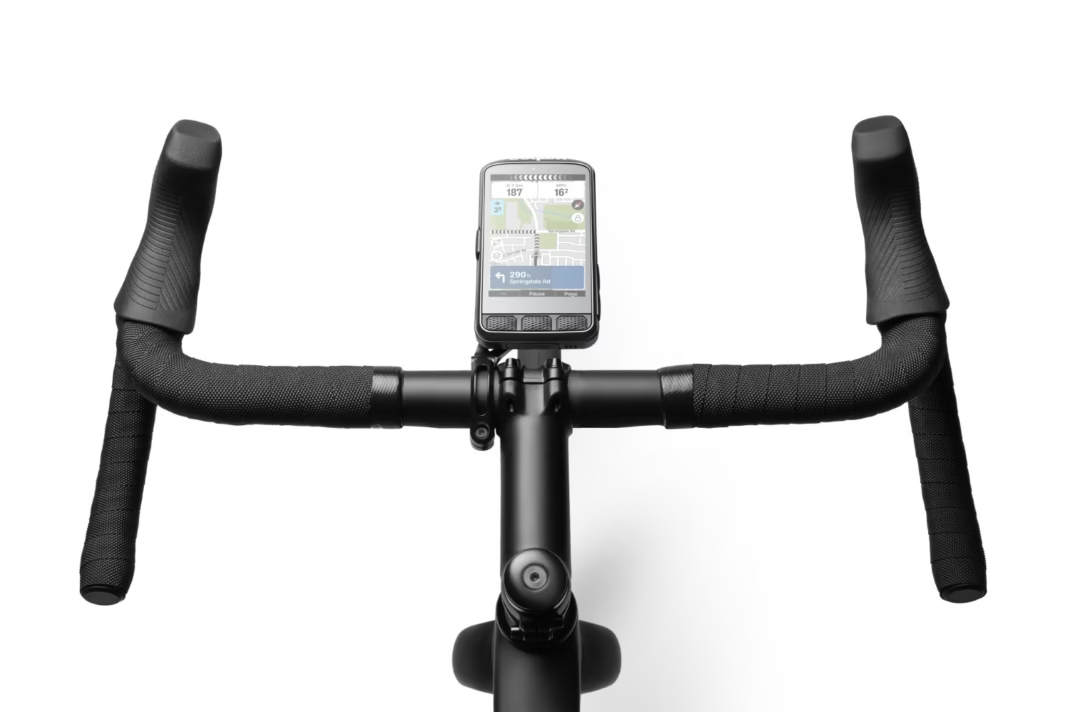
Mounting is another real consideration. The ACE is broad and heavy, and Wahoo specifically warns that certain integrated cockpits require a compatible alternative mount. Its supplied alloy mount is designed for 31.8mm handlebars. Before spending heavily, check the fit and the manufacturer’s supported mount options, especially on an integrated carbon cockpit. Use the prescribed tether where appropriate.
Price and value in the UK
The right comparison is the price you can actually pay in the UK, not the higher original launch price quoted in an old review. At the time of this check, Wahoo’s UK store listed the ACE at £449.99, while Tredz listed the Garmin Edge 1050 from £599.99. Stock, bundles and promotional pricing can change quickly; check the exact listing and any included mount before ordering.
That difference makes the Wahoo easier to justify if mapping is the priority and you do not need Garmin-specific extras. The Edge 1050’s premium is more defensible for riders who will use its training ecosystem, advanced group functions and additional on-device tools. Neither device is a sensible purchase merely for recording a commute to work; cheaper computers can already handle that task competently.
Current manufacturer and retailer listings: Wahoo ELEMNT ACE and Garmin Edge 1050 at Tredz. These are direct, non-affiliate links; no commission-bearing destination is asserted.
Which should you buy?
Choose the Garmin Edge 1050 if structured training is central to your riding, you already use several Garmin services, or you want extensive customisation and advanced group-ride features. Its lower weight also matters on a compact race bike, although the device itself remains physically substantial. Garmin’s broad capabilities are most valuable when you genuinely intend to use them rather than simply have them available.
Choose the Wahoo ELEMNT ACE if you place clear map presentation, a large screen and a relatively straightforward daily workflow ahead of a longer feature list. Its 30-hour battery claim and currently lower UK direct price strengthen that recommendation. Accept the trade-off in weight, cockpit compatibility and the fact that its wind sensor is not a replacement for aerodynamic measurement.
For many riders, neither is the best-value upgrade. A mid-range computer with dependable navigation and full sensor support will meet most needs. But if you are choosing between these two flagships, the decision is fairly clear: Garmin has the deeper training environment, while Wahoo makes a strong case for navigation-led riding and day-to-day simplicity. This assessment combines manufacturer specifications and published independent evaluations; ProCyclingUK has not conducted a hands-on head-to-head test of these units.