A track pump is one of the few cycling purchases that should remain useful for years. It lives beside the bike rather than travelling in a jersey pocket, gets used before almost every ride and needs to do one job reliably: put the right amount of air into the tyre without turning a simple task into a struggle.
That job has become more demanding. A 28mm road tyre and a 45mm gravel tyre may call for very different pressures, and the reading on a pump’s gauge matters more when the target is relatively low. The best choice is not necessarily the pump with the highest maximum pressure or the most expensive barrel. Valve-head design, stability, pressure accuracy and the effort needed to move air all have a more direct effect on everyday use.
We have compared five identifiable track pumps currently listed by UK retailers, from a £24.99 basic model to a £75 high-pressure option. These recommendations draw on manufacturer specifications, published independent testing and current retailer listings. They are not presented as five pumps personally tested by ProCyclingUK. Prices and stock were checked on 23 October 2026 and may change.
Best track pumps for road and gravel riding: the quick comparison
| Track pump | UK price checked | Best for | Main compromise |
|---|---|---|---|
| Trek Charger Floor Pump | £24.99 | A straightforward, inexpensive home pump | No selectable high-volume mode |
| Topeak JoeBlow Sport III | £37 | Best all-round value for mixed road riding | Gauge accuracy is not perfect |
| Truflo Supertrax | £44.99 | Road and gravel riders wanting a pressure-mode switch | Bulkier than a simple basic pump |
| Trek Dual Charger | £49.99 | Households sharing road and wide-tyre bikes | Gauge remains at the base |
| Lezyne Classic Floor Drive | £75 | Premium construction and high-pressure use | Threaded chuck takes more time |
All five are manual floor pumps, not tubeless air chargers with a separate pressurised reservoir. The maximum-pressure figures printed on their gauges should not be treated as recommended tyre pressures. Always follow the lower applicable limit stated by the tyre and rim manufacturers.
1. Topeak JoeBlow Sport III: the best all-round choice
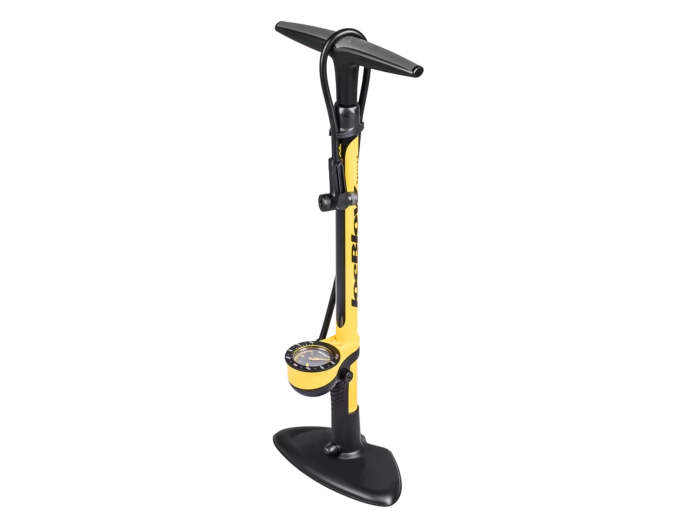
The JoeBlow Sport III makes the strongest argument for most home mechanics because the design is practical without being elaborate. It has a steel barrel and base, a stable stance, a 3-inch analogue gauge mounted part-way up the shaft and the TwinHead DX design for Presta, Schrader and Dunlop valves. The locking head saves the repeated unscrewing required by some premium pumps, and its mid-mounted gauge is easier to read than a dial sitting between your shoes.
At the time of checking, Sigma Sports listed the Sport III at £37, comfortably below its usual £47 reference price. That positions it between the most basic Trek and the switchable-volume alternatives. For a household with ordinary road bikes and perhaps the occasional gravel bike, there is little reason to spend twice as much merely to acquire a wooden handle or a higher pressure ceiling.
Its reputation is supported by actual testing rather than the specification sheet alone. Cyclist recorded 30 strokes to inflate a 28mm road tyre to 90psi and 26 strokes for a 40mm gravel tyre at 45psi. The magazine also found its reference pressure within 3psi on the road tyre in that test. A separate 2026 Cycling Weekly comparison was less flattering about gauge precision: the Topeak’s dial under-read the independent gauge by 4psi at both its 40psi and 72psi reference points. Those findings used different methods and should not be treated as contradictory laboratory results. They show why a tyre-pressure gauge is useful when you want repeatable settings.
Its 160psi maximum is more than enough for normal road and gravel use. It is not the most convenient option for a garage full of wide mountain-bike tyres, and the sturdy steel construction makes it a proper workshop tool rather than something to pack for travel. The upside is an uncomplicated layout and widely available parts. For further product-specific discussion, see our Topeak JoeBlow Sport III review.
Verdict: The best starting point for most buyers. Check the JoeBlow Sport III at Sigma Sports.
2. Trek Charger Floor Pump: best inexpensive option
A track pump does not need several modes to be useful. Trek’s standard Charger is a particularly clear example: it uses a steel construction, stable base, auto-select valve head and 4-inch analogue gauge positioned close to the floor. The head accommodates Presta, Schrader and Dunlop valves, and Trek specifies replaceable internals rather than a completely disposable design.
The £24.99 UK listing gives it a meaningful price advantage over the other choices. It is a sensible purchase for someone with one or two road bikes, a commuter or a family bike that needs occasional inflation. The larger dial should be easier to interpret than the small gauges on many mini pumps, though its base-mounted position still means looking down at floor level.
What you give up is a second air-delivery mode. On a narrow road tyre, that limitation is unlikely to be important; on a very wide gravel or mountain-bike casing, each stroke may move less air than a purpose-designed high-volume mode. Nor should the Charger be described as exceptionally precise simply because the gauge face is large. We found no comparable independent laboratory accuracy result for this exact current model that justified such a claim.
If £25 is the budget, buy this before a cheap unbranded pump with unclear valve compatibility or no parts support. It is not quite as versatile as the Topeak, but at its price the simple design is the point rather than a defect.
Verdict: The budget choice for ordinary home use. Check the Trek Charger in the UK pump range.
3. Truflo Supertrax: best for mixed tyre widths
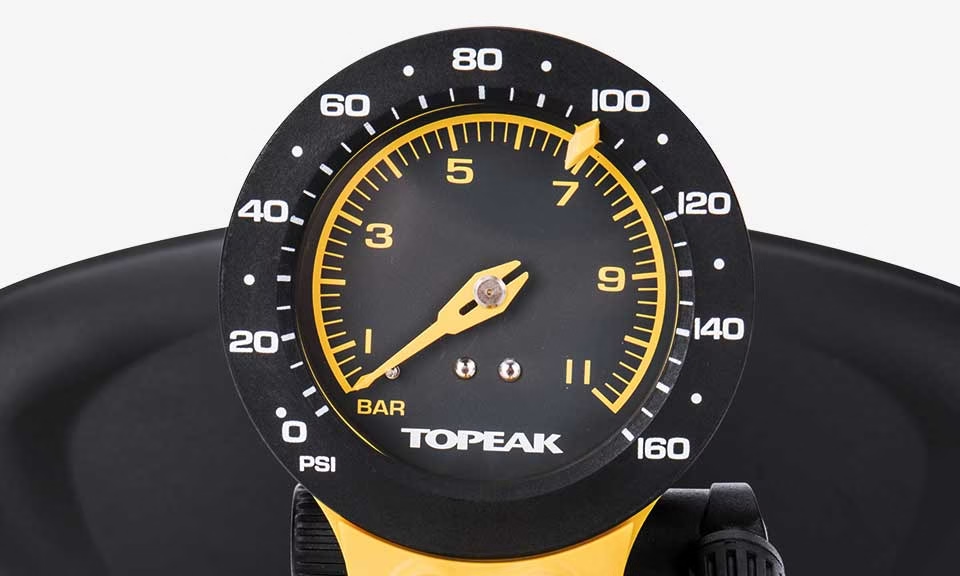
If you regularly move between road tyres and wider gravel rubber, the Truflo Supertrax offers something useful that a conventional pump lacks. A switch on its handle changes between high-volume and high-pressure settings. Start in the volume setting to move air quickly into a larger tyre, then use the pressure setting when resistance builds. It is the sort of feature that makes more sense in a shared garage than on a bike that always wears the same tyres.
The current QA4415 version has a steel barrel and base, an auto-select locking head for Presta and Schrader valves and a 3-inch base-mounted dual-scale gauge. The lower-pressure part of the display is intended to give wider-tyre riders more usable resolution rather than concentrating all the markings near 100psi. The manufacturer specifies a 160psi upper range, so the Supertrax is not restricted to low-pressure tyres.
Independent reviews provide some balance. Road.cc scored the Supertrax 8/10, finding a stable pump with a good valve head and legible dial. BikeRadar also praised its ability to handle high-volume and high-pressure inflation but was less convinced by some materials and the handle feel. Those are reviewer observations, not a claim of a universal build defect. Both assessments reinforce that the functional switch is the main reason to pick this over a simpler model.
Freewheel listed the Supertrax at £44.99, with a matching QA4415 product page and ordering option when checked. That is a relatively small step above the Topeak, although the correct choice depends on whether you will use the switch. If every tyre in the house is a 28mm road tyre, the feature is mostly redundant.
Verdict: A useful road-and-gravel crossover pump. Check the Truflo Supertrax at Freewheel.
4. Trek Dual Charger: best for several different bikes
Trek’s Dual Charger addresses much the same problem as the Truflo but puts the switch near the pump’s base instead of on the handle. Move it towards the high-volume setting for large tyres, then change to high pressure as resistance increases. That can save strokes for households that include a mountain bike, gravel bike and road bike, though the benefit is much smaller if you only inflate narrow tyres.
Trek specifies a steel barrel and replaceable internals, a stable base, an auto-select head for Presta and Schrader valves and a 4-inch base-mounted analogue gauge. Maximum pressure is 160psi. The current model is listed in Catalina Fog, under model number 5342949, at £49.99 on Trek’s UK website. It is important not to confuse this model with Trek’s more expensive TLR Flash Charger, which includes a separate air-storage function for certain tubeless tyre installations.
There is an important distinction between published comparisons of similarly named Trek pumps. Cycling Weekly tested a Trek dual-mode pump in its 2026 group test and reported that this type of volume/pressure switching was effective, but those measurements should not automatically be attributed to every subsequent Dual Charger version without confirming the model number. On the precise current Trek listing, the headline functions and controls are independently identifiable; a detailed like-for-like accuracy figure is less securely established.
For a household with several disciplines covered, the extra £5 over the Truflo is not unreasonable. The choice comes down mainly to which control location feels more natural and whether you favour Trek’s large gauge and parts support. Riders who regularly adjust gravel pressure by just a couple of psi may still prefer a dedicated digital gauge rather than relying exclusively on any pump dial.
Verdict: The versatile household option. Check the Trek Dual Charger.
5. Lezyne Classic Floor Drive: best premium high-pressure pump
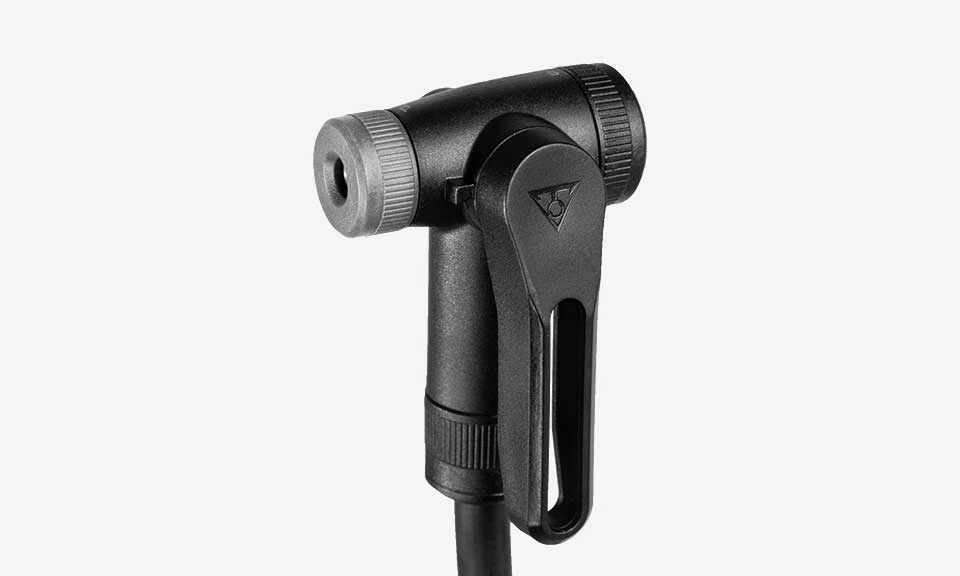
The Lezyne Classic Floor Drive is the one to consider if you value a substantial workshop tool and spend most of your time inflating relatively narrow road tyres. A machined aluminium base, steel barrel and piston, long reinforced hose and varnished wooden handle give it a different character from the utilitarian pumps above. None of those materials guarantees a more accurate final pressure, but they make sense on an item intended to survive repeated use.
Its 3.5-inch base-mounted dial has a 220psi maximum, substantially above what most modern road and gravel tyres should be inflated to. That number describes the pump’s ability, not a reason to use very high pressures. The ABS-1 Pro chuck screws onto Presta or Schrader valves and includes an air-release function. A secure threaded connection is useful when the hose is stretched across a bike on a workstand, although the process is slower than a flip-lever head.
Cyclist’s independent review praised the robust construction, stable pumping action and long hose. It also considered the threaded chuck fiddlier than a lever and highlighted that this pump is optimised for higher pressures. In its test, the gauge did not match its reference device perfectly. The bleed feature is principally useful for depressurising the hose or chuck when disconnecting, not a guarantee of laboratory-grade final tyre pressure.
At £75 from 99 Bikes, this is not an obvious value winner. It is appealing for a rider with a dedicated workshop who values serviceable components, stable construction and the longer hose. A rider with a modern low-pressure gravel setup may get better practical versatility for less money from either switchable pump.
Verdict: The premium road-focused alternative. Check the Lezyne Classic Floor Drive at 99 Bikes.
What matters most when buying a track pump?
Pressure accuracy matters more than the maximum printed on the dial
A track pump marked to 160psi or 220psi is not automatically more precise at the 35psi or 60psi you might actually use. Analogue dials can vary by several psi compared with an independent reference, and their markings may be difficult to resolve at low pressures. If your rim and tyre combination has a narrow safe range, especially with hookless rims, use the manufacturer’s limits and consider checking the final figure with a reliable separate gauge.
An informative pump test should state the tyre size, target pressure and reference measuring device. Stroke-count figures from different publications are not directly comparable when they use different starting pressures, tyres or setups. That is why the recommendations here emphasise the overall evidence rather than treating a single benchmark as a race.
Presta, Schrader and the valve-head question
Most current road and gravel bikes use Presta valves; many utility and mountain bikes still use Schrader. Some pumps have a two-sided head, some switch automatically and others need the user to reverse an internal part or screw the connection on. If you own several bikes, an auto-select or clearly marked dual head saves frustration. On removable Presta valve cores, threaded heads also deserve care when disconnecting so the core does not loosen.
A hose long enough to reach a bike in a stand or a wheel positioned awkwardly beside the workbench is worth considering. For repeated use, a stable steel or aluminium base can be more valuable than shaving a few hundred grams from something that stays at home.
High volume is not the same as a tubeless booster
A high-volume setting moves more air per stroke, useful when filling wide gravel and mountain-bike tyres. But this is not the same as a pressurised tubeless booster designed to release a sudden blast of air to seat certain tyre beads. Some tubeless tyres seat easily with a normal pump; others require a dedicated booster or compressor, depending on the tyre, rim and fit. None of the five standard pumps in this list should be sold as a guaranteed solution to difficult tubeless seating.
Which track pump should you buy?
For most road cyclists, the Topeak JoeBlow Sport III offers the clearest balance of price, usability and independent performance evidence. The Trek Charger gives riders on a tighter budget the essentials without the cost of a second mode. If you alternate between road and gravel tyres throughout the week, the Truflo Supertrax or Trek Dual Charger deserves closer attention, particularly when you regularly inflate much wider casings.
The Lezyne Classic Floor Drive is a premium choice rather than a necessary upgrade. Its sturdy construction and threaded chuck will appeal to some home mechanics, but its higher ceiling and wooden handle do not make it the best value for everyone. Think about the pressures you use, how often you swap valve types and whether you will really use a high-volume switch. Get those decisions right and a manual track pump should remain a useful piece of kit long after a more fashionable cycling accessory has been replaced.