The SKS EMP and Topeak E-Booster Digital Mini are two ways of solving the same roadside problem: getting a tyre back to a useful pressure without spending several minutes working a small hand pump. Both use rechargeable batteries, a digital pressure display and automatic shut-off. Both also come with an extension hose, which is particularly important when inflating TPU inner tubes with plastic valve stems. Yet their approaches are different enough that choosing between them deserves more thought than comparing the 120psi figure on the box.
The Topeak is lighter, more compact and adds a colour screen, integrated light and weatherproof storage pouch. The SKS is a slightly larger, more conventional-feeling tool, with a protective silicone sleeve, quick claimed charging and strong results in independent inflation tests. In the UK, price promotions can reverse their relative value, so it is worth checking the actual retailer rather than assuming the model with the lower recommended price will be cheaper.
This is a specification and independent-evidence comparison, not a claim that ProCyclingUK has conducted a fresh side-by-side test. We have checked the exact models, manufacturer documentation, UK listings and published hands-on assessments. The relevant individual reviews on this site are the SKS EMP review and Topeak E-Booster Digital Mini review. Neither retailer link below is tracked or commissioned.
SKS EMP vs Topeak E-Booster Digital Mini specifications
| Specification | SKS EMP | Topeak E-Booster Digital Mini |
|---|---|---|
| Model | EMP, item 12191 | E-Booster Digital Mini, TDP-E02 |
| Claimed bare weight | 151g | 120g |
| Dimensions | 83 × 33 × 52mm | 54 × 34 × 72mm |
| Maximum pressure | 120psi / 8.3 bar | 120psi / 8 bar |
| Battery | 500mAh rechargeable | 7.4V, 500mAh |
| Claimed recharge | About 25 minutes | About 45 minutes |
| Pressure control | Digital preset, auto-stop | Colour digital preset, auto-stop |
| Valve support | Presta, Schrader, Dunlop; Clik with adapter | Presta, Schrader, Clik Valve |
| Included protection | Silicone sleeve, hose, bag | Hose, storage bag, weatherproof zip bag |
| UK example checked | £68.66, BikeParts, low stock | £82.49, Tweeks, in stock |
The figures are manufacturer specifications for the exact models rather than interchangeable numbers from other electric pumps in either range. Topeak also sells the larger E-Booster Digital, with a different battery and weight, while SKS has other Clik-oriented inflators. Mixing those specifications would make the comparison meaningless. Prices are examples checked on 28 October 2026, not fixed RRPs or promises about checkout availability.
Which is easier to carry on a road bike?
At a claimed 120g, the Topeak has a clear bare-weight advantage of 31g over the SKS. That is not transformative when compared with the weight of a filled bottle or saddle bag, but it is meaningful for a device carried on every ride and used only occasionally. The Topeak’s short, broad body is also easier to arrange around tyre levers and a spare tube than its specifications might suggest. Its integrated LED is a small but practical addition when a puncture happens on an unlit lane.
The SKS measures 83mm along its longest dimension and weighs 151g before accessories. That sounds like a disadvantage, but its silicone cover gives the rider something more secure to grip and adds a layer between fingers and a motor that heats during inflation. BikeRadar found it substantial and well made, although larger and louder than some rivals. Neither bare-weight figure describes the complete roadside kit: adding the supplied hose, protection and bag narrows the difference in what actually goes into a pocket.
 Photo Credit: Topeak
Battery capacity matters more than maximum pressure
Both claim 120psi, a ceiling well above the pressures most riders now use with 28mm to 35mm road tyres. A maximum pressure figure tells you little about whether a pump can inflate several tyres from flat, particularly if a puncture repair needs a second attempt. The two batteries have the same quoted 500mAh capacity, but battery voltage, motor efficiency, tyre volume and target pressure determine the useful work delivered. Comparing one brand’s inflation count with another brand’s figure at a different tyre pressure would be misleading.
SKS quotes up to three inflations of a 700 × 28 tyre on a charge. Road.cc independently achieved three 28mm inflations to 72.5psi with charge left over, while its gravel-tyre testing reached two complete 650 × 42 inflations to 40psi before running short on the third. BikeRadar’s separate test used a different 32mm tyre and lower target pressure and recorded a higher number of inflations. Those results are not contradictory: they illustrate why the test pressure and tyre size have to accompany every capacity claim.
Topeak’s own figures include three inflations of a 700 × 28 tyre to 80psi and six of a 700 × 40 tyre to 40psi, with a recommended five-minute interval between uses. Road.cc reported four complete inflations of a 35mm tubeless tyre to 50psi, then part of a fifth. German magazine TOUR also found competitive performance in a broader comparison. There is credible evidence of several useful roadside inflations from either pump, but no controlled identical-condition test here that proves one consistently lasts longer than the other.
Speed, noise and the feel of the controls
SKS claims a full recharge in approximately 25 minutes, compared with around 45 minutes for the Topeak. That favours riders who regularly forget to charge a device until shortly before leaving. Actual charging results can vary with the power supply and starting battery state: BikeRadar measured almost an hour for its SKS sample, and another independent test recorded 39 minutes. The manufacturer figure is therefore a useful guide, not a guaranteed turnaround. Both use USB-C, so neither demands a proprietary charger.
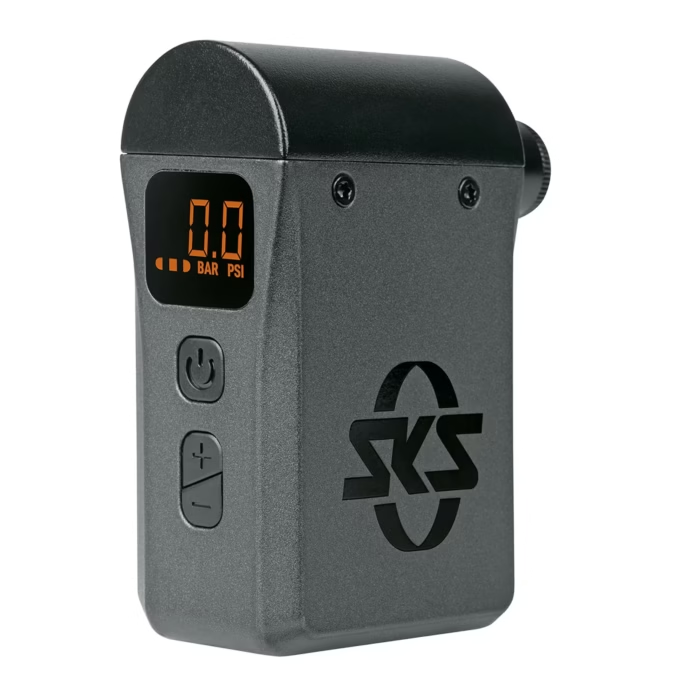
The SKS has a readable orange-on-black display and a pressure memory function. The Topeak uses a full-colour display and a built-in LED torch. Independent reviewers found both simple to operate, although road.cc noted that the Topeak’s direct connection was awkward on some Presta valves and preferred the hose. That matters because the best pump is the one a rider can attach correctly with cold hands and a wheel resting against a hedge, not the one that looks most sophisticated on a workbench.
Noise is unavoidable with these miniature compressors. Road.cc measured the SKS at around 80dB from one metre in its own conditions, while BikeRadar reported a higher reading with its different measurement arrangement. Those numbers cannot be used as a fair direct sound-level ranking. The practical message is simpler: either device will be clearly audible in a quiet street or on a club ride, and neither should be judged as a silent substitute for a hand pump.
TPU tubes, valve standards and the heat problem
The extension hose is essential equipment rather than a decorative accessory. Compact compressors generate heat, and holding a hot pump directly against a plastic TPU valve stem risks damaging it. SKS explicitly advises using its supplied hose with plastic valve stems, and Topeak gives the same warning for resin valves. Riders using TPU tubes should keep the hose with the pump at all times, even if the direct connection looks more convenient. The extra few seconds are preferable to turning a successful puncture repair into another failure.
Valve compatibility also needs care. The SKS uses a reversible head for Presta, Schrader and Dunlop valves; Schwalbe Clik Valve use requires an SKS CLIK TEC adapter. Topeak specifies compatibility with Presta, Schrader and Clik Valve systems on the E-Booster Digital Mini. Do not assume every valve type works with the same connector arrangement or that a pump head for the larger Topeak E-Booster is identical. For riders who switch between road and family bikes, checking the valve arrangement before buying is more useful than chasing a marginal weight saving.
 Photo Credit: SKS Germany
What the independent tests actually establish
The strongest evidence for the SKS is its consistency across different independent assessments. Road.cc found the pressure display close to a separate gauge and confirmed the manufacturer’s three-road-tyre claim. BikeRadar praised the fast airflow, construction and capacity while noting noise and size. Bike-X’s comparative test also found substantial inflation capacity, but questioned the tactile clarity of the controls through the silicone cover. Those are complementary observations rather than a universal verdict: they describe a robust tool that is not the most compact or refined in every detail.
The Topeak has an equally credible case. Road.cc praised its simple preset operation and useful hose, while marking down value at the higher original asking price. TOUR’s controlled comparison reported a balanced performance profile and modest heat at its lower test pressure. Its combination of a colour screen, LED and compact form is particularly appealing for the rider who wants the device to disappear into a small repair kit. However, a compact body does not remove the need to carry the hose or charge the battery.
UK price and value in October 2026
At the time of checking, BikeParts listed the SKS EMP at £68.66, with limited stock, while Tweeks listed the Topeak at £82.49 and in stock. Other retailers listed the SKS closer to its £84.99 UK reference price, and the Topeak’s recommended price has been as high as £109.99. The difference between offers is large enough to change the value judgement, so check the exact product page and delivery conditions rather than relying on an old comparison chart.
If the SKS is available around £69 and the Topeak costs £82, the SKS is difficult to dismiss: it has a proven pressure gauge, good usable capacity, a protective sleeve and a fast quoted charge. If both are around £85, the Topeak’s lighter body and additional features become more persuasive. Neither is a bargain against a conventional £20 hand pump. The extra money buys easier inflation and pressure control, not a guarantee that a battery-powered device will always be ready after months in a neglected saddle bag.
Which pump should you buy?
Choose the SKS EMP if you value a protective silicone casing, straightforward controls and the reassuring battery results from several independent tests. It is particularly sensible for a road rider who also uses gravel tyres and wants the supplied hose ready for TPU valves. The weight is higher, and the real charging time may be longer than the headline claim, but the essentials are well executed. The best value case is strongest when a verified UK offer puts it materially below the Topeak.
Choose the Topeak E-Booster Digital Mini if a smaller, lighter pump matters more, you want the colour display and built-in light, or you already prefer Topeak’s valve and accessory system. The hose is not optional for resin-valved TPU tubes, and the direct Presta connection deserves attention. It is a credible all-rounder rather than a clear battery-life winner. Riders who need a broader shortlist should read our four-model electric mini pump buying guide before deciding.
Neither model completely replaces the argument for a manual backup on a remote or unsupported ride. Battery capacity, charging discipline and the possibility of a damaged hose are part of the decision, regardless of the pump’s performance when new. For most normal club rides, the choice is between the SKS’s protective practicality and the Topeak’s compact convenience. Buy on the exact UK price and the way you carry your repair kit, not the identical 120psi claim.
-
 Photo Credit: Lucas Abad (Canyon SRAM media release)
-
 Photo Credit: David Pintens / BELGA MAG/AFP via Getty Images
-
 Photo Credit: Canyon SRAM (supplied media release)