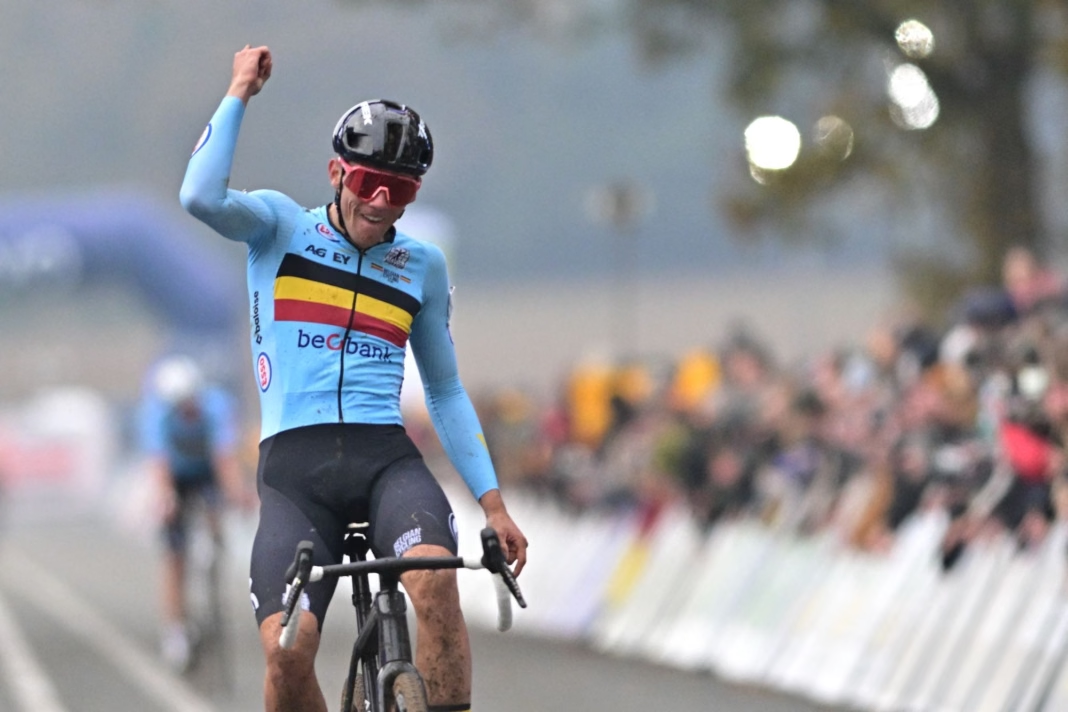
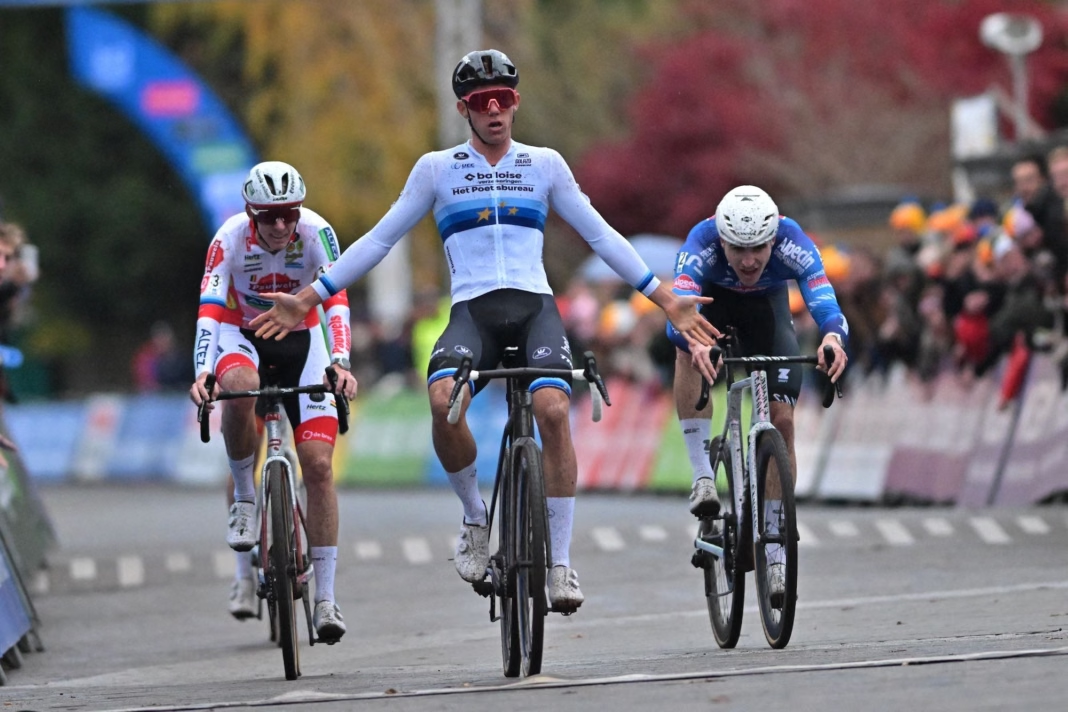
Tábor’s cyclocross history runs through several different eras of the sport. The Czech city has staged four UCI Cyclo-cross World Championships, hosted numerous World Cup races and given both established champions and rising young riders an opportunity to prove themselves on a demanding winter circuit. The UCI World Cup returns to the Komora sports area on Sunday, 29 November 2026, the second round of the new season.
The venue’s recent record is particularly rich. Thibau Nys and Lucinda Brand won the elite World Cup races in November 2025; Mathieu van der Poel and Fem van Empel claimed elite world titles there in 2024; and Zdeněk Štybar delivered a celebrated home championship victory in 2010. Those are distinct races, but together they explain why Tábor has remained a reference point beyond Belgium and the Netherlands.
How Tábor became one of Europe’s major cyclocross venues
International races in Tábor can be traced to the 1990s, a period when the Czech cyclocross tradition was already producing riders who could compete with the best in Europe. The sport had deep roots in the country before the modern World Cup took its current shape, and Tábor became a meeting place for strong local riders and the elite Belgian and Dutch specialists who regularly set the pace in winter.
A venue does not remain relevant merely because it hosted one memorable race. Organisers need a dependable course, knowledgeable marshals and facilities that can cope with international competition even when weather conditions change during the day. Tábor’s record across World Championships and World Cups demonstrates an ability to provide that infrastructure without losing the distinctive character of its route.
The location adds a different flavour to the calendar. The race is not staged among the Belgian fields or dunes that define many of the sport’s familiar contests. It takes place in South Bohemia, at a course where cold weather and changes in surface grip have repeatedly influenced the racing. It requires visiting riders to solve a technical problem, not merely reproduce their form from another venue.
The 2026–27 cyclocross calendar shows the place of the Czech event within an increasingly international World Cup. Tábor is not a new stop introduced to fill a geographic gap; its history gives the race a significance in its own right.
World Championships in 2001 and 2010
Tábor first hosted the modern UCI Cyclo-cross World Championships in 2001. The elite men’s title went to Belgian Erwin Vervecken, while Germany’s Hanka Kupfernagel won the elite women’s race. The event established the town as a venue capable of staging the sport’s biggest weekend at a time when the women’s championship had only recently been introduced.
The World Championships returned in 2010 and produced one of the defining moments of Czech cyclocross. Zdeněk Štybar won the elite men’s race in front of home supporters. It was his first world title and the beginning of a run that would eventually include three elite rainbow jerseys, an achievement that placed him among the most influential riders of his generation.
Marianne Vos won the women’s race in 2010, contributing to a sequence of world titles in a career that also included major victories on the road and track. Her appearance among Tábor’s champions matters because it demonstrates that the course did not reward one narrow type of rider. Successful competitors have combined different proportions of power, endurance and bike-handling precision.
The 2010 championships also gave Czech spectators a tangible connection between local racing and the highest international standard. Štybar’s success was not merely an emotional win on home soil. It showed that a rider from the host country could master the same difficult circuit against the world’s best, even with the weight of the home crowd’s expectations.
The 2015 and 2024 championships
In 2015, Mathieu van der Poel became the elite men’s world champion in Tábor. It was his first title at that level and a landmark in his emergence as one of the defining figures of modern cyclocross. Pauline Ferrand-Prévot took the elite women’s title, adding another remarkable result to her multi-discipline career and underlining the range of athletes capable of succeeding at the Czech venue.
Those champions succeeded in different ways. Van der Poel’s technical speed and ability to accelerate repeatedly made him exceptionally difficult to follow. Ferrand-Prévot brought the endurance and skill developed across road, mountain bike and cyclocross. The route accommodated both approaches, provided the rider could maintain control on the more awkward sections.
Tábor hosted the championships for a fourth time in 2024. Van der Poel returned to secure his sixth elite men’s world title, confirming how far his career had developed since that 2015 breakthrough. Fem van Empel defended the women’s crown ahead of Lucinda Brand and Puck Pieterse, completing an all-Dutch podium that reflected the depth of talent in that generation.
The younger categories were significant as well. Tibor Del Grosso won the men’s under-23 title and Stefano Viezzi took the men’s junior race, demonstrating the value of the same venue as a platform for emerging riders. The championship results should be kept separate from the annual World Cup records, because a rainbow jersey and an individual series victory are not interchangeable honours.
Past World Cup winners at Tábor
The recent World Cup winners show another side of the venue’s history. In 2021 Lars van der Haar won the elite men’s race, with Lucinda Brand victorious in the women’s event. In 2022 Eli Iserbyt took the men’s contest and Fem van Empel won the women’s. The results reflect successive stages in the sport’s changing competitive order, with experienced specialists racing alongside increasingly prominent younger riders.
The World Cup returned to Tábor on 23 November 2025 after an absence from the series in the intervening seasons. Thibau Nys produced a commanding solo performance to take the elite men’s victory. Brand won the women’s race by holding off a determined challenge from Sara Casasola. The two races were won by different tactical methods, even though they shared the same venue and conditions.
Nys’s victory depended on creating a gap and sustaining it across consecutive laps. Brand needed to be precise enough to keep Casasola behind when the contest remained close into the final phase. Both performances illustrate how the Komora circuit can produce either a long individual effort or a race of repeated tactical decisions, rather than dictating one type of victory.
The venue has hosted World Championships in some years when no equivalent World Cup round took place. That distinction is important when reading past-winner tables. Van der Poel’s 2024 rainbow jersey should not be added to the list of annual Tábor World Cup victories, and the 2026 race will be a new World Cup edition rather than another championship. Our guide to World Cup points and classifications explains what is at stake in each round.
Komora’s course and the importance of winter conditions
The circuit is based at the Komora sports complex and combines grassy sections, barriers, changes of direction, short climbing efforts and surfaces that can become more difficult as temperatures and traffic alter them. There is no single monumental climb to define the race. The crucial measure is the rider’s ability to link the obstacles together efficiently, avoiding repeated losses of momentum.
Cold weather is part of Tábor’s reputation. In the 2025 World Cup the ground was hard with frost, but sunlight softened the upper surface and made portions of the route slippery. The difference between a stable frozen line and a slick thawing one can force riders to reconsider tyre pressure, tread and their handling through corners during the event itself.
The fastest rider on the flat is not necessarily the fastest through an awkward off-camber turn. A competitor who needs to brake heavily and accelerate again after every technical feature can spend considerably more energy than another who carries speed through the same section. That cost grows with each lap and can eventually be reflected in a gap large enough to decide the race.
Choices about running or riding short obstacles matter too. A well-timed dismount and remount can save time compared with stalling in a poor gear on a slippery incline. The pit offers an opportunity to replace a muddy bike, but a stop is not automatically worth making on firm ground. The correct decision depends on the condition of the equipment, the surface and the distance to other riders.
Tábor provides a revealing circuit on which to watch technique as carefully as power. The riders who seem to be making the fewest adjustments may be conserving energy that will become decisive in the final two laps, even when the early split times suggest a close contest.
Why the 2026 return follows Ostrava
The 2026–27 UCI Cyclo-cross World Cup begins in Czechia with a round in Ostrava on Friday, 27 November. Tábor follows on Sunday, 29 November, creating a double-header that gives elite riders two opportunities to earn points in the opening weekend. This is an unusual scheduling rhythm compared with the more common weekly World Cup interval.
Ostrava is staging its first race at World Cup level, while Tábor returns as an established host with an extensive winners’ record. That difference gives the weekend genuine variety. Riders will need to adapt to a new international course before switching to one of the most familiar Czech settings just two days later. Our Ostrava history and first World Cup feature explains the new venue’s place in the programme.
Recovery between the races is an important part of the tactical equation. A rider who expends enormous energy on Friday may struggle to repeat that intensity on a technically demanding Sunday course. Equally, an athlete who narrowly misses a result in Ostrava has little time to dwell on it before Tábor offers another opportunity to improve a series standing.
The UCI calendar confirms that Sunday’s programme includes elite women and men, with junior and under-23 categories also represented. Final startlists are subject to publication nearer the event, so a history article should not claim that every possible contender is certain to attend. The date and venue are established, while the field and the precise challenges posed by race-day weather will become clearer.
What to watch for in the next Tábor race
When the 2026 World Cup returns, the first lap will show how the field responds to the Komora circuit and which competitors have judged the conditions correctly. That is an early indicator rather than the full story. Once traffic has changed the racing line, the fastest route through a bend may shift, and riders who respond early can gain seconds without making a conspicuous attack.
The 2025 victories by Nys and Brand remain useful examples, but they do not establish a guaranteed pattern. A different weather forecast, a changed entry list and the short recovery after Ostrava could all produce another type of race. The historical record offers context for understanding a result, not a substitute for watching how it develops.
UK viewers can consult our 2026–27 cyclocross broadcast guide for the relevant television and streaming arrangements. Our women to watch in the 2026–27 season feature provides wider context on the elite contenders. Tábor’s most instructive passages will be those in which riders preserve traction, move smoothly between features and continue to do so when fatigue makes every technical choice more difficult.
-
 Photo Credit: David Pintens / BELGA MAG/AFP via Getty Images
-
 Photo Credit: Cor Vos
-
Photo Credit: David Pintens/Belga via AFP