Lucinda Brand is already winning races, but the women’s 2026–27 cyclocross season has several stories beyond the world champion’s early dominance. Brand has already won at Dendermonde, Overijse and the Koppenbergcross, while Ceylin del Carmen Alvarado has claimed a victory at Heerderstrand. Fem van Empel is making a measured return to racing, and several riders who were consistent through last winter are looking for the result that changes their standing.
The biggest events are still to come. The European Championships take place at Zeddam in early November, the World Cup opens at Ostrava on 27 November, and the World Championships are scheduled for Ostend at the end of January 2027. That leaves time for the balance of power to change. A rider who looks dominant in October may have a very different programme in December, while a younger competitor can build towards a single championship without contesting every weekend.
Lucinda Brand sets the standard
Brand begins the season as the reigning world champion and the most reliable form guide. Her opening performances have been built on a combination of sustained pressure and technical accuracy. At Overijse she separated herself from the field during the middle of the race; at the Koppenbergcross she handled a demanding climbing course and maintained her advantage. She is not winning through one particular type of terrain, which makes her difficult to target.
The more revealing statistic is often how rarely Brand has a poor race. During 2025–26 she assembled an extraordinary sequence of podium finishes and victories, turning her consistency into a weapon across the major classifications. A rival can beat her on a particular circuit, but winning a series means doing so repeatedly while avoiding mistakes elsewhere. That is why her rivals must think beyond a single attack or a single result.
Brand’s programme will also matter. Cyclocross is her immediate focus, but her wider road commitments and team arrangements have been part of the discussion heading into the new season. The important point for spectators is that an entry list should not be inferred from the rankings. Even the strongest rider cannot collect points at an event she does not start.
Ceylin del Carmen Alvarado is the technical challenger
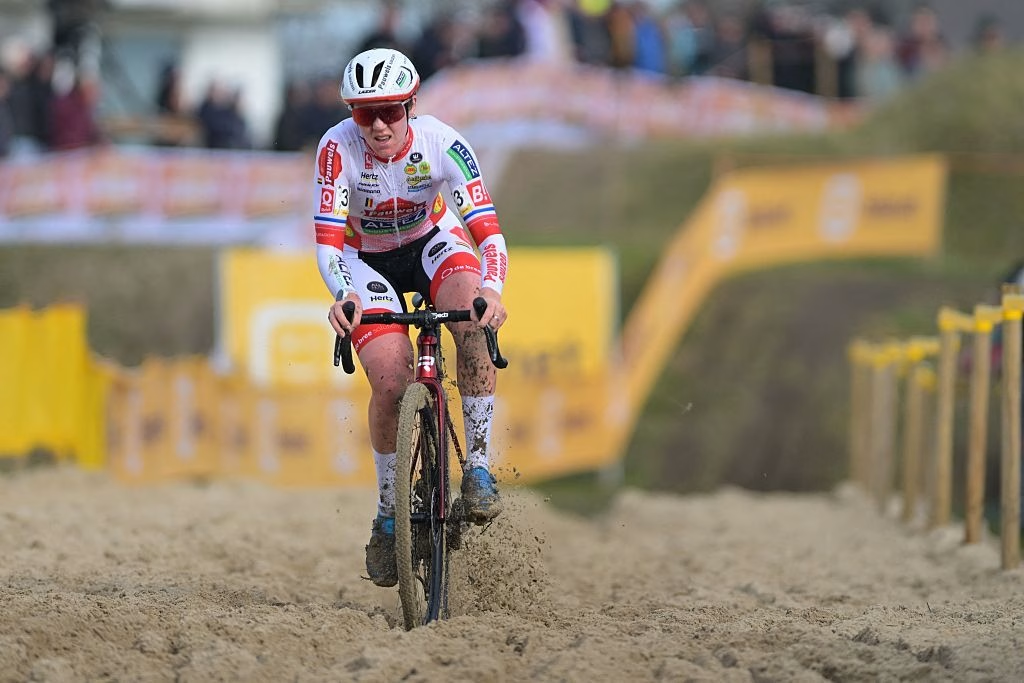
Alvarado’s victory at Heerderstrand on 24 October was an early reminder of what makes her dangerous. In a closely contested race she attacked through the sand on the final lap, beating Denise Betsema and Aniek van Alphen. It was not a win secured by simply riding harder on the easiest section of the course. Her ability to carry speed and make clean decisions on unstable ground gave her the decisive advantage.
That technical skill makes Alvarado a natural threat at venues such as Koksijde, Zonhoven and other circuits where sand or difficult transitions can expose a weakness. She has already won the elite world title and knows how to manage the pressure of a championship. If she can match Brand’s consistency over several weekends, the season becomes a genuine contest rather than a sequence of isolated upsets.
Her recent history also illustrates the importance of health and timing. A cyclocross winter is long enough for form to rise and fall more than once. The riders who arrive strongest in October are not always those who produce their best performance in late January. Alvarado’s challenge will be to turn her early speed into a campaign that lasts.
Fem van Empel’s return deserves patience
Van Empel’s return is one of the most significant stories of the season. After stepping away from competition, she has approached the new winter with a reduced programme and a stated emphasis on enjoying racing again. At Heerderstrand she finished fifth, after showing early speed but losing ground as the race developed. That result was encouraging evidence of a return to the field, not a reliable measure of her eventual ceiling.
At her best, Van Empel combines explosive acceleration with exceptional confidence through difficult sections. She has won elite world titles and can turn a close race into a decisive victory within a single lap. But the demands of returning to a demanding sport should not be underestimated. Fitness, racing rhythm and confidence can develop at different rates, and she does not need to dominate every weekend for the comeback to be meaningful.
If her schedule remains selective, the most useful way to assess her will be to compare performances on similar courses rather than simply count wins. A strong technical race in November followed by an improved result in December may say more about her trajectory than an isolated podium. She remains a rider capable of changing the hierarchy, but it would be premature to assume that she will contest every classification.
Aniek van Alphen and Inge van der Heijden offer consistency
Aniek van Alphen won the 2025–26 Superprestige overall and began the new series with second place at Overijse. That combination is worth taking seriously. A season-long competition does not always reward the rider who can produce the highest single performance; it rewards the rider who is present, competitive and able to avoid the costly off-day. Van Alphen has demonstrated those qualities against deep fields.
She also finished third at Heerderstrand after working her way back towards the front late in the race. That kind of recovery is useful when a course changes during the event. A rider who can remain calm after losing contact may regain positions as others begin to make mistakes. It is not as spectacular as a long solo attack, but it can be the difference between a podium and a finish outside the top five.
Inge van der Heijden was third at Overijse and has become another dependable presence near the front. Her performances at Niel and across the Superprestige show that she can race effectively on technically demanding Belgian circuits. She may not always start as the favourite, but a race that remains close into the final laps gives her opportunities to exploit mistakes and finish strongly.
There is a tactical distinction between those approaches. Brand often tries to make the race selective. Van Alphen and Van der Heijden can benefit from remaining within reach, using their consistency and course management to stay in contention. If either begins converting podiums into victories, the points tables will change quickly.
Amandine Fouquenet and the international challengers
Amandine Fouquenet made a major step during the 2025–26 season, including victory at Middelkerke in February. She has the physical strength to force a race apart and has become a serious presence in the leading group. Her next task is to reproduce that level across different conditions, particularly when the strongest Dutch riders are all present. A victory at a familiar venue is valuable; repeated wins on unfamiliar courses would establish a new status.
Marie Schreiber brings a different profile. The Luxembourg rider is known for explosive starts and has shown that she can upset a more established favourite when she gets into her rhythm early. A quick opening lap can be a tactical weapon, especially on courses where passing is difficult. The question is whether she can maintain that speed when the race settles and the leading group begins to apply sustained pressure.
Blanka Vas and Shirin van Anrooij add the complication of multi-discipline schedules. Both have demonstrated that they can compete at the top of cyclocross while pursuing major ambitions on the road. Vas can bring considerable power and technical assurance, while Van Anrooij’s endurance and tactical intelligence make her dangerous on courses that reward a controlled effort. Their participation patterns may be more selective than those of riders focused on the full winter calendar.
For British spectators, Zoe Bäckstedt remains a particularly compelling rider to follow. Her strength and technical development have already brought major results at younger levels and competitive performances against elite opposition. A difficult course that rewards power under fatigue can suit her well. The key measure this winter is whether she can make the leading group consistently, rather than treating every result outside the podium as a disappointment.
The next generation is already close
Leonie Bentveld is one of the younger Dutch riders pushing towards the established elite. Her under-23 achievements and regular appearances near the front suggest that she is increasingly comfortable racing against women who have spent years winning World Cups and championships. The challenge is to convert that promise into results when the pace becomes most intense in the closing laps.
There is also growing depth beyond the Dutch and Belgian heartland. The international calendar offers opportunities for riders from France, Britain, the United States and central Europe to compete regularly against the strongest field. That matters because cyclocross has historically been concentrated in a small number of countries. A broader competitive base can make the World Cup more interesting, especially at venues outside Belgium and the Netherlands.
For the emerging riders, progress will not necessarily be measured in victories. A rider who moves from fifteenth to seventh across several races may be closing a significant performance gap. Likewise, a strong start followed by a fade can indicate that speed is present but endurance or pacing still needs work. Those details often tell us more about an emerging rider than the headline classification.
Where the season could be decided
The first important checkpoint is the European Championships at Zeddam in November. A championship race can be very different from a series round: there is no need to protect points for the following week, and national-team dynamics can alter how the race develops. One mistake or one perfectly timed attack may be enough to settle the medals.
The World Cup begins at Ostrava on Friday, 27 November, followed by Tábor two days later. It then moves to Glasgow on 13 December, before a crowded holiday programme including Antwerp, Koksijde, Gavere, Namur and Besançon. Those races cover a wide variety of surfaces and technical demands. A rider who can win on all of them has a very different claim to dominance from one who excels on only one type of circuit.
The World Championships at Ostend on 29–31 January 2027 provide the final major target. Coastal terrain, the possibility of sand and unpredictable winter weather mean that equipment choices and technique could become particularly important. However, the exact course and race-day conditions will matter more than any generic assumption about a seaside venue. Championship form is best judged closer to the event.
The various series reward different approaches. Superprestige points encourage regular high finishes, the X²O Trophy uses accumulated time, and the World Cup has its own calendar and scoring system. A rider may target one classification while using other races to prepare for a championship. Comparing their season totals without acknowledging those choices can produce misleading conclusions.
How to follow the women’s 2026–27 season
A useful way to watch the winter is to track three things: who is starting, how the course suits them and whether their form is improving. Brand’s dominance is the central story for now, but Alvarado’s technical speed, Van Empel’s comeback, Van Alphen’s consistency and the progress of younger riders give the season several possible directions. A confirmed start list and the conditions on the day should always carry more weight than reputation alone.
ProCyclingUK’s 2026–27 calendar brings together the major events, while the UK viewing guide explains the broadcast options. For the opening form lines, see Brand’s Overijse victory, Alvarado at Heerderstrand and the Koppenbergcross report.