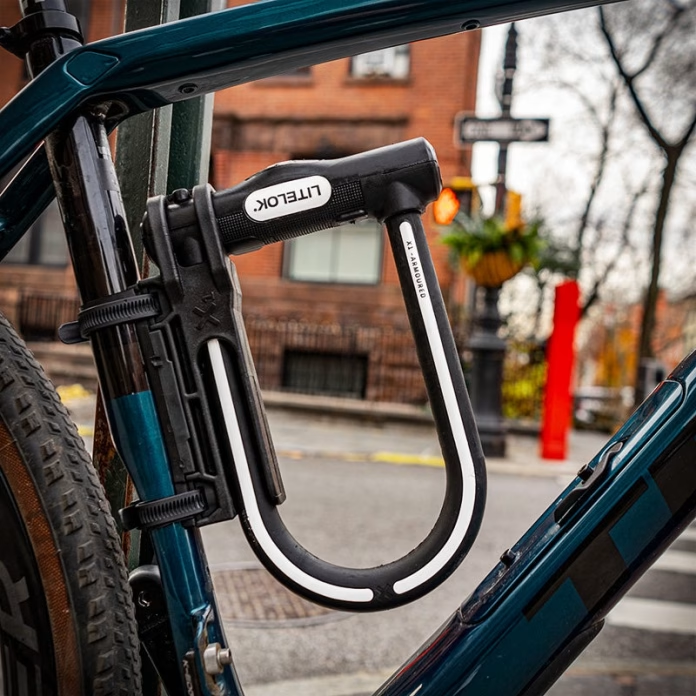
A £170 bike lock can meet the same headline security certifications as a £280 one and still offer noticeably less resistance to a determined angle-grinder attack. That is the practical decision between the Litelok X1 and X3. Both are full-size British-made armoured D-locks, both hold Sold Secure Pedal Cycle Diamond and Powered Cycle Diamond ratings, and both use Litelok’s Barronium approach to resist cutting. The X3 is built to withstand more punishment, but adds weight and £110 to the manufacturer’s current UK price.
This is a research-led comparison, not a claim that ProCyclingUK has tried to cut either lock. We have compared Litelok’s specifications with independent testing from BikeRadar, road.cc, Cycling Weekly and Cycling UK. The evidence is unusually useful because both products have actually been attacked with tools, although the exact test protocols and attack times are not interchangeable. The question is whether the X3’s extra resistance matters enough to you to justify carrying it.
Litelok X1 vs X3 specifications
| Specification | Litelok X1 | Litelok X3 |
|---|---|---|
| UK manufacturer price, November 2026 | £169.99 | £279.99 |
| Manufacturer weight | 1.7kg | 2.1kg |
| Internal locking space | 101 × 197mm | 100 × 195mm |
| Sold Secure Pedal Cycle | Diamond | Diamond |
| Sold Secure Powered Cycle | Diamond | Diamond |
| Other independent security grade | ART4 | ART4 |
| Construction | Barronium armoured steel D-lock | Heavier, thicker Barronium armoured steel D-lock |
| Published product focus | Everyday high-security portability | Maximum powered-tool resistance |
Prices reflect Litelok’s UK listings checked in November 2026 and can change. The £110 premium buys a more heavily armoured shackle and lock construction, rather than a meaningfully larger opening. In fact, their quoted usable internal spaces are nearly identical. Litelok sells additional X1 Mini and X1 Plus variants, but they are different products with different reach and weight; this comparison is specifically the standard full-sized X1 and X3.
The headline security rating doesn’t tell the full story
Both the X1 and the X3 meet Sold Secure Diamond for pedal cycles and powered cycles. That matters because it confirms neither is merely a normal lightweight commuter lock with a marketing claim about grinder resistance. Both have been independently certified to a high standard, and both satisfy the broad rating category many UK bicycle insurance policies require for high-value bikes.
Certification is a threshold, not a league table of how many minutes a thief needs. A lock can meet Diamond and still be significantly slower to cut than another lock with exactly the same marking. Test results depend on tool power, cutting discs, how the shackle is held, whether one or two sides need cutting and how easily the bike and locking point allow the attacker to work. A certification should be read as one part of the buying decision.
The X1 has a 1.7kg construction and a substantial armoured shackle, while the X3 weighs 2.1kg and uses thicker armour. Litelok markets the X3 as a much stronger barrier against an angle grinder, but the useful evidence comes from independent destructive testing, not just its own multiplier claims.
How much stronger is the X3 against an angle grinder?
In BikeRadar’s 2026 comparative security test, it took four minutes and 38 seconds, including disc changes, to cut through one side of the X1’s shackle. The X3 resisted for more than 12 minutes before a single side was cut in that publication’s test, at a cost of four cutting discs. Those figures make a compelling case for the more expensive lock under that specific testing method. They do not mean that every real theft will take either of those times, nor that cutting both sides will always simply double the figure.
Cycling UK’s independent grinder-resistant lock group test told a similar story. Its tester was unable to cut through the X3 during the timed attempt, whereas the X1 was eventually defeated, albeit after enough resistance to impose a substantial delay. Road.cc, testing the X1 separately, also praised the balance between meaningful protection and everyday weight. The pattern across those evaluations is consistent: the X1 is genuinely hard to cut, and the X3 provides a further margin against powered tools.
Another detail from BikeRadar deserves consideration. The X3 proved extraordinarily robust under mechanical attack but ceased functioning after 120 hours of its corrosion test. That is not a claim that it will stop working after five days outside. It does show why the keyway and moving mechanism deserve ordinary maintenance, even on a lock whose shackle is designed to resist exceptional attack. Maximum security is not an excuse to ignore lubrication and cleanliness.
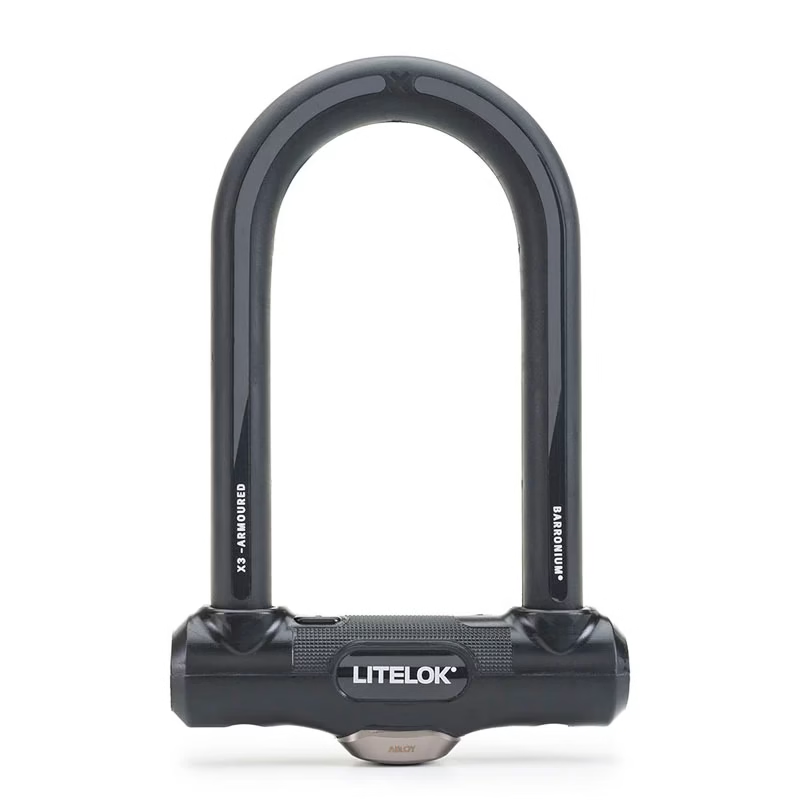 Photo Credit: Litelok
A 400g weight difference is significant on a daily commute
The X1 weighs about 1.7kg, compared with the X3 at 2.1kg. That 400g gap is the weight of a filled small cycling bottle before the bottle itself is counted. It is not much beside the mass of an e-bike, but it becomes noticeable if you carry the lock in a rucksack every morning, attach it to a frame or take it on errands where you may only lock the bicycle for ten minutes.
Neither lock is a featherweight accessory. Both are reassuringly substantial pieces of security equipment, and neither should be treated as a convenient alternative to a cable or a compact café lock. Their purpose is to secure an expensive bicycle to a fixed stand under conditions where an opportunistic thief might arrive equipped with serious tools.
Litelok offers carry solutions for both locks, including lock-specific mount options. Check exactly what is included with the version you purchase because accessories and bundles can differ. A secure fit on your own frame matters more than a generic claim that a lock can be transported on a bicycle. An oversized lock mounted poorly on a slender road frame is likely to rattle, interfere with a bottle or encourage you to leave it behind.
Locking space and real-world fitting
On paper the X1’s opening is 101 × 197mm and the X3’s is 100 × 195mm. This is remarkably close. Neither unlocks a new level of reach around a very thick post, broad cargo-bike tube or unusually spaced wheel and frame. If you need more reach, consider the geometry of the locking point before simply buying the more expensive X3. The standard X1 might actually provide marginally more usable space in one dimension, but the difference is too small to be a compelling reason on its own.
For either product, put the lock through the frame and a secure fixed stand, adding a wheel when the geometry allows. Keep the shackle low and tight rather than leaving a big open space where a tool can be positioned. If the frame is awkward to secure, combine the main D-lock with another appropriate lock or cable for the vulnerable wheel. A thief who cannot cut the shackle may still exploit an insecure rack or a quick-release component.
Buyers of high-value e-bikes and cargo bikes should also check that an insurer accepts the exact lock and the locking method. Both models carry the relevant Diamond powered-cycle category, but the policy can still have rules about the type of anchor, where the bike is left and the total value of the machine. The certification doesn’t remove those conditions.
 Photo Credit: Litelok
Does the X3 justify the extra £110?
For a cyclist locking outside a city-centre station, outside a gym for a long evening or near a workplace with frequent thefts, the extra time imposed by the X3 can be worth far more than £110. The strongest independent grinder evidence is substantial, and the £280 purchase becomes easier to justify against the replacement cost of a £3,000 road bike or e-bike. The 400g penalty may be acceptable if the lock can be left securely at the destination.
The argument changes for someone commuting through lower-risk streets who wants a lock they can bring everywhere. The X1 already gives outstanding security credentials for its weight and cost. It is not the weak option: it carries the same highest Sold Secure categories and has shown several minutes of resistance under independent grinder testing. The £110 saved could fund a second lock for the front wheel or a better ground anchor at home.
There is also the issue of opportunity. A lock deters theft when it is actually used correctly. If the extra bulk makes you reluctant to bring the X3, the X1 can offer more practical protection simply because you are willing to carry it. Many riders will get more real security from a high-quality X1 and consistent locking habits than from a stronger lock used only on special occasions.
Where each lock fits in Litelok’s range
Litelok now sells more than these two models. The shorter X1 Mini is aimed at riders who can work with a smaller opening and prioritise compactness, while the longer X1 Plus is designed for extra reach. They should not be confused with the standard X1 when comparing dimensions, prices or test results. The X3 remains the heavier, maximum-resistance choice within the bicycle range.
If portability is the priority but even the X1 is too cumbersome, a smaller lock can be sensible if you know your parking arrangements. If security against a well-equipped thief is the absolute priority, the X3 is the logical product in this pair. Do not buy on the assumption that a shorter or longer model carries an identical weight or fitting profile.
Our standalone Litelok X3 review examines its construction and ownership compromises. The long-term Litelok X1 review provides background on the lighter lock, while the X3 versus Hiplok DX comparison explains how Litelok’s grinder resistance differs from a conventional high-security D-lock.
Which Litelok would we choose?
The X1 is the stronger value recommendation for most cyclists who need Diamond-rated protection every day. It is lighter, appreciably cheaper and has independent testing that demonstrates genuine resistance to an angle grinder. Its compact price premium over an ordinary D-lock makes sense for city commuting or higher-value road and gravel bikes without demanding the maximum weight.
The X3 is the better choice where an angle grinder is a realistic primary threat and the bicycle may be left unattended for extended periods. Its additional resistance is supported by direct destructive tests, not merely its £110 higher retail price. If the lock is going to live at a station or workplace, the extra weight matters less. Just remember that protecting the shackle is only one part of protecting the entire bicycle.
Litelok publishes full product specifications and current UK prices for the X1 and X3. These links go directly to the manufacturer and are not commission-tracked. This comparison is independently researched and does not claim first-hand destructive testing by ProCyclingUK.
-
 Photo Credit: MFonzatti / Wikimedia Commons (CC BY-SA 4.0)
-
 Photo Credit: Hoebele / Wikimedia Commons (CC BY-SA 4.0)