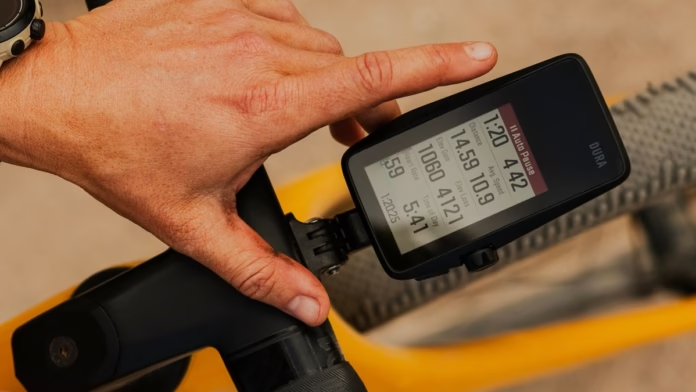
The COROS DURA has one advantage that remains difficult for rival bike computers to answer: battery life. COROS quotes up to 120 hours in its standard all-systems GPS mode, with solar charging capable of adding up to two hours of riding time for every hour in sufficiently strong direct sunlight. That makes the DURA particularly interesting for audax, bikepacking and riders who simply do not want another device that needs charging every few rides.
Battery life alone does not make a good cycling computer, though. The DURA launched with software that felt less mature than the established Garmin and Wahoo ecosystems, and early independent reviews were much more enthusiastic about its endurance than its navigation. COROS has continued developing the platform since then, so the 2026 DURA is a more complete proposition, but its strengths and compromises remain unusually clear.
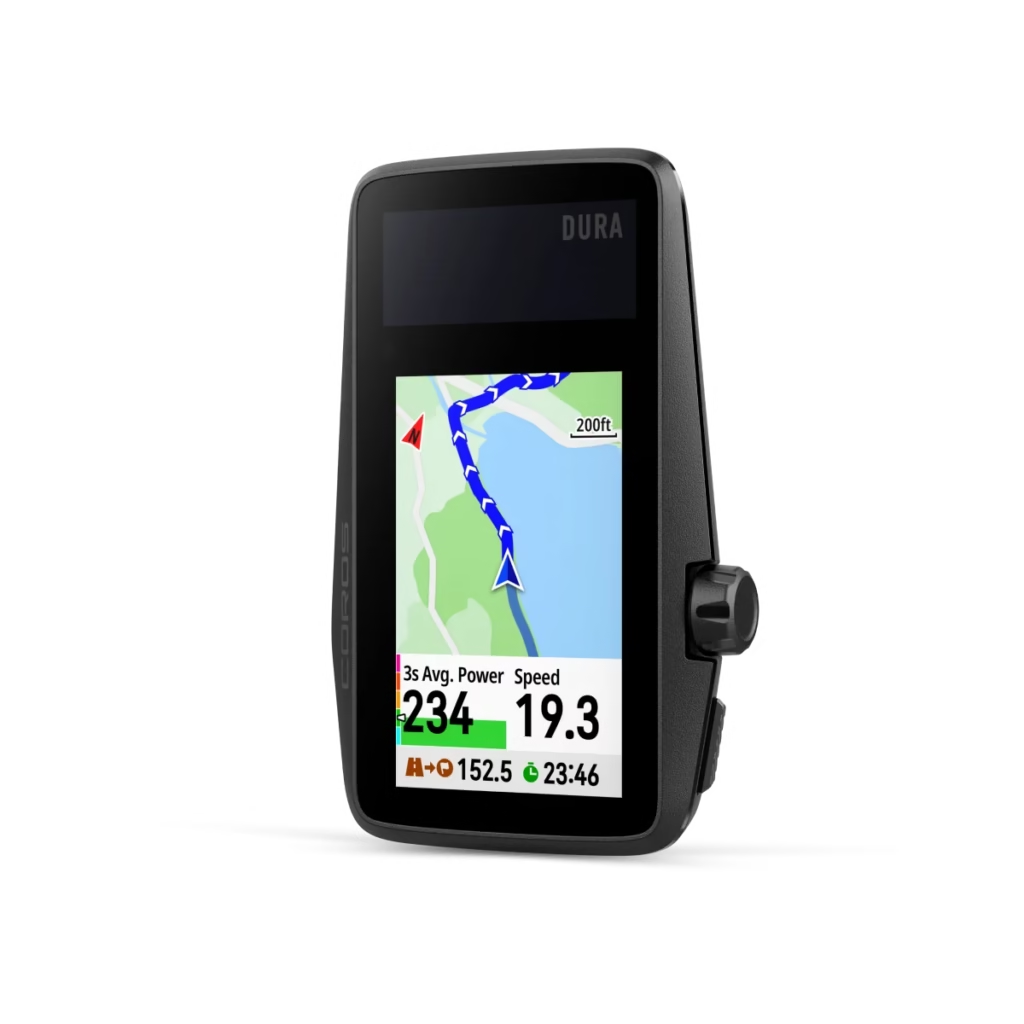
COROS DURA specifications
| Display | 2.7-inch MIP colour touchscreen |
| Battery | Up to 120 hours in standard all-systems GPS mode |
| Dual-frequency GPS battery | Up to 70 hours in standard daytime use |
| Solar charging | Up to two extra hours per hour in suitable direct sunlight |
| Navigation | Offline global maps, turn-by-turn directions and smart rerouting |
| Connectivity | Bluetooth and ANT+ |
| Controls | Touchscreen, digital dial and button |
| Weight | 102g |
| Water resistance | IP67 |
| UK price | £249 |
Battery life is still the DURA’s defining feature
COROS now publishes more useful battery figures than the headline 120-hour claim alone. With navigation and three connected accessories, its estimate falls to 67 hours in standard all-systems GPS during daytime riding, or 55 hours at night. Dual-frequency GPS is more demanding, with estimates of 49 hours using navigation and accessories during the day and 42 hours at night.
Those lower figures are arguably more useful because they reflect the way a performance cyclist is likely to use the device. Even then, endurance remains excellent. Cyclingnews’ launch testing produced remarkably low net battery drain on a sunny three-hour ride, although solar input accounted for much of that result. The sensible conclusion is not that the DURA never needs charging, but that charging becomes a much less frequent concern than with most mainstream computers.
The 2.7-inch display prioritises efficiency over visual impact
The DURA uses a 2.7-inch memory-in-pixel colour display rather than the brighter, richer screens appearing on some premium computers. MIP technology makes sense for a product built around endurance because it remains visible in daylight without consuming excessive power. An adaptive backlight deals with darker conditions.
The interface combines touch input with COROS’s familiar digital dial and a physical button. That gives riders an alternative to touchscreen operation in gloves or poor weather. Early reviews found the display response slower than the best rivals, however, and anyone moving from a modern smartphone-like cycling computer should expect a more functional visual experience.
Navigation has improved, but Garmin remains the reference point
COROS now describes the DURA as offering built-in global offline maps, turn-by-turn guidance and smart rerouting powered by Google Maps. Routes can be created in the COROS app or synced from services including Strava, Komoot and Ride with GPS.
Navigation was the area that drew the most criticism when the DURA arrived. Cycling Weekly liked the value and battery life but found the navigation less convincing away from straightforward road riding, while Cyclingnews’ early test also exposed limitations in the launch software. That history matters because it explains why the DURA is not simply a £249 Garmin replacement despite its exceptional endurance.
For riders who mostly follow prepared road routes, the current feature set is much easier to live with. Those who prioritise sophisticated mapping, on-device route creation and a deeply established accessory ecosystem may still prefer Garmin. ProCyclingUK’s Garmin Edge 840 Solar review shows the alternative approach, while the Beeline Velo 2 review covers a much simpler navigation-first option.
Sensor and training support is broad enough for serious riding
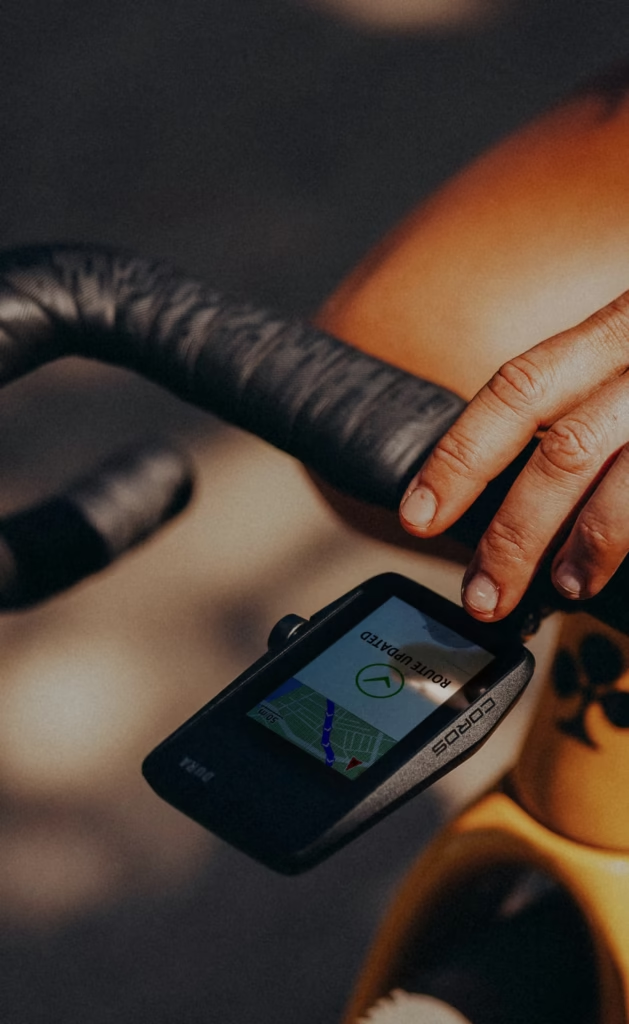
Bluetooth and ANT+ support allow the DURA to connect to power meters, heart-rate monitors, speed and cadence sensors, radar units and compatible electronic drivetrains. It also sits inside the wider COROS training platform, which is useful for riders already using one of the company’s watches.
That makes the DURA much more than a navigation device. It can handle the core data expected from a modern performance computer and is particularly well suited to long events where power, heart rate, navigation and battery endurance all need to coexist.
Who should buy the COROS DURA?
The strongest case is for endurance riders. Audax, ultra-distance events, bikepacking and long weekends away all expose the inconvenience of short battery life, and the DURA removes much of that anxiety. The £249 UK price also undercuts many flagship computers while retaining dual-frequency GPS, mapping and full sensor connectivity.
It is less convincing for someone whose first priority is the richest mapping interface or the broadest ecosystem. Garmin and Wahoo have had much longer to refine their cycling platforms, and that maturity still has value. The DURA instead offers a focused combination of endurance, useful training functions and an unusually competitive price.
COROS DURA verdict
The DURA’s original headline has survived contact with the market: its battery performance really is exceptional. More importantly, COROS has continued developing the software around it, so the computer is no longer defined only by how long it can stay switched on.
Navigation and interface polish remain the reasons not to treat it as an automatic alternative to an Edge or ELEMNT. For riders who value endurance above a huge feature catalogue, though, £249 buys dual-frequency GPS, offline mapping, extensive sensor support and a battery specification that changes how often a cycling computer needs attention.
-
 Photo Credit: quentinphotographiebe
 -
 Photo Credit: Getty