Chiang Mai is one of the easiest places in South-East Asia to combine a city break with serious road cycling. The old city sits on a broad plain, but the western edge rises almost immediately into the mountains of Doi Suthep-Pui National Park. That gives riders a rare combination: flat roads for an easy spin, a benchmark climb beginning within riding distance of the centre, and longer mountain loops that can fill an entire day.
The riding is not effortless to organise. Heat, traffic and air quality all matter, while the steepest roads around the city are considerably harder than their modest altitude might suggest. An early start is usually the difference between a good ride and an uncomfortable one. Get the timing right, though, and Chiang Mai offers a varied week on the bike without needing to change hotels every night.
Doi Suthep: Chiang Mai’s benchmark climb
Doi Suthep is the obvious first ride because the climb begins on the western edge of the city near Chiang Mai Zoo and the university. The established ascent to Wat Phra That Doi Suthep is about 10.8km at roughly 6% average. It is long enough to be a proper training effort but steady enough for most fit road cyclists to settle into a rhythm rather than spend the entire climb fighting the gradient.
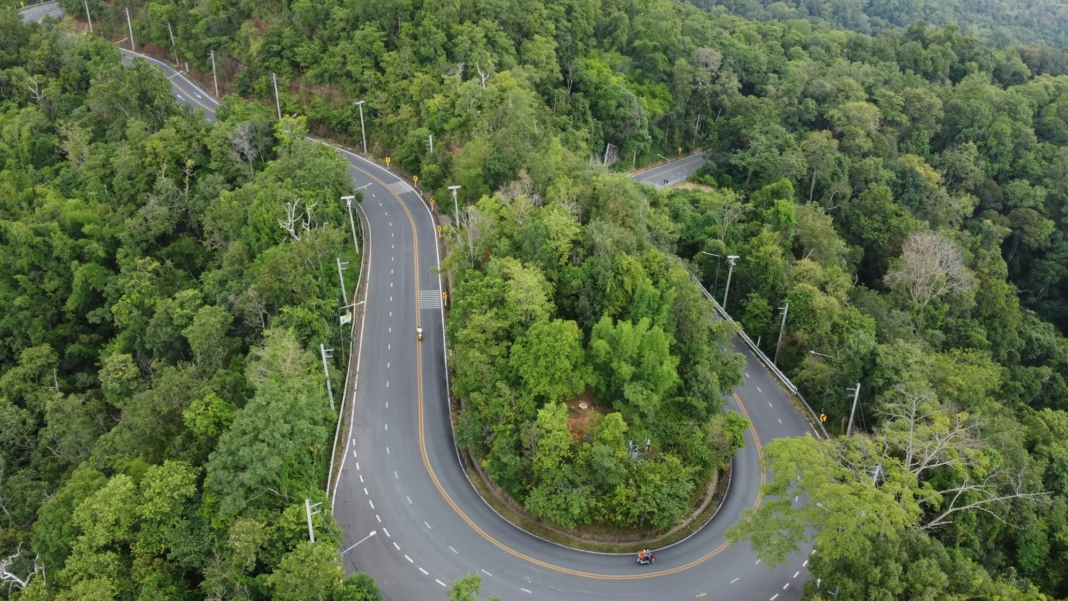
The road rises through forest on a sequence of bends, with occasional views back across Chiang Mai. Most of the climb sits around a manageable gradient, although the final approach contains a much sharper ramp. Local riders use Doi Suthep as a regular benchmark, which gives the mountain the feel of a city training climb rather than a remote expedition.
Reaching the temple does not have to be the end of the ride. The road continues towards Bhubing Palace and higher into Doi Pui, taking the route towards roughly 1,600 metres. That extension adds a meaningful amount of climbing and changes the character of the day. Riders who are new to the heat may be better stopping at the temple on their first attempt and adding Doi Pui later in the trip.
The descent needs more caution than the climb. Tourist traffic, including songthaews, uses the same road and vehicles can stop or change line unexpectedly. Forest shade can also make surface changes harder to read. Start early, keep the descent comfortably within your limits and expect traffic even if the road felt relatively quiet on the way up.
The Samoeng loop: a full mountain day
If Doi Suthep is the standard morning climb, the Samoeng loop is the classic longer ride. The exact distance depends on where in Chiang Mai you start and which city roads you use, but common versions are around 85 to 100km with roughly 1,500 metres of climbing. The route heads into the mountains north-west and west of the city before returning from the south.
Riding counter-clockwise takes you towards Mae Rim and onto Route 1096 before connecting with Route 1269. The terrain is repeatedly broken rather than built around one long ascent. The Mae Sa climb is around 3km at about 6%, followed by further climbing towards Pong Yaeng. Later, the route contains much steeper ramps, including the well-known seven-hairpins section, where the average gradient is around 12% for more than 2km and individual pitches are steeper again.
That section is the reason compact gearing is sensible even for a strong rider. A 34-tooth inner chainring with at least a 30-tooth sprocket gives useful room once the accumulated climbing and heat begin to tell. The loop has shops and cafés, particularly through the more populated sections, but it is still worth carrying enough food to fuel the ride to avoid relying on finding something immediately before the hardest climb.
The descents are fast and twisting, making a secure braking position important. Our guide to when to ride in the drops explains how hand position affects control and access to the brake levers. A local rider who knows every bend can carry speed that would be unwise for a visitor seeing the road for the first time. Tropical rain can also leave damp patches or debris on the surface. Treat the first Samoeng ride as reconnaissance rather than an exercise in chasing downhill segments.
Mon Jam, Mae Rim and quieter roads north of the city
The Samoeng loop is useful because it introduces several areas that can be turned into separate rides. Mae Rim is particularly valuable for cyclists who find central Chiang Mai too busy. Staying or starting farther north cuts down the urban kilometres and gives quicker access to rolling roads, mountain climbs and quieter lanes.
Mon Jam is one of the obvious climbing targets from this side of the city. The roads around it are steeper and more irregular than Doi Suthep, with short ramps that punish over-gearing. It works well as a shorter mountain day between bigger rides, especially if you build the route through Mae Rim rather than simply following the largest road out of central Chiang Mai.
East and north-east of the city, flatter rural roads provide another option when the legs need a break from climbing. The landscape changes quickly once clear of the busiest urban corridors. For a recovery ride, that can be a better use of the day than forcing another summit into an already climbing-heavy week.
Doi Inthanon and longer rides in northern Thailand
Doi Inthanon is the major climbing objective beyond Chiang Mai itself. At 2,565 metres it is Thailand’s highest mountain, and the road to the summit has become a recognised challenge for cyclists. It is not a casual extension to a city ride. The distance from Chiang Mai and the scale of the ascent make it better treated as a dedicated day with transport or a carefully planned longer route.
The wider region also opens the possibility of multi-day riding towards Pai, Mae Hong Son and other parts of northern Thailand. Those journeys introduce longer distances, repeated mountain passes and more complicated traffic considerations. They suit riders who are comfortable being self-sufficient and researching individual roads rather than assuming that a route popular with motorcyclists will automatically be pleasant on a bicycle.
For a one-week cycling trip, there is little need to chase those distances. Doi Suthep, the Samoeng loop, Mae Rim and a Doi Inthanon day already provide several distinct types of riding. Longer touring makes more sense if northern Thailand itself is the focus of the holiday rather than Chiang Mai being the fixed base.
Traffic, heat and road safety
The biggest adjustment for many visiting European riders is traffic rather than climbing. Thailand drives on the left, which at least removes one unfamiliarity for British cyclists, but road behaviour is different and motorcycles are a constant presence. The busiest roads around Chiang Mai are rarely the enjoyable part of a ride. Where practical, use quieter parallel roads and accept a slightly longer route if it avoids a major arterial road.
Daytime running lights are sensible, as is a conservative position on descents and through junctions. Do not assume a vehicle has seen you simply because you are established on the road. The mountain routes can feel calm compared with the city, but tourist vehicles and motorcycles still appear on blind bends.
Heat changes the pacing of even familiar-looking gradients. Starting around sunrise is common among local riders because the first hours of daylight are cooler and generally quieter. Carry two bottles for longer rides and plan refills rather than waiting until both are nearly empty. Electrolytes are useful on the longer mountain days, particularly for riders arriving directly from a cool European climate.
Rain is another reason to ride early. From roughly May to September, showers and storms are more likely later in the day. A morning start will not guarantee a dry ride, but it improves the odds and reduces the chance of being caught high in the mountains when a storm develops.
When to cycle in Chiang Mai
For a road-cycling holiday, the cool dry period from roughly November to February is the straightforward choice. Mornings are generally more comfortable, rainfall is lower and the mountain roads are easier to plan around. October can also work as conditions transition out of the wetter season.
The major complication comes later in the dry season. Northern Thailand experiences a recurring smoke and haze problem associated with agricultural and forest burning, with conditions often deteriorating from February into April. The precise timing and severity vary from year to year, so fixed calendar advice is not enough. Check live air-quality readings before hard outdoor exercise and be prepared to change plans if pollution levels are poor.
March and April are also among the hottest months. Combining high temperatures with poor air quality makes them a weak choice for a trip built around sustained climbing. If cycling is the main reason for travelling, November, December and January offer a much more reliable target window.
Bike choice, gearing and where to stay
A normal road bike is suitable for the headline routes. The main Doi Suthep and Samoeng roads are paved, so there is no need to bring a gravel bike unless smaller tracks and mixed-surface riding are part of the plan. Modern 28mm or wider road tyres give useful comfort and margin on variable surfaces without making the long climbs feel cumbersome.
Low gearing matters more. Doi Suthep itself is manageable on conventional climbing gears, but Samoeng and some of the roads around Mon Jam contain much steeper sections. A compact chainset and a cassette reaching 30 or 32 teeth is a sensible baseline. Riders who prefer spinning on steep gradients may want lower still.
Staying inside or near the old city is best if cycling shares the trip with restaurants, temples and sightseeing. The trade-off is that most serious rides begin with urban traffic. Accommodation towards the western side of the city shortens the approach to Doi Suthep, while Mae Rim is a better choice for a trip where riding takes priority over city-centre convenience.
Bike hire and guided riding are well established in Chiang Mai, including road-bike options and local guides familiar with Doi Suthep, Samoeng, Mon Jam and Doi Inthanon. A guide is not essential for the standard routes, but local knowledge is particularly useful for stitching together quieter roads out of the city and understanding where traffic becomes unpleasant.
Planning a week of riding
A sensible first ride is Doi Suthep to learn the heat, traffic and descending conditions without committing to an all-day route. Follow it with an easier rural day, then tackle the Samoeng loop once you know how quickly you are drinking and how the local gradients feel. Mon Jam or a higher extension towards Doi Pui can fill another climbing day, with Doi Inthanon reserved for the biggest outing of the trip.
That sequence also leaves room to move rides around if the weather or air quality changes. Chiang Mai rewards flexibility. The mountains are close enough that there is little reason to force a major ride on a poor day when the same route can be attempted the following morning.
The city’s strength as a cycling destination comes from that proximity. Doi Suthep can be ridden before breakfast, Samoeng provides a demanding mountain loop, and the wider province has enough climbing to occupy riders who want considerably harder days. Combine early starts with sensible gearing and careful route choice, and Chiang Mai works as a serious road-cycling base rather than simply somewhere to hire a bike between sightseeing days.
-
 Photo Credit: quentinphotographiebe
 -
 Photo Credit: Getty