
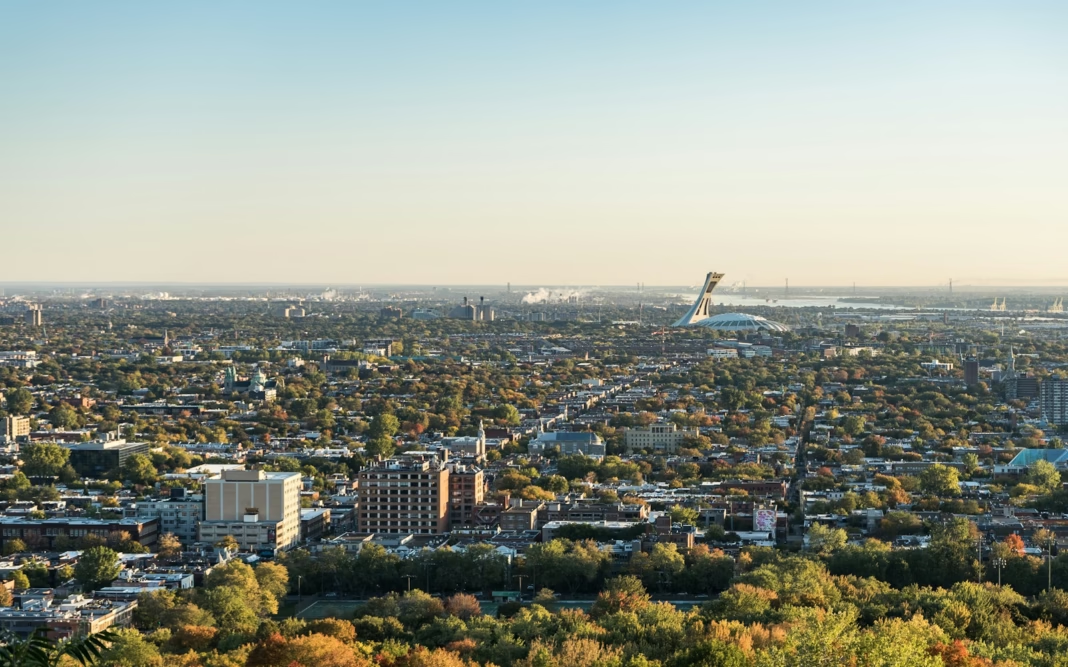
Montréal works best as a cycling destination when the city and the countryside are treated as parts of the same trip. Mount Royal gives road riders a genuine training climb within minutes of the centre, the Lachine Canal and Saint Lawrence provide easier kilometres, and the Laurentians begin close enough to turn a few days in Montréal into a much longer riding holiday.
The headline route outside the city is the 234km P’tit Train du Nord, a former railway corridor running through forests, lakes and small towns from the northern edge of Greater Montréal towards Mont-Laurier. It is a very different type of ride from repeated efforts on Mount Royal, but that contrast is precisely what makes the combination work.
You can spend one morning climbing roads used by the WorldTour, another cruising beside the canal and then move north for two or three days of largely traffic-free riding. For anyone looking beyond the traditional European cycling bases, Montréal offers an unusually easy way to mix proper riding with a city break.

What kind of cycling trip does Montréal suit?
Montréal is particularly good for riders who want cycling to be important without making the entire holiday revolve around it.
Staying centrally means there is no need to drive for every ride. Mount Royal rises directly out of the city, the canal network can be reached by bike and the islands around Parc Jean-Drapeau provide another direction for flatter riding. You can train in the morning, return to the hotel and still have the rest of Montréal available rather than spending every day isolated at a mountain resort.
That also makes the city useful for mixed groups. A stronger road cyclist can spend an hour doing climbing repetitions while somebody looking for an easier day follows segregated paths along the canal or river. Both can then use the Laurentians differently, either as a touring destination or as a base for longer road rides.
ProCyclingUK’s travel and riding abroad hub has more ideas for combining cycling with a wider trip, but Montréal stands out because the transition from urban riding to a proper multi-day route is unusually straightforward.
Mount Royal is the climb every road cyclist should ride
Mount Royal is the obvious place to start.
The climb through Voie Camillien-Houde is not a huge mountain by European standards, but it is long and steep enough to provide a meaningful effort. The main racing section is roughly 1.8km at around 8%, with the road winding through forest rather than feeling like a conventional city street.
It is also one of the most important roads in Canadian professional cycling. Camillien-Houde forms the backbone of the Grand Prix Cycliste de Montréal and has appeared repeatedly in major championship racing. The GP Montréal 2026 route guide shows how a manageable climb becomes extremely selective once the professional peloton rides it again and again.
For a visiting rider, one ascent is enough to understand the appeal. The gradient is consistent enough to find a rhythm but hard enough that riding properly rather than sightseeing quickly becomes a threshold effort.
The surface was renewed ahead of the 2026 World Championships, improving what had previously been one of the less enjoyable parts of riding the climb. Traffic is still part of the normal experience, however, so this is not an Alpine pass where you can simply drift across the road looking at the scenery. Ride predictably, use a rear light and treat the descent with the same respect as any other urban road.
During summer, Montréal also operates Cyclovia sessions on selected dates when part of Camillien-Houde is closed to motor traffic. If your trip coincides with one, it is an excellent opportunity to ride repetitions without cars.

You do not need to recreate the GP Montréal circuit
There is a temptation to look at the professional route and decide that the obvious ride is to copy an entire lap.
That is not necessarily the best introduction to Montréal.
The WorldTour circuit combines Camillien-Houde with the Côte de la Polytechnique, Avenue Pagnuelo and a series of urban transitions before returning towards Avenue du Parc. The history of GP Montréal explains why those roads have become so important to the city’s cycling identity.
For training, however, the most useful approach is often simpler. Ride Camillien-Houde, descend carefully, add one or two other climbs around Mount Royal and then use flatter roads to recover before repeating the effort.
The Côte de la Polytechnique is particularly useful if you want a sharper effort. It is shorter than Camillien-Houde but includes a much steeper section, so the sensation is completely different. Pagnuelo is another shorter climb that can be linked into a loop without requiring the full race circuit.
Three or four Mount Royal ascents can create a serious morning ride without travelling far from your accommodation.
That is one of Montréal’s main advantages as a cycling base. Training does not require an hour of riding simply to reach the interesting terrain.
The Lachine Canal is the obvious recovery ride
The Lachine Canal provides almost the opposite experience.
Instead of climbing, it offers a predominantly flat, traffic-free corridor through the southwest of Montréal. The established cycle path follows the canal between the Old Port area and Lachine, passing locks, former industrial buildings, parks and residential neighbourhoods.
It works particularly well on an arrival day.
After a flight, assembling a bike and immediately attacking Camillien-Houde is rarely the best decision. A gentle canal ride allows you to check the bike, loosen the legs and understand how Montréal’s cycle network fits together without committing to a difficult route.
For stronger cyclists it can also become the backbone of a longer easy day. Continue towards the river, add kilometres around the western side of the island or simply turn back when the distance suits.
The point is not to find elevation. It is to have somewhere you can genuinely ride easily.
That is surprisingly valuable during a multi-day cycling trip. In destinations where every road immediately climbs, a supposed recovery ride often becomes another training session. Montréal gives you a much clearer choice.
Parc Jean-Drapeau adds another useful city option
Another good direction from central Montréal is towards Parc Jean-Drapeau and Île Notre-Dame.
The islands sit in the Saint Lawrence and are connected into Montréal’s wider cycling network. They provide flatter riding away from the constant stop-start rhythm of normal city streets, with views back towards the skyline and easy connections towards the river.
The biggest attraction for road cyclists is the Circuit Gilles-Villeneuve.
Outside major events and closures, cyclists can use the Formula 1 circuit, giving you a smooth, wide place for steady laps or a more structured tempo session. It is shared with other users and access changes around major events, so check the current schedule rather than assuming it is permanently available.
Combined with the Lachine Canal, it gives Montréal another useful characteristic: you can have a proper riding week without every session becoming a Mount Royal climbing session.
The Laurentians change the character of the trip
The Laurentians begin north of Montréal and quickly replace dense urban riding with forest, lakes and rolling terrain.
There are mountains, but this is not an Alpine landscape of enormous passes and hour-long climbs. The road riding is more about accumulation. Shorter hills arrive repeatedly, and a route that looks moderate on paper can still build substantial elevation over three or four hours.
That makes the region particularly good after riding Mount Royal.
Instead of chasing one famous summit, you can build a loop around towns such as Saint-Sauveur, Sainte-Adèle and Morin-Heights, combining quieter roads with sections of cycle path. Official regional routes such as Les Pays-d’en-Haut use exactly that mixture, linking villages and rolling roads rather than concentrating everything around one climb.
Further north, Mont-Tremblant provides another useful base. The cycling there is less about the ski resort itself than the network of roads and trails connecting Tremblant, La Conception and Labelle.
The best approach is to decide what sort of ride you want before choosing the base. Stay further south if you want easier access back to Montréal and punchier road loops. Move towards Tremblant if you want the landscape and quieter surroundings to become a bigger part of the trip.
The P’tit Train du Nord is the Laurentians’ headline ride
The P’tit Train du Nord is what turns the Laurentians from a good road-cycling area into something more distinctive.
The linear park follows a former railway for 234km between Bois-des-Filion and Mont-Laurier. Because it was built on an old rail alignment, gradients are generally much more manageable than the surrounding terrain suggests.
That does not mean the route is completely flat. It means changes in elevation tend to happen gradually rather than through repeated steep ramps.
For touring, that is ideal.
You can ride long days without spending the entire time calculating the next climb, and towns along the route provide natural places to stop for food, accommodation and supplies. Old stations survive at several points, reinforcing the sense that you are following an actual transport corridor rather than a cycle path designed purely for recreation.
The scenery changes steadily as you move north. Urban edges give way to woodland, rivers and lakes, then the landscape becomes increasingly remote as the route progresses towards Mont-Laurier.
It is the sort of ride where covering the whole distance is rewarding, but not essential.
You do not have to ride all 234km
The full distance can make the P’tit Train du Nord sound like a committed bikepacking trip.
It does not need to be.
One of the route’s strengths is how easily it can be divided. Recreational riders can cover 30-50km per day and build a relaxed multi-day tour. Stronger cyclists can make 70-100km days without needing to treat the ride as an endurance event.
There are also plenty of opportunities to use only part of the trail.
Saint-Jérôme is the traditional starting point for many multi-day trips because of its transport connections with Montréal. From there, you can ride north for a day, stay overnight and continue, or simply select one section as part of a wider Laurentians holiday.
This flexibility makes it useful for groups with different fitness levels. The strongest rider does not have to spend four days riding at walking pace, while a less experienced cyclist is not forced into a 200km weekend simply because that is the headline route.
Choose the distance around the trip rather than letting the trail dictate the holiday.

The surface means tyre choice matters
The P’tit Train du Nord is not uniformly paved.
Some sections are asphalt while others use compacted stone dust, and the exact mix changes along the route. That distinction matters if you are arriving with a road bike built around narrow race tyres.
A modern endurance bike with 30-35mm tyres is a good compromise if the trip needs to cover both Montréal roads and the P’tit Train du Nord. A gravel bike with fast tyres gives even more flexibility and sacrifices very little on a route where outright road speed is rarely important.
A conventional race bike can still work if your chosen sections are paved and conditions are good, but check the current surface map before setting out rather than assuming every kilometre resembles a European tarmac cycleway.
Rain changes the calculation too. Stone-dust sections that are straightforward when dry can become slower and messier after prolonged wet weather.
For a trip centred entirely on Mount Royal and Laurentians road loops, take the road bike.
For a trip built around the P’tit Train du Nord, wider tyres are the easier choice.
You can reach the trail without hiring a car
Transport is one of the strongest practical arguments for combining Montréal with the P’tit Train du Nord.
Saint-Jérôme is connected to the Montréal area by commuter rail, and bicycles can be carried on the service subject to the operator’s current rules and available space. The station is close to the trail, which removes much of the awkward transfer normally associated with beginning a point-to-point cycling trip.
There are also dedicated shuttle services operating along the P’tit Train du Nord. These can transport riders and bicycles to different starting points, while luggage-transfer services allow you to ride from accommodation to accommodation without carrying full touring bags.
That makes a multi-day version much more approachable.
You can arrive in Montréal with a normal road or gravel setup, spend a couple of days riding in the city, transfer north and then ride with only the equipment required for each day. Your main luggage can travel separately.
It is still worth booking transport in advance, particularly during summer weekends and the autumn foliage period. Bicycle capacity is never something to assume when travelling with public transport.

Road riders should not ignore the Laurentians beyond the trail
The P’tit Train du Nord receives most of the attention because it is easy to explain and easy to follow.
Strong road cyclists should also look beyond it.
The roads around Saint-Sauveur, Sainte-Adèle, Morin-Heights and Mont-Tremblant provide enough rolling terrain to build substantially harder days than the rail trail itself. The climbs are generally shorter than major European ascents, but there are plenty of them.
That produces riding closer to the Ardennes than the Alps.
You accelerate uphill, descend, recover briefly and then climb again. The difficulty comes from repetition rather than one huge effort.
Regional road routes give a useful starting point because they have been designed with cycling in mind rather than generated automatically by a mapping app. Les Pays-d’en-Haut, for example, links Sainte-Adèle with Saint-Sauveur and surrounding roads, while the Mont-Tremblant area has mixed road-and-path loops extending through La Conception and Labelle.
If you create your own route, check road choice carefully. Route 117 and other larger roads can carry fast traffic, and a road that looks ideal on a map may be less pleasant than a quieter parallel option.
The rail trail can also act as an escape route. Build a road loop around part of the Laurentians, then use the P’tit Train du Nord for the return if traffic, weather or fatigue makes the original plan less attractive.
Late summer and early autumn are the most attractive periods
Montréal has a much shorter conventional road season than southern Europe, so timing matters.
Summer provides the longest days and most dependable warmth. It is the easiest period for a trip combining city riding, long Laurentians loops and multi-day trail sections, although heat and thunderstorms are still possible.
Early autumn may be more visually impressive.
The Laurentians are famous for their autumn colour, and riding through forest as the leaves change can transform an otherwise straightforward trail day. The trade-off is increasing visitor demand, shorter daylight and a greater chance of cool or wet conditions.
That makes late August through September a particularly attractive compromise for serious cyclists.
Spring is less predictable as the region emerges from winter, while deep winter changes the sporting options entirely. Montréal may maintain substantial sections of its cycling network through the colder months, but that is not the same thing as conditions being suitable for a conventional road-cycling holiday.
If road riding is the purpose of the trip, build around the warmer months.
-
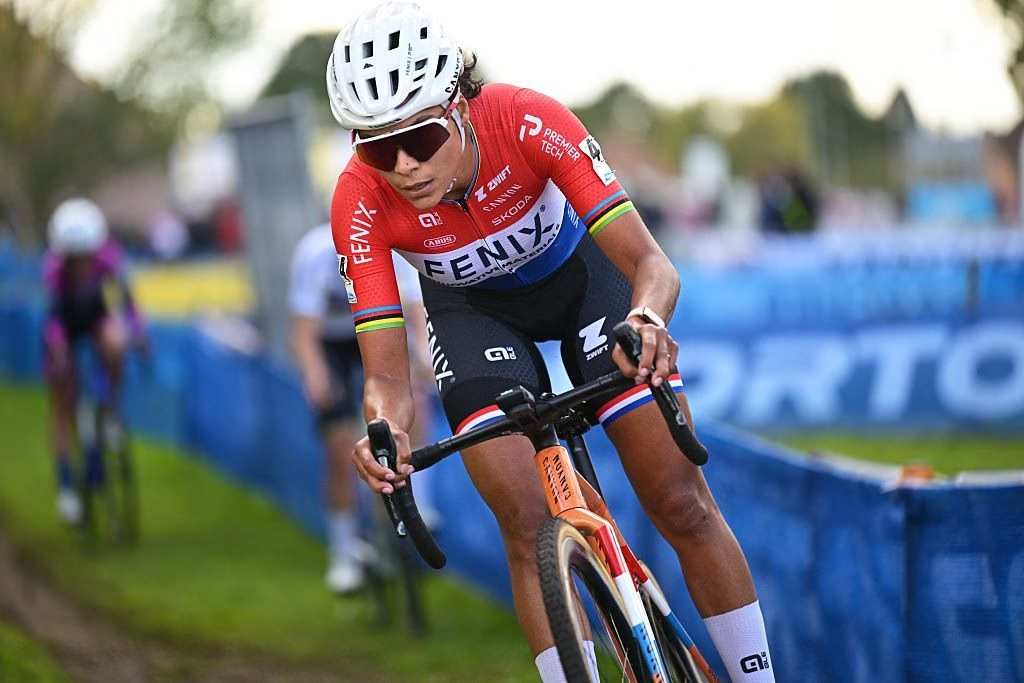
 Photo Credit: David Pintens / BELGA MAG/AFP via Getty Images
 -
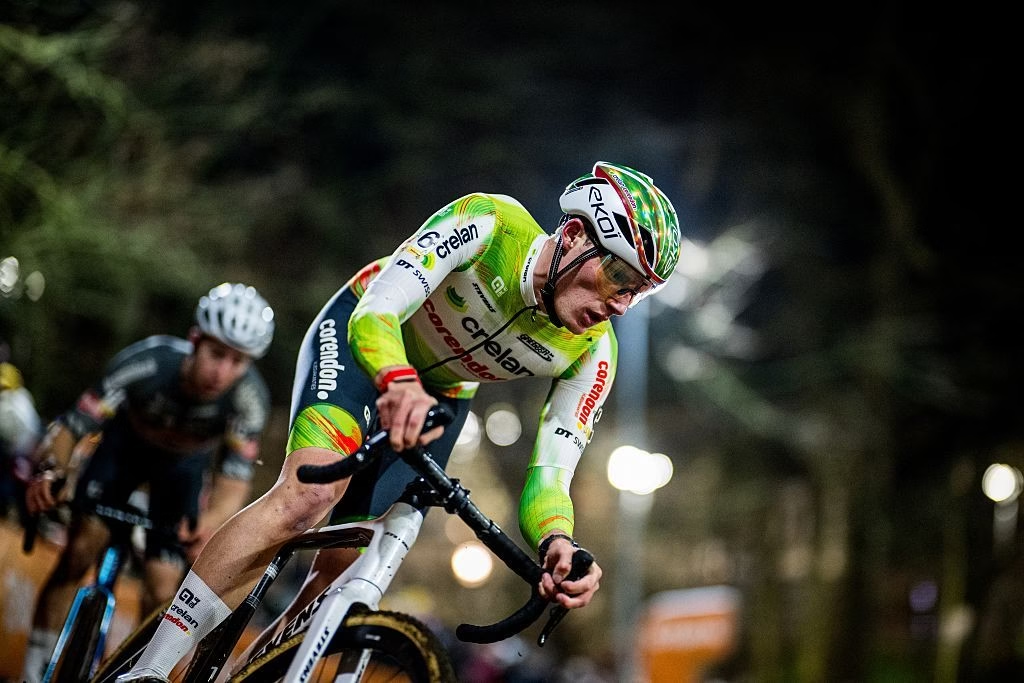
Photo Credit: BELGA MAG/AFP via Getty Images
A four-day Montréal and Laurentians cycling trip
A good first day is deliberately easy. Assemble the bike, ride the Lachine Canal and add Parc Jean-Drapeau if the legs feel good. That gives you useful kilometres without turning travel day into a fitness test.
Day two is for Mount Royal. Ride Camillien-Houde, add Polytechnique or another climb around the mountain and repeat according to fitness. There is no need to imitate the professional race and accumulate thousands of metres of climbing unless that is specifically the point of the trip.
On day three, move north towards Saint-Jérôme. From there, either begin a P’tit Train du Nord overnight trip or ride a selected section before returning. Anyone using Montréal as a fixed base can keep the distance modest and treat it as the sightseeing day of the trip.
Day four can then become the longer Laurentians road ride, perhaps around Sainte-Adèle and Saint-Sauveur, or another section of the rail trail if the trip is more touring-focused.
That sequence works because the days feel different. Flat city kilometres, a climbing session, rail-trail riding and rolling countryside each ask something slightly different from the rider.
Montréal makes more sense when you include what lies north of it
The city already has enough cycling to justify bringing a bike.
Mount Royal provides a genuine climb, the Lachine Canal gives you a protected route for easier riding, and Parc Jean-Drapeau adds smooth, flatter kilometres close to downtown. The same roads also connect recreational cycling with the city’s unusually rich racing history, from the 1974 World Championships to the modern GP Montréal.
The Laurentians stop the trip becoming repetitive.
Within a relatively short transfer, urban riding gives way to forest, lakes and rolling roads. The P’tit Train du Nord then provides something Montréal itself cannot: a long point-to-point journey where traffic largely disappears and the bike becomes the way you move through the region rather than simply something used for a morning training ride.
Neither part needs to fill an entire holiday on its own.
Together, they give Montréal one of the most varied cycling propositions in eastern Canada.

