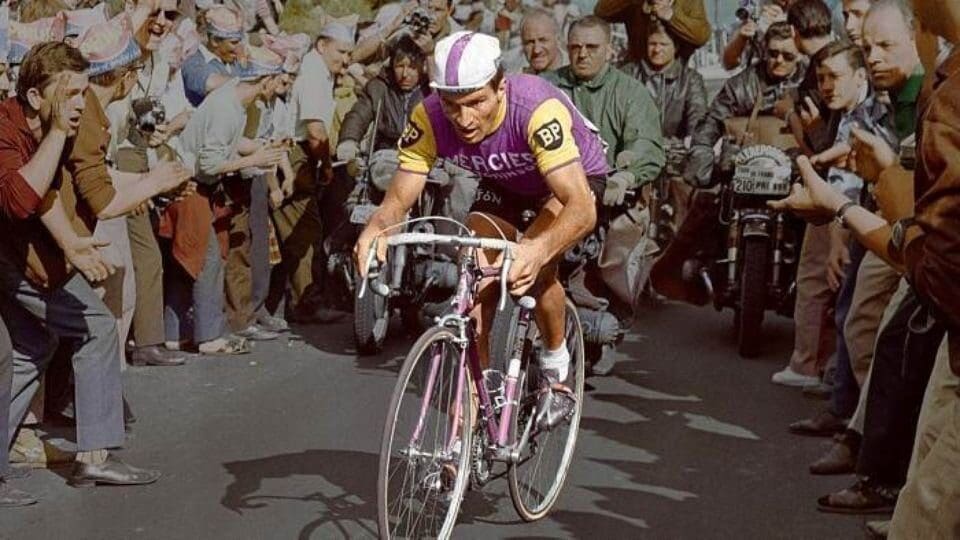
Gan-Mercier-Hutchinson was not a team that appeared from nowhere in 1972. It was the latest name for a Mercier organisation that had already spent decades in professional cycling. The sponsor changed, but the riders, management and distinctive French identity carried on.
Between 1972 and 1976, that continuity brought together Raymond Poulidor’s final years, Cyrille Guimard’s attacking racing and Joop Zoetemelk’s emergence as a Tour de France contender. Barry Hoban gave the squad another weapon in the sprints. It was a team with several ways to win, not merely a supporting cast for one leader.
Mercier before the Gan sponsorship
Mercier had backed professional cycling since the 1930s, with former Tour winner Antonin Magne becoming a central figure in its management. Bicycle manufacturers were more visible in the sport then, and Mercier’s name remained attached to the team even as commercial partners came and went.
The Gan name covered 1972 to 1976. Before and after that period, the squad appeared under other combinations of sponsors, including Fagor, Miko and Coop. This is why results credited to different team names can belong to the same sporting lineage. It also explains how Poulidor could spend his entire professional career within the Mercier structure.
Poulidor was still winning
Poulidor had long been one of France’s most popular riders, but the Gan years were not simply a farewell tour. He won Paris-Nice in 1972 and again in 1973, beating elite opposition in a race that rewarded climbing, time-trialling and consistency across several days.
He remained a threat at the Tour de France, finishing second overall in 1974 and third in 1976, his final appearance. Those performances came well after his early battles with Jacques Anquetil and showed that his popularity rested on more than a reputation for finishing second. He was still capable of reaching the podium against younger rivals.
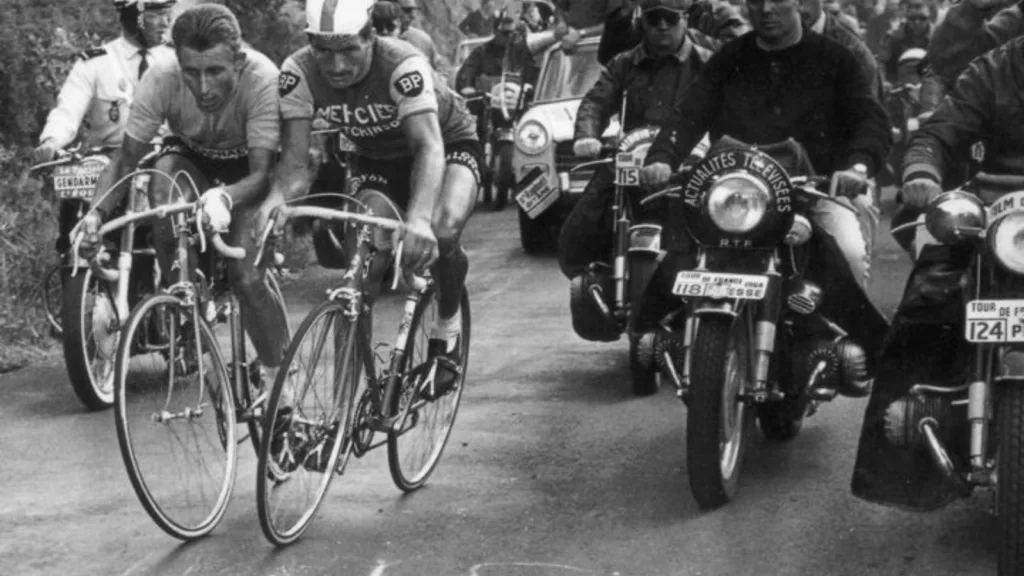
Guimard’s extraordinary 1972 Tour
Cyrille Guimard offered the team a different kind of leader. Fast in a sprint and aggressive on varied terrain, he won four stages of the 1972 Tour de France and looked capable of challenging for a high overall finish. A knee injury forced him out near the end of the race, denying him the chance to complete the job.
The contrast with Poulidor’s career is revealing. Guimard’s time as a top-level rider was curtailed by injury, but his later career as a directeur sportif gave him another major role in French cycling. During his Gan-Mercier years, he made the team competitive on days when a pure climber would have struggled to win.
Zoetemelk takes over the leadership
Joop Zoetemelk joined the Mercier organisation in 1974. The Dutch rider brought the endurance, climbing and time-trialling needed to challenge over a full stage race, and he won Paris-Nice in both 1974 and 1975. As Poulidor approached retirement, Zoetemelk increasingly became the rider around whom the team’s general classification ambitions could be organised.
His eventual Tour de France victory in 1980 came with TI-Raleigh, not Mercier. That distinction is worth keeping clear. The Gan period was important to his development, but the team’s record should not be inflated by claiming a victory won under another sponsor.
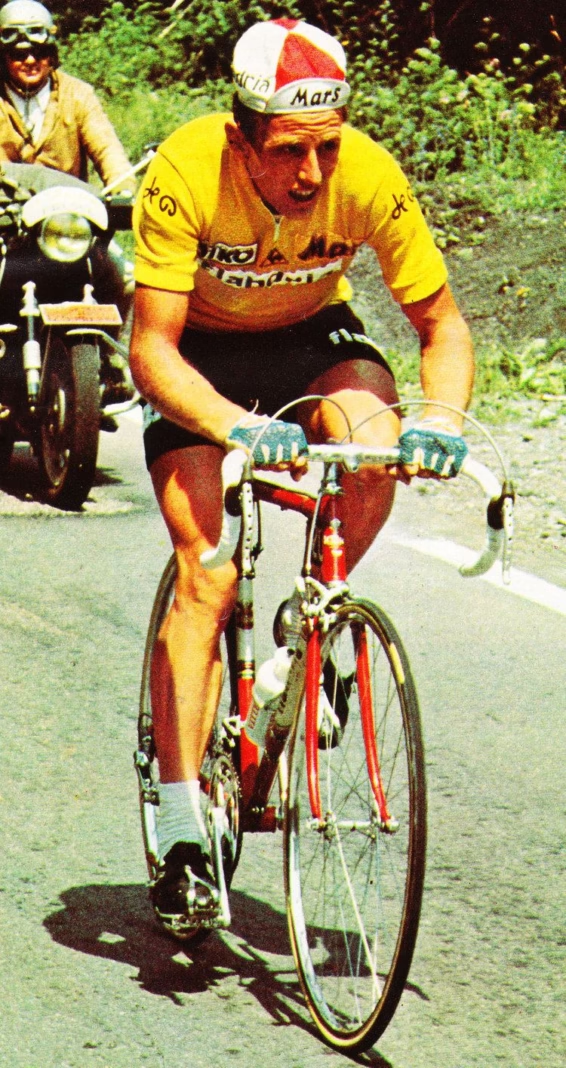
Barry Hoban and the value of a sprinter
The British rider Barry Hoban brought stage-winning speed to the squad. While Poulidor and Zoetemelk were focused on the overall classification, Hoban could contest finishes on days when the strongest climbers were unlikely to feature. His Tour de France stage victories helped give the Mercier team a presence across different kinds of racing.
That range was commercially useful as well as sporting. Sponsors needed the team to be visible throughout the season, not just on the final podium in Paris. A squad with sprinters, attackers and stage-race leaders had more chances to deliver results.
Paris-Nice became a team speciality
Four consecutive Paris-Nice victories, two for Poulidor in 1972 and 1973 and two for Zoetemelk in 1974 and 1975, were among the clearest achievements of the period. The race was a serious early-season test, with difficult stages and changing conditions rather than a gentle warm-up for July.
Those wins also show the transition between leaders. Poulidor could still win major stage races, while Zoetemelk was ready to take over as a central figure. The team did not have to disappear or start again when one generation moved aside.
What happened after Gan left
The Gan sponsorship ended after 1976, but the Mercier team continued under other names. Miko and later Coop featured in its final years before the organisation closed in 1984. The shifting sponsor names can make its history look fragmented, particularly when results databases treat each title as a separate entry.
The stronger way to understand Gan-Mercier-Hutchinson is as a chapter in a much longer story. Poulidor’s endurance, Guimard’s stage wins, Hoban’s sprinting and Zoetemelk’s rise were connected by the same team structure. That is what makes those five years more interesting than the sponsor name alone.