
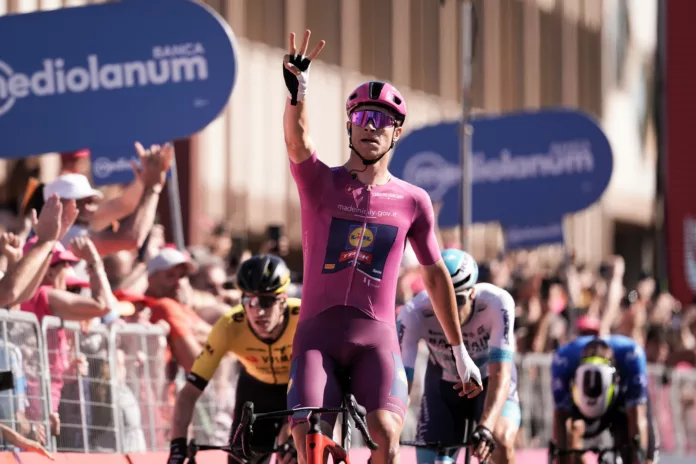
The men’s Giro d’Italia 2026 begins on Friday, 8th May with Stage 1 from Nessebar to Burgas, giving the race its first Grande Partenza in Bulgaria. It is an unusual opening for the Corsa Rosa, but the sporting shape is familiar enough: a flat coastal stage, a nervous peloton, sprint teams under pressure and the first maglia rosa waiting at the finish.
The route covers 147km along the Black Sea coast and should give the fast men their first opportunity of the race. There is very little climbing, with around 500 metres of elevation gain across the day, but opening stages rarely behave like ordinary sprint stages. Everyone is fresh, everyone wants position, and the fight for the first leader’s jersey can make the final hour more frantic than the profile suggests.
Jonathan Milan, Kaden Groves, Dylan Groenewegen, Paul Magnier, Casper van Uden, Ethan Vernon and Pascal Ackermann should all see this as a major chance. For Milan in particular, this is a huge early target. He already has Giro sprint pedigree, and taking the opening stage would also put him into the maglia rosa for the first time.
For a full breakdown of the three-week route, our men’s Giro d’Italia 2026 full route guide covers every stage from Bulgaria to Rome.
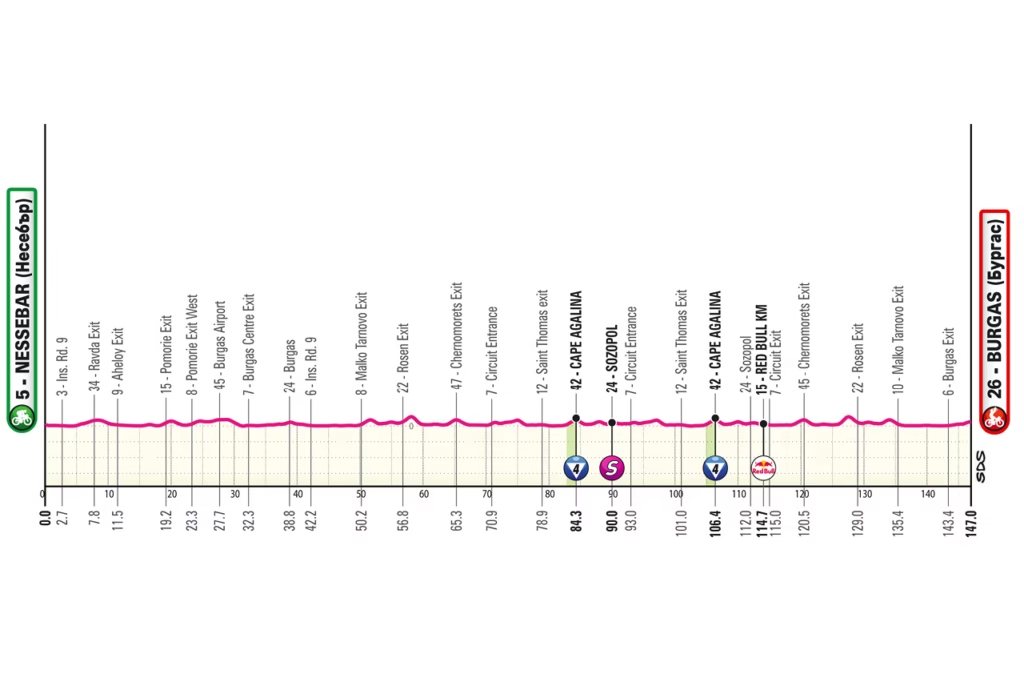
Giro d’Italia 2026 stage 1 route
Stage 1 runs from Nessebar to Burgas, keeping the race close to Bulgaria’s Black Sea coastline. Nessebar gives the Giro a scenic and historic start, with its old town sitting on a small peninsula, while Burgas provides a more conventional sprint finish setting on wide urban roads.
The route is almost entirely flat. There are no major climbs to disturb the sprinters, and the low total elevation gain should make this one of the most straightforward sprint opportunities of the opening week. That does not mean it will be calm. Coastal roads always carry some risk from wind, and the opening day of a Grand Tour tends to magnify every small hazard.
There is also a mid-stage circuit element, which means the peloton will get repeated exposure to some of the same roads before the run towards Burgas. That can help teams understand the course, but it can also increase tension because they know exactly where the important positioning points are.
The finish should favour a full bunch sprint. The final road is wide enough for sprint teams to organise, but the fight for position will be intense because the first stage brings more than just a stage win. It brings the pink jersey, the first points in the ciclamino competition and an immediate psychological lift.
What time does stage 1 start?
Stage 1 starts at 13:50 local time in Bulgaria, which is 11:50 in the UK. The finish is expected at around 17:15 local time, or 15:15 UK time.
Key stage details:
- Date: Friday, 8th May
- Route: Nessebar to Burgas
- Distance: 147km
- Stage type: Flat
- Estimated climbing: around 500 metres
- Stage start: 11:50 UK time
- Expected finish: around 15:15 UK time
- Finish city: Burgas
- First maglia rosa: awarded after the stage
UK viewers can follow the race through TNT Sports and HBO Max. Our guide to watching the Giro d’Italia 2026 in the UK covers the wider broadcast picture across all 21 stages.
Why stage 1 matters
Stage 1 matters because it gives the sprinters their first and most visible opportunity of the race. Winning a Giro stage is always significant, but winning the opening stage also brings the maglia rosa. That changes the value of the day completely.
For a rider like Milan, this is a clear target. He has already built a strong Giro sprint record, and Lidl-Trek arrive with one of the most obvious lead-out structures in the race. A win in Burgas would immediately put him in pink and underline his status as the leading points-classification favourite.
Groves will see it differently. He is not only quick, but durable, and he often becomes more dangerous when finales are not perfectly controlled. If the opening-day nerves disrupt the lead-outs, Alpecin-Premier Tech will know that Groves can still improvise.
For the GC contenders, the day is not about winning. It is about avoiding trouble. Jonas Vingegaard, Jai Hindley, Egan Bernal, Adam Yates, Ben O’Connor and the rest of the overall contenders do not need to be involved in the sprint, but they do need to stay safe through the final 20km. Opening stages can be treacherous because the whole peloton is fighting for space long before the sprint trains take over.
For more on the riders targeting the overall win, our Giro d’Italia 2026 contenders preview looks at the main GC names and how the route suits them.
The Red Bull KM and bonus seconds
The Giro’s Red Bull KM bonus sprint adds another layer to Stage 1. Bonus seconds are available during the stage as well as at the finish, which means the opening day may not be only about the final sprint.
For the sprinters, the finish bonus is the main prize. For the GC riders, the Red Bull KM is less likely to be a major target on Stage 1, but it still matters because every second counts across three weeks. If an opportunistic rider can collect time without spending too much energy, it may influence the early order of the general classification.
The finish bonuses are more important for the maglia rosa. The stage winner should be the first race leader, unless the intermediate bonus seconds create an unusual scenario. In a likely bunch sprint, the simplest outcome is that the winner in Burgas pulls on pink.
Contenders to watch on stage 1
Jonathan Milan is the strongest favourite. He has the power, Giro record and team support to win a flat opening stage, and Lidl-Trek will know this is one of their best chances to take pink. Milan is not always the neatest sprinter in chaotic finales, but when he is delivered well and launches at speed, very few riders can match his power.
Kaden Groves is the obvious danger. He can handle messy, physical sprints and is often at his best when the final is not perfectly textbook. That makes him well suited to an opening Grand Tour stage, where the lead-outs can become scrambled and the strongest sprinter is not always the one with the cleanest train.
Dylan Groenewegen brings pure sprint speed and experience. He remains one of the fastest riders in a straight, well-organised finish, and Team Jayco AlUla should give him a clear structure for Burgas. The question is whether the opening-day chaos allows him to get the smooth run he usually needs.
Paul Magnier is one of the most interesting sprint names in the field. He has the speed to contest a finish like this, and Soudal Quick-Step will want to make an early impact. A first Grand Tour stage is a big ask, but if he is positioned well, he has the acceleration to surprise more established names.
Casper van Uden gives Team Picnic PostNL a realistic sprint option. He will need to survive the fight for position against stronger lead-out structures, but he has the speed to be involved if the final becomes more open.
Ethan Vernon and Pascal Ackermann should also be watched. Vernon has the raw speed to place highly if he is delivered well, while Ackermann brings experience and a proven ability to survive the physical side of Grand Tour sprinting.
-
 Photo Credit: A.S.O./Gaëtan Flamme
Tactical outlook
The first breakaway of the Giro will almost certainly go early. That is part of the opening-day pattern: smaller teams and opportunistic riders want television time, intermediate points and a chance to be part of the first story of the race. The question is not whether a break goes, but how much freedom the peloton allows.
Lidl-Trek, Alpecin-Premier Tech, Team Jayco AlUla, Soudal Quick-Step and Team Picnic PostNL all have reasons to control. With the first maglia rosa on offer, the sprint teams should not allow the breakaway too much space. The likely rhythm is a small move going clear, a managed gap through the middle of the stage, then a steady chase once the race turns towards the final hour.
The key danger is wind. If the Black Sea coast produces exposed sections, the peloton may become nervous earlier than expected. GC teams will want their leaders near the front, sprint teams will want the same road space, and that combination usually increases stress.
The final 10km should be fast and crowded. Lidl-Trek have one of the clearest sprint structures, but Alpecin-Premier Tech and Team Jayco AlUla will not want to let Milan’s train dominate. The winner is likely to come from the front five or six riders into the final few hundred metres. On an opening stage, coming from too far back is rarely a winning strategy.
Prediction
Stage 1 should finish in a bunch sprint, and Milan is the strongest pick. The route is flat, the finish should suit power, and Lidl-Trek have built a squad capable of putting him into position. The additional prize of the maglia rosa only makes this stage more important for him.
Groves is the main threat if the sprint becomes messy, while Groenewegen, Magnier, Van Uden, Vernon and Ackermann all have credible podium routes. The breakaway should get airtime but is unlikely to survive unless the wind or opening-day nerves create more disruption than expected.
The most likely outcome is a controlled chase, a frantic final 10km and Milan launching late enough to overpower the rest in Burgas. If he gets it right, he will take both the stage and the first pink jersey of the men’s Giro d’Italia 2026.

