Johan Museeuw has a strong claim to be the defining men’s Classics rider of the 1990s. He was not as universally dominant as Eddy Merckx, nor as all-surface versatile as Roger de Vlaeminck, but in the cobbled heart of the spring, he became the reference point of his generation. Three wins at the Tour of Flanders, three at Paris-Roubaix, a world title and a long list of other one-day victories explain why he remains one of the central figures in men’s cycling history.
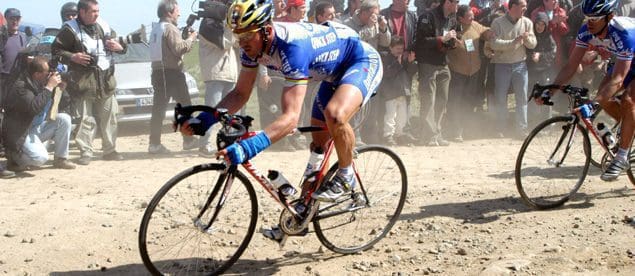
Rider history
Museeuw turned professional in 1988 and was quickly part of a major team environment, riding for ADR in 1989 when Greg LeMond won the Tour de France. A year later he moved to Lotto and won two Tour de France stages in 1990, which reflected the sort of rider he still was at that point: quick, durable and not yet fully transformed into the cobbled specialist who would later define his career. That shift really began to show in 1992, when he won E3 Harelbeke and the Belgian national road title, then accelerated in 1993 after moving to MG-GB, where he won the Tour of Flanders and Dwars door Vlaanderen.
By the mid-1990s, Museeuw had become one of the key men of the northern spring. He won Amstel Gold Race in 1994, took a second Tour of Flanders in 1995 and then produced the season that fixed his place among the very best. In 1996, he won Paris-Roubaix and later that year became road world champion, a combination that made him the outstanding one-day rider in the world. The nickname Lion of Flanders had already begun to follow him by then, but those results gave it proper substance.
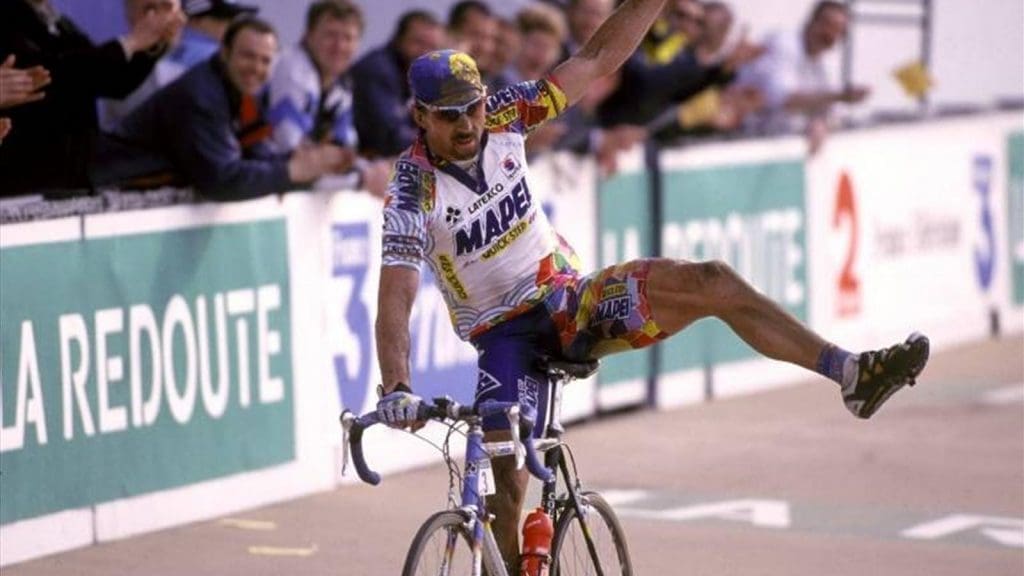
His career then moved through one of the more dramatic arcs any Classics champion has known. In 1998 he won the Tour of Flanders for a third time, equalling the race record, but his spring was then defined by the crash at Paris-Roubaix that almost cost him his leg. The injuries were severe, infection set in, and gangrene meant amputation was discussed. Instead of ending his career there, Museeuw rebuilt it. That is a large part of why his later victories carry so much emotional weight. When he returned to win Paris-Roubaix again in 2000, pointing to the damaged leg on the finish line, the image instantly became part of the race’s mythology.
He won Paris-Roubaix for a third time in 2002 and added further late-career wins such as Omloop Het Nieuwsblad in 2003 before retiring in 2004. His final seasons also helped connect generations, because his time at Quick-Step overlapped with the rise of Tom Boonen, who would go on to inherit much of Belgium’s cobbled expectation. Museeuw’s full spring record is narrower than Merckx’s and less varied than de Vlaeminck’s, but on the pavé roads of Flanders and northern France he was one of the defining riders of the modern era.
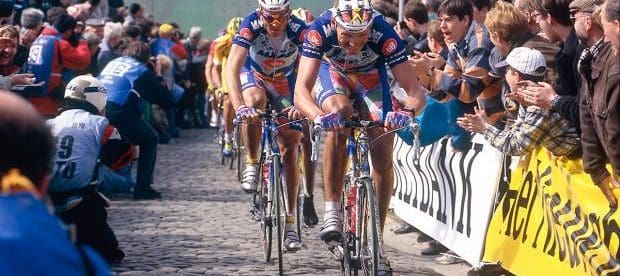
Greatest race victory
2000 Paris-Roubaix
The 2000 edition of Paris-Roubaix stands as the clearest symbol of what Museeuw became. Not simply a great cobbled rider, but one who could come back from the sort of injury that usually ends a career and still win the hardest race of them all.
The race itself was attritional rather than chaotic early on. A large break formed and the shape of the day kept changing as stronger teams tried to reorganise the front of the race. Museeuw made his decisive move with roughly 60 kilometres remaining, bridging across and then attacking again to go clear on his own. That second acceleration was the winning one.
The gap grew significantly, then began to fall again as the chase behind started to organise itself, but Museeuw had judged the move perfectly. He still had enough in hand to reach Roubaix alone after 272 kilometres of racing. What made the win resonate so strongly was not only the solo attack itself, but everything that sat behind it.
Two years earlier, Museeuw’s Paris-Roubaix had ended in the sort of crash that left his career and even his leg in doubt. In 2000 he returned not merely to compete, but to dominate the race from distance and finish with that famous gesture towards the injured leg. Paris-Roubaix often crowns riders who can endure suffering. In Museeuw’s case, it crowned a rider who had already endured far more than most.
Spring Classics palmarès
Monuments
Tour of Flanders
1993, 1995, 1998
Paris-Roubaix
1996, 2000, 2002
Classics
E3 Harelbeke
1992, 1998
Amstel Gold Race
1994
Omloop Het Nieuwsblad
2000, 2003
Dwars door Vlaanderen
1993, 1999
Brabantse Pijl
1996, 1998, 2000
Kuurne-Brussels-Kuurne
1994, 1997