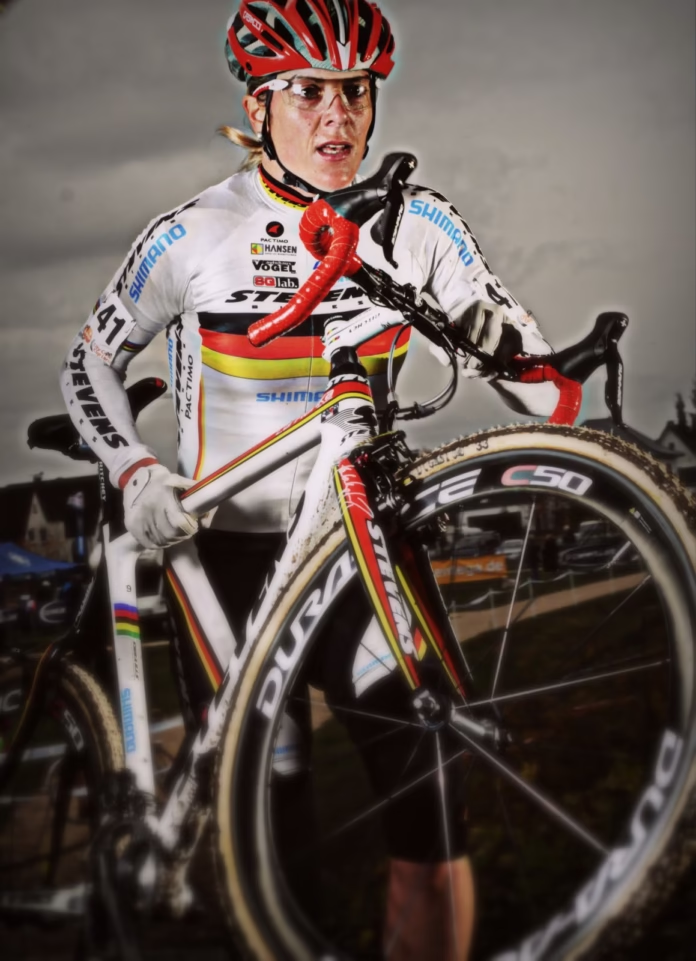
When Hanka Kupfernagel won the first women’s UCI Cyclo-cross World Championship in January 2000, the men’s rainbow jersey had already been awarded for half a century. Her victory at Sint-Michielsgestel in the Netherlands did not create women’s cyclocross, a discipline in which women had been racing for years. It made their highest international title part of the same formal world championship programme. From that point, the history of the sport could no longer be told entirely through the male winners.
The route to a full set of women’s world titles took another two decades. An under-23 women’s championship arrived in 2016, and the first women’s junior rainbow jersey was contested in 2020. By then the strongest international riders were racing a demanding calendar and the UCI was also acting on inequalities in race duration and World Cup prize money. A set of equivalent age categories did not instantly produce equivalent resources or opportunities, but it provided a framework on which modern women’s cyclocross could build.
The names most familiar to today’s followers, Marianne Vos, Sanne Cant, Ceylin del Carmen Alvarado, Fem van Empel and Lucinda Brand, belong to successive phases of that development. Their world titles can be measured against the early winners, but the races around them have changed considerably: deeper starting fields, televised World Cup series, dedicated junior events and increased overlap between road, mountain bike and cyclocross programmes.
Before 2000: established racing without an elite women’s rainbow jersey
The world championships began in 1950 with a men’s elite event. Junior men were added in 1979 and under-23 men in 1996, while women remained outside the championship title structure. That administrative history should not be confused with the history of women actually participating in cyclocross. National championships, regional races and mixed cycling careers existed well before the UCI created the elite women’s event.
Cyclocross was traditionally concentrated in Belgium, the Netherlands and France, with its biggest winter audiences and professional infrastructure clustered in those regions. Women looking to compete internationally faced a thinner programme and fewer occasions on which to race riders from other countries. Some built their careers across road cycling and cyclocross, where the winter discipline developed handling, running ability and race fitness. The absence of a world championship made it harder for sponsors, media and national federations to treat the women’s discipline on comparable terms.
The first women’s world championship was therefore the result of a sport catching up with existing competition rather than the sudden birth of a new event. It gave an elite winner the rainbow jersey, placed an official title in the historical records and established a clear international target for the next generation. The earliest fields still reflected the unequal depth of the national programmes from which riders could progress.
Kupfernagel and the first generation of world champions
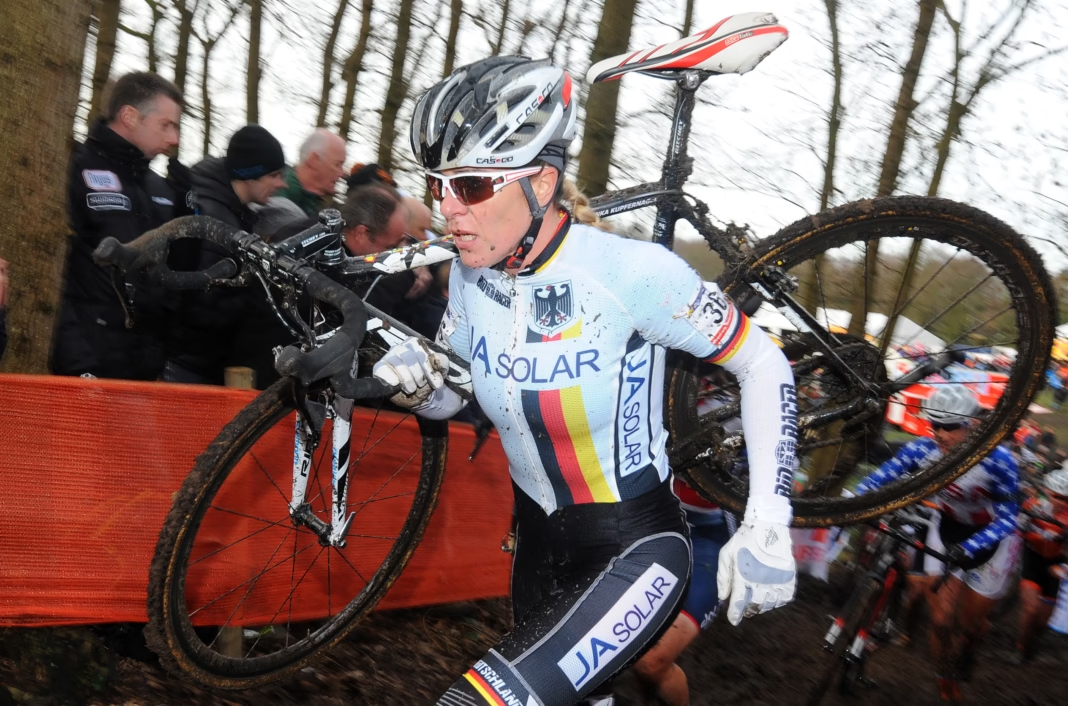
Kupfernagel won the inaugural world title on 29 January 2000, ahead of Great Britain’s Louise Robinson and Dutch rider Daphny van den Brand. Contemporary reporting described the German riding clear and maintaining a decisive advantage across a 13-kilometre women’s race. The placing of Robinson is an important part of British cyclocross history: a British rider was on the podium at the first championship rather than arriving years after the discipline gained official recognition.
Kupfernagel went on to win four elite women’s world titles, in 2000, 2001, 2005 and 2008. Her career illustrated how the first generation of champions used both road and cyclocross programmes, and she was also a major international time-trial rider. The modern expectation of a closely planned cyclocross season had not yet become the only route to success for leading competitors.
Other world champions in the first decade included Laurence Leboucher, Daphny van den Brand and Maryline Salvetat. Their titles, and the regular presence of strong French, Dutch and German riders, prevented the championship from becoming simply a one-rider narrative. The women’s race still had a much shorter historical record than the men’s championship, but its competitive traditions and rivalries quickly accumulated.
This period also produced riders who helped define national programmes outside the main continental centres. British women such as Louise Robinson and later Helen Wyman showed that international cyclocross did not depend exclusively on being raised in Belgium or the Netherlands. Racing repeatedly in those countries remained important, however, because it exposed riders to demanding courses, large crowds and the highest level of technical competition.
Marianne Vos and the transformation of the women’s elite race
Marianne Vos won her first elite women’s cyclocross rainbow jersey in 2006, when she was still a teenager, and subsequently turned the championship into a central part of her remarkable multi-discipline career. Between 2009 and 2014 she won six consecutive elite world titles. Her eighth championship victory came in 2022, sixteen years after the first. No woman has won more elite cyclocross world titles.
Vos brought an unusual combination of road-racing endurance, technical certainty and sprinting speed. On some courses she could ride away from rivals; on others she could follow until a late acceleration or sprint. The important change was that the championship became part of a broader public sporting profile. An audience that knew her road achievements could follow her into the winter, and cyclocross was no longer detached from the wider story of women’s professional cycling.
The rise of Vos did not mean the rest of the field stopped developing. Katie Compton became a formidable American competitor on the World Cup circuit, while Helen Wyman was a consistent British contender and two-time European champion. Sanne Cant later won three consecutive elite world titles from 2017 to 2019, showing that Belgium could produce a women’s champion as dominant in important races as its best-known male specialists.
These women raced through changing broadcast and team structures. World Cup weekends brought the strongest riders together regularly, rather than only at the world championships, and their performances helped create a recognisable international hierarchy. The small technical differences that distinguish cyclocross, running through mud, remounting under pressure, balancing grip against rolling resistance, were increasingly available for viewers to study every winter.

2016 and 2020: the missing age categories finally arrive
For years the elite women’s title existed without an equivalent international pathway below it. Men could compete for both junior and under-23 world titles, whereas talented women often had to move straight into elite-level competition. A promising teenager could be among the strongest riders of her age and still find herself measured against fully established professional women at the most visible event of the season.
The UCI introduced the women’s under-23 world championship in 2016 at Heusden-Zolder in Belgium. Britain’s Evie Richards won the first race ahead of Nikola Nosková and Maud Kaptheijns. Richards later won a second under-23 title in 2018. The change offered developing riders a recognisable international prize and gave federations another reason to support young women through specialised training and race programmes.
The junior women’s world championship followed in 2020 at Dübendorf in Switzerland. Shirin van Anrooij became the first winner, completing the set of junior, under-23 and elite individual rainbow jerseys available to women. The UCI described the addition as creating parity in the world championship programme: the same three individual age-category titles now existed for men and women.
It was an important administrative equality, but it should not be overstated. The depth of youth racing, the number of fixtures available to developing riders and the budgets of national and trade-team programmes continued to differ. A championship alone cannot supply weekly high-level competition. What it can provide is a clear target, a visible progression from junior to under-23 to elite, and a result that teams and sponsors can use when assessing a young rider’s development.
The impact is visible in the riders who have come through the new categories. Richards, Van Anrooij, Zoe Bäckstedt, Fem van Empel, Puck Pieterse and Leonie Bentveld are associated with the modern under-23 championship era. The emergence of these riders is a story of both individual talent and a more structured route into elite cyclocross. It has also encouraged riders to combine cyclocross with successful road or mountain bike careers rather than see the disciplines as mutually exclusive.
Race duration, prize money and the difference between titles and equality
Completing the world championship programme did not resolve every disparity. The UCI later adopted changes to women’s race duration and prize distribution, and those decisions explain why the period from 2018 to 2022 matters beyond the names of the world champions. Equal status on a results sheet does not tell the whole story if riders have fewer race opportunities or lower financial rewards for performances at comparable events.
From the 2018–19 season, the men’s and women’s World Cup overall classifications carried equal prize money. The UCI then introduced a staged requirement for equality in prize money at individual World Cup rounds, reaching that objective in the 2021–22 season. These were World Cup competition measures, not a declaration that every commercial cyclocross event paid equal rewards or provided identical team budgets.
Race duration changed too. The UCI increased women’s elite World Cup races to a target of 50 minutes from 2020–21, and made the 50-minute duration apply to women’s races for riders aged 19 and over across international calendar and national championship events from 2021–22. Men’s elite races remained longer. The reform narrowed a longstanding gap while acknowledging that identical duration was not yet part of the regulations.
These changes affected how riders prepared and how races unfolded. A longer event changes the value of pacing, repeated technical accuracy and the amount of fatigue accumulated before the final lap. Better prize structures also create a stronger financial case for riders and teams to travel to a full programme of races. Neither step guarantees equality in exposure or sponsorship, but both have consequences on the course and away from it.
Television remains another part of the calculation. A women’s race placed at an accessible time, with strong production and a familiar commentary team, can attract viewers who might otherwise see only highlights. The UCI has previously encouraged event organisers to reconsider race order, including cases where the elite women race last. The modern winter calendar contains far more opportunities to follow women’s cyclocross live than the early championships could provide.
The modern champions: from Alvarado and Van Empel to Brand
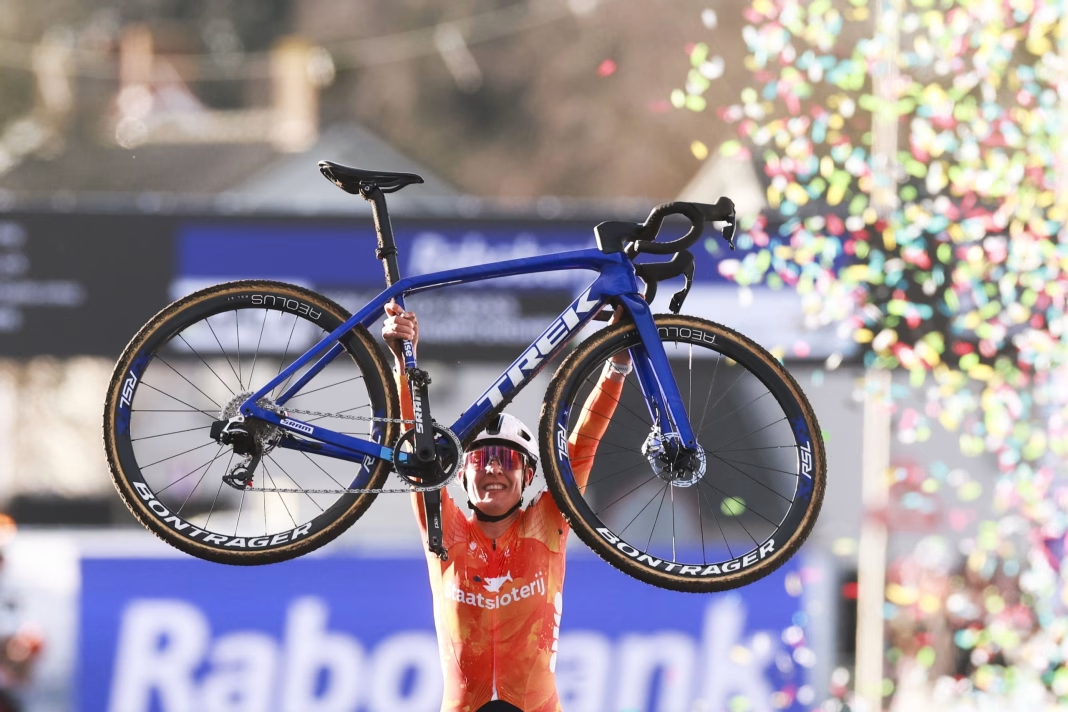
Ceylin del Carmen Alvarado became world champion in 2020, the same weekend that the junior women’s title was contested for the first time. Lucinda Brand followed in 2021, then Vos returned to win again in 2022. Their titles demonstrate that the elite field now included both established champions with long careers and a newer generation that had come through increasingly specialised cyclocross programmes.
Fem van Empel won three consecutive elite world titles from 2023 to 2025, matching Cant’s three-year sequence and joining Vos among the women to achieve a run of at least three. Her repeated success came against riders such as Pieterse and Brand, making those seasons a particularly important period of Dutch competition. The leading riders could challenge each other on sand, mud, steep banks and faster circuits, making the world championships a test of adaptability rather than just sustained power.
Brand reclaimed the title at Hulst in 2026, winning ahead of Alvarado and Pieterse. The UCI noted that Brand had then secured an elite championship medal in every edition since 2018, a record of remarkable consistency. Her second world title came five years after her first, a useful contrast with Van Empel’s concentrated period of victories. Both paths have a place in the recent history of the event.
The under-23 title at the same 2026 championships went to Leonie Bentveld, while Barbora Bukovská took the women’s junior event. Their results complete a snapshot of an era that the pioneers of 2000 could not have entered: a full women’s programme in which elite and younger champions receive separate rainbow jerseys. The challenge now is to keep that pathway strong internationally, with opportunities outside the traditional Dutch and Belgian centres as well.
For newcomers to the sport, ProCyclingUK’s beginner’s guide to cyclocross explains the equipment, rules and technical demands underpinning these races. The 2026–27 race calendar provides the modern context. The history of the women’s rainbow jersey is visible every weekend in the depth of riders able to compete, the age categories represented and the number of countries now producing serious contenders.