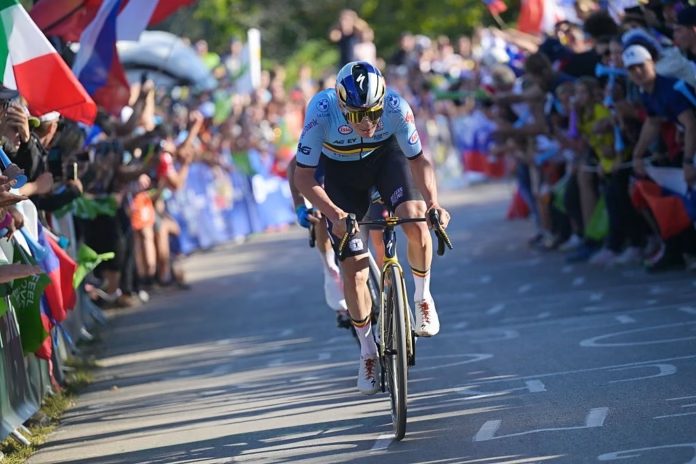
Remco Evenepoel did not win the 2026 European Championships because one attack blew the race apart. He won because Belgium spent almost the entire afternoon shaping the race around him, then had enough riders left to rescue the plan when his first decisive move ended with him on the ground.
That distinction matters. Evenepoel was the strongest rider in Šenčur, but strength alone would not have been enough once Giulio Ciccone emerged as the only rival capable of following him. Belgium had already controlled the break, chased dangerous counters and repeatedly kept the race in a state where Evenepoel could choose when to attack rather than react to somebody else’s move.
The final margin made the race look much closer than the tactical balance had been. Evenepoel beat Ciccone by centimetres in the sprint, but Christian Scaroni was already 59 seconds behind in third. The European title was decided by two riders. Belgium’s work was what made sure one of them was their leader.
It was also an important response to Montréal. A week earlier Evenepoel had finished 12th in the World Championships road race as Brandon McNulty escaped a chaotic contest that Belgium never fully controlled. Our analysis of McNulty’s world title centred on how the USA exploited that uncertainty. Slovenia produced almost the opposite race.
Belgium made the race predictable before Evenepoel made it selective
The 196.3km route from Ljubljana to Šenčur was built around five passages of Možjanca, a 2.1km climb averaging 10.3%. That gave other nations obvious places to attack, but Belgium refused to let the race develop beyond a range they could manage.
The early break never received enough freedom to become a genuine problem. Once the race reached the finishing circuit, Belgium kept returning to the front and allowed other nations to spend energy without surrendering control. The break was effectively neutralised before the decisive part of the race began, leaving the favourites to fight on terrain where Evenepoel had teammates around him.
That became increasingly important as the field shrank. Italy raised the pace, Slovenia worked for Primož Roglič and Pavel Sivakov tried to use the descent to get clear. Each move forced a reaction, but Belgium still had riders capable of responding. By the time the front of the race had been reduced to around 40 riders, the basic plan remained intact.
Ramses Debruyne’s work was particularly valuable. On the third lap he set a hard pace on Možjanca with Evenepoel positioned directly behind, contributing to a split of roughly 22 riders. Denmark eventually repaired the damage, but doing so cost them. Belgium did not need the first selection to stick. They needed repeated selections to make everybody else spend.
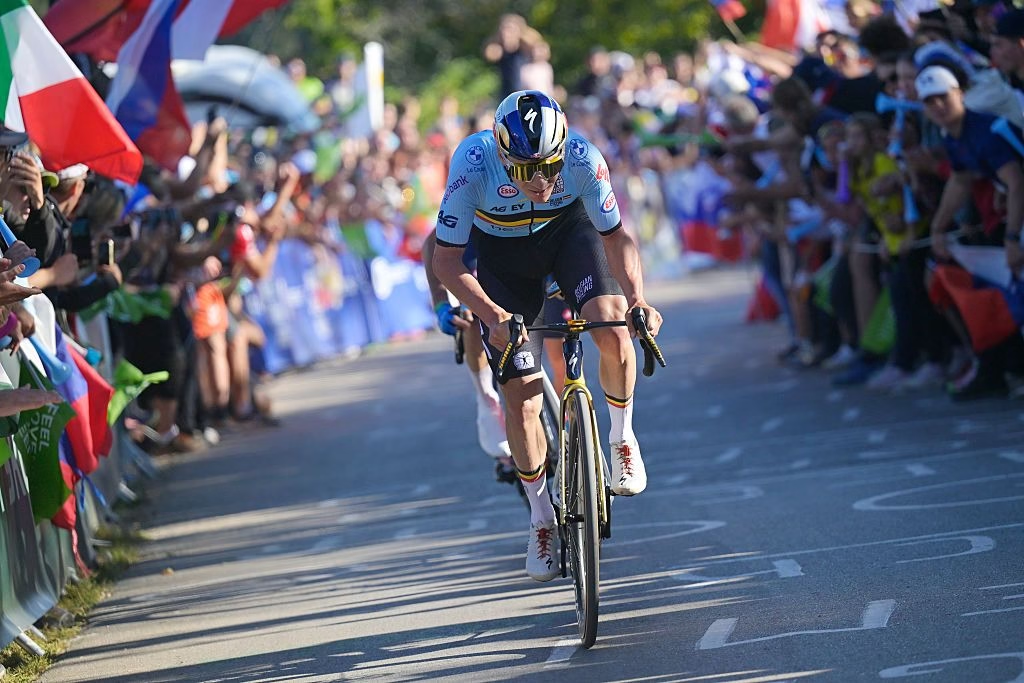
The first attack showed Evenepoel had the legs
The decisive phase began on the penultimate ascent of Možjanca. Slovenia had moved to the front through Matej Mohorič and Jan Tratnik, trying to make the race hard for Roglič, while Belgium remained close enough to launch Evenepoel once the climb began to bite.
With roughly 36km remaining, Evenepoel attacked. Ciccone was the only rider able to respond immediately. That was the first clear sign that the race had narrowed to two men, but Evenepoel never got the chance to test how far the move could go.
He carried too much speed into a corner after the summit, lost the front wheel and slid onto the road. Ciccone suddenly had daylight and Evenepoel was back on his feet chasing a race he had just broken open himself.
This is where Belgium’s earlier work paid for itself. The crash did not turn into a minute-long chase through a scattered race. Evenepoel had teammates available, Ciccone was still within reach and the group behind had not reorganised around a new leader. Belgium helped close the gap and reset the situation.
Evenepoel later described the response simply: “we stayed calm and we came back to the plan”. That is a better summary of the victory than the photo finish. The crash looked dramatic, but Belgium had built enough control into the race to absorb it.
The second attack was better because it came before the climb
Evenepoel did not wait for another conventional uphill launch. Around four kilometres after the crash, he attacked again before the descent. Ciccone reacted and the pair went clear for good.
That timing changed the race. The first move had been a direct test of climbing strength. The second used the terrain between the climbs, where hesitation behind could be just as costly as a lack of power. Once Evenepoel and Ciccone were moving together at speed, the chase group had to organise immediately.
It never really did. Evenepoel drove the pair hard while Belgium’s remaining riders sat in the chase and disrupted its rhythm. France eventually committed riders to the front, but the gap had already grown. With 20km remaining the leaders had around half a minute, and that advantage moved towards 40 seconds as the chase continued to look at one another.
This was the tactical core of Belgium’s race. Once Evenepoel was ahead, the same teammates who had spent the day chasing suddenly had no reason to contribute. Rivals had to do the work while Belgian riders occupied places in the group and waited. Evenepoel still had to ride hard at the front, but he was no longer fighting his own team’s workload as well.
Ciccone forced Evenepoel to win the race twice
Ciccone deserves much of the credit for making the final 30km difficult. He was the only rider who could repeatedly respond to Evenepoel, and once the pair had enough advantage, his priorities changed.
The Italian did not need to help Evenepoel maximise the gap. Belgium had more riders behind and Evenepoel was the stronger time-trial engine. Ciccone’s best chance was to save energy, force the Belgian to keep driving and turn the title into as short a contest as possible.
That is why Evenepoel became visibly frustrated inside the final 10km when Ciccone stopped contributing. From Ciccone’s perspective, there was little value in taking equal turns simply to guarantee a sprint against a rider doing most of the work. Every second spent in Evenepoel’s wheel was a second saved for the finish.
Evenepoel therefore had to solve two problems. First he had to ensure Scaroni, Roglič and the rest never came back. Then he had to beat a rider who had spent more of the finale sheltering behind him.
The final corner nearly undid everything
The last 300 metres produced the one moment where Ciccone’s strategy almost overturned the race.
Evenepoel led into the final corner but carried enough speed that Ciccone could dive to the inside and come out in front. The Italian opened a small gap and, for several seconds, looked as though he had converted an afternoon of following into the European title.
Evenepoel had one acceleration left. He closed the gap in the final straight, drew level and threw the bike at the line. Neither rider knew immediately who had won. The photo finish eventually gave the title to Evenepoel.
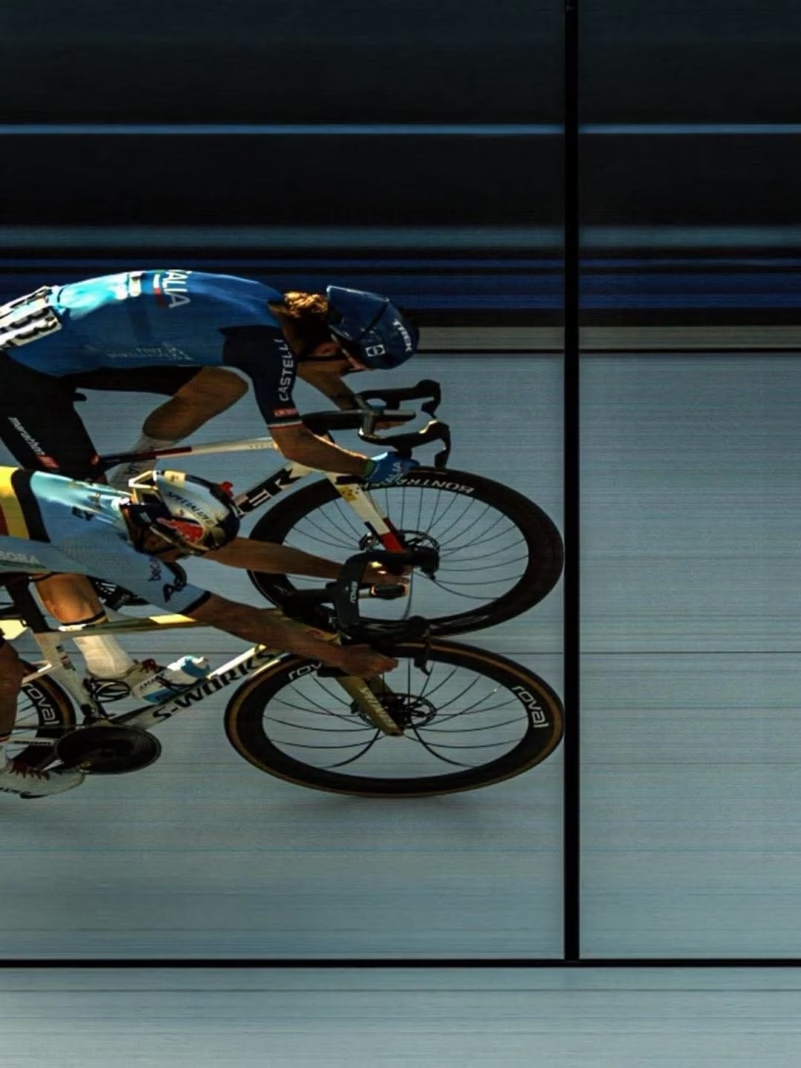
The finish was close enough to make the victory look precarious, and it was. Evenepoel had done more work, made the harder efforts and nearly lost the title because one technical corner allowed Ciccone to turn saved energy into a gap. But the final sprint also showed why Ciccone’s plan was necessary. Even after driving most of the break, Evenepoel still had enough to come back around him.
Why Roglič and the chase never became a threat
Primož Roglič eventually finished 10th, 1:19 down, while Scaroni escaped the chase to take bronze at 59 seconds. The result reflects a chase that never found enough cooperation once Evenepoel and Ciccone were clear.
Belgium had already forced several nations to use riders before the decisive move. Denmark had spent heavily repairing an earlier split. Slovenia had worked on Možjanca. France waited too long before committing fully to the pursuit. Italy had Ciccone ahead and no reason to help bring him back.
Scaroni understood the situation better than most. Rather than wait for a chase that was unlikely to succeed, he attacked with around 14km remaining and turned Italy’s position into a second medal. The battle behind was no longer about catching Evenepoel. It was about deciding who finished third.
This was the version of Belgium that was missing in Montréal
The contrast with the World Championships is the strongest reason this victory matters beyond the jersey itself. In Montréal, Evenepoel was part of a race that fragmented early and never settled into a structure Belgium could dictate. McNulty’s winning move came from a situation where several teams had cards ahead and no single nation could impose a clean chase.
In Slovenia, Belgium did the opposite. They reduced uncertainty. They controlled the break, responded to attacks, kept Evenepoel near the front and still had enough support left after his crash to put the race back together. Once he attacked for the second time, they changed roles and stopped helping the chase.
That did not make the final 30km easy. Ciccone was strong enough to stay with Evenepoel and smart enough to make him work. But Belgium had already removed most of the tactical variables before the pair went clear.
Evenepoel finally adds the European road title
Evenepoel’s European Championships victory fills the major elite road-race title that was still missing from his collection. He already had the World Championship road race and Olympic road race titles, alongside four consecutive world time-trial championships.
The timing also matters. Montréal raised questions about his road form despite another dominant world time-trial win. One week later he was strong enough to attack repeatedly, recover from a crash, drive a two-man break and still win the sprint.
He will now skip the European Championships time trial and turn towards Il Lombardia. The 2026 Il Lombardia route asks a different question again, with longer climbs and far more accumulated climbing, but this was exactly the sort of race Evenepoel needed beforehand.
His European title was not a solo demolition. It was a controlled team race that became a two-man tactical fight, briefly fell apart when Evenepoel crashed and was rebuilt within minutes. That makes it a more revealing win than the final centimetres suggest.
-
 Photo Credit: David Pintens / BELGA MAG/AFP via Getty Images
 -
 Photo Credit: BELGA MAG/AFP via Getty Images