
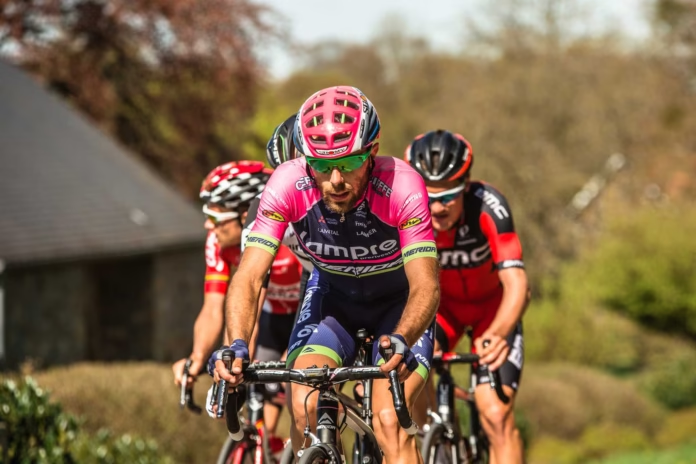
Lampre were never cycling’s neatest team to explain.
They were not one of the sport’s dominant super-teams. They did not build an era around a single Tour de France winner. Their identity was not as clean as Mapei’s Classics machine, Banesto’s Indurain years, Telekom’s German boom or Sky’s later Grand Tour system.
But that is exactly why Lampre matter.
For more than two decades, the pink and blue Italian team sat inside almost every major shift in modern road cycling. They were there in the sponsor-heavy 1990s. They were there through the Giro-centred Italian boom. They survived the move into the ProTour and WorldTour age. They carried climbers, puncheurs, sprinters, time triallists and opportunists. They had major wins, licence issues, doping-era shadows, sponsor changes and eventually a handover into the project that became UAE Team Emirates.
Lampre’s story is not one of constant dominance. It is a story of endurance. The team bent, rebranded, adapted and sometimes drifted, but it remained one of Italian cycling’s most recognisable presences until the old structure finally disappeared at the end of 2016.
For broader context on the teams that shaped men’s road cycling, see our Men’s Cycling History Hub.
 Photo Credit: A.S.O/Gautier Demouveaux
The pink-blue thread through modern cycling
Lampre first entered professional cycling in 1991 as co-sponsor of Colnago-Lampre, then became title sponsor in 1992. That early partnership with Colnago immediately placed the team inside a recognisably Italian world: domestic sponsor, Italian bike heritage, Italian management and a squad built around the racing culture of the Giro, Milan-San Remo and the autumn Classics.
The name then moved through several sponsor combinations: Lampre-Polti, Lampre-Panaria, Lampre-Daikin, Lampre-Caffita, Lampre-Fondital, Lampre-Farnese Vini, Lampre-ISD and finally Lampre-Merida. The secondary sponsors changed, the bikes changed, the sport changed around them, but Lampre remained the visual anchor. The colours became part of the peloton’s furniture.
That consistency matters. Modern cycling has always been unstable. Teams are rarely clubs in the football sense. They are commercial vehicles, dependent on sponsors, licence rules and management groups. Lampre were a good example of that fragility, but also of how a team could keep an identity even as the legal and financial structure shifted underneath it.
Saronni, continuity and the Italian management model
Lampre’s long life was closely tied to Giuseppe Saronni.
Saronni, the 1982 world champion and two-time Giro d’Italia winner as a rider, retired in 1990 and moved into management with Lampre. His presence helped give the project a clear Italian spine. This was not a faceless sponsor arrangement dropped onto the sport from outside. It had a former champion at the centre and a racing culture that made sense inside Italy’s cycling ecosystem.
That model was familiar for the period. Italian teams often revolved around a mix of industrial sponsors, charismatic managers, regional loyalties and riders who could speak directly to the Giro audience. Lampre were not alone in that. But they were one of the teams that lasted longest.
Saronni’s structure was not always smooth, and the team had moments of financial and administrative pressure, but continuity was the point. Lampre felt old-fashioned in some ways even while they were racing inside a changing global sport. That tension became central to their identity.
San Remo showed what the team could be
The early Lampre years were not just about survival.
In 1993, Maurizio Fondriest won Milan-San Remo for Lampre-Polti, beating Luca Gelfi and Max Sciandri after a decisive move on the Poggio and descent into San Remo. It was exactly the kind of win that suited the team’s image: Italian rider, Italian Monument, Italian sponsor, Italian cycling theatre.
That victory is important because it showed Lampre could win races that mattered beyond the domestic calendar. Milan-San Remo is not a race that can be hidden away as a secondary success. It gave the team immediate credibility in one of cycling’s biggest one-day events.
It also set a pattern. Lampre were rarely a team of total control. Their best image was often a rider finding the right day, the right moment and the right finish. Fondriest at San Remo fitted that perfectly.
 Photo Credit: A.S.O./Stéphane Reix
The Giro was always the centre of gravity
If Lampre had a natural home, it was the Giro d’Italia.
That does not mean they ignored the Tour de France or the Classics, but their emotional centre was Italian stage racing. The Giro suited the team’s management culture, sponsor profile and rider base. It also gave Lampre the kind of audience that understood what the team represented.
Gilberto Simoni’s 2001 Giro victory for Lampre-Daikin remains one of the team’s defining moments. Simoni started that race as Lampre’s leader and won the overall classification, confirming himself as one of the major Italian climbers of his generation.
That win gave Lampre a Grand Tour identity. It was not only a team that could win stages or place in Classics. It could carry the maglia rosa to Milan.
The Giro connection continued through later years. Simoni would return to the broader Lampre story, Damiano Cunego became one of the faces of the squad after his Saeco breakthrough, and Michele Scarponi would be recorded as the 2011 Giro d’Italia winner while riding for Lampre-ISD.
Lampre’s Giro history was not linear, but it was persistent. The race kept pulling the team back to the centre of Italian cycling. For more background on the race that shaped so much of Lampre’s identity, see our brief history of the Men’s Giro d’Italia.
Cunego carried the romance and the burden
Damiano Cunego is central to how many people remember Lampre, even if the most important win of his career came before he joined the team.
Cunego won the 2004 Giro d’Italia with Saeco, not Lampre. The Saeco-Lampre connection then helped bring him into the Lampre orbit, where he became one of the team’s defining riders across the second half of the 2000s. He carried both opportunity and burden: a Giro winner still young enough to promise more, but never quite able to recreate that 2004 explosion as a Grand Tour force.
That made him an ideal Lampre rider in one sense. He was talented, recognisable, elegant on the right terrain and capable of wins that felt instinctive rather than mechanical. He also embodied the uncertainty of Italian cycling after its most intense 1990s and early-2000s period. Was he a Grand Tour leader, a hilly Classics rider, a stage hunter, or a rider permanently being judged against a version of himself that no longer existed?
Lampre never fully solved that question. But Cunego still gave the team identity. He was not a system rider. He was a name, a story, a source of expectation and frustration.
His earlier setting at Saeco also matters. For more on that team’s place in Italian cycling, see our Saeco team history.
 Photo Credit: A.S.O./Bruno Bade
Ballan gave Lampre a world champion
Alessandro Ballan gave Lampre one of their most visible global moments.
His victory in the 2008 World Championships road race in Varese was not a trade-team win in the normal sense, because world titles are won in national colours. But Ballan was a Lampre rider at the time, and the rainbow jersey returned to the squad. The image mattered: an Italian world champion, from an Italian team, winning on home roads.
Ballan also showed another side of Lampre. He was not a pure climber or a pure sprinter. He was a Classics-style rider, physically strong, able to attack, able to survive hard races and make decisive moves. Lampre’s best squads often had that blend: riders who could win in the gaps between obvious categories.
His rainbow year also helped keep Lampre visible at a time when the sport’s centre of power was moving. Anglo-American investment, Kazakh money, Russian projects and later Gulf backing would all shape WorldTour cycling. Lampre still looked like an Italian team from an older model, but Ballan’s world title kept them relevant.
Petacchi and the late-career sprinter solution
Lampre also had a habit of taking established Italian names and giving them another chapter.
Alessandro Petacchi is the clearest example. By the time he joined Lampre-Farnese Vini, he was already one of the great sprinters of his generation. Yet his 2010 Tour de France green jersey gave the team a rare and valuable success outside the Giro-centred script. Petacchi won two stages in the first week and took the points classification in Paris.
That win matters for Lampre history because it briefly shifted the team’s image. This was not just a Giro climbing squad or a hilly Italian outfit. It could still win one of the most visible classifications at the Tour.
It also showed the team’s pragmatism. Lampre were not building a Cavendish-style sprint empire. They were using a proven Italian winner, a workable lead-out and a moment in the race where experience mattered.
That was often the Lampre way: not total reinvention, but tactical recycling of riders who still had something left. For wider context on the lineage of fast men at the Tour, see our guide to the greatest Tour de France sprinters.
Scarponi, Ulissi and the final Italian generation
The later Lampre years were shaped by a mix of established names and developing Italian talent.
Michele Scarponi brought Grand Tour quality and later became part of the team’s Giro record through the reclassification of the 2011 race. Diego Ulissi gave Lampre a different kind of rider, one suited to punchy finishes, selective stages and the Italian calendar. Adriano Malori offered time-trial quality. Sacha Modolo brought sprint options. Filippo Pozzato, in his Lampre years, added another recognisable Italian presence.
This was not a team with a single perfect structure. It was a patchwork. Some riders were chasing one more peak. Some were developing. Some were specialists. Some were there because Lampre remained a natural home for Italian professionals who did not fit the increasingly internationalised super-team model.
That patchwork could be messy, but it was also honest. Lampre looked like the sport they were living through: old loyalties, new money, shifting calendars, changing science, tightening licence rules and a peloton becoming less nationally anchored.
The ProTour did not suit old habits
Lampre’s survival through the ProTour and WorldTour years was not always comfortable.
The UCI’s top-tier licence system changed what it meant to be a professional team. It was no longer enough to have history, riders and sponsors. Teams had to meet administrative, financial and ethical requirements in a more formalised structure. For a team built on older Italian sponsorship habits, that created pressure.
That became visible in 2010, when Lampre-Farnese Vini were initially caught up in registration problems. The team was granted a temporary ProTour licence while those issues were being addressed, before full licence rights were restored later that spring.
That episode was not the whole Lampre story, but it did show the direction of travel. Cycling was becoming more bureaucratic, more global and more dependent on compliance. The old style of team management had to adapt or disappear.
Lampre adapted for a while. Eventually, the wider economics caught up.
 Photo Credit: A.S.O./Alex Broadway
The shadows were part of the era too
No serious Lampre history can pretend the team existed outside cycling’s darker years.
Like many teams of their era, they were touched by doping allegations, investigations and the wider credibility crisis that shaped professional cycling from the 1990s into the 2010s. The point is not to reduce Lampre’s story to scandal. That would be too easy and too blunt.
But it would also be false to write about a long-running Italian team from that period as if the context did not exist. Lampre were part of the same sport, the same pressures and the same credibility battles as everyone else.
Their history carries both the romance of Italian cycling and the complications of the era that produced it.
That tension is familiar across several long-running teams of the period. Our Telekom team history and Rabobank men’s team history show how complicated those legacies can become once results, memory and credibility sit together.
Merida changed the look, not the soul
The Lampre-Merida years from 2013 to 2016 marked the final recognisable phase of the team.
Merida’s arrival changed the equipment and gave the squad a more international commercial shape, but it did not fully transform the identity. The team still felt Italian. The management culture was still rooted in the Saronni structure. The roster still leaned into familiar Lampre patterns: Italian stage hunters, ageing leaders, opportunists, climbers, sprinters and imported riders who fitted into a loose, adaptable squad.
By that point, however, the WorldTour had moved again. Budgets were rising. Team Sky had pushed stage-race preparation into a more controlled, data-heavy space. BMC, Katusha, Astana and others had shown what bigger backing could do. The old Italian sponsor model was struggling to hold the same ground.
Lampre-Merida could still win races. It could still develop riders. It could still put a recognisable jersey into the biggest events. But it no longer felt like a team shaping the sport. It felt like a team trying to remain attached to the sport as the sport moved away.
 Photo Credit: A.S.O./Bruno Bade
The failed Chinese bridge and the UAE ending
The end of Lampre was not clean.
In 2016, Chinese company TJ Sport Consultation was announced as the new licence holder for the Lampre-Merida WorldTour licence, with the idea of creating the first Chinese WorldTour team from 2017.
That plan did not land as originally imagined. The project struggled to finalise its backers, and the rescue eventually came from the United Arab Emirates.
The team that emerged in 2017 was UAE Abu Dhabi, later UAE Team Emirates. That moment was both continuity and rupture.
The licence story, some personnel threads and elements of the Italian management structure connected the new team to the Lampre-Merida past. But the identity changed completely. The pink-blue Italian team was gone. In its place came a Gulf-backed WorldTour project that would eventually become one of the most powerful teams in the sport.
Lampre did not become UAE, but they made the handover possible
It is tempting to draw a straight line from Lampre to UAE Team Emirates and treat them as the same team wearing different colours.
That is too simple.
Lampre were an Italian sponsor team shaped by the Giro, domestic cycling culture and a flexible, sometimes chaotic commercial model. UAE Team Emirates became a state-backed, globally ambitious super-team, eventually built around Tadej Pogačar and a depth of talent that Lampre never had.
But the transition still matters. Lampre’s licence, management history and WorldTour place created the bridge. Without the old Italian structure, there is no easy path into the top tier for the UAE project.
That makes Lampre a strange ancestor of modern cycling power. They were not the model UAE copied. They were the platform UAE replaced.
That transition also sits inside the sport’s wider move towards state-backed and globally funded projects, a subject explored in our piece on sportswashing in cycling.
-
 Photo Credit: Canyon SRAM (supplied media release)
 -
 Photo Credit: Park Tool

What Lampre represented
Lampre represented a version of cycling that no longer quite exists.
They were sponsor-dependent, Italian-centred, rider-led and often imperfect. They could win a Giro, a San Remo, a world title through a trade-team rider, Tour stages, a green jersey and countless smaller races. They could also drift through seasons looking underpowered against richer, sharper teams.
That mixture was the point.
Lampre were never as cleanly defined as the great dynasties. They were more like a long-running thread through the sport’s changing fabric. Follow Lampre and you pass through the old Italian calendar, the rise of the ProTour, the doping-era reckoning, the move towards global sponsors, the decline of traditional Italian team structures and the arrival of Gulf investment.
Few teams tell that full story so clearly.
The legacy of the pink and blue
Lampre’s legacy is not measured only in trophies.
Yes, there was Simoni’s Giro, Fondriest’s Milan-San Remo, Ballan’s rainbow jersey, Petacchi’s Tour green jersey, Scarponi’s Giro record and a long list of stage wins. But the deeper legacy is continuity.
For years, Lampre gave Italian cycling a stable shape inside an unstable sport. The jersey changed slightly, the second sponsor changed often, the riders came and went, but the identity stayed visible.
When Lampre disappeared after 2016, it felt like more than a sponsor leaving. It felt like the end of one of the last old Italian WorldTour houses. The sport had already changed around them, but the disappearance of Lampre made that change visible.
The modern peloton is richer, faster, more global and more professionalised. It is also less full of teams like Lampre.
That is why their history still matters.
Not because they dominated cycling, but because they lasted long enough to show how cycling changed.

