
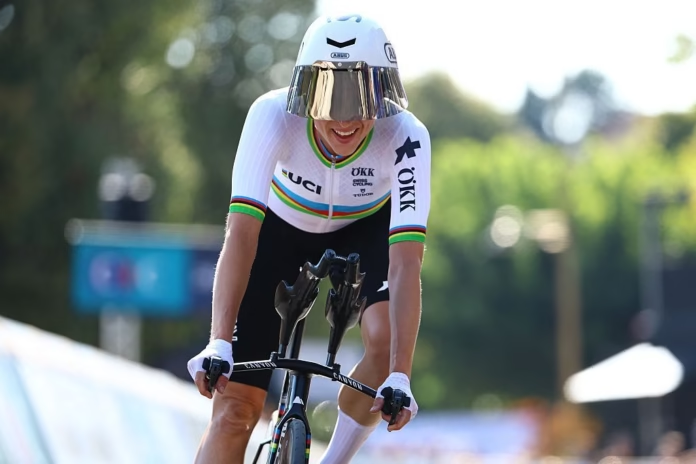
The Men’s Tour de Suisse 2026 reaches its decisive time-trial stage on Saturday, 20th June, with stage 4 in Aarburg giving the GC riders and specialists a 23.8km test against the clock. After three road stages shaped by long-range moves, breakaways and Tadej Pogačar’s control of the general classification, this is the day where the race becomes entirely individual.
For UK viewers, the men’s time-trial is scheduled to begin at 14:05 BST, with the final rider expected to finish at around 16:30 BST. The route starts and finishes in Aarburg and includes 270m of climbing, making it a fast and technical specialist stage rather than a mountain time-trial.
This is the stage that should decide how much of a contest remains before Sunday’s queen stage in Villars-sur-Ollon. Pogačar has been in control since his stage 1 solo win in Sondrio, but Aarburg is the last clear opportunity for riders such as Primož Roglič, Tom Pidcock, Richard Carapaz, Brandon McNulty, Aleksandr Vlasov and Andrea Bagioli to either gain ground, limit losses or protect a podium position before the mountains return.
For wider race context, see our Men’s Tour de Suisse 2026 full route guide, the full start list for Men’s Tour de Suisse 2026, our Men’s Tour de Suisse 2026 team-by-team guide and our Men’s Tour de Suisse 2026 stage 4 preview.

What time does Men’s Tour de Suisse 2026 stage 4 start?
Men’s Tour de Suisse 2026 stage 4 starts at 14:05 BST on Saturday, 20th June.
The official Aarburg host programme lists the men’s time-trial start at 15:05 local time, which is 14:05 in the UK. The final rider is expected to finish at around 17:30 local time, which is 16:30 BST.
That gives stage 4 a clear afternoon viewing window for UK fans. It is not a full road stage with several hours of build-up, but a concentrated time-trial programme where the early benchmarks matter and the GC picture should become clearer once the final wave of riders starts.
Men’s Tour de Suisse 2026 stage 4 timings in the UK
Stage 4 date: Saturday, 20th June
Stage: Aarburg to Aarburg individual time-trial
Distance: 23.8km
Climbing: 270m
First men’s rider starts: 14:05 BST
Last finisher expected: around 16:30 BST
Podium ceremony: around 16:30 BST
Exact rider start times should be confirmed once the official time-trial order is published, but the final GC riders are expected to be among the last starters. That means the most important overall contenders should be on course later in the afternoon.
How to watch Men’s Tour de Suisse 2026 stage 4 in the UK
UK viewers should be able to watch the Men’s Tour de Suisse 2026 through TNT Sports and HBO Max, with coverage also linked to the wider Eurosport/Warner Bros. Discovery cycling package.
For stage 4, check the live schedule on the morning of the race because time-trials sometimes have different broadcast windows from road stages. The key race window is 14:05-16:30 BST, so coverage should be centred around the afternoon time-trial rather than the earlier women’s race programme.
The Tour de Suisse is also available through several European broadcasters and local Swiss coverage, but UK viewers looking for the simplest domestic route should use TNT Sports or HBO Max. For a full overview, see our how to watch Men’s Tour de Suisse 2026 in the UK guide.

What is the route for stage 4?
Stage 4 is a 23.8km individual time-trial in Aarburg. It starts and finishes in the same town, continuing the compact 2026 Tour de Suisse format where each stage is centred around a host location.
The route includes 270m of climbing, so it is not a completely flat power course, but it is also not a climbing time-trial. The official description points towards a fast specialist stage, with few elevation changes, fast sections and corners where technically strong riders can gain time.
That should make pacing important. Riders will need to settle quickly, stay aerodynamic, carry speed through the technical sections and avoid fading late. On a course of nearly 24km, small mistakes can become meaningful time losses.
Aarburg’s historic setting along the Aare gives the stage a strong visual identity, but for the riders it will be a pure test of execution. This is not a stage for hiding behind teammates or waiting for the right tactical moment. The clock will expose everyone.
Why stage 4 matters for the GC
Stage 4 matters because the race is running out of road. After Aarburg, only the final mountain stage in Villars-sur-Ollon remains, and that day is hard enough to change the podium but not long enough to erase every mistake.
Pogačar’s stage 1 attack in Sondrio gave him a large early advantage, and he has managed the race from there. Stage 2 in Locarno went to Romain Grégoire from the breakaway, while stage 3 in Bad Ragaz was won by Jhonatan Narváez after he and Xandro Meurisse narrowly held off the bunch.
That means stage 4 becomes a sorting day. Riders who can time-trial well may strengthen their overall position before Sunday. Riders who struggle against the clock will be forced into a more aggressive final-stage strategy.
For Pogačar, the objective is simple: ride cleanly, avoid risk and take more time where possible. He does not need to win the stage to tighten his grip on the race. For Carapaz, Roglič, Pidcock, Bagioli, Vlasov and the rest, the time-trial is either a chance to move up or a stage where they must limit losses before Villars-sur-Ollon.
Who are the stage 4 favourites?
Tadej Pogačar is the obvious reference point. His form has been exceptional, and a fast, moderately rolling time-trial should suit him well enough to compete for the stage. More importantly, it gives him a chance to increase his overall lead before the queen stage.
Primož Roglič should also be watched closely. This kind of controlled effort suits him much better than a chaotic breakaway day, and a 23.8km time-trial gives him a clearer route to a stage result. If Red Bull-BORA-hansgrohe want to salvage a major result from the race, Aarburg is one of their best opportunities.
Brandon McNulty is a strong outsider for the stage. He has the time-trial engine, and UAE Team Emirates-XRG may use his ride as both a stage opportunity and a reference point before Pogačar. If McNulty is given freedom to go full gas, he can challenge for the podium.
Tom Pidcock has the technical ability to make the corners and rhythm changes count, though the longer power sections may decide whether he can challenge the very fastest riders. Aleksandr Vlasov, Andrea Bagioli and Richard Carapaz will be important in the GC fight, while riders such as Mauro Schmid could target a strong home-road result.
What happened on stage 3?
Stage 3 was won by Jhonatan Narváez after a long breakaway move with Xandro Meurisse survived the chase into Bad Ragaz. Narváez beat Meurisse from the two-up finish, while the peloton came close but ran out of road.
The result meant another stage went to the breakaway after Romain Grégoire’s victory in Locarno on stage 2. Pogačar remained in the overall lead, keeping the race under control without needing to chase stage wins every day.
That context matters for stage 4. The road stages have allowed non-GC riders to take their opportunities, but the time-trial will pull the race back towards the overall contenders. There is no breakaway equation in Aarburg. The GC riders have to answer directly.
What should viewers watch for?
The first thing to watch is the early benchmark. A strong time-trial rider starting before the final GC wave could set a target that holds for much of the afternoon. On a course like this, a well-paced ride from a specialist can remain competitive even once the overall contenders start.
The second thing is Pogačar’s margin. He does not need a huge ride, but if he takes time from Carapaz, Roglič and Pidcock, the race may be close to settled before Villars-sur-Ollon. If one of those rivals beats him, Sunday becomes more interesting.
The third thing is the podium fight. Stage 4 may be more important for 2nd, 3rd, 4th and 5th overall than for yellow. A strong ride from Roglič, Pidcock, Bagioli or Vlasov could change the shape of the final day.
The fourth thing is technical execution. The route has fast sections and corners where confident bike handling can save time. In a time-trial, a rider does not need to crash or visibly struggle to lose seconds. A few poor corners, bad pacing or a fading final few kilometres can be enough.
-
 Photo Credit: Flavia Ossola
How stage 4 sets up the final day
The final stage in Villars-sur-Ollon is the queen stage of the 2026 Tour de Suisse, with 151.1km and more than 4,200m of climbing. That means stage 4 is not the last word, but it will decide what kind of race Sunday becomes.
If Pogačar extends his lead in Aarburg, UAE Team Emirates-XRG can ride more defensively on the final day. Their job would be to control attacks, keep Pogačar out of trouble and manage the strongest climbers.
If the gaps behind him tighten, stage 5 could become more aggressive. Riders fighting for the podium may need to attack before the final climb, especially if the time-trial leaves only small differences between them.
If a rider such as Roglič or Pidcock gains time in Aarburg, the final stage becomes much more tactical. They may not be close enough to threaten yellow, but they could force the race open behind Pogačar.
The time-trial will not remove the importance of the queen stage. It will decide how much risk everyone needs to take there.
Men’s Tour de Suisse 2026 stage 4 prediction
Stage 4 should be one of the clearest specialist tests of the week, but Pogačar’s current form makes him hard to oppose. He has the race lead, the power and the confidence to ride a strong time-trial without taking unnecessary risks.
Roglič is the most obvious challenger if he has targeted the stage fully, while McNulty has a credible chance of a podium ride. The GC riders who struggle here will have to race much more aggressively in Villars-sur-Ollon.

