

ONCE was one of the defining cycling teams of the 1990s. Bright yellow, tactically sharp and unmistakably Spanish, it became a Grand Tour force at a time when Spain was reshaping the sport’s identity through Miguel Indurain, the rise of La Vuelta and a generation of riders increasingly comfortable racing at the centre of the European calendar.
The team was launched in 1989 and sponsored by ONCE, Spain’s national organisation for the blind, best known internationally through its lottery. That backing gave the squad an instantly recognisable identity. The yellow kit was not subtle, and neither was the ambition. Under Manolo Saiz, ONCE became one of the most modern, controlled and strategically distinctive teams in the peloton.
Its story is also more complicated than a clean roll of honour. ONCE produced Grand Tour winners, Tour de France podium riders, Classics victories, time trial dominance and one of the most recognisable team cultures of its era. It also belonged to a period of cycling that would later be heavily scrutinised, and its post-ONCE evolution into Liberty Seguros and Astana-Würth placed it close to some of the sport’s most difficult early-2000s questions.
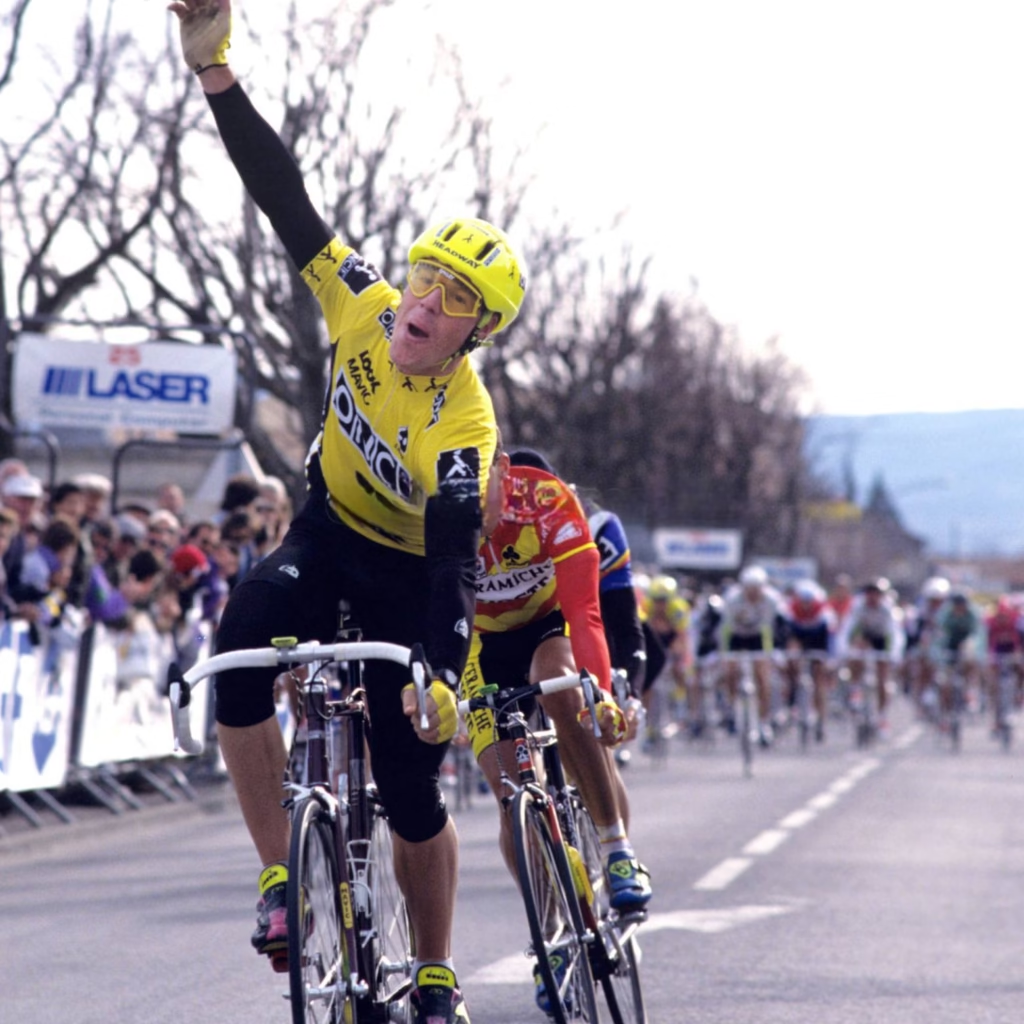
The birth of ONCE and the Manolo Saiz project
ONCE entered the professional peloton in 1989, built around a Spanish sponsor with a powerful social identity and a manager who wanted to run a cycling team differently. Manolo Saiz was not the old-fashioned ex-rider figure who simply managed from instinct. He was associated with preparation, structure, technology, training control and a highly managed racing environment.
That mattered. Professional cycling in the late 1980s and early 1990s was still uneven in how teams approached performance. Some squads relied heavily on tradition, road knowledge and rider autonomy. ONCE leaned towards something more systematised. The team looked organised, rode in a recognisable way and carried itself like a project rather than just a collection of riders.
The yellow kit made the team visible, but its racing made it influential. ONCE was often associated with aggressive team time trialling, disciplined work on the front of the peloton and carefully managed Grand Tour campaigns. It was not only chasing stage wins. It wanted to control races.
Melcior Mauri and the first Vuelta breakthrough
The team’s first major Grand Tour breakthrough came quickly. In 1991, Melcior Mauri won the Vuelta a España for ONCE, beating Miguel Indurain and Marino Lejarreta. It was a huge result for a young team, and it immediately placed ONCE among Spain’s most important cycling structures.
Mauri’s victory was built around time trialling and control. The 1991 Vuelta featured enough kilometres against the clock to make his strengths decisive, and ONCE used that platform superbly. The result also carried extra weight because Indurain was on the podium in second place. As Indurain went on to dominate the Tour de France, Mauri’s win gained a retrospective glow: ONCE had beaten the rider who would soon define the decade.
For wider context on Indurain’s place in that period, ProCyclingUK’s feature on Miguel Indurain, the quiet giant who defined an era explains how his controlled style came to shape the early 1990s.
That first Vuelta victory established a pattern. ONCE would be a Grand Tour team, but not always in the romantic, mountain-attacking sense. It would win through planning, pacing, time trialling and collective organisation. Saiz’s team wanted to make stage racing predictable for itself and uncomfortable for everyone else.
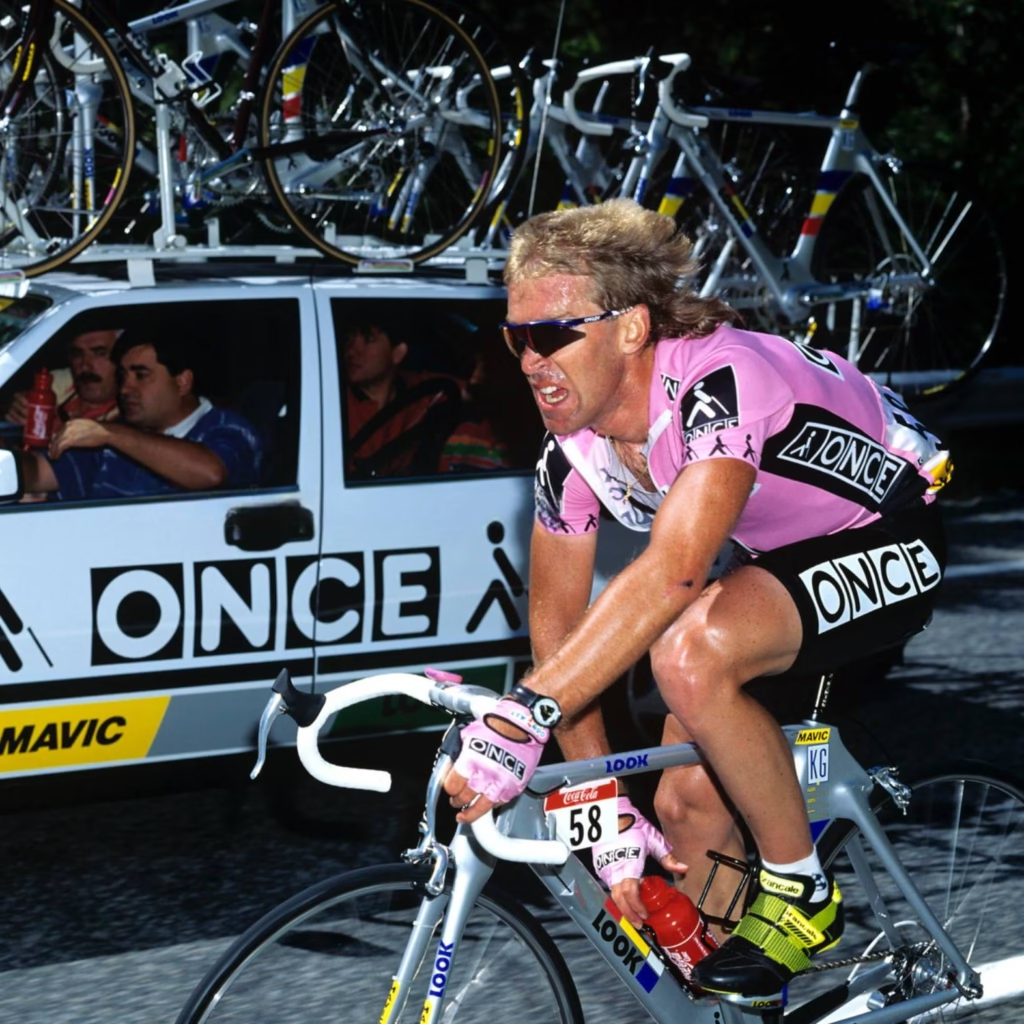
Laurent Jalabert and ONCE’s golden transformation
The arrival and rise of Laurent Jalabert changed ONCE from a strong Spanish team into one of the most compelling squads in the world. Jalabert had already been known as a fast finisher, but at ONCE he became something far broader: a Classics winner, stage-race force, points-machine and Grand Tour contender.
His 1995 Vuelta a España victory remains one of the great ONCE performances. Jalabert did not merely win the overall title. He also won the points classification and the mountains classification, an extraordinary sweep that captured both his range and the team’s dominance. ONCE also won the team classification, with Johan Bruyneel finishing third overall.
That 1995 Vuelta was the clearest expression of ONCE at full power. Jalabert gave the team star quality, but the broader structure mattered just as much. ONCE could protect, chase, attack and control. It had the tactical confidence of a squad that believed the race could be shaped to its own design.
Jalabert also gave the team a wider identity beyond Spain. He won major one-week races and Classics, including Paris-Nice and La Flèche Wallonne, and became one of the sport’s most versatile riders. For ONCE, he was the perfect emblem: fast, tough, adaptable and capable of winning in several different ways.
 Photo Credit: Cor Vos
Alex Zülle and the Vuelta dynasty
If Jalabert gave ONCE its most complete Grand Tour display, Alex Zülle gave the team its most sustained Vuelta dominance. The Swiss rider won La Vuelta in 1996 and 1997, turning ONCE’s home Grand Tour strength into a sequence rather than a single peak.
Zülle was one of the best time triallists and stage racers of the 1990s. With ONCE, he had the right environment to convert that strength into Grand Tour victories. His riding style suited the team’s identity: measured, powerful, relentless and highly effective when backed by a disciplined collective.
Those back-to-back Vuelta wins meant ONCE had won four editions of the race in seven years: Mauri in 1991, Jalabert in 1995, and Zülle in 1996 and 1997. That is the core of the team’s Grand Tour legacy. It made ONCE synonymous with the Vuelta, not simply as a Spanish team winning at home, but as a squad that knew how to bend the race to its strengths.
Zülle’s time at ONCE also raised the team’s Tour de France ambitions. He was a rider capable of finishing on the Tour podium, and ONCE increasingly looked like a team that wanted to challenge beyond Spain. The Tour, though, proved a harder prize to unlock.
The Tour de France question
ONCE’s relationship with the Tour de France was one of ambition without ultimate victory. The team won stages, animated the race and regularly arrived with riders who could challenge high overall, but it never won the yellow jersey in Paris.
Part of that was timing. ONCE’s rise overlapped with Indurain’s dominance, then the more chaotic and controversial years that followed. The Tour was also less suited to the team’s easiest path to control. La Vuelta often gave ONCE terrain, time trials and tactical conditions that worked beautifully for its leaders. The Tour demanded another level of depth, consistency and resistance to outside pressure.
That wider 1990s context also brings ONCE into comparison with the Banesto structure around Indurain. ProCyclingUK’s Team Banesto history looks at the rival Spanish model that turned Tour control into a dynasty.
Even so, ONCE was rarely peripheral. The team was highly visible in the Tour, especially in the 1990s and early 2000s, and its yellow jerseys created an easy visual echo with the race leader’s maillot jaune. It often looked like a team built for command, even when the overall prize remained out of reach.
Joseba Beloki came closest to turning that ambition into a Tour-defining result. He finished third in 2000, third again in 2001 and second in 2002, establishing himself as one of the strongest Grand Tour riders of that period. His consistency gave ONCE its most serious late-era Tour threat, but the team still could not make the final step.
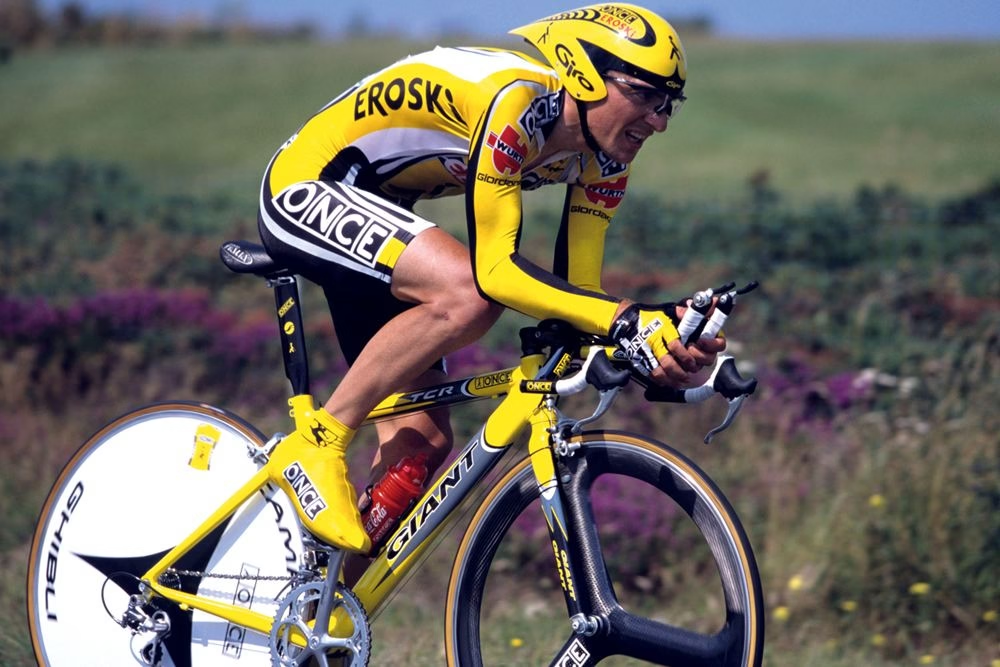
Beloki, the early 2000s and the final ONCE years
By the early 2000s, ONCE was no longer only the Jalabert and Zülle team. Joseba Beloki became the new centre of its Grand Tour project, particularly at the Tour de France. He was not as explosive a personality as Jalabert or as mechanically smooth in memory as Zülle, but he was durable, tactically reliable and capable of reaching the podium in the sport’s biggest race.
Beloki’s run of Tour podiums placed ONCE among the most serious stage-race teams of the era. The squad also continued to produce strong performances across one-week races and team time trials, where its organisation remained a signature strength.
The most famous moment of Beloki’s career, however, was also one of the most painful. On stage 9 of the 2003 Tour de France, he crashed heavily on the descent into Gap while chasing Lance Armstrong. The crash ended his Tour and effectively changed the trajectory of his career. It also symbolised the fragility of ONCE’s final push for Tour glory. The team had come close, but the race again slipped away.
ONCE’s sponsorship ended after the 2003 season. The team continued under new backing as Liberty Seguros from 2004, still under Saiz’s management, but the distinctive ONCE era was over. The yellow kit, the name and the lottery-backed identity disappeared from the front of the sport.
What made ONCE tactically different?
ONCE’s reputation was built not just on who won, but on how the team raced. It was one of the squads most strongly associated with the controlled, managerial style that became increasingly important in modern cycling. Saiz wanted information, structure and discipline. Riders were expected to fit into a system.
That approach was clearest in stage races. ONCE often rode as if it had a plan for every phase: the time trial, the mountain transition, the chase, the protection of a leader, the calculation of when to defend and when to increase pressure. The team was not always romantic, but it was extremely effective.
The team time trial became part of the mythology. ONCE looked at home in formation, yellow jerseys lined out across the road, each rider locked into the same rhythm. It was the perfect visual expression of the team’s philosophy. Individual talent mattered, but collective precision mattered too.
In that sense, ONCE helped point cycling towards the more controlled team structures that would dominate later eras. It did not invent modern management, but it made the idea highly visible in Spanish cycling.
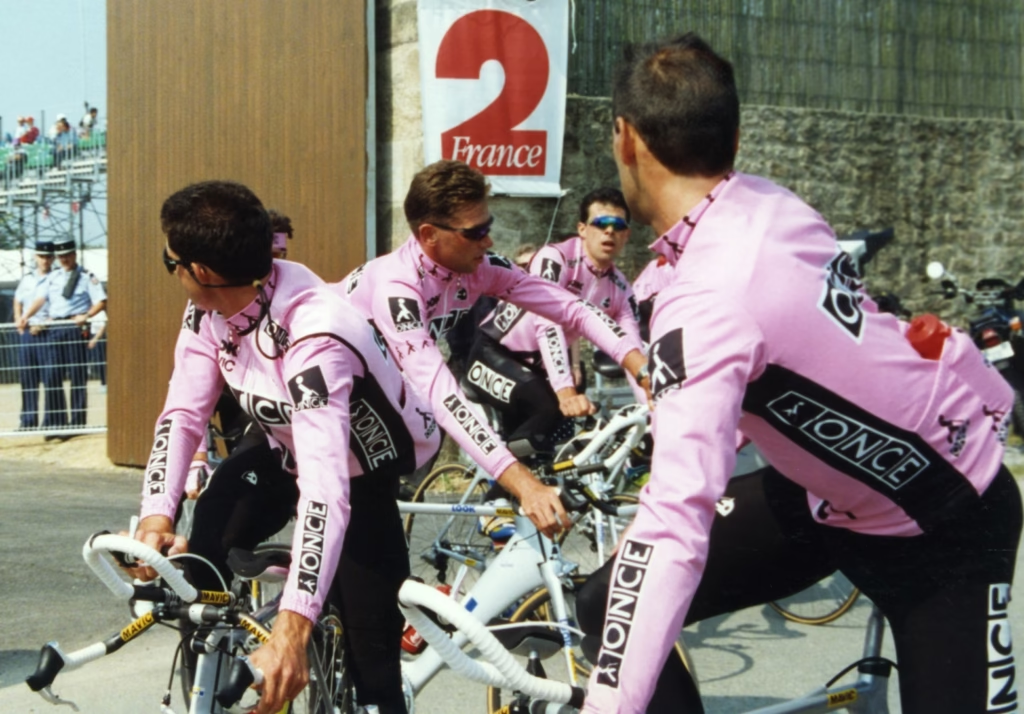
The riders who defined ONCE
Laurent Jalabert remains the team’s most charismatic figure. His transformation from sprinter to all-round superstar gave ONCE its most compelling story, and his 1995 Vuelta remains the team’s signature Grand Tour victory. He was the rider who made the yellow kit feel dangerous in almost every kind of race.
Alex Zülle was the purest Grand Tour machine. His back-to-back Vuelta wins in 1996 and 1997 gave ONCE its strongest run of stage-race authority, and his time-trialling power fitted perfectly with the team’s structure.
Melcior Mauri gave the project its first Grand Tour proof. His 1991 Vuelta win came early enough to validate the team’s ambitions and showed that ONCE could compete with Spain’s strongest structures almost immediately.
Joseba Beloki carried the team into its final era. His Tour de France podiums made ONCE a serious presence in July and kept the team’s Grand Tour ambitions alive after the Jalabert and Zülle years had passed.
The wider cast mattered too. Riders such as Johan Bruyneel, Abraham Olano, Igor González de Galdeano, Marcos Serrano, Íñigo Cuesta, Neil Stephens, Mikel Zarrabeitia and others helped make ONCE a deep and adaptable squad. It was rarely just one leader and a thin support group. The team’s strength came from its density.
The difficult end: Liberty Seguros, Astana-Würth and Operación Puerto
The end of the ONCE-branded team cannot be separated from what followed. After ONCE’s sponsorship ended, the structure became Liberty Seguros in 2004. Roberto Heras won the 2004 Vuelta a España with the team, while the squad continued to operate as one of the major stage-race forces in the peloton.
By 2006, however, the team was engulfed by the Operación Puerto doping investigation. Liberty Seguros withdrew its sponsorship, and the structure briefly raced under Astana-Würth and then Astana branding. The original Saiz-led project did not survive in its existing form.
That ending complicates the memory of ONCE. The team’s best years belong to the 1990s, but its managerial structure and later evolution ran directly into one of cycling’s most damaging scandals. Any history of ONCE has to hold both truths together: it was a brilliant, influential and tactically modern team, and it was also part of an era whose results and methods sit under a long shadow.
The later Astana team that emerged from the turbulence carried some continuity in personnel and opportunity, but the ONCE identity was gone. What remained was the memory of a Spanish team that had helped shape modern stage racing, even as the sport around it was being forced to confront uncomfortable realities.
-
 Photo Credit: Cor Vos (via Radsport-News)
 -
 Photo Credit: Chris Auld
ONCE’s Grand Tour record
ONCE’s Grand Tour identity was built above all at La Vuelta. The team won the race with Melcior Mauri in 1991, Laurent Jalabert in 1995, and Alex Zülle in 1996 and 1997. That run made it one of the defining Vuelta teams of the 1990s.
At the Tour de France, the team came close but never won overall. Joseba Beloki’s podium finishes were the clearest expression of its Tour ambition, while Jalabert and others gave the team important stage wins and visibility. The gap between Vuelta mastery and Tour frustration is central to the ONCE story.
At the Giro d’Italia, ONCE never had the same deep identity as it did at La Vuelta or the Tour. Its historical meaning is Spanish and Tour-focused rather than Italian. That imbalance is not a weakness so much as a reflection of the team’s priorities and calendar rhythm.
For more on the wider shape of men’s cycling history, ProCyclingUK’s men’s cycling history hub brings together team histories, rider profiles and race features from across different eras of the sport.
The legacy of Spain’s bold yellow team
ONCE’s legacy is larger than its statistics. It showed what a Spanish team could look like when it combined strong sponsorship, modern management, international recruitment and a clear tactical identity. It was national in colour and culture, but international in ambition.
The team helped make La Vuelta a centrepiece for Grand Tour specialists, not simply the third race in the hierarchy. Its run of Vuelta wins in the 1990s gave the race star power, storylines and a home structure capable of dominating. It also gave Spain another major cycling institution during the same decade that Indurain was turning the Tour de France into a national obsession.
Visually, ONCE remains one of the most recognisable teams of its era. The yellow kit, the black lettering, the sharp team formations and the presence of riders such as Jalabert, Zülle and Beloki gave it a strong place in cycling memory. It looked like a team with a plan, and for much of the 1990s, that plan worked.
Its final chapter was messy, and the period it belonged to cannot be cleaned up into nostalgia. But the sporting significance remains. ONCE was bold, ambitious and influential. It did not win the Tour de France, but it changed the texture of Spanish professional cycling and built one of the most distinctive Grand Tour teams of the modern era.

