Paul Seixas ended the 2026 road season with a Monument victory at Il Lombardia, less than two years after winning the junior world time-trial title in Zurich. Born in Lyon in September 2006, the French rider had already finished fourth on his Tour de France debut and won Itzulia Basque Country and La Flèche Wallonne. The scale of that progression is striking, but the individual results explain more than the labels attached to him. His development has combined climbing, time trialling and the ability to win races that demand very different decisions.
From junior racing to the WorldTour
A junior foundation built on more than climbing
Seixas won the junior men’s individual time trial at the 2024 UCI Road World Championships in Zurich, one of the most objective tests available at that level. The discipline rewards pacing, position and sustained power, and a title against an international field provided evidence that his ability was not confined to steep finishes. His junior programme also included cyclocross and hilly road races, giving him experience of changing pace and handling a bike under pressure.
The transition into Decathlon’s professional structure in 2025 was unusually early. A WorldTour rider must manage longer events, stronger teams and repeated competition against riders with many years of experience. For Seixas, the first season was therefore about learning how to use his strengths without treating every race as a test of whether he could win.
His results in 2025 were encouraging, including a bronze medal in the elite European Championships road race and seventh at Il Lombardia. Both placed him against established professionals rather than only riders from his age group. The performances suggested he could be competitive in the hills, but a three-week stage race remained an entirely different challenge.
The spring of 2026 changed his standing
Seixas won a stage of the Volta ao Algarve and finished second overall, then added the Faun-Ardèche Classic. At Strade Bianche he finished second behind Tadej Pogačar, a result that carried weight because the race demands positioning, repeated accelerations and endurance over rough roads. It was evidence that he could survive a hard one-day race without needing the protection of a conventional stage-race rhythm.
At Itzulia Basque Country he won the general classification and three stages, including the opening time trial. He also led the points, mountains and young rider classifications. The result was unusually comprehensive: winning against the clock established an early advantage, while the road stages required him to defend it and continue attacking on demanding terrain.
Victory at La Flèche Wallonne followed later in April, and second place at Liège–Bastogne–Liège confirmed that he could handle the longer Ardennes test as well. Those races reward different strengths, but both demand the ability to accelerate late after a day of repeated climbing. By the end of the spring, his results justified treating him as a contender rather than a rider merely gaining experience.
A first Tour de France at 19
Seixas made his Tour de France debut in July 2026 and finished fourth overall. That is a different measure of ability from winning a one-day classic. A rider must avoid losing time in crosswinds, recover from difficult mountain stages and preserve enough strength for the final week. The cumulative demands are particularly difficult to predict for someone who has not previously raced for three weeks.
His Tour included several strong mountain-stage performances, but the general classification placing depended on consistency rather than a single spectacular attack. The team also had to manage the expectations created by his spring victories. A rider who can compete for the overall classification must sometimes resist the temptation to chase a stage result if doing so would threaten the following day’s performance.
Fourth place did not make him an established Grand Tour winner, and it would be premature to treat future victories as inevitable. It did demonstrate that his climbing and recovery were already sufficient to remain close to the strongest riders across a full Tour. The next test is whether that standard can be repeated as rivals and teams plan specifically around him.
Montréal and the Lombardia victory
At the September world championships in Montréal, Seixas took bronze in the elite individual time trial. The result linked directly to his junior world title, showing that his strength against the clock had continued to develop against the senior field. His road race was less successful, a reminder that form and execution can vary even within the same championship.
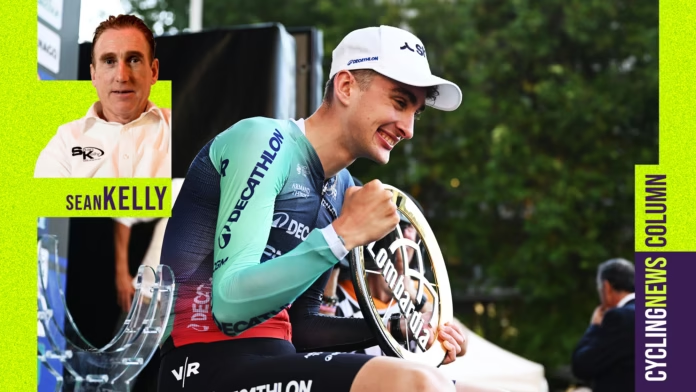
On 10 October he won Il Lombardia from Bergamo to Como over 239 kilometres. Enric Mas finished second at 48 seconds, with Giulio Ciccone third at 1 minute 5 seconds. Seixas attacked before the final climb and rode clear, turning a difficult one-day race into a sustained individual effort. The win made him the youngest Monument winner since Rik Van Steenbergen in 1944.
The Lombardia result completed a season in which he had won a major stage race, an Ardennes classic and a Monument, finished fourth at the Tour and taken a world championship time-trial medal. Those achievements are stronger evidence of his range than any projection about his future. They also create a practical challenge for Decathlon CMA CGM: managing the calendar and expectations of a rider who has reached the top level unusually quickly.
Paul Seixas emerged from French junior cycling with results that suggested unusual versatility. Born on 24 September 2006, he combined road racing with cyclocross and quickly became one of the most closely followed young riders in France. His performances against the clock and on climbs were particularly notable, because they pointed towards the demands of stage racing rather than a single narrow speciality.
Seixas joined the development pathway associated with Decathlon AG2R La Mondiale and moved directly into the WorldTour structure for the 2025 season. That progression was unusually rapid, but the team had already seen enough in junior and development racing to justify giving him a professional programme at 18.
The early question was not whether he could win junior races. It was how much of that form would translate into longer distances, stronger fields and repeated days of competition. WorldTour racing places different demands on recovery, positioning and tactical judgement, even for a rider who is already strong on the climbs.
A world title against the clock
The clearest junior milestone came at the 2024 UCI Road World Championships in Zurich, where Seixas won the junior men’s individual time trial. The title provided a straightforward measure of his ability against the best riders of his age, rather than a result shaped entirely by team tactics.
The discipline suits riders who can sustain power while pacing a difficult course accurately. Seixas’s victory also showed that he was more than a climber who happened to be quick uphill. The ability to time trial matters in stage races because a rider can lose significant time on flatter courses even when climbing with the leaders.
He was also competitive in one-day racing and stage races as a junior. Taken together, those results explained why a French WorldTour team would invest in him early. They did not guarantee immediate professional success, but they gave a stronger basis for promotion than a single eye-catching performance.
The transition to professional racing in 2025
Seixas began his professional career with Decathlon AG2R La Mondiale in 2025, becoming one of the youngest riders in the WorldTour peloton. The team needed to manage his calendar carefully, exposing him to high-level racing without treating every start as an obligation to chase a result.
His performances quickly drew attention, including his ability to remain competitive on climbs against established professionals. At the Tour of the Alps, he demonstrated that his climbing could translate to mountainous professional racing. He also gained experience in the sort of tactical situations that junior racing rarely reproduces at the same intensity.
The difference between a promising debut and a sustainable career is consistency. For a young rider, finishing difficult stage races, learning to conserve energy and handling poor days are part of the development process. The strongest evidence of progress comes from repeated performances across different race types rather than a single placing.
Results that shaped his reputation
Seixas’s junior world time-trial title remains a defining early result, while his first professional season showed that he could compete against far older riders. In 2026 he won Itzulia Basque Country and three stages, La Flèche Wallonne and Il Lombardia, while finishing fourth overall at the Tour de France. Those results, alongside his elite world time-trial bronze in Montréal, established his ability across stage races, one-day events and races against the clock.
The public attention around Seixas has sometimes moved faster than the normal development cycle. Comparisons with established Grand Tour winners may generate headlines, but they can obscure the actual work of becoming a complete stage racer. A young rider still has to learn when to attack, how to respond to repeated accelerations and how to cope with three weeks of racing.
France has produced many highly rated juniors, and the move from junior dominance to elite success has never been automatic. Seixas’s early performances make him an important rider to follow, but each season needs to be assessed on its own results and the quality of the opposition.
What his riding suggests about the years ahead
Seixas’s strongest qualities appear to be climbing and sustained efforts, supported by a high level against the clock. That combination is valuable for general classification ambitions, but professional racing also rewards descending, positioning, tactical patience and the ability to handle difficult weather and long transfers.
His team has an interest in giving him a balanced calendar rather than rushing every milestone. One-week stage races can offer useful opportunities to lead while allowing more recovery than a Grand Tour programme. Hilly one-day races also develop the ability to respond to changes of pace and choose the right moment to commit.
The route from junior world champion to WorldTour contender is already significant. What comes next will depend on how Seixas develops across multiple seasons, not simply on whether he matches the most optimistic expectations attached to his name.
-
 Photo Credit: Unipublic/Cxcling/Aritz Arambarri