Miguel Ángel López has lost his final appeal against the four-year anti-doping suspension imposed over the use and possession of menotropin around the 2022 Giro d’Italia, after the Swiss Federal Tribunal rejected his challenge to the Court of Arbitration for Sport ruling.
The judgment leaves López suspended until 24 July 2027 and also upholds the financial sanction imposed under the UCI Anti-Doping Rules. The UCI described the case as definitively closed after the Federal Tribunal rejected the Colombian’s arguments against the CAS award delivered in May 2025.
López was originally sanctioned by the UCI Anti-Doping Tribunal in May 2024 after being found to have used and possessed menotropin, a prohibited peptide hormone, in the period immediately before the 2022 Giro. ProCyclingUK covered the original decision in Miguel Ángel López banned for four years due to doping.
His subsequent attempts to overturn that ruling have now failed at both CAS and Switzerland’s highest court.

Federal Tribunal backs CAS decision
CAS dismissed López’s first appeal on 7 May 2025 and fully upheld the UCI Anti-Doping Tribunal decision.
The panel concluded that López had taken delivery of menotropin between 1 and 5 May 2022 and subsequently used the substance. The case did not originate from a conventional positive doping control. Instead, much of the evidence came from information gathered by Spanish authorities during Operation Ilex.
López challenged the use of that material and the conclusions drawn from it, taking the CAS award to the Swiss Federal Tribunal.
The Federal Tribunal has now rejected that challenge.
One of the issues considered was whether sporting disciplinary bodies could legitimately rely on evidence gathered during a state criminal investigation. The court accepted that anti-doping organisations necessarily operate with far fewer investigative and coercive powers than police or judicial authorities and did not find the use of the material incompatible with the legal protections invoked by López.
That leaves the underlying finding unchanged: López committed anti-doping rule violations through the use and possession of menotropin around the 2022 Giro d’Italia.
Operation Ilex evidence was central to the case
The proceedings against López developed from Operation Ilex, the Spanish investigation centred on doctor Marcos Maynar.
Evidence gathered by the Guardia Civil and Spain’s anti-doping authorities was subsequently provided to the International Testing Agency and formed the basis of the sporting case.
The investigation eventually created an unusual situation in which the criminal and sporting processes were considering evidence under different standards and for different purposes.
López has consistently disputed the anti-doping findings and argued that the evidence used against him did not establish that he had doped. His legal challenge also came against the background of developments in the Spanish proceedings which he believed supported his position.
The sporting tribunals reached a different conclusion.
CAS found the evidence sufficient to establish both possession and use under the UCI Anti-Doping Rules. The Federal Tribunal has now found no basis to overturn that award.
The result is important because it confirms that anti-doping proceedings do not need to mirror the outcome of a criminal investigation. Sporting tribunals apply their own rules and standards of proof, while evidence collected by state authorities can still be considered even when the sporting bodies themselves would not have had the power to obtain it directly.
Financial sanction also upheld
López also challenged the financial element of his punishment.
Under the UCI Anti-Doping Rules, a rider found to have intentionally committed an anti-doping rule violation can face a fine calculated at 70% of the gross cycling income they were entitled to receive during the calendar year in which the violation occurred.
The Federal Tribunal accepted that the provision pursues a legitimate objective.
Its reasoning centred on preventing an athlete who intentionally breaks anti-doping rules from retaining the financial benefit associated with competing during that period, while also recognising the deterrent effect of a substantial financial sanction.
The court concluded that such a penalty can serve both punitive and preventative purposes and did not find the sanction imposed on López incompatible with substantive public policy or the protections he relied on under the European Convention on Human Rights.
A similar UCI provision was applied when Robert Stannard received a backdated four-year suspension in 2024, when his financial penalty was also calculated using the 70% rule.
For López, the Federal Tribunal judgment means both the sporting suspension and financial consequences remain in place.
López remains suspended until July 2027
The four-year period of ineligibility began on 25 July 2023, when López was provisionally suspended, and runs through 24 July 2027.
That timetable has not changed through any of the appeals.
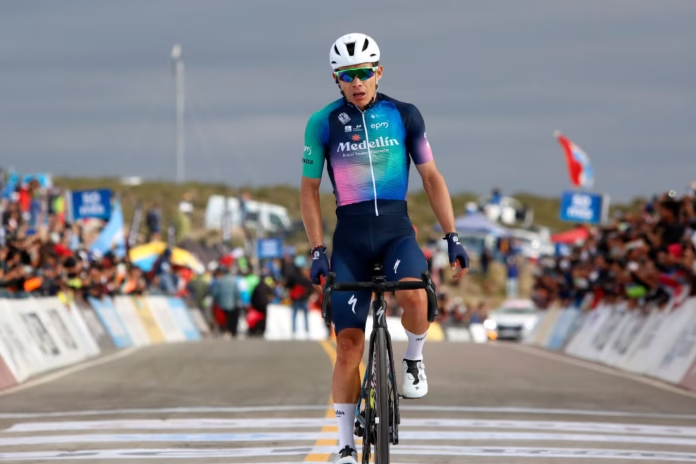
López last raced during 2023 with Team Medellín-EPM after leaving the WorldTour at the end of his second spell with Astana. Before his suspension he had dominated several races in South America, including the Vuelta a Colombia.
His absence from UCI racing will therefore reach four years before he becomes eligible to return.
López will be 33 by then.
A comeback would not be impossible, particularly for a rider whose career included podium finishes at both the Giro d’Italia and Vuelta a España, victory at the Tour de Suisse and one of the most memorable climbing victories of the 2020 Tour de France on the Col de la Loze.
The length of the absence makes any return to the highest level much harder to predict.
The case has travelled through three levels of sporting and legal review
The original UCI Anti-Doping Tribunal ruling came on 29 May 2024.
López appealed to CAS, which held a hearing later that year before dismissing the appeal in May 2025. The Colombian then took the case to the Swiss Federal Tribunal, as permitted for challenges to CAS awards made in Switzerland.
That final challenge was dismissed on 19 August 2026.
The UCI has now said the proceedings are definitively closed.
The case has consequently moved from the original anti-doping tribunal, through CAS and finally to Switzerland’s highest court without the central finding or the four-year sanction being changed.
It also leaves intact a ruling which reinforces two parts of the UCI’s anti-doping framework: the ability to use evidence obtained from state investigations and the ability to impose substantial financial penalties alongside suspensions in intentional doping cases.
For López, the immediate consequence is simpler. His suspension remains in force until July 2027, and after more than three years of legal challenges, there is no remaining route within the Swiss sporting arbitration system to overturn it.