
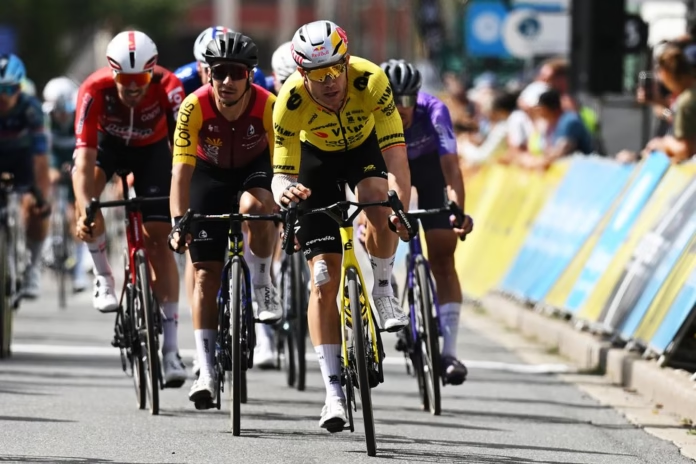
The Tour Auvergne – Rhône-Alpes 2026 moves into its decisive phase on stage 6, with the first of three consecutive mountain stages. After Wout van Aert finally gave the sprint teams their reward on stage 5, the race now turns back towards the general classification with a 182.3km route from Saint-Vulbas to Crest-Voland.
This is the first stage where the GC contenders can no longer hide. The opening half is not brutally selective, but the final 45km change the race completely, with the Côte d’Héry-sur-Ugine and Côte de Crest-Voland effectively forming a two-part final climb. It is not the steepest mountain finish of the race, with the Grand Colombier and Plateau de Solaison still to come, but it is hard enough to expose anyone who has been bluffing through the first five stages.
Alex Baudin begins the mountain block still in yellow after protecting his lead through the flatter stage 5 finish. Kévin Vauquelin and Oscar Onley remain close behind for Netcompany INEOS Cycling Team, while Matteo Jorgenson, Juan Ayuso, Mattias Skjelmose, Isaac del Toro, Paul Seixas, Ben Healy and Carlos Rodriguez are all waiting for the first proper climbing day to reshape the standings.
For the wider race context, see our Tour Auvergne – Rhône-Alpes 2026 full route guide, Tour Auvergne – Rhône-Alpes 2026 team-by-team guide and how to watch Tour Auvergne – Rhône-Alpes 2026 in the UK. The race also sits directly in the build-up to July, with several of the same names covered in our Tour de France 2026 young riders to watch.
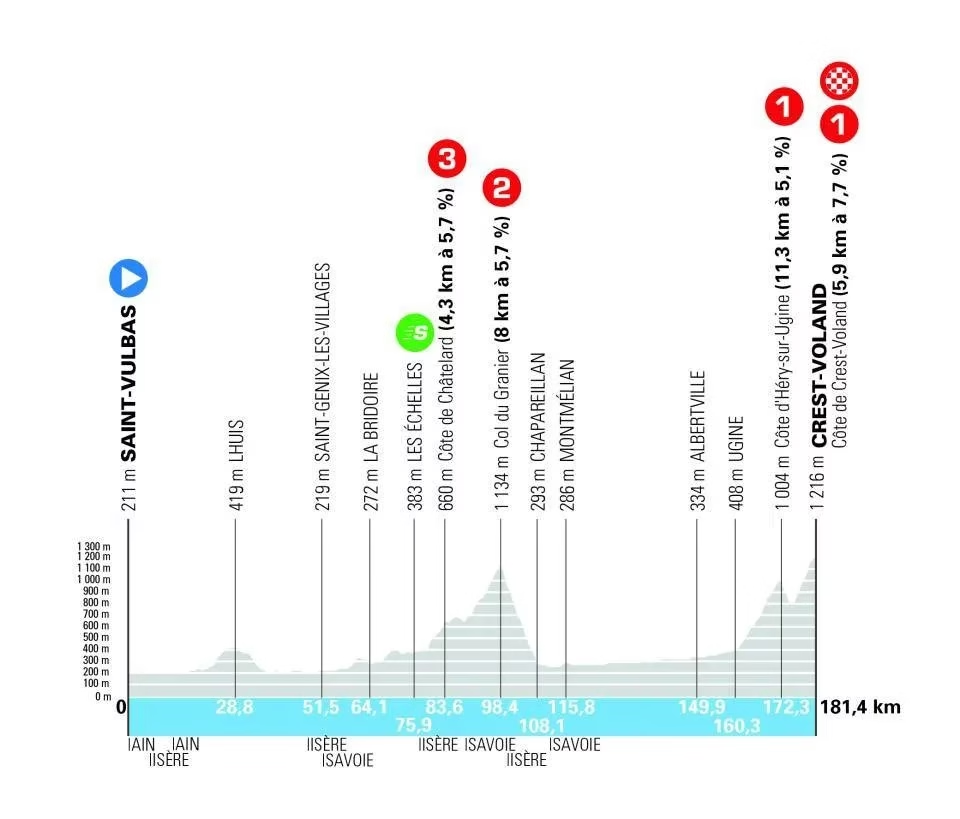
Tour Auvergne – Rhône-Alpes 2026 stage 6 route
Stage 6 starts in Saint-Vulbas and finishes at Crest-Voland after 182.3km. It is officially classified as a mountain stage, but the route is more about a long, patient build-up than constant climbing from the gun.
The first 75km should allow a breakaway to form, with the race moving through the Ain, Isère and Savoie before the first categorised climb. That opening phase will still matter, because teams with riders out of the GC battle will see this as one of the final chances to get ahead of the favourites before the stage becomes harder to control.
The intermediate sprint comes at Les Échelles after 76.1km, before the road begins to rise more seriously on the Côte de Châtelard. From there, the race climbs towards the Col du Granier, descends back into the valley, then heads towards Albertville and Ugine before the final paired ascent to Crest-Voland.
The two last climbs are the heart of the stage. The Côte d’Héry-sur-Ugine is long enough to thin the bunch and force teams into early decisions, while the Côte de Crest-Voland is steeper and comes at the finish. If the strongest climbers want to test Baudin, this is the first obvious place to do it.
What’s on offer on stage 6?
The stage includes four categorised climbs, with the two category 1 ascents packed into the final section.
- Côte de Châtelard: 4.3km at 5.7%, category 3
- Col du Granier: 8km at 5.7%, category 2
- Côte d’Héry-sur-Ugine: 11.6km at 5.1%, category 1
- Côte de Crest-Voland: 5.9km at 7.7%, category 1
There is also an intermediate sprint at Les Échelles, with points available for the green jersey, but the stage is unlikely to be shaped by the points competition. Once the race reaches the Col du Granier and then the final climbs, the GC teams should take over.
The final ascent to Crest-Voland is the decisive feature. At 5.9km and 7.7%, it is steep enough to create time gaps but short enough to reward punch as well as pure endurance. That should make it an important test for riders such as Ayuso, Del Toro, Seixas, Onley, Jorgenson and Vauquelin, who all have different ways of approaching a climb like this.
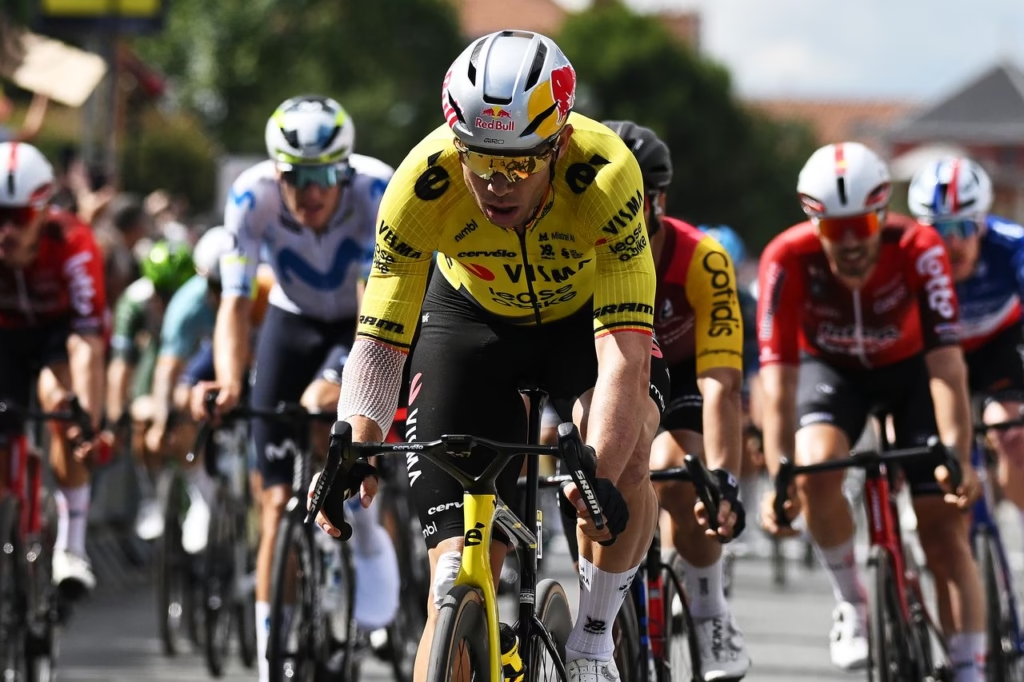
How the race stands before stage 6
The first five stages have left the general classification open. Alex Baudin still has the yellow jersey, and EF Education-EasyPost have defended it well through a varied opening half of the race. But the shape of the route now becomes much harder for a rider holding a narrow advantage.
Netcompany INEOS Cycling Team are especially well placed, with Kévin Vauquelin and Oscar Onley both close on GC and Carlos Rodriguez still within range. That gives them more than one way to approach the final climb. They can protect a rider, use one as an attacking card, or force EF and UAE Team Emirates-XRG to react earlier than they would like.
Team Visma | Lease a Bike also have momentum after Van Aert’s stage 5 victory. Matteo Jorgenson is still one of the key GC names, and the team’s stage 3 time trial win showed that they have enough collective strength to shape the race. The question now is whether they can turn that into climbing pressure.
UAE Team Emirates-XRG have Isaac del Toro and Pavel Sivakov in the mix, with Benoît Cosnefroy and Kevin Vermaerke useful on harder rolling terrain. Lidl-Trek have Juan Ayuso and Mattias Skjelmose, which gives them two riders who should be far more influential now the race reaches the mountains.
This is where the early race uncertainty should start to narrow. The Grand Colombier and Plateau de Solaison are harder on paper, but stage 6 is the first proper filter.
Why Crest-Voland matters
Crest-Voland is not the hardest finish of the week, but that may make it tactically more interesting. The favourites know that stage 7 to the Grand Colombier and stage 8 to Plateau de Solaison are still to come, so not every rider will want to empty themselves on the first mountain finish.
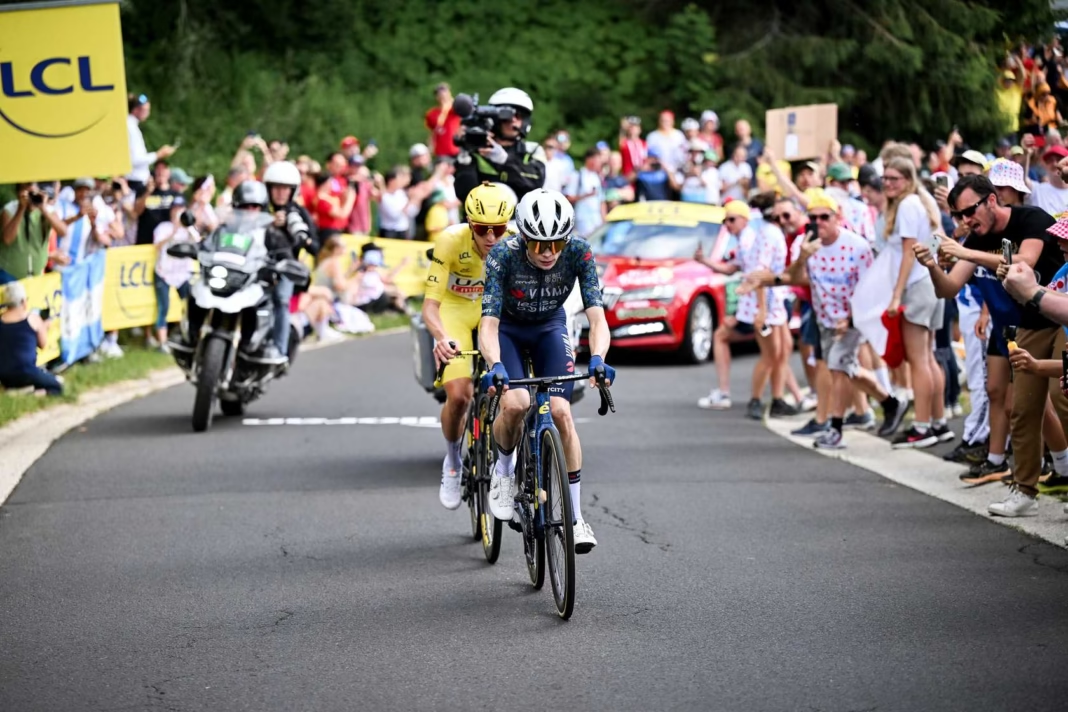
That could create a tense final climb. Teams may try to ride tempo on the Côte d’Héry-sur-Ugine, remove weaker domestiques, then wait until the steepest parts of Crest-Voland to attack. If the pace is controlled, the front group could still be relatively large at the foot of the final 6km. If UAE Team Emirates-XRG, Lidl-Trek, Netcompany INEOS Cycling Team or Team Visma | Lease a Bike decide to attack earlier, the yellow jersey group could shrink much sooner.
The stage is also important because it changes the psychological balance. Until now, Baudin has had the jersey and others have had the need to prove themselves. After Crest-Voland, the GC will have a clearer shape. Some riders will move from contenders to favourites, while others may have to switch towards stage hunting for the final weekend.
 Photo Credit: Getty
The favourites for stage 6
Isaac del Toro is one of the most obvious names for this finish. The final climb is hard enough to suit him, but not so long that the stage becomes purely about grinding endurance. If UAE Team Emirates-XRG want to start moving the race before the Grand Colombier, this is a good place to do it.
Juan Ayuso also fits the stage well. He has the acceleration for a climb like Crest-Voland and should be looking to confirm his GC position before the deeper mountain stages. Lidl-Trek’s advantage is that Mattias Skjelmose can also stay involved, which gives them two riders capable of influencing the finale.
Paul Seixas will be one of the most watched riders. The French teenager has been one of the key stories of the race, and this is the first finish where he can show whether he is ready to handle a proper WorldTour mountain stage against riders who will also be part of the Tour de France conversation. The climb should suit him, but the expectation around him is now part of the test.
Matteo Jorgenson is another serious contender. He may not need to attack immediately, especially with the final weekend still to come, but if Team Visma | Lease a Bike decide to ride hard, he has the all-round strength to finish it off. Oscar Onley and Kévin Vauquelin give Netcompany INEOS Cycling Team two dangerous options, while Ben Healy remains the kind of rider who can turn a controlled mountain stage into something much less predictable.
Pello Bilbao, Tobias Halland Johannessen, Cian Uijtdebroeks, Carlos Rodriguez and Mattias Skjelmose are also worth watching. This is the sort of finish where the difference between winning the stage and losing 20 seconds may come down to positioning at the bottom of the final climb.
Can the breakaway survive?
A breakaway has a chance, but it needs the right composition. Stage 6 is hard enough for strong climbers to stay away, yet important enough for the GC teams to chase if the move contains anyone dangerous.
The most likely scenario is an early break taking shape before Les Échelles, building a gap through the flatter first half, then being gradually reduced on the Col du Granier and Côte d’Héry-sur-Ugine. If the GC teams hesitate, a climber who starts the day far enough down overall could still survive to Crest-Voland.
The problem for the breakaway is timing. This is the first mountain finish of the race, and several teams need to test Baudin. UAE Team Emirates-XRG, Lidl-Trek, Netcompany INEOS Cycling Team and Team Visma | Lease a Bike all have reasons to keep the stage within reach. If they ride with intent, the break may be caught before the final climb.
A breakaway win is possible, but the stage feels more likely to be decided by the GC group.
-
 Photo Credit: A.S.O./Billy Ceusters
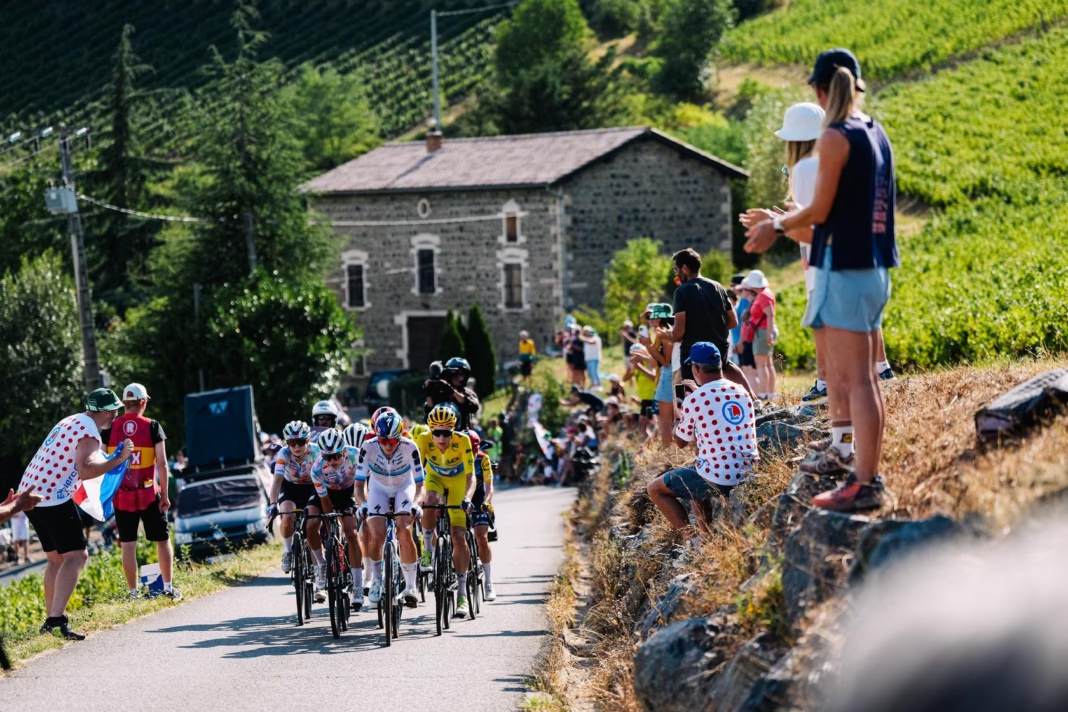
Riders to watch on stage 6
The main stage 6 contenders are:
- Isaac del Toro
- Juan Ayuso
- Paul Seixas
- Matteo Jorgenson
- Oscar Onley
- Kévin Vauquelin
- Ben Healy
- Mattias Skjelmose
- Carlos Rodriguez
- Pello Bilbao
- Tobias Halland Johannessen
- Cian Uijtdebroeks
Del Toro, Ayuso and Seixas look like the most natural fits for a final climb that requires sharp climbing legs rather than only long-distance endurance. Jorgenson and Onley may be more controlled in the way they race, but both can be dangerous if the front group is still compact inside the final 2km.
Healy is the wildcard. If he goes early, the stage changes. If he waits for the final climb, he may not have the same pure acceleration as some of the lighter GC riders, but he can still make the race awkward before the finish.
Stage 6 prediction
Stage 6 should finally show which riders are genuinely ready to win the Tour Auvergne – Rhône-Alpes 2026. The first half of the stage may belong to the breakaway, but the final 45km should bring the GC teams forward and force the first major selection of the race.
The Côte d’Héry-sur-Ugine should reduce the group, but the decisive move is more likely to come on the final climb to Crest-Voland. That climb suits riders who can accelerate after a long day rather than those who need a long, steady grind.
Isaac del Toro looks like the best pick. UAE Team Emirates-XRG have enough strength to position him well, the climb suits his punch, and the stage gives him a chance to make a statement before the Grand Colombier and Plateau de Solaison. Ayuso, Seixas, Jorgenson and Onley should all be close, but Del Toro has the profile to turn this into both a stage win and a GC move.
Prediction: Isaac del Toro

