
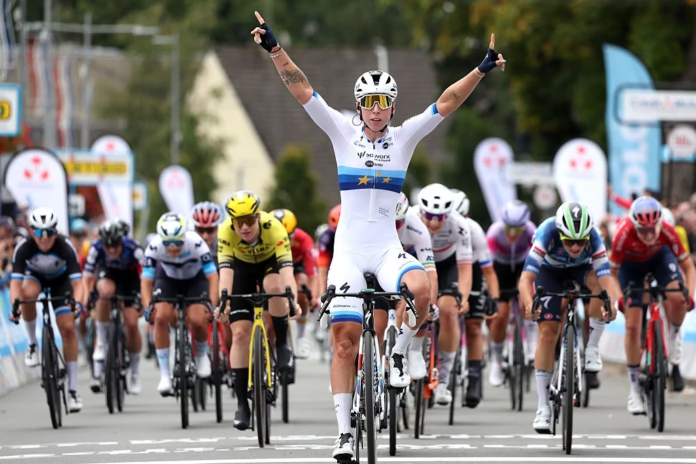
The La Choralis Fourmies Féminine 2026 takes place on Sunday 13 September, returning to northern France for another edition of a race that has developed quickly from a small UCI 1.2 event into a fixture on the UCI Women’s ProSeries calendar.
The race first appeared in 2019 and has already gone through several stages of growth. It began at 1.2 level, moved up to 1.1 for 2024 and then joined the Women’s ProSeries in 2025. That means the 2026 edition remains at UCI 1.Pro level, immediately below the Women’s WorldTour.
Despite that increased status, Fourmies has kept a very distinctive identity. It is a relatively short French one-day race, usually around 120 to 130 kilometres, with rolling roads and a finishing circuit that often keeps the race together long enough for the sprinters to remain heavily involved. That does not make it entirely predictable, however. Marta Lach won from a late move in 2023, while Silvia Zanardi and Lorena Wiebes have both taken bunch-sprint victories in the two editions since.
For anyone discovering the race for the first time, here is what you need to know.
La Choralis Fourmies Féminine 2026 at a glance
Date: Sunday 13 September 2026
Country: France
Location: Fourmies, Hauts-de-France
Race type: Women’s one-day road race
UCI classification: 1.Pro
Series: UCI Women’s ProSeries
Expected distance: Around 120-130km
First edition: 2019
2025 winner: Lorena Wiebes
2024 winner: Silvia Zanardi
2023 winner: Marta Lach
Fourmies sits one level below the Women’s WorldTour but has quickly established itself as one of the more useful late-season opportunities for sprinters and Classics riders.
ProCyclingUK’s 2025 La Choralis Fourmies Féminine preview provides a useful picture of the sort of field and tactical race produced since the step up to ProSeries level.
What is La Choralis Fourmies Féminine?
La Choralis Fourmies Féminine is the women’s professional race held as part of the long-established Grand Prix de Fourmies weekend in northern France. The men’s race has a much longer history, but the women’s event is relatively new.
The first edition was held in 2019, when Thi That Nguyen became the inaugural winner. The race then disappeared from the calendar during the disruption of 2020 before returning and gradually building its status. It has since become part of a useful cluster of French one-day races held late in the European season.
That position is important. By September, many riders are coming out of the main summer stage-racing block and beginning to target the final Classics, championships and UCI points available before the season closes. Fourmies provides a particularly useful opportunity because it is prestigious enough to attract WorldTour-level riders but open enough tactically that smaller teams can still influence the race.
Why is the race called La Choralis Fourmies Féminine?
The name combines the race’s commercial title with the town that hosts it.
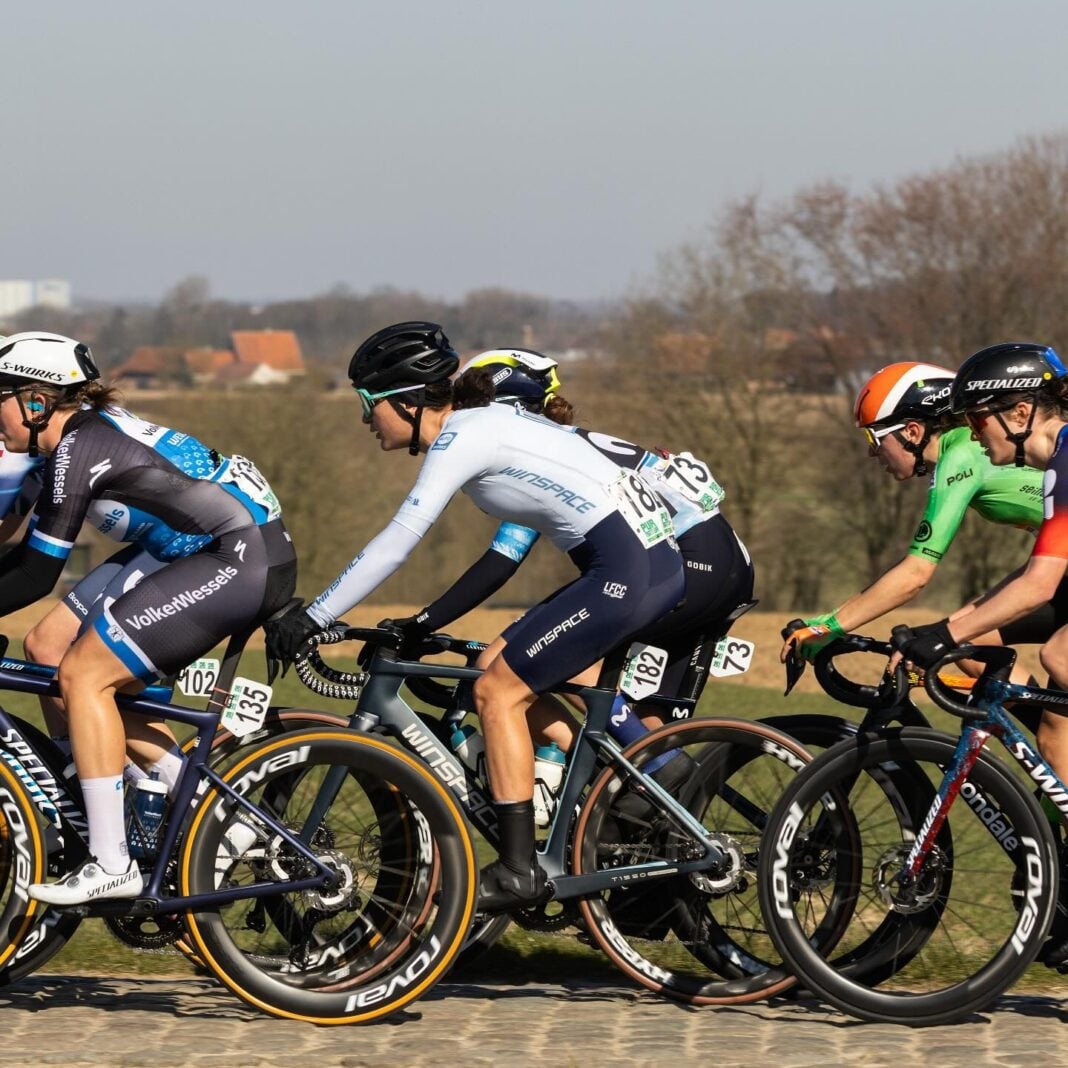
Fourmies is a town in the Nord department of northern France, close to the Belgian border. The surrounding landscape is very different from the mountainous terrain often associated with French professional cycling. There are no long Alpine or Pyrenean climbs. Instead, the roads are rolling, with short rises, exposed sections and frequent changes in rhythm.
That naturally makes the race much more accessible to sprinters and Classics-style riders. The “La Choralis” element comes from the race’s title sponsorship, while Fourmies remains the geographic identity at the heart of the event.
How has La Choralis Fourmies Féminine grown?
The rise through the UCI classifications has been rapid. The race began in 2019 at UCI 1.2 level, later moved up to 1.1 for 2024, and only one year later was promoted again, joining the Women’s ProSeries for 2025.
That means the hierarchy now looks like this:
Women’s WorldTour
⬇
Women’s ProSeries
⬇
UCI 1.1
⬇
UCI 1.2
Fourmies therefore sits just one step below the Women’s WorldTour. That promotion has helped bring stronger teams and riders to the race while retaining opportunities for ProTeams and Continental squads.
If the classifications themselves are unfamiliar, ProCyclingUK’s beginner’s guide to the Pointe du Raz Ladies Classic 2026 also explains what the 1.Pro designation means within women’s professional cycling.
What is the La Choralis Fourmies Féminine route like?
The detailed 2026 route is still to be confirmed, but recent editions give a clear idea of the likely format. The race is centred on Fourmies, with the riders typically completing a broader opening loop before entering repeated finishing circuits around the town.
The course is usually relatively short by elite professional standards, with recent editions generally sitting in the region of 120 to 130 kilometres. The terrain is rolling rather than mountainous, with enough short climbs and accelerations to encourage attacks but not normally a decisive ascent capable of removing all of the strongest sprinters.
That creates the central tactical question every year. Can the attackers make the race hard enough to escape, or will the sprint teams retain control until Fourmies?
Is Fourmies a sprinters’ race?
More often than not, yes, but not always.
The recent winners illustrate that balance perfectly. Lorena Wiebes won in 2025 from a bunch sprint, while Silvia Zanardi did the same in 2024. Marta Lach, however, won in 2023 after escaping late and holding off the chasing peloton.
That tells you almost everything you need to know about Fourmies. The course is not hard enough to eliminate the sprinters automatically, but it is difficult enough to create fatigue and tactical uncertainty. If the main sprint teams hesitate, a late attacker can still succeed.
Previous winners
2025 – Lorena Wiebes
2024 – Silvia Zanardi
2023 – Marta Lach
2022 – Clara Copponi
2021 – Pfeiffer Georgi
2019 – Thi That Nguyen
No rider has yet won the race twice, which is notable for an event that has already developed a relatively clear preference for riders with a fast finish.
2019: Thi That Nguyen becomes the first winner
The inaugural edition was won by Vietnamese rider Thi That Nguyen. At that point, the race was still operating at UCI 1.2 level and was much smaller in status than the event seen today.
Her victory established the first name on a winners’ list that has since become increasingly strong. The fact that no repeat winner has emerged yet also shows how open the race has remained.
2021: Pfeiffer Georgi wins after the race returns
After the disruption of 2020, the race returned in 2021 and British rider Pfeiffer Georgi took victory from a small group after attacking on the final lap.
It was her first professional UCI road victory and provided an early indication of the Classics rider she would become. ProCyclingUK’s report on Pfeiffer Georgi’s 2021 Fourmies victory shows why her rider profile worked so well on this course.
Georgi is not a pure sprinter, but she has enough finishing speed to win from a reduced group and enough strength to survive repeated accelerations beforehand. That remains one of the best templates for success at Fourmies.

2022: Clara Copponi gives France a home victory
Clara Copponi won the 2022 edition, bringing exactly the kind of speed needed to convert a controlled race into victory while still being versatile enough to handle the rolling roads beforehand.
Her victory remains one of the most important early road results of her career. Copponi has since developed into an established international sprinter and Classics rider, with her wider career covered in ProCyclingUK’s Clara Copponi rider profile.
Her Fourmies win is another useful example of the rider profile the race tends to reward.
2023: Marta Lach beats the sprinters with a late attack
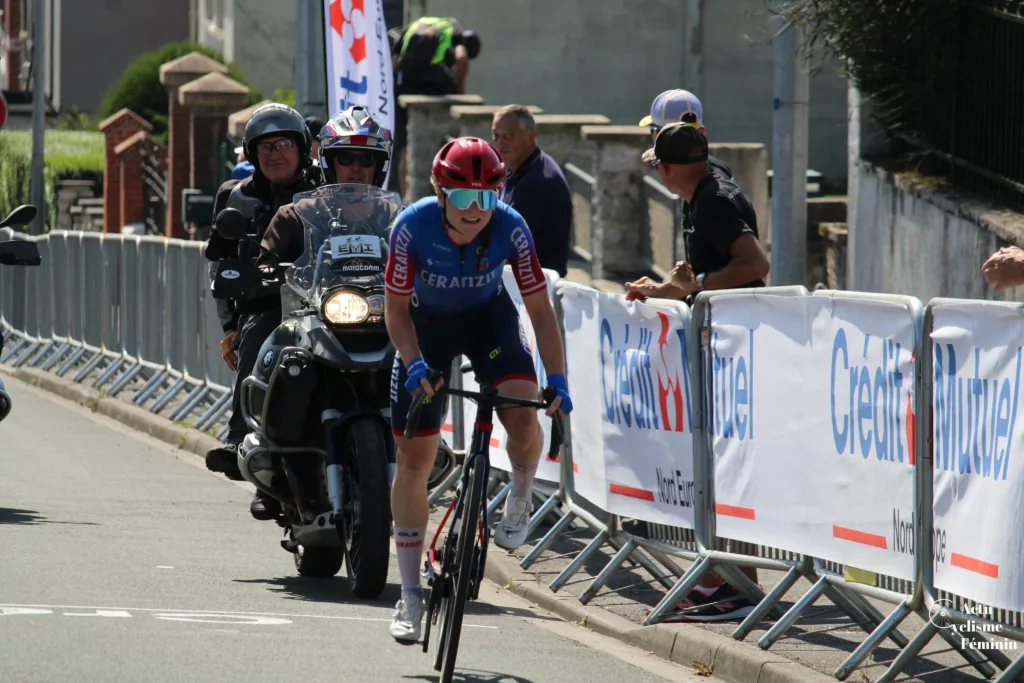
The 2023 edition is probably the most useful recent example for understanding why Fourmies cannot simply be treated as a guaranteed bunch sprint.
Marta Lach attacked late and managed to stay clear of the chasing peloton. She reached the finish with only a tiny advantage, but it was enough.
ProCyclingUK’s 2023 GP Fourmies race report covers how Lach held off the fast-closing bunch to take victory.
That result demonstrated the risk sprint teams face at Fourmies. If nobody wants to commit fully to the chase, a rider with enough power can use the rolling finishing circuit to steal the race. It also explains why the final laps are often more interesting than the relatively modest profile might suggest.
Lach’s development since then can also be followed through her ProCyclingUK rider profile.

2024: Silvia Zanardi wins from the bunch
The 2024 race moved up to UCI 1.1 level and produced a more conventional result.
Silvia Zanardi was the fastest in the final sprint, taking her first victory of the season. The race had featured attacks and late moves, but none managed to stay clear, and Zanardi eventually beat Cat Ferguson and Martina Alzini in the sprint.
ProCyclingUK’s 2024 La Choralis Fourmies Féminine race report covers how the race eventually came back together despite repeated attempts to avoid a bunch finish.
Her success continued the pattern of Fourmies rewarding riders who possess outright speed without being completely dependent on flat, controlled racing.
2025: Lorena Wiebes confirms the race’s sprinting character
The move to ProSeries level brought an even stronger field in 2025, and this time Lorena Wiebes delivered the result most people expected.
The Dutch sprinter won the bunch sprint ahead of Lara Gillespie and Gladys Verhulst-Wild, taking another victory in a remarkable season.
ProCyclingUK’s report on Wiebes’ 2025 Fourmies victory shows how SD Worx-Protime controlled repeated attacks before delivering Wiebes into the finish.
Her win reinforced an important point about Fourmies. A truly elite sprinter who survives comfortably is extremely difficult to stop here. The route can encourage attacks, but it does not necessarily provide enough difficulty to prevent the fastest riders reaching the finish.
What type of rider should you watch in 2026?
The final start list is still some way from being confirmed, so a proper favourites preview will need to wait. The type of rider to watch is much easier to define.
Pure sprinters who can handle rolling terrain remain obvious contenders. Fourmies is one of the better late-season opportunities for fast riders, and a sprinter does not need exceptional climbing ability so long as they are comfortable enough on repeated short rises to remain fresh for the finish. Wiebes showed in 2025 what happens when the best sprinter in the field reaches Fourmies without being seriously weakened.
The challenge for everybody else is therefore often not beating the fastest rider in the final 200 metres, but preventing the race from reaching that situation at all. That same tactical problem is explored more broadly in ProCyclingUK’s analysis of how to beat Lorena Wiebes.
Classics-style fast finishers may be the ideal Fourmies profile. Riders such as Georgi, Lach and Zanardi combine finishing speed with the ability to race aggressively before the sprint. They are less dependent on perfect control because they can follow a small group if it goes clear and still sprint if everything comes back together.
Late attackers also have a genuine chance. The 2023 result keeps that option alive. If the sprint teams look at each other during the final circuit, a powerful rider can take advantage. The move needs to be well timed because the roads are not hard enough to create a huge gap through climbing alone, but a few seconds can be enough.
Why do late attacks have a chance?
The finishing circuit creates an awkward problem for sprint teams. They know the race is likely to end in a sprint, which makes them reluctant to waste riders too early. But if every sprint team waits for someone else to chase, a late move can quickly gain enough of a gap to become dangerous.
This is exactly what Lach exploited in 2023.
The terrain also helps attackers because the road is rarely completely flat and straightforward. Small rises make it harder for an organised peloton to maintain one constant high speed, while an attacker can use those changes in gradient to maintain momentum as the chase behind repeatedly reorganises.
The decisive balance is therefore rarely between climbers and sprinters. It is between control and hesitation.
Why September matters
Fourmies comes very late in the European road season, and that changes the dynamics compared with a spring Classic.
By September, some riders are approaching the end of a long campaign while others are specifically targeting late-season form. Teams may also be chasing UCI points, which can affect how aggressively they race for top-10 positions rather than concentrating exclusively on victory.
The race’s ProSeries status makes those points particularly valuable. That can create a more open style of racing because several teams have strong reasons to place riders in attacks rather than simply helping a favourite win.
Where is Fourmies?
Fourmies is in the Nord department of northern France, close to the Belgian border. The wider area is part of Hauts-de-France and sits within a region with a strong cycling culture.
The landscape is very different from southern France. There are wooded roads, rolling hills and plenty of smaller towns, but no major mountain passes.
Its location also makes the race easily accessible to Belgian, Dutch and northern French teams, helping explain the strong Classics influence on both the field and the style of racing.
Is it part of the Coupe de France?
La Choralis Fourmies Féminine has also formed part of the Coupe de France Femmes, adding another layer of importance for French teams and riders.
That can matter tactically. Teams contesting the season-long French competition may have reasons to protect a rider’s finishing position even if the overall race victory is no longer realistic.
For French riders, that means Fourmies can carry significance beyond the UCI result itself.
When is La Choralis Fourmies Féminine 2026?
The race takes place on Sunday 13 September 2026.
Interestingly, that is also the day of the Women’s Cycling Grand Prix Region Stuttgart, another Women’s ProSeries one-day race.
That clash will inevitably divide some WorldTour teams and riders between France and Germany. Fourmies is likely to appeal particularly to the outright sprinters and fast Classics riders, while the more rolling Stuttgart event offers another option for teams looking for a selective race.
-
 Photo Credit: quentinphotographiebe
 -
 Photo Credit: Getty
How to watch La Choralis Fourmies Féminine 2026
Full broadcast details have not yet been confirmed.
Coverage arrangements for French one-day racing can vary considerably, particularly for races outside the Women’s WorldTour. The move to ProSeries status improves the importance of the race, but UK viewers should wait for the official broadcast announcement closer to September rather than assuming Fourmies will automatically appear on one of the major international streaming platforms.
ProCyclingUK will update the viewing information once the 2026 television and streaming arrangements are confirmed.
Why should you watch La Choralis Fourmies Féminine?
Fourmies is a good example of why the Women’s ProSeries can produce excellent one-day racing. The route is selective without being overwhelming, which means sprinters know they have a genuine opportunity while attackers know the course gives them a chance.
Smaller teams can influence the race, and the biggest squads cannot simply wait for one obvious climb to decide everything. That tension has already produced several different types of winner.
Pfeiffer Georgi won after an attacking race. Marta Lach stole victory from the sprinters with a late move. Clara Copponi and Silvia Zanardi converted their finishing speed. Lorena Wiebes showed what happens when an elite pure sprinter reaches the final straight with her team still in control.
The 2026 edition should again revolve around the same simple question: can anyone make the race hard enough to stop the sprinters before Fourmies?

