
The Tour de France 2026 begins with one of the most unusual opening stages in modern Tour history: a team time-trial through Barcelona, finishing on Montjuïc. It is only 19.6km on the official stage page, or 19.7km in the Grand Départ description, but it could immediately put gaps between the main general classification favourites before the race has even left Spain.
This is not a normal team time-trial. The stage classification will be based on the time of the first rider from each team, but the general classification will use individual times. That means every rider’s own finishing time counts for the overall standings, rather than every rider receiving the same team time based on the fourth or fifth rider across the line.
That single change alters almost everything. A traditional team time-trial is about keeping enough riders together until the timing point. The 2026 Tour de France opener is closer to a hybrid between a team effort and an individual GC test. Teams will still need to ride fast together, but in the final kilometres, especially on the climbs to Montjuïc, the strongest leaders may have to finish the job themselves.
For wider race context, see our Tour de France 2026 full route guide, our Tour de France 2026 route analysis, the Tour de France 2026 Grand Départ guide and the full start list for Tour de France 2026. The official Tour de France details are available on the stage 1 page, the overall route page and the Grand Départ Barcelona page.
 Photo Credit: Getty
What is a team time-trial?
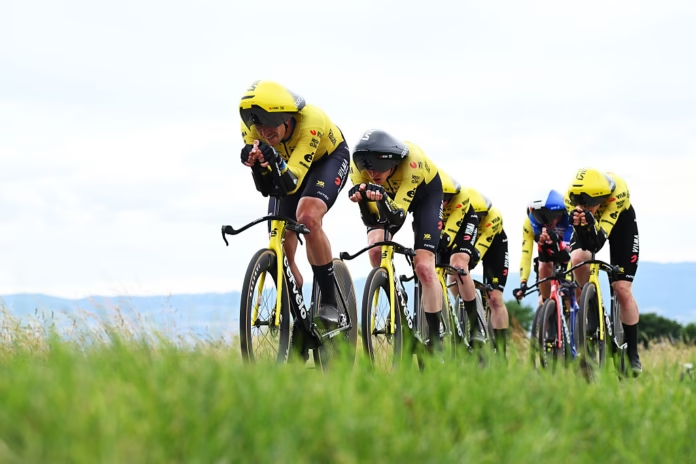
A team time-trial is a stage where each team rides against the clock rather than racing together in one peloton. Teams set off separately at fixed intervals, form a rotating line, and try to complete the course as quickly as possible.
The basic idea is simple. The rider on the front takes the wind, then swings off and drops back into the line, allowing the next rider to pull through. The team moves like a machine, trying to keep speed high without breaking weaker riders too early.
In a traditional road stage, drafting happens in a bunch. In a team time-trial, drafting happens within each team. The strongest squads can maintain higher speeds because they have more riders capable of taking long, powerful turns. The weaker squads often lose time because their line becomes uneven, riders struggle to hold position, or they have to slow down to keep enough teammates together.
The discipline rewards power, pacing, aerodynamics, communication and precision. It punishes bad corners, poor rotation, over-eager early efforts and leaders who get isolated too soon.
How does the Tour de France 2026 team time-trial work?
Stage 1 of the Tour de France 2026 is a team time-trial in Barcelona on Saturday, 4th July. The route starts from the Fòrum area by the seafront, runs along the coast, passes through wide city boulevards and reaches landmarks such as the Sagrada Família before the final section climbs twice towards the Lluís Companys Olympic Stadium on Montjuïc.
The stage classification will be decided by the time of the first rider from each team. In simple terms, the team whose first rider crosses the line fastest wins the stage.
The general classification is different. Each rider’s time will be recorded individually. That means if a team leader finishes 10 seconds ahead of his teammates, the leader gets his own time. If another rider is dropped in the final kilometre, he loses that time in the overall standings.
This is the key difference from a classic team time-trial. The team still matters, but riders are no longer fully protected by a single collective finishing time. A GC leader cannot rely completely on the fourth or fifth rider rule. He has to finish strongly himself.
The official Tour de France stage 1 page lists the route as 19.6km with 200m of elevation gain, while the official Grand Départ Barcelona page describes it as a 19.7km team time-trial. That small distance discrepancy is normal between route summaries and stage pages, but the format is the important part: first rider for the stage result, individual times for the overall.
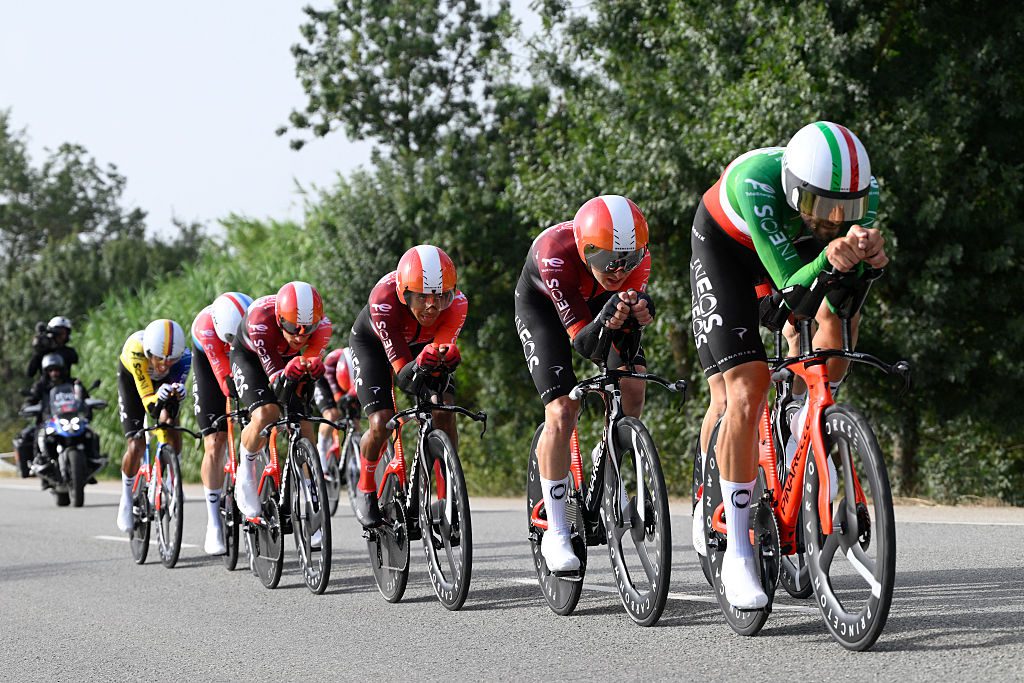 Photo Credit: Getty
How is this different from a normal team time-trial?
In many traditional team time-trials, a team’s official time is taken on a set rider across the line, often the fourth or fifth rider. That encourages teams to keep a minimum group together. Once enough riders have crossed the line, the whole team’s classification can be based on that team time, depending on the race rules.
The 2026 Tour de France opener changes the balance. The stage winner is still decided by the first rider from each team, but the overall contenders get their own individual times. That means the final kilometres can become much more aggressive.
In a normal team time-trial, a leader may stay with a group even if he could go faster, because the team time depends on keeping the correct number of riders together. In this format, if the leader feels strong, there is more incentive to keep pushing. Teammates can still tow him through the early and middle sections, but once the course reaches the climbs to Montjuïc, the stage can split within teams.
That is why the Barcelona course is so interesting. A flat, straight team time-trial would mostly reward collective power. The Montjuïc finish introduces a climbing element at exactly the point where team order is most likely to break down.
Why is the Barcelona course so important?
The route is not long, but it is perfectly designed to create tactical tension. The opening part should favour big, organised teams. The seafront and city boulevards give strong time-trial squads a chance to build speed, settle into formation and gain time through collective power.
Then the course changes. The final stretch includes two successive climbs towards the Olympic Stadium on Montjuïc, with the official stage page listing the Côte du Stade Olympique de Montjuïc at 0.8km and 7 per cent. That may not sound huge in normal Tour de France climbing terms, but at the end of a full-gas team time-trial, it becomes a serious separator.
This is where the format becomes decisive. A team can look smooth on the flat, then fracture on the climb. A heavy time-trial specialist may struggle as the road rises. A lightweight GC leader may suddenly become the strongest rider in the line. A team has to decide whether to wait, reorganise, or let the leader push on.
Because each rider’s time counts for GC, those decisions cannot be treated as cosmetic. If a leader finishes alone, that may be good for him but damaging for teammates. If a team waits too long for a struggling rider, the leader may lose time to rivals. If a team burns too many riders before Montjuïc, the final climb can expose the leader when he most needs support.
The wider Catalan Grand Départ is explained on the local official site, letour.barcelona, which covers the three-day opening block in Barcelona and Catalonia.
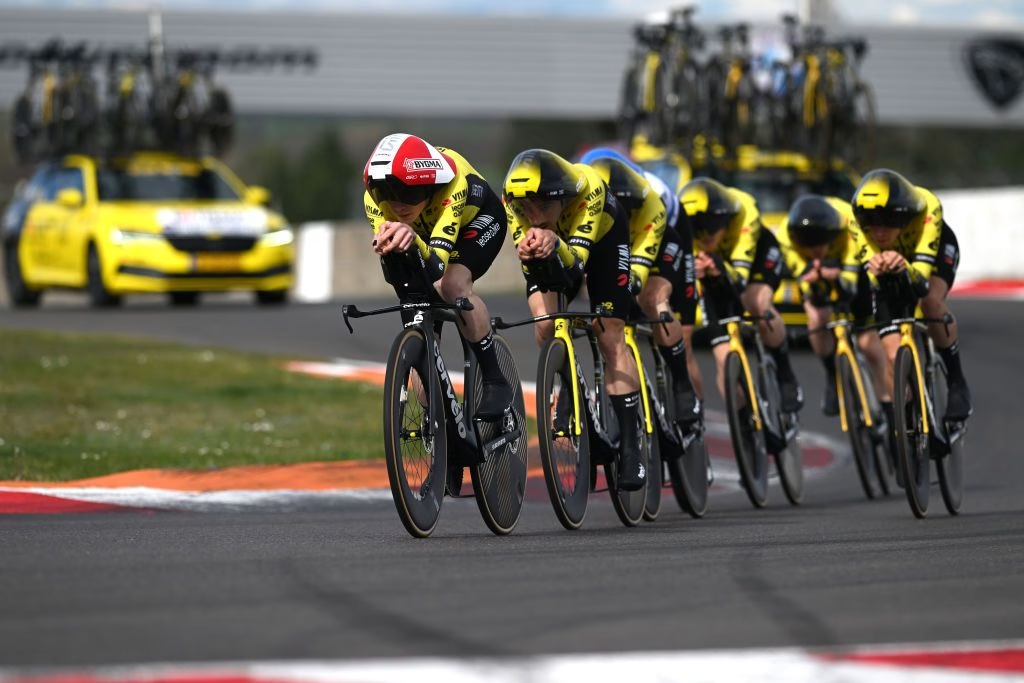 Photo Credit: Getty
Why are individual times such a big deal?
Individual times change the risk. In a standard team time-trial, a weaker rider may be dragged along long enough to receive the same time as stronger teammates. In the 2026 Tour de France format, anyone who loses contact near the finish will lose time personally.
For GC leaders, this makes the stage more direct. Tadej Pogačar, Jonas Vingegaard, Remco Evenepoel, Primož Roglič, Juan Ayuso, Carlos Rodríguez, Mattias Skjelmose, Adam Yates, Simon Yates, Enric Mas and the rest of the overall contenders are not simply waiting for their team’s fourth rider. Their own finishing time matters.
That creates a strange blend of collective and individual racing. A team may spend 16km setting up its leader, then the final 3km become almost leader against leader. The strongest squads will try to deliver their GC rider to Montjuïc fresh, positioned and protected. The strongest leaders will then need to finish the stage at full effort.
It also means small errors become expensive. A badly judged turn, a gap opening through a corner, or a rider going too deep too early can become a real GC loss. On stage 1, there is nowhere to hide behind the peloton. Every second is visible.
Who benefits from the 2026 format?
The biggest winners should be teams with both strong time-trial engines and elite GC riders. It is not enough to have one or the other.
A squad packed with powerful rouleurs can dominate the flat opening section, but if its leader struggles on Montjuïc, the final GC effect may be limited. A team with an outstanding climber but weak time-trial support may arrive at the climb already behind. The ideal team needs enough horsepower to reach the final kilometres quickly, then enough climbing quality to keep its leader close or launch him.
Team Visma | Lease a Bike should be one of the most important squads to watch because their structure, discipline and time-trial history fit the format. UAE Team Emirates-XRG also have the depth and leader quality to make the stage a major weapon, especially if Pogačar is supported by strong engines on the flat and climbers who can keep the pace high on Montjuïc.
Soudal – Quick-Step would normally be one of the most interesting teams in any time-trial conversation if Evenepoel is present. The individual-times format should suit a rider of his profile because he can finish brutally strongly if delivered well into the final part of the stage.
Red Bull-BORA-hansgrohe, Lidl-Trek, Ineos Grenadiers, Bahrain Victorious and Decathlon CMA CGM could all find themselves under scrutiny depending on their final line-ups. This is the kind of stage where a strong collective can give a leader an immediate advantage, but a poorly balanced squad can lose the Tour’s first meaningful seconds before the climbing stages arrive.
Our Tour de France 2026 team-by-team guide goes deeper on how the major squads are likely to be built for the opening week and the GC fight.
 Photo Credit: Getty
Who could lose time?
The danger is greatest for leaders whose teams are weaker against the clock, or whose squads are built more for the mountains than for flat, fast, coordinated work. A climbing-heavy team may look excellent in week three, but stage 1 asks a different question.
Teams with several light climbers and fewer time-trial specialists could struggle in the first two-thirds of the course. They may survive Montjuïc better, but if the damage has already been done on the flat boulevards, the final climb may only limit losses rather than reverse them.
Leaders also risk losing time if their teams are uneven. A team time-trial is not only about having strong riders. It is about having riders who can hold a line at the same speed. If one rider takes turns too hard, the line stretches. If another cannot hold the wheel after a corner, the rhythm breaks. Every small disruption costs speed.
The final climb adds another issue. A team may have to decide whether to sacrifice riders early, keep more numbers for the climb, or pace the stage more evenly. The wrong choice can leave a leader isolated or boxed into the wrong rhythm.
That makes stage 1 especially dangerous for teams who have built everything around the high mountains. Barcelona is not a mountain stage, but it can still punish climbers who arrive with the wrong support.
What does this mean for the yellow jersey?
The first yellow jersey will go to a rider from the fastest team, but the exact rider depends on how each team handles the finish.
Because the stage classification is based on the first rider from each team, the winning team’s first rider across the line should win the stage. If that rider is also fastest on the day overall, he will take yellow. In practice, that could be a GC leader, a powerful time-trial specialist, or a rider chosen to launch first over the line.
The individual-times format makes this more interesting. A team might deliberately set up its GC leader to cross first if the team is strong enough and the leader can finish the climb well. Another team might allow a specialist to take the stage result if that does not compromise its leader’s overall time.
Because the Tour starts from zero, there are no previous GC gaps to manage. The first stage immediately creates the first hierarchy. A rider who gains 15 or 20 seconds here may not have won the Tour, but he has changed the tone of the opening weekend. A rider who loses that time must spend the rest of the race knowing the first damage came before the Pyrenees.
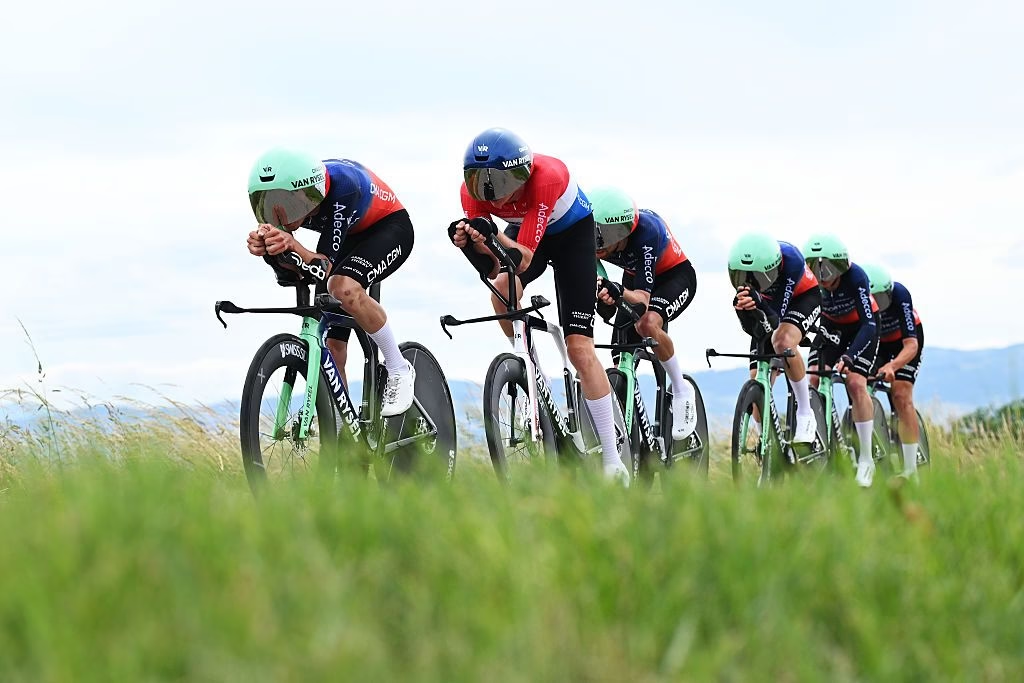 Photo Credit: Getty
Why this stage could shape the whole first week
The Tour de France 2026 route does not give the peloton a gentle first week. Stage 2 also finishes on Montjuïc after a hilly finale into Barcelona. Stage 3 heads from Granollers to Les Angles, taking the race towards the Pyrenees much earlier than usual. The race then continues into a demanding opening phase before later time trials and mountain blocks.
That makes the stage 1 team time-trial more than a spectacle. It sets the initial GC order before the race gets properly chaotic. A rider who loses time in Barcelona may have to race more aggressively as soon as stage 2. A team that wins the opener may have to defend earlier than it would like.
The Tour de France 2026 route analysis already points to a race where the opening block carries real danger. The team time-trial gives that opening block a sharper edge. It creates pressure before the first road stage and turns the Grand Départ into a sporting test rather than only a presentation weekend.
For fans, that is good news. The 2026 Tour should not need a week to come alive.
What tactics will teams use?
The best teams will split the course into phases.
The opening coastal and boulevard section should be about speed, formation and aerodynamics. Riders will rotate smoothly, with the biggest engines taking longer turns and the protected GC rider spending more time sheltered. The priority is to keep the line fast without causing splits.
The middle section near the Sagrada Família and through the city will demand precision. Corners, road furniture, changes of direction and speed variations can break rhythm. Teams must stay calm, avoid panic after any small mistake, and keep the protected riders near the front of the line.
The final approach to Montjuïc is where the strategy changes. Some riders may empty themselves before the climb. Others may be saved to pace the first ramp. The GC leader may be moved forward. A team may decide that from a certain point, the leader’s time is more important than preserving the full group.
The most aggressive teams may use the last climb almost like a lead-out. The powerful riders drag the leader to the base, the climbing domestiques pace the steep section, and the leader finishes with whatever is left. That is why this format has been described by critics as less like a classic team time-trial and more like a long lead-out for the GC leader.
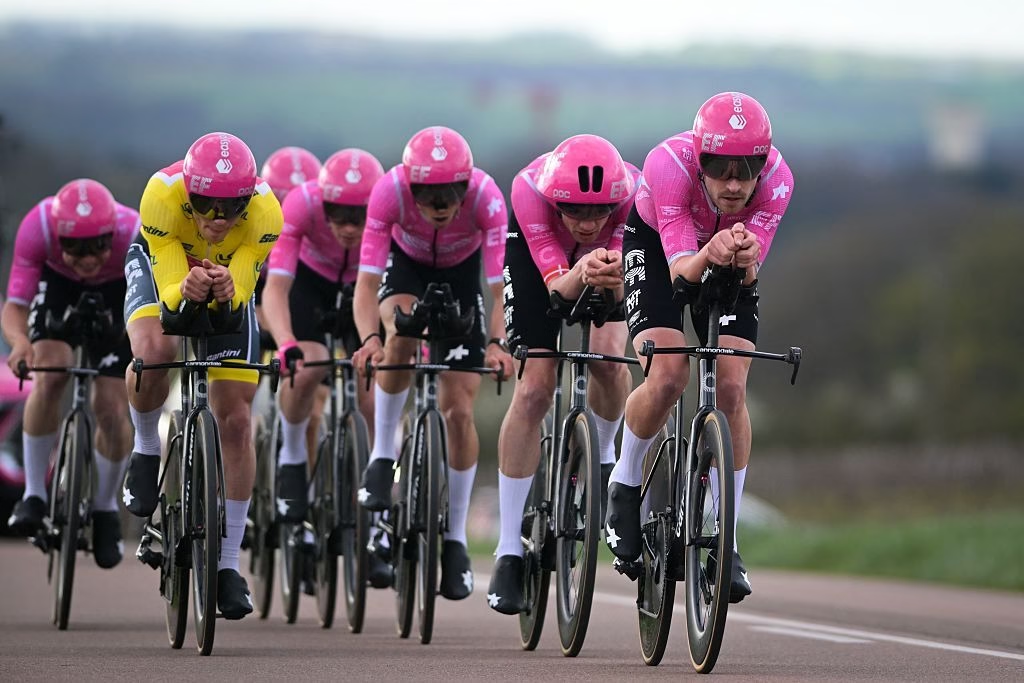 Photo Credit: Getty
Why Tour Auvergne – Rhône-Alpes was a useful rehearsal
The 2026 Tour Auvergne – Rhône-Alpes included an individually timed team time-trial on stage 3, making it one of the clearest rehearsals for the Tour de France opener. Team Visma | Lease a Bike won that stage, with Matteo Jorgenson crossing the line alone after the team had used its collective strength to set up the final effort.
That stage showed how dramatic the format can become. A team may start as one unit, but the final part can turn into a leader-focused effort. Mechanical problems, dropped riders and pacing choices become more visible than in a conventional team time-trial because individual GC times are still at stake.
That is why Barcelona should not be treated as a short technical curiosity. The Tour Auvergne – Rhône-Alpes example showed how quickly gaps can open when teams stop thinking only about the collective result and start protecting individual leaders. The Tour Auvergne – Rhône-Alpes 2026 season analysis explains why that rehearsal mattered for July.
Why some people dislike the format
Traditionalists often like team time-trials because they are pure collective efforts. The whole point is that a team has to stay organised, protect its weaker links, and finish with enough riders together. The 2026 format changes that identity.
With individual times counting for GC, the strongest rider can become separate from the team in the final kilometres. That makes the race more dynamic, but it also reduces the importance of keeping the whole unit intact. Instead of every rider being locked into the team’s collective time, the final section can become more leader-focused.
Some team managers have criticised that shift because it changes the discipline. They argue that it turns the team time-trial into a set-up for individual leaders rather than a true team event. That criticism is fair, but it is also exactly why the stage should be compelling.
The format creates drama. It creates visible decisions. It forces teams to choose between collective order and individual gain. It gives viewers a clearer reason to watch the final kilometres of a discipline that can sometimes feel technical but predictable.
 Photo Credit: Getty
Why the Tour de France wanted it
From a race organiser’s point of view, the format does several useful things. It gives the Grand Départ spectacle. It makes Barcelona central to the sporting story. It creates early GC gaps without using a huge mountain stage on day one. It also gives the Tour a different kind of opening stage from the usual sprint, short individual time trial or rolling road stage.
The Montjuïc finish is important here. Barcelona is not only providing scenery. The city’s geography shapes the race. The seafront and boulevards give the stage speed and scale, while the climb to the Olympic Stadium gives the finale sporting bite.
The result should be a stage that is easy to explain visually. Teams start together, ride fast through Barcelona, then begin to break apart on Montjuïc. The first yellow jersey will not simply be the fastest sprinter or the best short-course time-triallist. It will belong to a rider whose team got the whole balance right.
That is a strong way to start a Tour.
How big could the gaps be?
The stage is short, so the gaps should not be enormous in normal circumstances. The best and worst teams could still be separated by meaningful time, but among the strongest GC squads, the differences may be measured in seconds rather than minutes.
The individual-times format increases the possibility of unusual gaps inside teams. A leader who pushes on late could gain a few seconds on teammates and rivals. A leader who cracks on Montjuïc could lose more than expected. A team that misjudges pacing could see its formation fall apart just when the individual times start to bite.
A 10-second gap on stage 1 might not sound dramatic, but in a Tour de France where the best riders can be closely matched, it is not trivial. A 20 or 30-second loss would be much more serious. It would not end anyone’s race, but it would force an immediate response.
The psychological gaps may be just as important. A team that dominates in Barcelona will look organised and ready. A team that splinters on the first day will face questions before the race has properly begun.
-
 Photo Credit: Cor Vos
What fans should watch for
The first thing to watch is team shape. Smooth teams look almost boring: clean rotations, no gaps, no sudden surges, no riders fighting the wheel. Struggling teams look ragged: riders drifting, gaps opening after corners, uneven pulls and leaders forced into the wind too early.
The second thing is where each GC leader sits. If a leader is sheltered well, that team is confident. If he is already taking long turns early, the team may lack power or be chasing time. If he is isolated before Montjuïc, the stage has gone wrong.
The third thing is the final climb. This is where the stage should stop looking like a normal team time-trial. Watch which teams stay together, which leaders move ahead, and which riders are dropped. The moment a team breaks formation, the GC clock becomes much more personal.
The final rider order across the line will also be revealing. In this format, who finishes first from a team is not a minor detail. It decides the stage classification for that squad and may decide who wears yellow.
UK viewers can follow the broadcast details through our how to watch Tour de France 2026 in the UK guide.
Tour de France 2026 team time-trial summary
The Tour de France 2026 starts with a 19.6km team time-trial in Barcelona on Saturday, 4th July. The route begins near the seafront, passes through fast city roads and finishes on Montjuïc by the Olympic Stadium after a final climbing section.
The stage classification will be based on the time of the first rider from each team. General classification times will be recorded individually, using the Paris-Nice-style formula. That means every rider’s own finishing time counts for GC.
This is the key point: it is a team time-trial, but not in the traditional Tour de France sense. Teams still have to ride together, but leaders cannot rely entirely on a collective team time. They must finish strongly themselves.
The stage should favour teams with big time-trial engines, good organisation and GC leaders who can climb hard at the end of a maximum-effort effort. UAE Team Emirates-XRG, Team Visma | Lease a Bike, Soudal – Quick-Step, Red Bull-BORA-hansgrohe and other major GC teams could all shape the first yellow jersey fight.
The distance is short, but the consequences could be significant. The 2026 Tour de France may begin with only 19.6km in Barcelona, but the first real GC pressure will arrive before the race has even reached its first road stage.

